
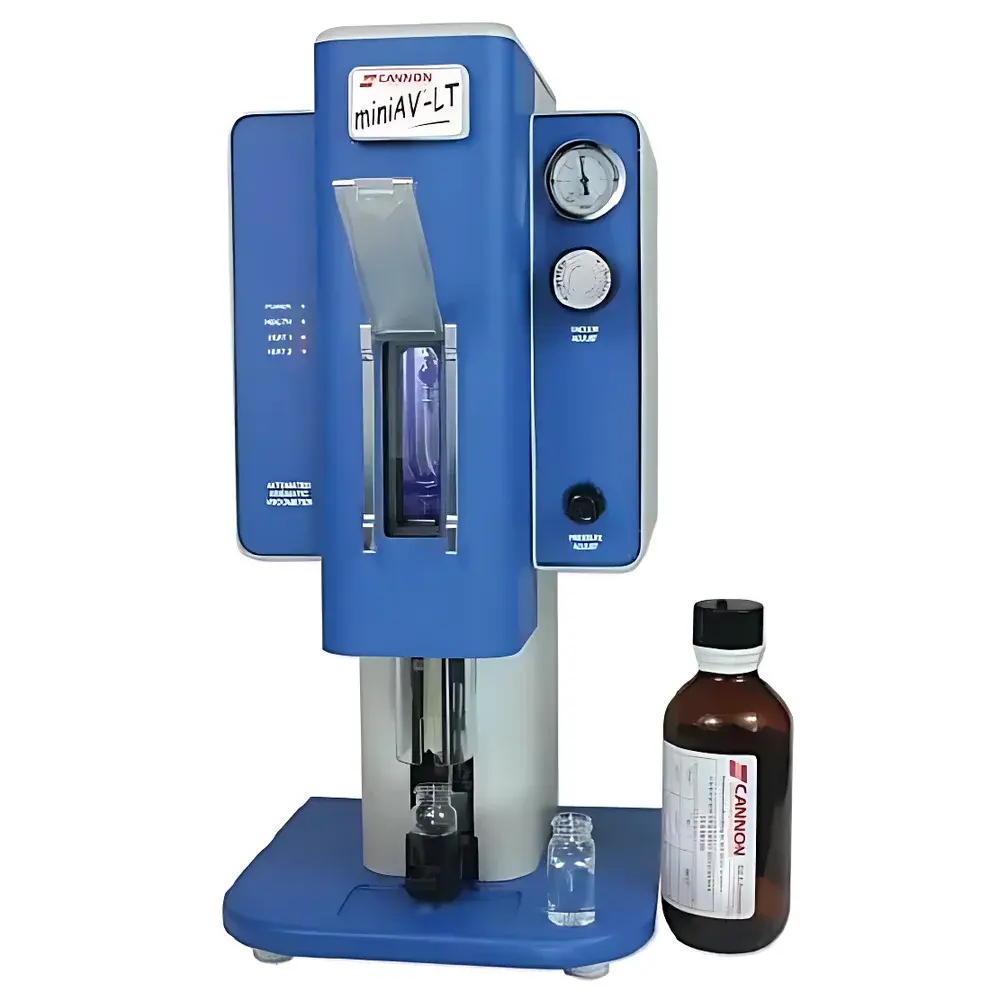
CANNON miniAV-LT Automated Low-Temperature Kinematic Viscometer
| Brand | CANNON |
|---|---|
| Origin | USA |
| Model | miniAV-LT |
| Instrument Type | Capillary Viscometer (Fixed-Station) |
| Kinematic Viscosity Range | up to 20,000 mm²/s |
| Temperature Range | −40 °C to +30 °C |
| Temperature Stability | ±0.05 °C |
| Compliance | ASTM D445, D1655, D2532, ISO 3104, ISO 3105, IP 71, DEF STAN 91-91, GB/T 265 |
| Cooling Method | Integrated Peltier Thermoelectric System with Air–Water Heat Exchange |
| Sample Volume | ~6 mL |
| Cleaning & Drying | Automated solvent rinse and thermal drying at +30 °C |
Overview
The CANNON miniAV-LT is an automated, benchtop kinematic viscometer engineered for high-precision, low-temperature viscosity measurement of aviation fuels, turbine oils, hydraulic fluids, and transformer oils in accordance with globally recognized standards. It operates on the principle of capillary flow time measurement under gravity-driven laminar flow, as defined by the Poiseuille equation—where kinematic viscosity (ν) is calculated from measured efflux time (t), calibrated capillary constant (C), and temperature-corrected density. The instrument integrates a thermally stabilized Ubbelohde-type viscometer tube with embedded thermal-sensing elements, enabling real-time temperature monitoring at the capillary bulb zone—critical for accurate ASTM D445-compliant reporting. Its design centers on reproducibility at extreme sub-zero conditions, particularly −40 °C, where conventional bath-based systems face condensation, thermal lag, and calibration drift. The miniAV-LT eliminates external chillers via a closed-loop Peltier cooling architecture coupled with an internal air–water heat exchanger, delivering stable, vibration-free thermal control without facility modifications or cryogenic consumables.
Key Features
- Automated full-cycle operation: temperature equilibration, flow time acquisition, solvent rinse, and hot-air drying—all initiated with a single software command
- Integrated Peltier thermoelectric cooling system with ±0.05 °C temperature stability across the full −40 °C to +30 °C range—no external refrigeration required
- Thermally intelligent viscometer tubes featuring embedded platinum resistance sensors positioned directly at the timing bulb, ensuring measurement-grade thermal fidelity per ASTM D446 and ISO 3105
- Single-tube design supporting a 10× extended kinematic viscosity range (up to 20,000 mm²/s), reducing need for manual tube swaps and cross-calibration uncertainty
- Automated cleaning protocol: rapid heating to +30 °C followed by controlled solvent delivery and inert-air purge, eliminating residual moisture and solvent carryover—critical for repeatable low-viscosity fuel measurements
- Compact footprint (W × D × H ≈ 38 × 43 × 32 cm) optimized for QC laboratories with space constraints and regulatory audit workflows
Sample Compatibility & Compliance
The miniAV-LT is validated for use with jet fuels (Jet A, Jet A-1, JP-5, JP-8), gas turbine oils (MIL-PRF-23699, MIL-PRF-6081), hydraulic fluids (MIL-PRF-5606, MIL-PRF-83282), and insulating oils (IEC 60296, ASTM D3487). It fully satisfies the procedural requirements of ASTM D1655 (jet fuel at −20 °C), ASTM D2532 (turbine oil hot soak protocols up to 72 h at −40 °C), and DEF STAN 91-91 for military aviation applications. All thermal and timing subsystems are traceably calibrated to NIST-traceable reference oils and certified temperature standards. The system supports GLP/GMP-aligned operation through configurable user access levels, electronic signature capability, and audit-trail logging compliant with FDA 21 CFR Part 11 when deployed with VISCPRO software in validated environments.
Software & Data Management
VISCPRO software provides a secure, Windows-based interface for method setup, run scheduling, raw data visualization, and ASTM-compliant report generation. It includes built-in validation checks for flow time repeatability (per ASTM D445 Section 8), outlier detection using Dixon’s Q-test, and automatic correction for kinetic energy correction (K-factor) and thermal expansion. Data files are stored in encrypted SQLite format with immutable timestamps, and export options include CSV, PDF, and XML for LIMS integration. Software validation packages—including IQ/OQ documentation, test scripts, and traceability matrices—are available for regulated users requiring formal qualification under ISO/IEC 17025 or internal QA protocols.
Applications
- Low-temperature kinematic viscosity certification of aviation turbine fuels per ASTM D1655 Annex A1 and DEF STAN 91-91 Clause 6.3.2
- Hot-soak viscosity stability testing of synthetic lubricants under ASTM D2532 (3 h and 72 h protocols at −40 °C)
- Batch release testing of hydraulic fluids used in aerospace actuators and landing gear systems
- Transformer oil aging studies tracking viscosity increase as an indicator of oxidation byproducts per IEC 60429
- Research-grade characterization of bio-derived jet fuels and synthetic hydrocarbons across wide thermal gradients
- Third-party certification labs performing accredited testing to ISO/IEC 17025 scopes covering ASTM, ISO, and IP methods
FAQ
What temperature accuracy is maintained during a −40 °C viscosity measurement?
The system achieves ±0.05 °C stability at the capillary bulb location, verified via dual-point calibration against NIST-traceable PRTs and confirmed by ASTM D445 repeatability limits.
Can the miniAV-LT perform sequential measurements at multiple temperatures without manual intervention?
Yes—VISCPRO supports multi-step temperature ramping and automated re-equilibration between setpoints, enabling full ASTM D445 temperature sweeps (e.g., −40 °C → −20 °C → +40 °C) within a single unattended run.
Is the viscometer tube reusable, and how is calibration maintained over time?
Each thermally integrated tube is factory-calibrated with certificate of conformance; recalibration is performed per ASTM D446 using certified reference oils, with drift monitoring enabled via daily verification runs.
Does the system support 21 CFR Part 11 compliance for pharmaceutical or aerospace QA environments?
When configured with VISCPRO Enterprise Edition and validated hardware peripherals, the miniAV-LT meets electronic record and signature requirements—including role-based access, audit trail, and electronic signature enforcement.
What solvents are compatible with the automated cleaning cycle?
Standard analytical-grade solvents including toluene, xylene, n-heptane, and ASTM D93-approved cleaning blends; solvent selection is user-configurable and logged in each run report.



