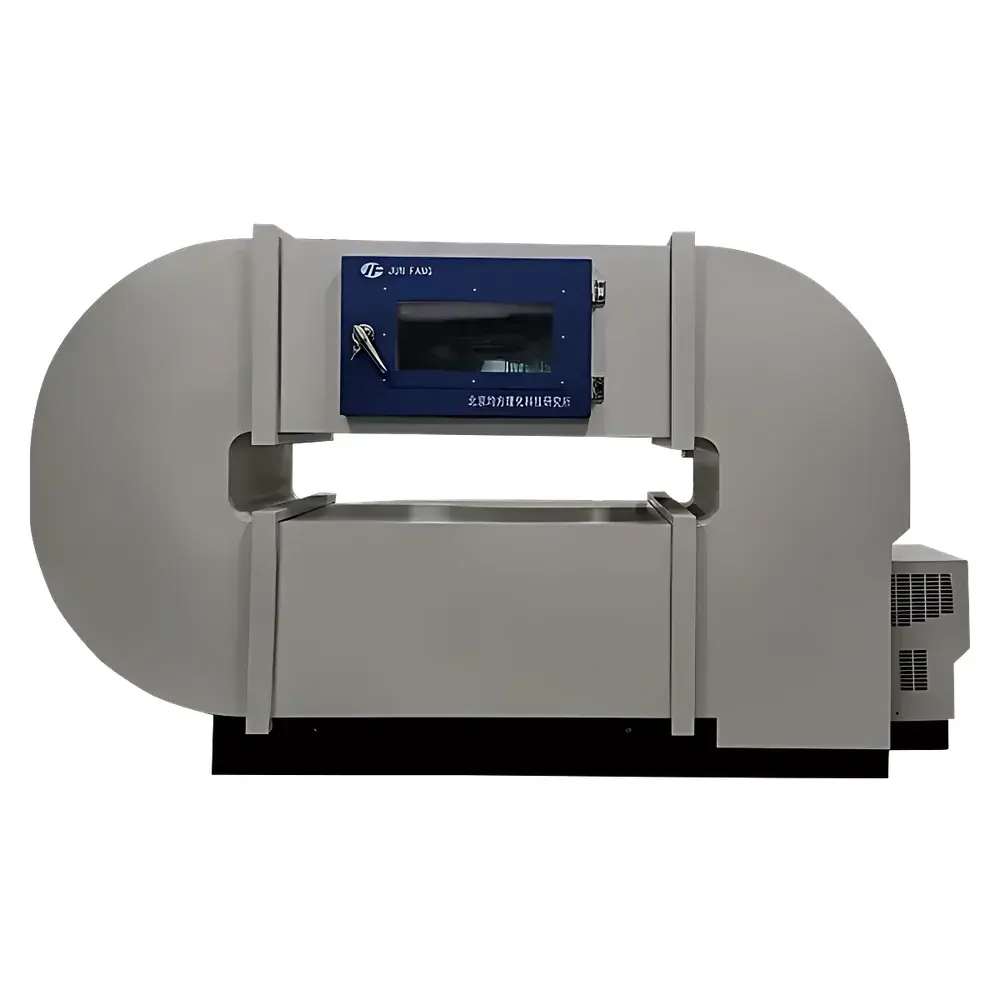
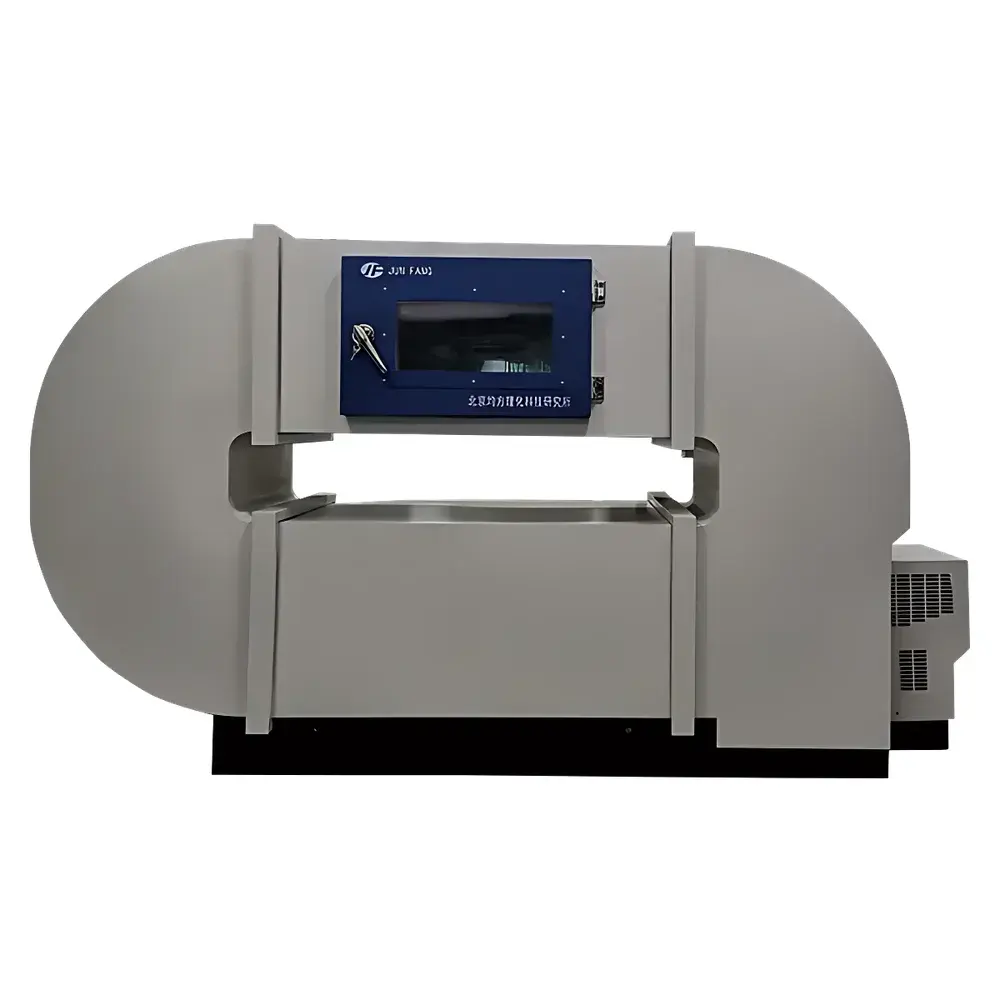
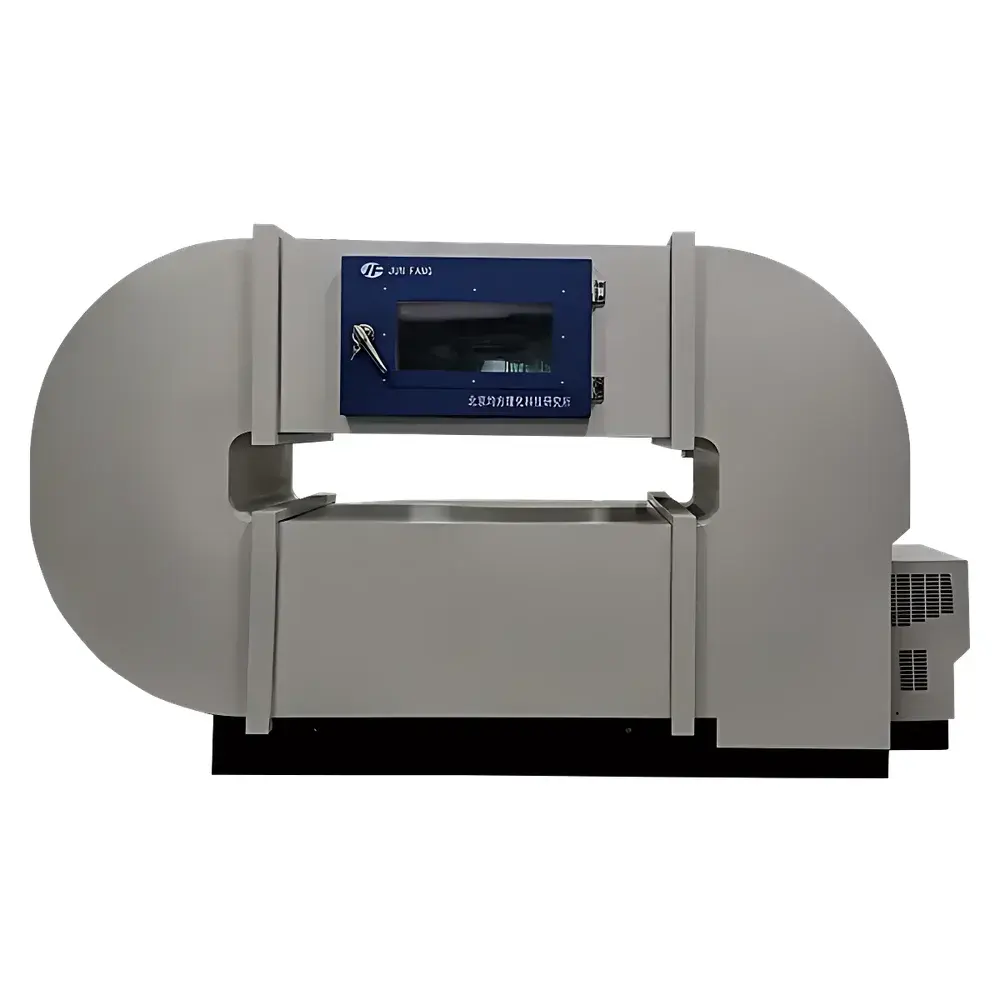
HXPQX-2020 Circular Gas Distribution Test Chamber for Combustible Gas Detectors
| Brand | Junfang Lihua |
|---|---|
| Origin | Beijing, China |
| Manufacturer Type | Authorized Distributor |
| Country of Origin | China |
| Model | HXPQX-2020 |
| Price Range | USD 28,000–42,500 |
| Internal Volume | 0.60 m³ |
| Cross-Sectional Dimensions | 400 × 300 mm |
| Tunnel Length (Centerline) | 1850 mm |
| Temperature Range (High Temp Test) | 50–70 °C ±2 °C |
| Temperature Range (Low Temp Test) | 0–−40 °C ±2 °C |
| Humidity Range (Steady-State Damp Heat) | 93 %RH ±3 %RH at 40 °C ±2 °C |
| Air Velocity Range | 0–6.5 m/s ±0.2 m/s |
| Rotational Step | 45° per increment |
| Temp Measurement Accuracy | ±0.5 °C (Resolution ≤0.1 °C) |
| RH Measurement Accuracy | ±0.5 %RH (Resolution ≤0.1 %RH) |
| Air Velocity Measurement | 0.2–10 m/s, ±5 % error (Resolution ≤0.1 m/s) |
| Heating Rate | ≤1 °C/min |
| Cooling Rate | 0.5–1 °C/min |
| Humidification Rate | ≤5 %RH/min |
| Dehumidification Rate | ≤1 °C/min |
Overview
The HXPQX-2020 Circular Gas Distribution Test Chamber is a purpose-built environmental simulation system engineered for the standardized performance evaluation and certification testing of combustible gas detectors in accordance with GB 15322.1–2019, GB 15322.2–2019, and GB 15322.3–2019. Unlike conventional climate chambers, this system integrates a closed-loop annular airflow duct—comprising a gas conditioning section, centrifugal ventilation unit, refrigeration subsystem (dual-stage low-temperature and humid-heat modules), precision humidification assembly, and fully programmable electrical control architecture—to replicate real-world operational stressors under metrologically traceable conditions. Its core design principle centers on delivering spatially uniform, dynamically controllable gas exposure environments where detector response characteristics—including alarm activation thresholds, span accuracy, response time, directional sensitivity, repeatability, high-velocity airflow interference, thermal extremes, poisoning resistance, low-concentration stability, and long-term drift—are quantitatively assessed in compliance with national fire safety instrumentation standards.
Key Features
- Annular closed-loop air circulation geometry ensures homogeneous gas distribution and minimizes turbulence-induced measurement artifacts during detector exposure.
- Dual-mode climate control: independent high-precision regulation of temperature (−40 °C to +70 °C) and relative humidity (90–96 %RH), with simultaneous operation capability for damp-heat testing at 40 °C ±2 °C / 93 %RH ±3 %RH.
- Programmable axial rotation stage enabling discrete 45° azimuthal positioning—critical for evaluating directional dependence of catalytic bead or infrared sensor elements.
- Calibrated air velocity control (0–6.5 m/s ±0.2 m/s) via variable-frequency ventilator, supporting high-flow interference testing per GB 15322 requirements.
- Integrated metrological subsystem: NIST-traceable temperature sensors (±0.5 °C accuracy, 0.1 °C resolution), capacitive RH transducers (±0.5 %RH accuracy, 0.1 %RH resolution), and hot-wire anemometry (0.2–10 m/s range, ±5 % full-scale error).
- Modular refrigeration architecture combining low-temperature cascade cooling and steam-based humidification—enabling stable ramp-and-soak profiles with controlled heating/cooling rates (≤1 °C/min and 0.5–1 °C/min respectively).
Sample Compatibility & Compliance
The chamber accommodates standard industrial combustible gas detectors (catalytic, infrared, semiconductor, and electrochemical types) up to 300 mm × 300 mm × 150 mm in physical envelope. Its internal volume of 0.60 m³ and 400 mm × 300 mm cross-sectional duct profile provide sufficient residence time and laminar flow development for repeatable gas exposure. All test protocols align with mandatory verification procedures defined in GB 15322 series standards—including Clause 5.3 (alarm value verification), Clause 5.4 (response time measurement), Clause 5.6 (repeatability assessment), Clause 5.7 (directional sensitivity), Clause 5.9 (high-velocity airflow immunity), Clause 5.10 (high-temperature operation), Clause 5.11 (low-temperature operation), Clause 5.13 (poisoning resistance), Clause 5.14 (low-concentration stability), and Clause 5.15 (long-term drift). The system supports GLP-aligned documentation workflows and is compatible with external data acquisition systems for audit-ready test record generation.
Software & Data Management
Equipped with a Windows-based control interface featuring real-time PID loop monitoring, multi-channel logging (temperature, RH, airflow, elapsed time), and automated test sequence execution. Each test run generates timestamped CSV files containing raw sensor outputs, setpoint trajectories, and pass/fail flags against GB 15322 acceptance criteria. Audit trails include operator ID, calibration certificate references, environmental deviation alerts, and electronic signatures compliant with ISO/IEC 17025 documentation requirements. Optional integration with LIMS platforms supports automated report export in PDF/A-1b format for regulatory submission.
Applications
- Certification testing laboratories performing third-party validation of combustible gas detectors for fire safety product registration.
- R&D departments optimizing sensor housing geometry, diffusion barrier design, and compensation algorithms under controlled environmental stress.
- Quality assurance units conducting incoming inspection of detector batches against factory acceptance test (FAT) specifications.
- Standards development bodies executing inter-laboratory comparison studies for GB 15322 method validation.
- Fire equipment certification bodies requiring reproducible, auditable test environments for CNAS-accredited evaluations.
FAQ
Does the HXPQX-2020 support automated test sequencing per GB 15322 clauses?
Yes—the embedded controller executes preconfigured sequences covering all mandatory tests (e.g., high-temp soak → alarm threshold check → response time measurement) with configurable dwell times and tolerance bands.
Can external gas analyzers be integrated into the airflow loop?
Yes—two standardized 6 mm OD stainless-steel sampling ports (upstream/downstream of test zone) enable connection to FTIR, GC, or electrochemical reference analyzers for real-time gas concentration verification.
Is the system suitable for testing detectors intended for explosion-proof (Ex d) hazardous area installation?
Yes—its non-sparking ventilation system, intrinsically safe control wiring, and Class II, Division 2-rated enclosure meet preliminary requirements for testing Ex-certified devices prior to ATEX/IECEx approval.
What calibration documentation is supplied with delivery?
A full metrological package including factory calibration certificates for all primary sensors (traceable to NIM, China), uncertainty budgets, and a 12-month recalibration schedule aligned with JJF 1033–2016.
How is thermal uniformity validated across the test zone?
Thermal mapping is performed using 9-point thermocouple arrays per IEC 60068-3-5; uniformity is verified as ≤±1.5 °C across the central 80 % of the duct cross-section at all specified operating points.
Related Products