
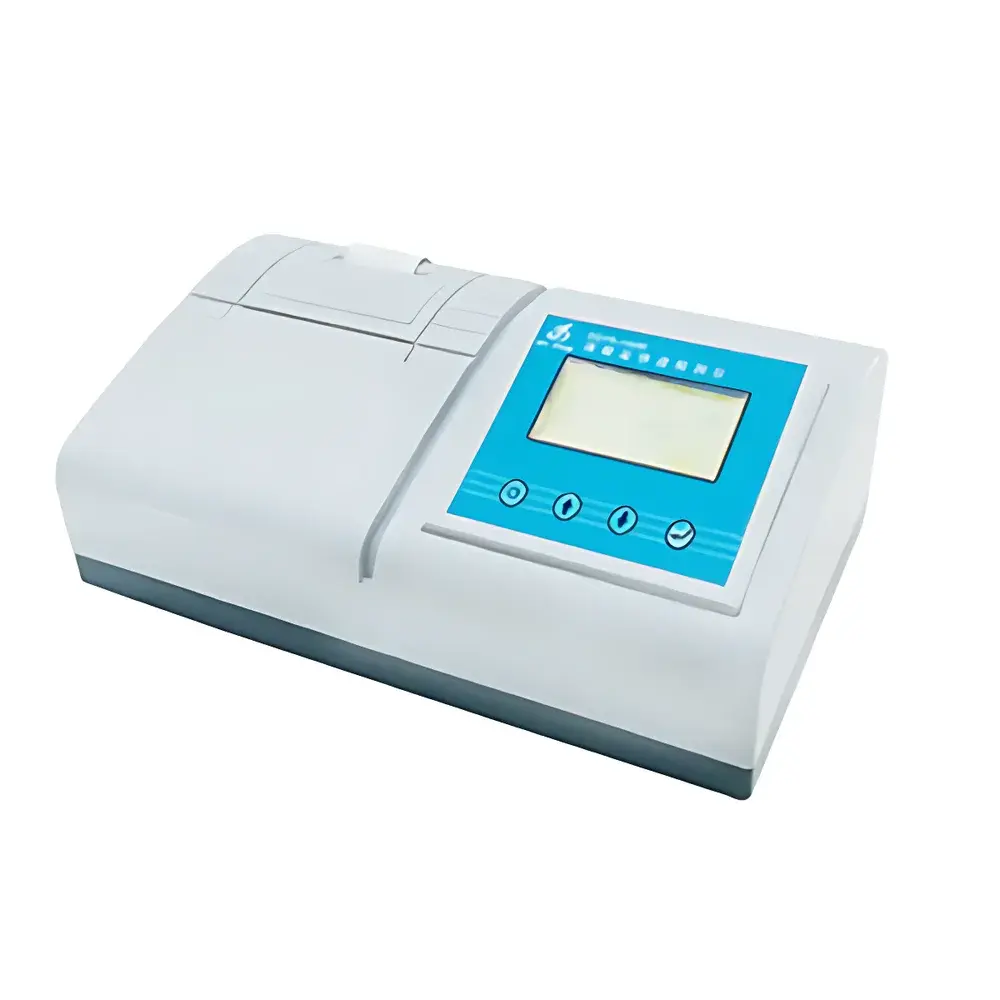
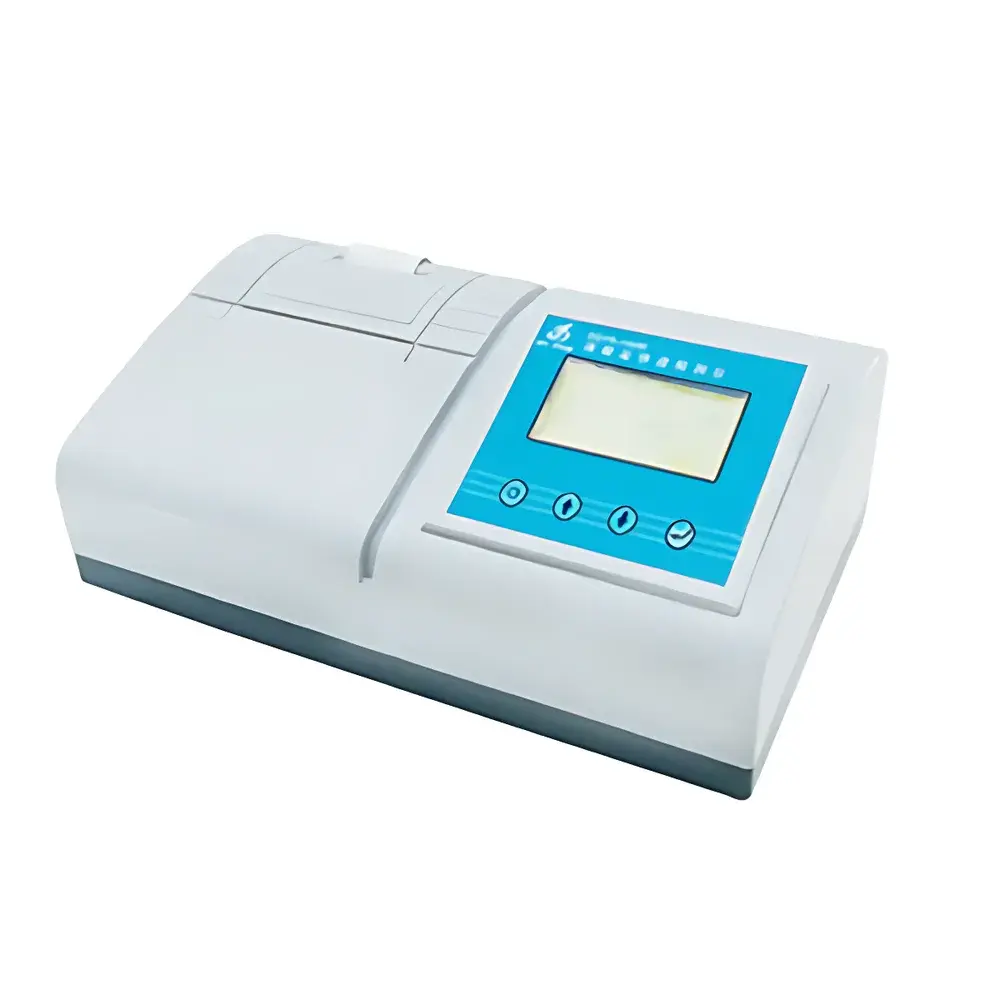
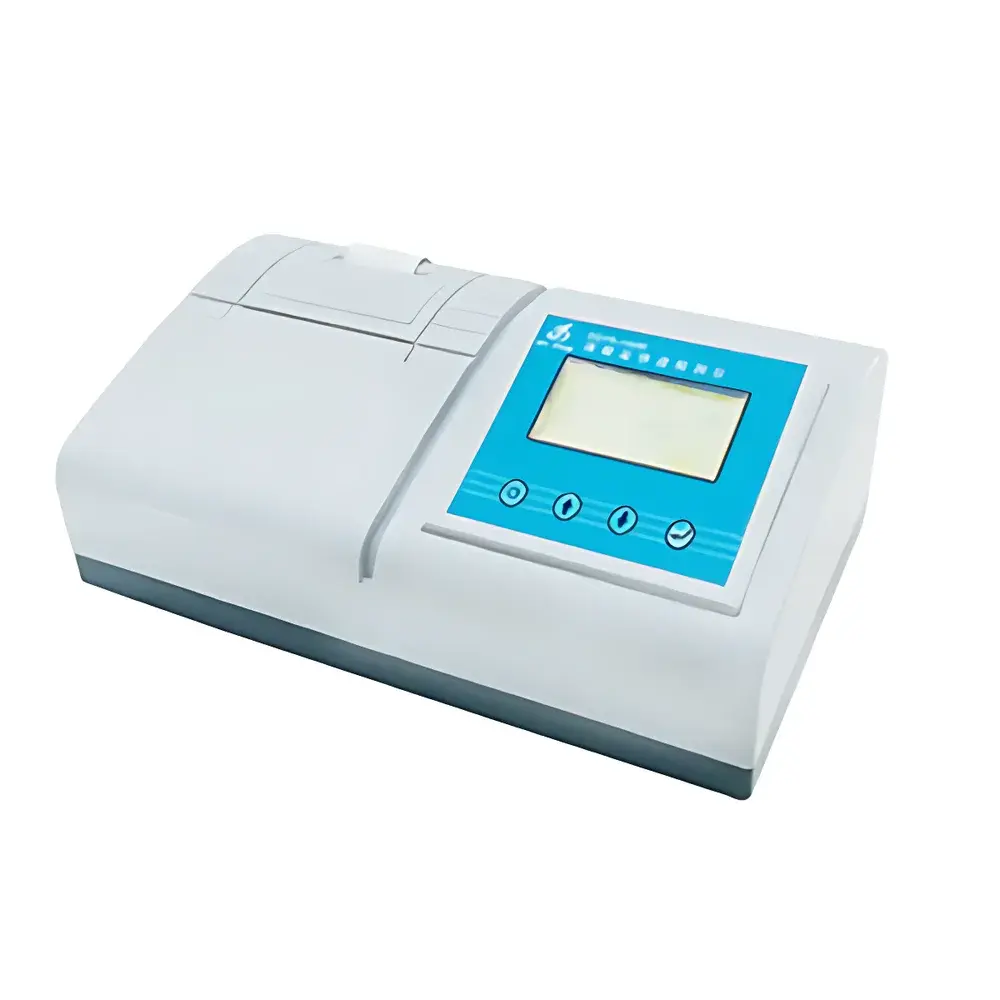
Jilin University & Little Swan GDYS-104SI Bromate Rapid Detection Analyzer
| Brand | Jilin University & Little Swan |
|---|---|
| Model | GDYS-104SI |
| Origin | Shanghai, China |
| Instrument Type | Benchtop Photometric Analyzer for Bromate (BrO₃⁻) |
| Measurement Principle | LED-based Absorption Spectrophotometry at 528 nm |
| Detection Limit | 0.004 mg/L |
| Range | 0.000–0.040 mg/L |
| Accuracy | ±0.002 mg/L |
| Repeatability | ±0.002 mg/L |
| Response Time | <20 min per sample |
| Operating Temperature | 5–40 °C |
| Power Supply | AC 220 V ±22 V, 50 Hz ±1 Hz |
| Dimensions | 470 × 280 × 180 mm |
| Weight | 3.8 kg |
| Sample Throughput | Up to 8 samples per batch with integrated pre-concentration and filtration |
| Optical Path | Extended-path cuvette design for enhanced sensitivity |
| Data Interfaces | USB 2.0 and RS-232 |
| Compliance | Designed for routine QC in bottled water production per GB 8537–2018 and aligned with ISO 10523:2022 (water quality — determination of pH) and AOAC Official Method 2015.01 (bromate in drinking water) |
Overview
The Jilin University & Little Swan GDYS-104SI Bromate Rapid Detection Analyzer is a dedicated benchtop photometric instrument engineered for the quantitative determination of bromate (BrO₃⁻) in ozonated mineral and spring waters. It operates on the principle of absorption spectrophotometry using a high-stability 528 nm LED light source and an extended optical path cuvette system—optimized to maximize signal-to-noise ratio within the low-concentration range required for regulatory compliance testing. Bromate is a disinfection by-product formed during ozone treatment of bromide-containing source water; its presence must be monitored rigorously due to classification as a Group 2B carcinogen by IARC. The GDYS-104SI meets the analytical demands of daily quality control in packaged drinking water manufacturing facilities, supporting adherence to national standards including China’s GB 8537–2018 and international frameworks such as WHO Guidelines for Drinking-water Quality (4th ed.) and EU Directive 2020/2184. Its compact footprint and self-contained operation enable deployment in both central QC laboratories and production-line satellite testing stations.
Key Features
- Integrated optical architecture featuring a temperature-stabilized 528 nm LED source and precision-machined long-path cuvette holder for improved detection sensitivity at sub-0.01 mg/L levels.
- Automated sample preparation module—including vacuum-assisted filtration, solid-phase extraction, and bromate-specific pre-concentration—enabling parallel processing of up to eight samples per run.
- Premixed, lyophilized reagent kits formulated for selective chromogenic reaction with bromate; eliminates interferences from chloride, nitrate, sulfate, and residual ozone.
- Factory-calibrated internal calibration curves stored in non-volatile memory; zero-point correction only requires blank reagent measurement—no manual standard curve generation needed.
- Onboard thermal printer with timestamped output of concentration values, sample ID, operator name, and analysis date—supporting GLP traceability requirements.
- Dual-mode software architecture: standalone firmware for immediate field use, plus PC-based application (Windows-compatible) enabling customizable report templates, Excel export (.xlsx), and audit-ready metadata logging (sample origin, analyst ID, instrument serial number).
- Standardized data connectivity via USB 2.0 and RS-232 interfaces for integration into LIMS environments or centralized instrument management systems.
Sample Compatibility & Compliance
The GDYS-104SI is validated for direct analysis of finished bottled water products following ozone disinfection, including natural mineral water, spring water, and purified drinking water. It accommodates raw water matrices with total dissolved solids (TDS) ≤ 500 mg/L and turbidity < 1 NTU after filtration. All assay protocols comply with method validation criteria outlined in ISO/IEC 17025:2017 (General requirements for the competence of testing and calibration laboratories) and support FDA 21 CFR Part 11-compliant electronic record retention when paired with approved LIMS configurations. Performance verification includes documented linearity (R² ≥ 0.999 over 0.004–0.040 mg/L), spike recovery (92–105% across three concentration levels), and intermediate precision (RSD ≤ 3.2%, n = 6 over three days).
Software & Data Management
The embedded microprocessor runs real-time firmware supporting automatic wavelength verification, dark-current compensation, and dynamic baseline correction. The desktop companion software provides full traceability: each analysis event logs instrument configuration, calibration status, environmental conditions (ambient temperature/humidity if externally sensed), and user-defined annotations. Data exports include CSV and native .xlsx formats with embedded metadata fields compliant with ISO 22000 food safety management documentation. Audit trails are time-stamped, immutable, and password-protected—meeting minimum requirements for GMP-regulated beverage production audits.
Applications
- Routine bromate monitoring in bottled water production lines before final packaging.
- Verification of ozone contact time and dose optimization during process validation studies.
- Supplier qualification testing for incoming source water with elevated bromide content.
- Regulatory submission support for health authority registrations (e.g., NMPA, NSF/ANSI Standard 60).
- Internal proficiency testing and inter-laboratory comparison programs under ISO/IEC 17043 accreditation scope.
FAQ
What regulatory standards does the GDYS-104SI support?
It is designed to meet GB 8537–2018 (China National Standard for Natural Mineral Water), WHO GDWQ guidance limits (10 µg/L), and aligns with analytical performance expectations in ISO 10523:2022 and AOAC Official Method 2015.01.
Can the instrument be used for other anions besides bromate?
No—the optical path, reagent chemistry, and calibration algorithms are specifically optimized for bromate; cross-reactivity with chlorate, iodate, or permanganate is minimized by proprietary masking agents in the kit formulation.
Is external calibration verification required?
Yes—while factory curves eliminate daily standard preparation, quarterly verification using NIST-traceable bromate reference standards (e.g., AccuStandard BRM-2001) is recommended per ISO/IEC 17025 Clause 7.7.
How is data integrity ensured during transfer to LIMS?
USB and RS-232 outputs transmit ASCII-encoded results with CRC-16 error checking; optional digital signature modules are available for cryptographic validation in high-assurance environments.
What maintenance intervals are specified for optical components?
LED source lifetime exceeds 50,000 hours; annual verification of photodetector linearity and cuvette path-length tolerance is advised using certified neutral density filters.







