
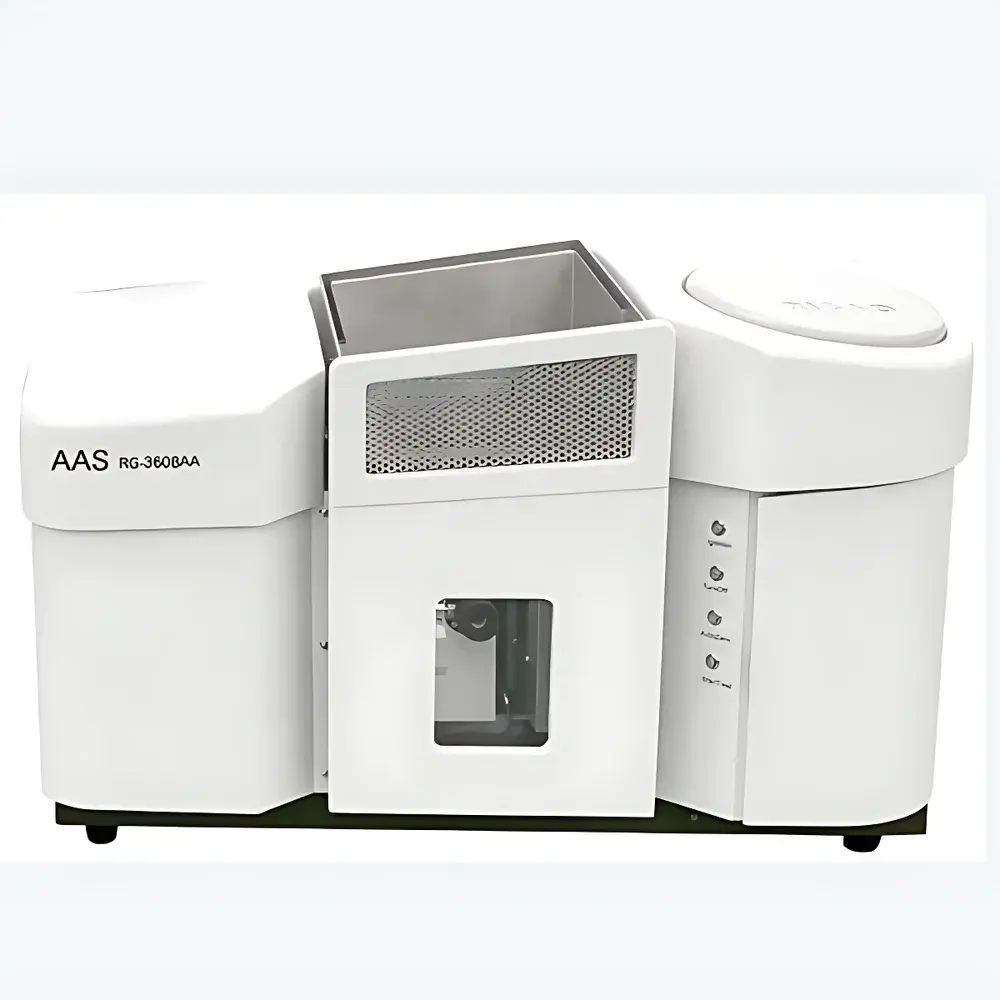
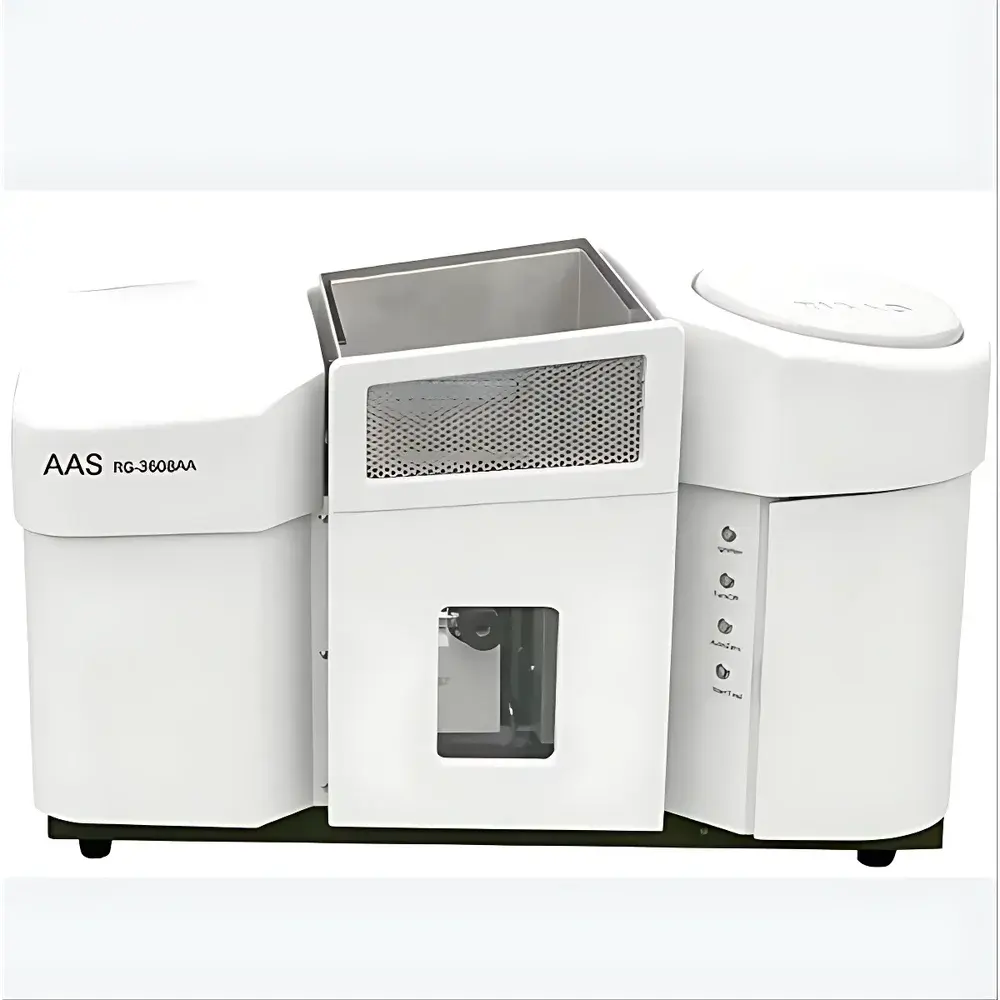
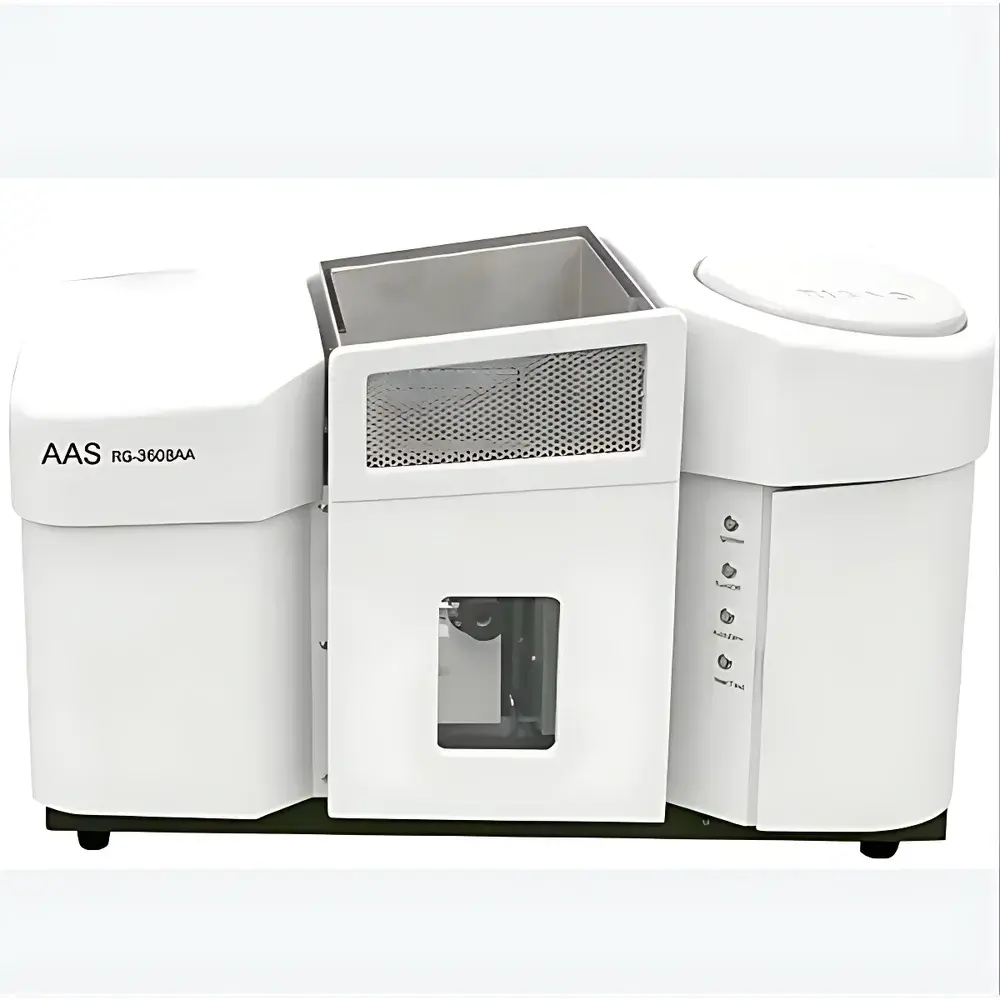
Yoke RG-3668AA Dual-Beam Atomic Absorption Spectrophotometer
| Brand | Yoke |
|---|---|
| Origin | Shanghai, China |
| Model | RG-3668AA |
| Wavelength Range | 190–900 nm |
| Wavelength Repeatability | ≤0.05 nm |
| Wavelength Accuracy | ±0.1 nm |
| Photometric Range (Absorbance) | 0–2.0 A |
| Optical System | Dual-beam |
| Lamp Positions | 8-position rotating turret (compatible with high-performance hollow cathode lamps) |
| Background Correction | Combined deuterium lamp and self-reversal (SR) background correction across full wavelength range |
| Software Platform | RG-WinAAS workstation for Windows OS |
Overview
The Yoke RG-3668AA Dual-Beam Atomic Absorption Spectrophotometer is a laboratory-grade analytical instrument engineered for quantitative elemental analysis in aqueous and digested sample matrices using flame atomic absorption spectroscopy (FAAS) and graphite furnace atomic absorption spectroscopy (GFAAS) techniques. Its dual-beam optical architecture—comprising separate sample and reference beam paths—minimizes drift and enhances photometric stability during extended measurement sequences. The system operates on the fundamental principle of atomic absorption: ground-state free atoms in the atomizer absorb characteristic radiation emitted by element-specific hollow cathode lamps, with absorbance directly proportional to analyte concentration per the Beer–Lambert law. Designed for routine QC/QA laboratories, environmental testing facilities, and academic research settings, the RG-3668AA delivers reproducible trace-metal quantification at sub-ppb levels when coupled with graphite furnace operation, while maintaining robust performance in flame mode for higher-concentration applications.
Key Features
- Dual-beam optical design with total-reflection optics, ensuring high signal-to-noise ratio and long-term baseline stability.
- Intelligent gas control module with real-time pressure monitoring and automatic interlock logic compliant with ISO 22196 and EN 14181 safety guidelines for acetylene and nitrous oxide handling.
- Integrated background correction combining broadband deuterium lamp (190–350 nm) and high-resolution self-reversal (SR) correction (220–900 nm), enabling accurate compensation for structured molecular absorption and light scattering effects.
- Motorized 8-position lamp turret with 360° rotation and auto-alignment; supports standard and high-intensity hollow cathode lamps without manual recalibration.
- Modular atomization system featuring interchangeable flame and graphite furnace assemblies, both equipped with motorized vertical positioning and thermal pre-heating protocols aligned with ASTM D1688 and ISO 11885 methodologies.
- Optimized monochromator with Czerny–Turner configuration and holographic grating (1200 grooves/mm), delivering spectral resolution <0.2 nm at 200 nm.
Sample Compatibility & Compliance
The RG-3668AA accommodates liquid samples prepared via acid digestion (EPA Method 3050B, ISO 17294-2), dilute aqueous standards, and matrix-matched calibration solutions. Flame mode supports direct aspiration of solutions up to 5% v/v organic content; graphite furnace mode enables analysis of volumes from 5–50 µL with integrated platform temperature control and integrated Zeeman-effect-free graphite tube geometry. Instrument design conforms to IEC 61010-1 for electrical safety and meets electromagnetic compatibility requirements per EN 61326-1. Data integrity features—including user-level access control, electronic signatures, and audit-trail-enabled method storage—are implemented to support GLP-compliant workflows and align with FDA 21 CFR Part 11 expectations for regulated environments.
Software & Data Management
RG-WinAAS is a native Windows-based application providing full instrument control, method development, calibration curve generation (linear, quadratic, and weighted least-squares), QC charting (Levey–Jennings, Westgard rules), and automated report export in PDF and CSV formats. All acquisition parameters—including lamp current, slit width, burner height, furnace temperature ramp profiles, and background correction selection—are stored with timestamped metadata. Raw spectral data and processed absorbance values are saved in vendor-neutral ASCII format for third-party statistical analysis. Software versioning, backup scheduling, and role-based permissions (Administrator, Analyst, Reviewer) ensure traceability and operational continuity across multi-user lab deployments.
Applications
- Environmental monitoring: Pb, Cd, Cr, Ni, Cu, Zn, and As quantification in wastewater, soil extracts, and drinking water per EPA Methods 7000B and 7130.
- Food and agricultural testing: Na, K, Ca, Mg, Fe, Mn, and Zn determination in fortified foods, dairy products, and plant tissues following AOAC 984.27 and ISO 6496 protocols.
- Clinical and pharmaceutical analysis: Trace metal impurity profiling in APIs and excipients per USP and , including Co, V, Mo, and Sn detection in parenteral formulations.
- Geochemical and metallurgical assays: Quantitative analysis of base metals in ore leachates and refinery electrolytes under ISO 11885 and ASTM E1019 frameworks.
FAQ
Does the RG-3668AA support both flame and graphite furnace atomization in a single instrument configuration?
Yes—the system includes interchangeable atomizer modules and unified control logic allowing seamless transition between FAAS and GFAAS modes without hardware reconfiguration.
Is RG-WinAAS compliant with 21 CFR Part 11 requirements for electronic records and signatures?
The software implements configurable audit trails, electronic signature capture, and secure user authentication; however, final Part 11 compliance requires site-specific validation documentation and administrative controls as defined in organizational SOPs.
What background correction methods are available, and how are they selected?
Two complementary techniques are supported: deuterium lamp correction for broadband background and self-reversal correction for narrowband, element-specific interference; selection is automated based on lamp type and wavelength, or manually overridden within method parameters.
Can the instrument be integrated into a LIMS environment?
Yes—RG-WinAAS supports ODBC-compliant database export and provides structured CSV output compatible with common LIMS ingestion protocols, including HL7 and ASTM E1384 message mapping.
What maintenance routines are recommended for optimal long-term performance?
Daily alignment verification using Cu 324.7 nm line, weekly cleaning of nebulizer and burner head, quarterly monochromator calibration with holmium oxide reference filter, and annual lamp energy verification per manufacturer’s service schedule.





