
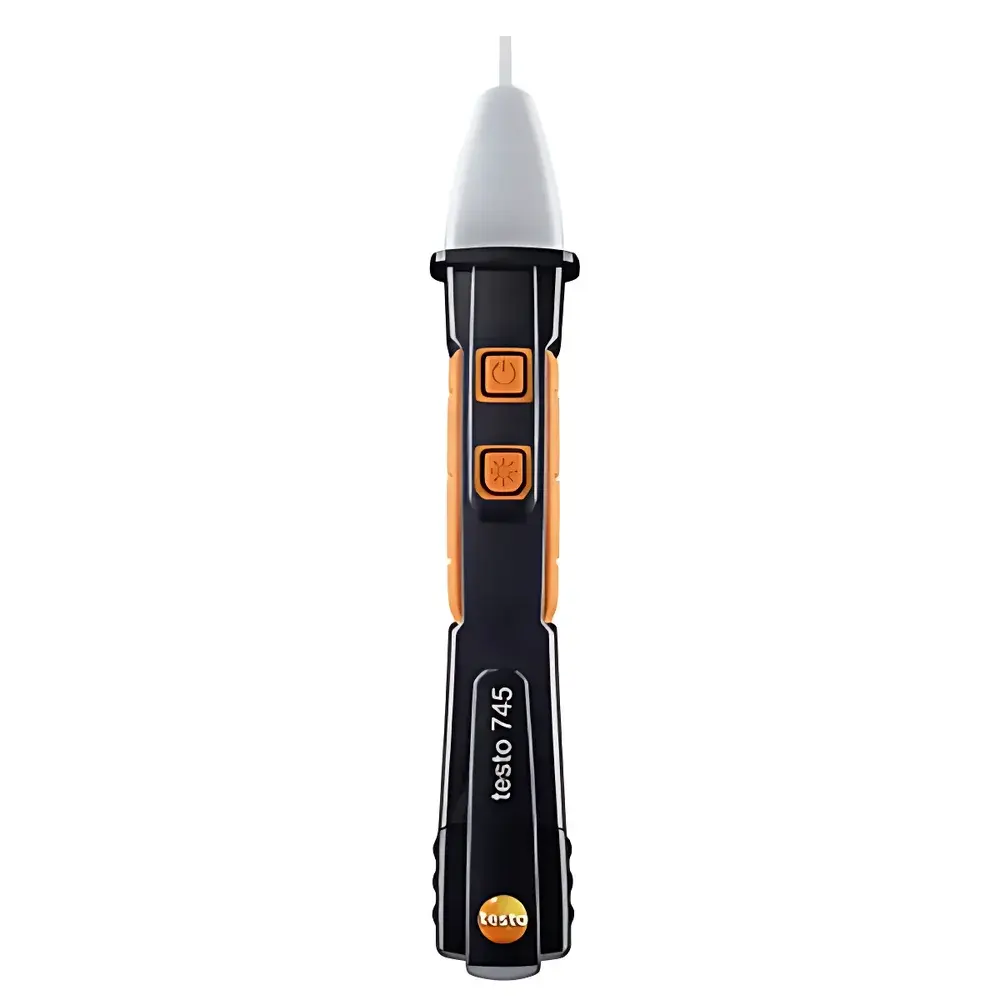
testo 745 Non-Contact Voltage Tester (Model 0590 7450)
| Brand | testo |
|---|---|
| Origin | Germany |
| Model | 0590 7450 |
| AC Voltage Range | 12–1000 V |
| Operating Temperature | −10 to +50 °C |
| Storage Temperature | −15 to +60 °C |
| Relative Humidity | 0–80 % RH |
| Weight | 63 g |
| Dimensions | 155 × 25 × 23 mm |
| Protection Rating | IP67 |
| Safety Category | CAT IV 600 V / CAT III 1000 V |
| Compliance | EN 61010-1, EN 61326-1 |
| Battery | 2 × AAA |
| Integrated LED Illumination | Yes |
| Alarm Type | Visual (LED) and Audible |
| Sensitivity Levels | 2-stage (Phase Detection / Voltage Presence Indication) |
| Interference Rejection | Built-in High-Frequency Noise Filter |
Overview
The testo 745 non-contact voltage tester (model 0590 7450) is an engineered diagnostic tool designed for rapid, safe, and reliable detection of alternating current (AC) voltage presence in conductors without physical contact. Based on capacitive coupling principles, the device senses the electric field generated by live conductors within its operational range (12–1000 V AC), eliminating the need for direct probe contact or circuit interruption. This makes it especially suited for preliminary fault isolation, live-circuit verification, and routine safety checks in industrial maintenance, electrical installation, and facility management workflows. Its robust construction—certified to IP67 for dust-tight and water-immersion resistance—and dual-category safety rating (CAT IV 600 V / CAT III 1000 V per EN 61010-1) ensure dependable performance in demanding environments, including damp, confined, or cluttered spaces where conventional contact testers pose increased risk.
Key Features
- Two-stage sensitivity selection: Level 1 optimized for phase identification (e.g., distinguishing live vs. neutral conductors); Level 2 calibrated for broader voltage presence indication across the full 12–1000 V AC range.
- Integrated high-frequency interference rejection filter—engineered to suppress false triggers from variable-frequency drives (VFDs), switching power supplies, and other common sources of electromagnetic noise—enhancing measurement reliability in modern industrial and commercial electrical systems.
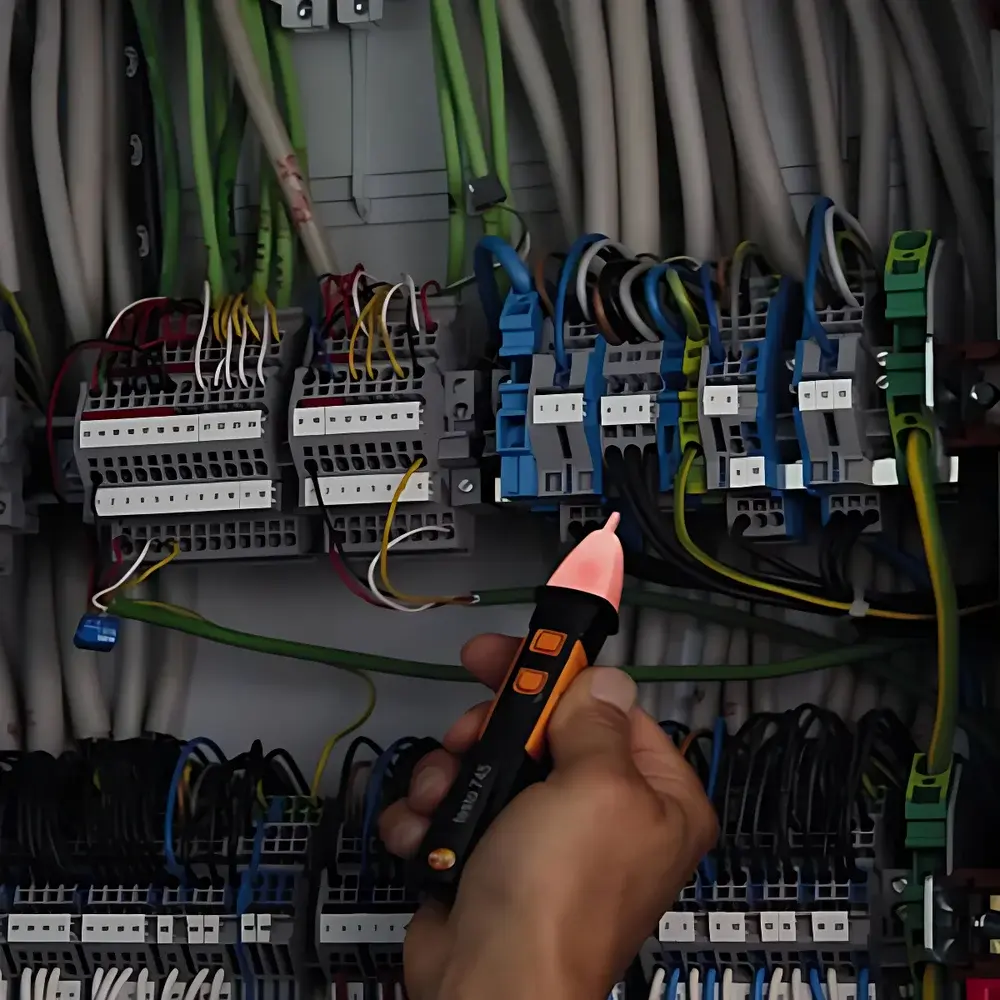
- Dual-mode alarm system: Simultaneous bright LED illumination and audible tone provide unambiguous feedback during voltage detection, supporting both visual and auditory confirmation under varied ambient conditions.
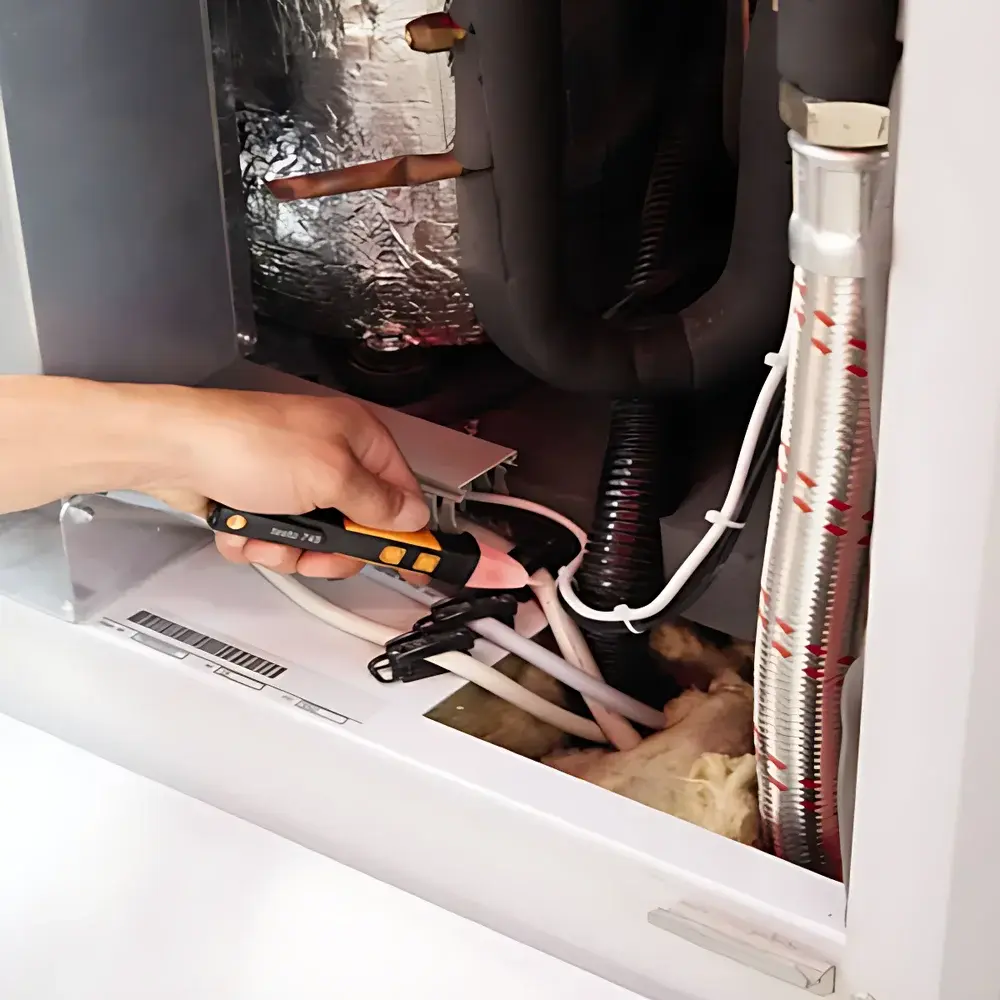
- Integrated white-light LED illuminator (switchable) enables precise targeting and safe operation in low-light or enclosed areas such as switchgear cabinets, ceiling voids, or underground utility enclosures.
- Compact ergonomic design (155 × 25 × 23 mm; 63 g) with matte black housing ensures one-handed operation, reduced fatigue during extended use, and compatibility with standard tool belts and pouches.
- Compliance with EN 61010-1 (electrical safety) and EN 61326-1 (EMC requirements for measurement equipment) supports integration into quality-assured maintenance programs aligned with ISO/IEC 17025 and internal GLP protocols.
Sample Compatibility & Compliance
The testo 745 is intended for non-invasive detection of AC voltage on insulated or sheathed conductors—including PVC-sheathed cables, armored cables, and busbar enclosures—provided the conductor is not shielded by continuous metallic braid or conduit that fully attenuates the electric field. It is not suitable for DC voltage detection or buried/unshielded underground lines. As a handheld portable instrument, it complies with the European CE marking directive and CSA certification for North American markets. Its CAT III 1000 V / CAT IV 600 V rating conforms to IEC 61010-1:2011, permitting use at distribution panels, main service entrances, and upstream of branch circuits in commercial and light-industrial settings. The IP67 ingress protection rating validates suitability for temporary exposure to rain, dust storms, or incidental submersion up to 1 m for 30 minutes—critical for outdoor substations, HVAC rooftop units, or wastewater treatment plant infrastructure.
Software & Data Management
The testo 745 operates as a standalone hardware instrument with no embedded memory, wireless connectivity, or software interface. All operational parameters are fixed at manufacture and require no configuration or firmware updates. Calibration is performed at the factory and documented in the included traceable calibration record (ISO/IEC 17025-accredited where applicable). While the device does not support digital data logging or export, its deterministic response behavior—verified through periodic functional checks using known live sources—ensures consistency required for audit-ready maintenance records under ISO 55001 or NFPA 70E compliance frameworks. Users are advised to retain the original calibration certificate and perform routine self-checks prior to each shift or work order.
Applications
- Rapid verification of de-energized status prior to lockout/tagout (LOTO) procedures in accordance with OSHA 1910.333 and NFPA 70E Article 120.
- Identification of energized phases during panelboard commissioning or retrofit projects.
- Locating open neutrals or broken conductors behind walls or in inaccessible junction boxes via comparative field strength assessment.
- Preventive diagnostics in data center power distribution units (PDUs), UPS outputs, and redundant feeder paths.
- Safety validation in HVAC control panels, lighting circuits, and emergency egress systems prior to servicing.
- Field verification of residual voltage after capacitor discharge in motor control centers (MCCs) and VFD installations.
FAQ
Can the testo 745 detect DC voltage?
No. It is specifically designed for AC voltage detection only, relying on time-varying electric fields inherent to alternating current.
Does it require periodic recalibration?
While no scheduled recalibration is mandated by testo, users should verify functionality before each use against a known live source and retain records of such checks for compliance audits.
Is the device suitable for use inside metal enclosures?
Performance may be attenuated inside fully enclosed grounded metal cabinets due to electric field shielding; testing should be conducted at accessible cable entries or external terminations.
What battery life can be expected under typical usage?
With two AAA alkaline cells, the instrument delivers approximately 1,000 hours of standby time and supports over 5,000 individual detection events before replacement.
How does the high-frequency filter improve reliability?
It actively suppresses false positives induced by fast-switching transients (e.g., from LED drivers or inverters), reducing operator uncertainty and unnecessary circuit isolation steps.
Related Products



