
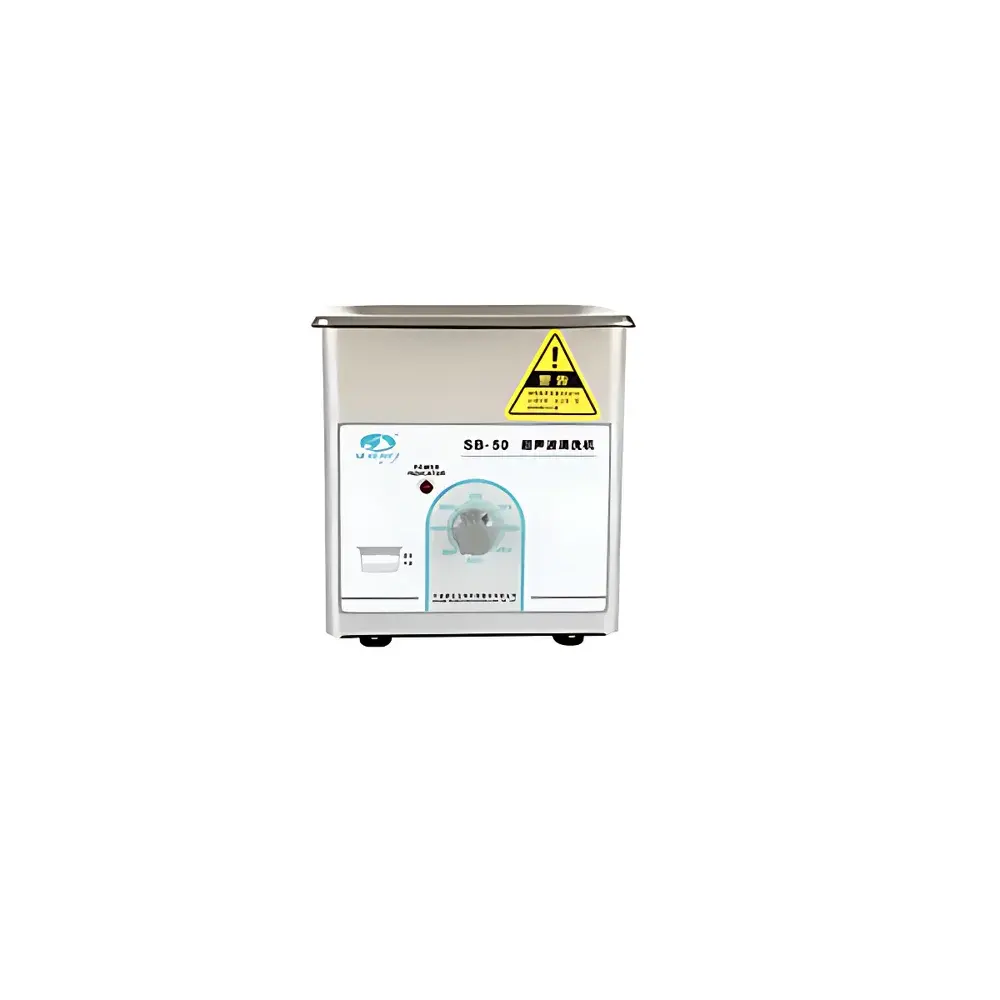
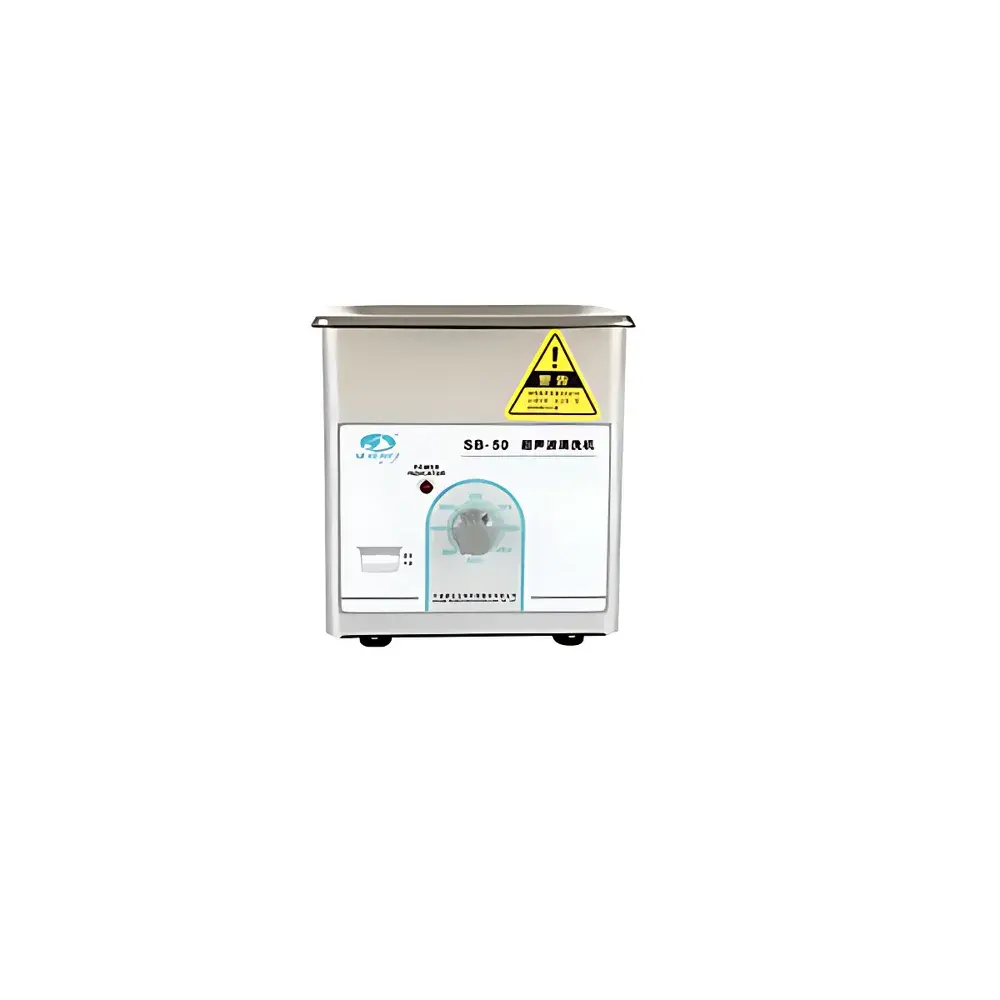
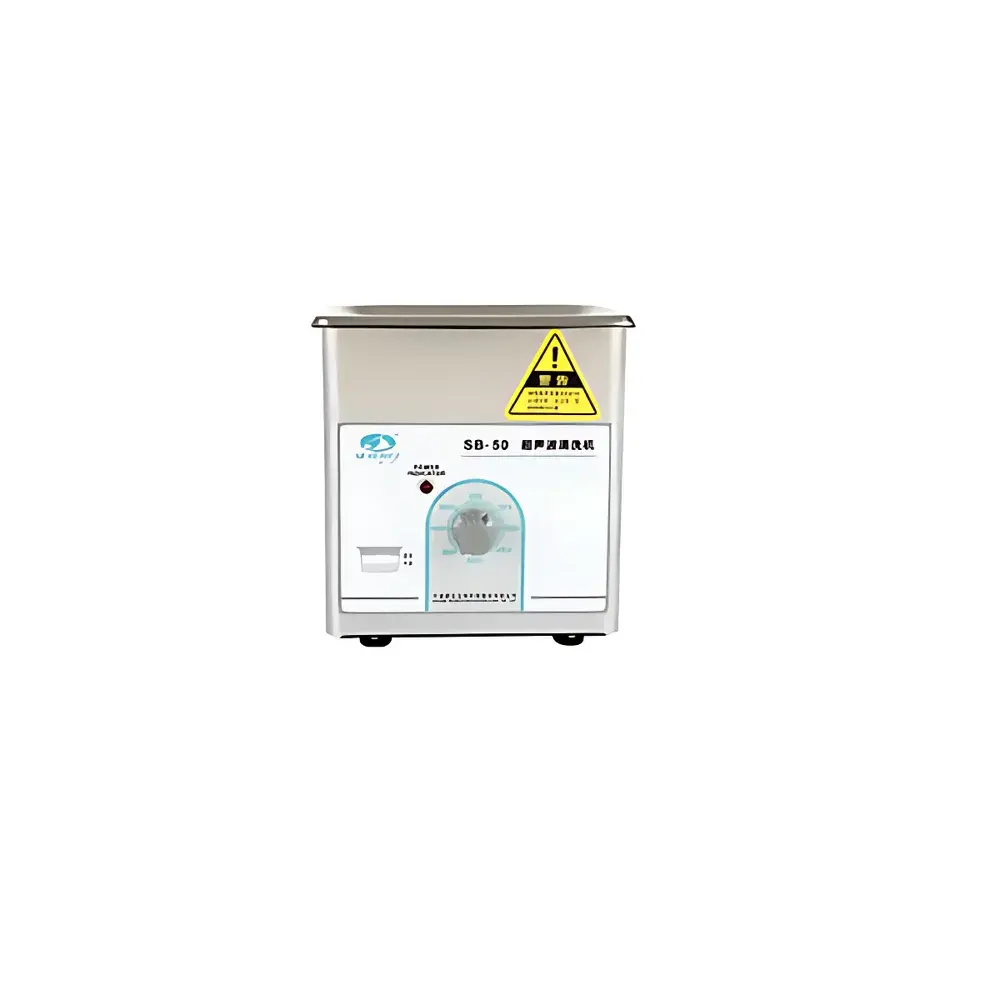
SCIENTZ SB-50 Digital Ultrasonic Cleaner
| Brand | SCIENTZ |
|---|---|
| Origin | Zhejiang, China |
| Manufacturer Type | Authorized Distributor |
| Product Category | Domestic |
| Model | SB-50 |
| Instrument Type | General-Purpose |
| Tank Capacity | 0.8 L |
| Ultrasonic Frequency | 40 kHz |
| Ultrasonic Power Output | 50 W |
| Timer Range | 1–120 min |
Overview
The SCIENTZ SB-50 Digital Ultrasonic Cleaner is a compact, general-purpose benchtop ultrasonic cleaning system engineered for precision and reliability in routine laboratory and light industrial applications. It operates on the principle of acoustic cavitation: high-frequency (40 kHz) ultrasonic energy is converted from electrical input into mechanical vibrations via piezoelectric transducers bonded to the stainless-steel tank base. These vibrations propagate through the cleaning medium—typically aqueous or mild solvent-based solutions—inducing the formation, growth, and implosive collapse of microscopic cavitation bubbles. The localized shockwaves and microstreaming generated during bubble collapse exert shear forces sufficient to dislodge particulate contaminants, organic residues, oils, and biofilms from complex surface geometries without mechanical abrasion or thermal degradation. Designed for consistent performance under repeated daily use, the SB-50 delivers reproducible cleaning efficacy across diverse sample types while maintaining low power consumption and minimal heat generation.
Key Features
- Digital LED display with real-time countdown timer (1–120 minute adjustable range), enabling precise process control and repeatability.
- Stainless-steel inner and outer tank construction (304 grade) ensures corrosion resistance, structural integrity, and long-term compatibility with common laboratory solvents and detergents.
- Integrated lid with sound-dampening design reduces ambient noise and prevents solvent evaporation during operation.
- Automatic shutdown with power-loss memory function retains last-set parameters after unexpected interruption, supporting GLP-compliant workflow continuity.
- Compact footprint (230 × 170 × 250 mm) and shallow tank dimensions (145 × 80 × 65 mm) accommodate standard microcentrifuge tubes, vials, optical components, and small precision parts.
- Thermally stable 40 kHz transducer array optimized for uniform energy distribution across the 0.8 L working volume, minimizing dead zones and ensuring consistent cavitation intensity.
Sample Compatibility & Compliance
The SB-50 is validated for use with glassware (e.g., pipettes, cuvettes, Petri dishes), metal components (bearings, nozzles, surgical instruments), optical elements (lens assemblies, quartz substrates), dental tools, jewelry, and polymer-based labware. Its non-contact cleaning mechanism preserves surface finish and dimensional accuracy—critical for metrology-grade optics and calibrated instrumentation. While not certified for sterilization per ISO 17664 or EN 13060, it supports pre-sterilization cleaning steps compliant with ISO 15883-1 and AAMI ST79 guidelines when used with validated detergents and process parameters. The unit meets CE marking requirements for electromagnetic compatibility (EMC Directive 2014/30/EU) and low-voltage safety (LVD Directive 2014/35/EU). No regulatory claim is made regarding FDA 510(k) clearance or USP validation; users are responsible for establishing in-house cleaning validation protocols per their quality management system.
Software & Data Management
The SB-50 operates as a standalone analog-digital hybrid instrument with no embedded firmware, network interface, or data export capability. All operational parameters—including elapsed time and remaining duration—are displayed locally on the front-panel LED screen. No software installation, driver dependency, or cloud connectivity is required. This architecture eliminates cybersecurity risks associated with IoT-enabled devices and aligns with institutional IT policies restricting networked laboratory equipment. For audit trails, users must manually record settings and cycle logs in paper-based or validated electronic lab notebooks (ELN) per 21 CFR Part 11 requirements where applicable. Time-stamped parameter retention upon power loss satisfies basic GLP documentation expectations for routine cleaning processes.
Applications
- Cleaning of analytical glassware and plastic consumables prior to spectroscopic, chromatographic, or mass spectrometric analysis.
- De-gassing of HPLC mobile phases and calibration standards to prevent pump cavitation and baseline drift.
- Preparation of homogeneous suspensions for particle size analysis (e.g., laser diffraction, dynamic light scattering).
- Removal of polishing compounds and residual adhesives from optical lenses, semiconductor wafers, and MEMS devices.
- Supporting tissue homogenization and cell lysis in low-throughput molecular biology workflows (e.g., RNA extraction from small-volume samples).
- Maintenance cleaning of reusable dental burs, orthodontic appliances, and endoscopic accessories in clinical support labs.
FAQ
Is the SB-50 suitable for sterilization?
No. It performs cleaning only—not sterilization or disinfection. Validation for microbial reduction requires supplementary thermal or chemical treatment per ISO 15883 or AAMI ST79.
Can I use organic solvents in the tank?
Yes, but only those with flash points above 60 °C and confirmed compatibility with 304 stainless steel. Avoid halogenated hydrocarbons, strong acids, or oxidizers without prior compatibility testing.
What is the recommended cleaning solution temperature?
Ambient to 45 °C maximum. Elevated temperatures accelerate cavitation but may degrade certain transducers or compromise seal integrity over extended use.
Does the unit include a heater?
No. The SB-50 is a non-heated model. Temperature control must be achieved externally via water bath or heated cleaning solution preparation.
How often should the tank solution be replaced?
Typically every 4–8 hours of cumulative operation or immediately upon visible contamination, turbidity, or reduced cleaning efficiency—per institutional SOPs.



