
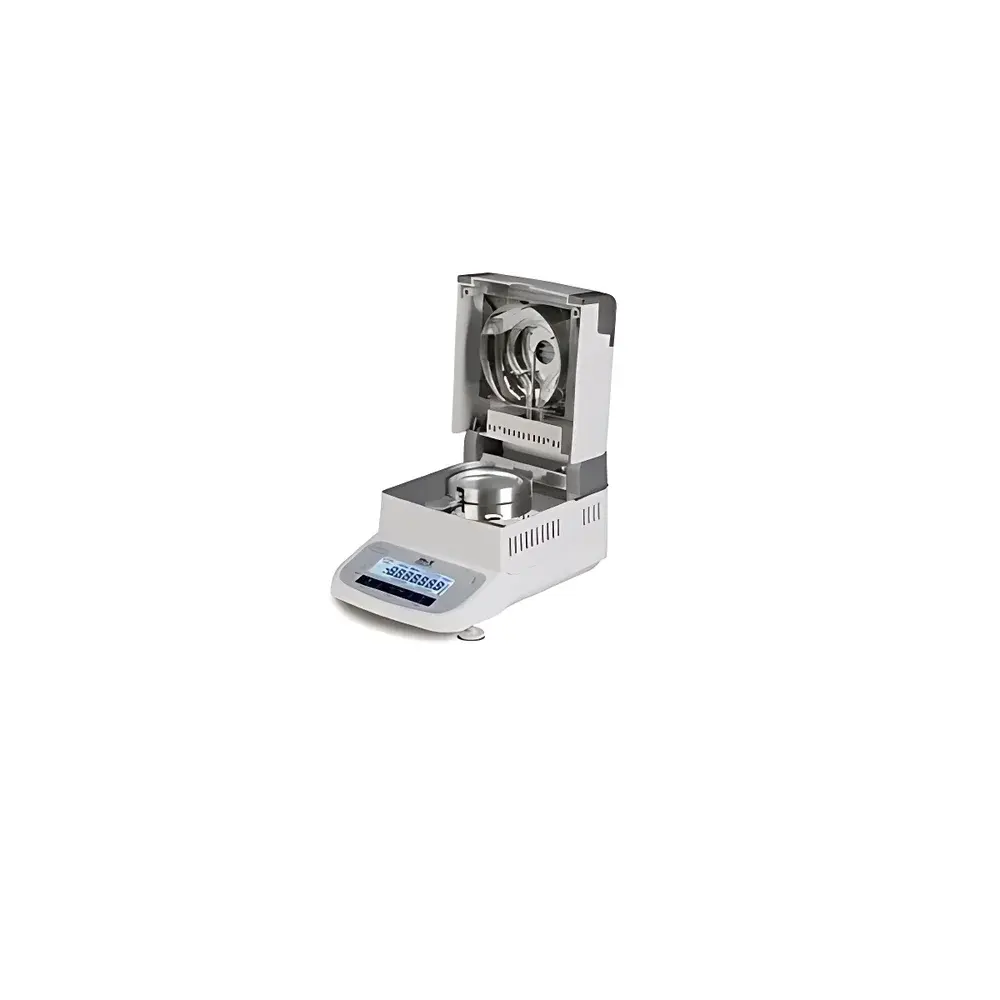
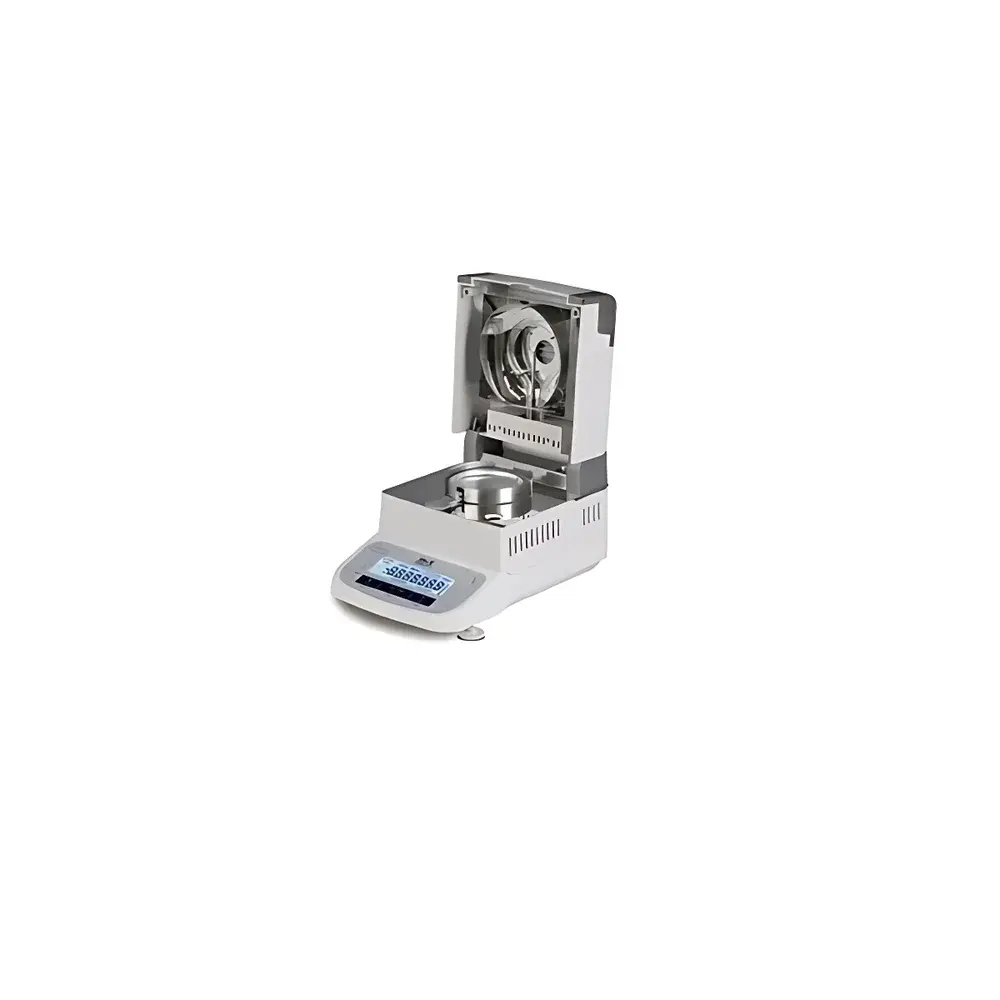
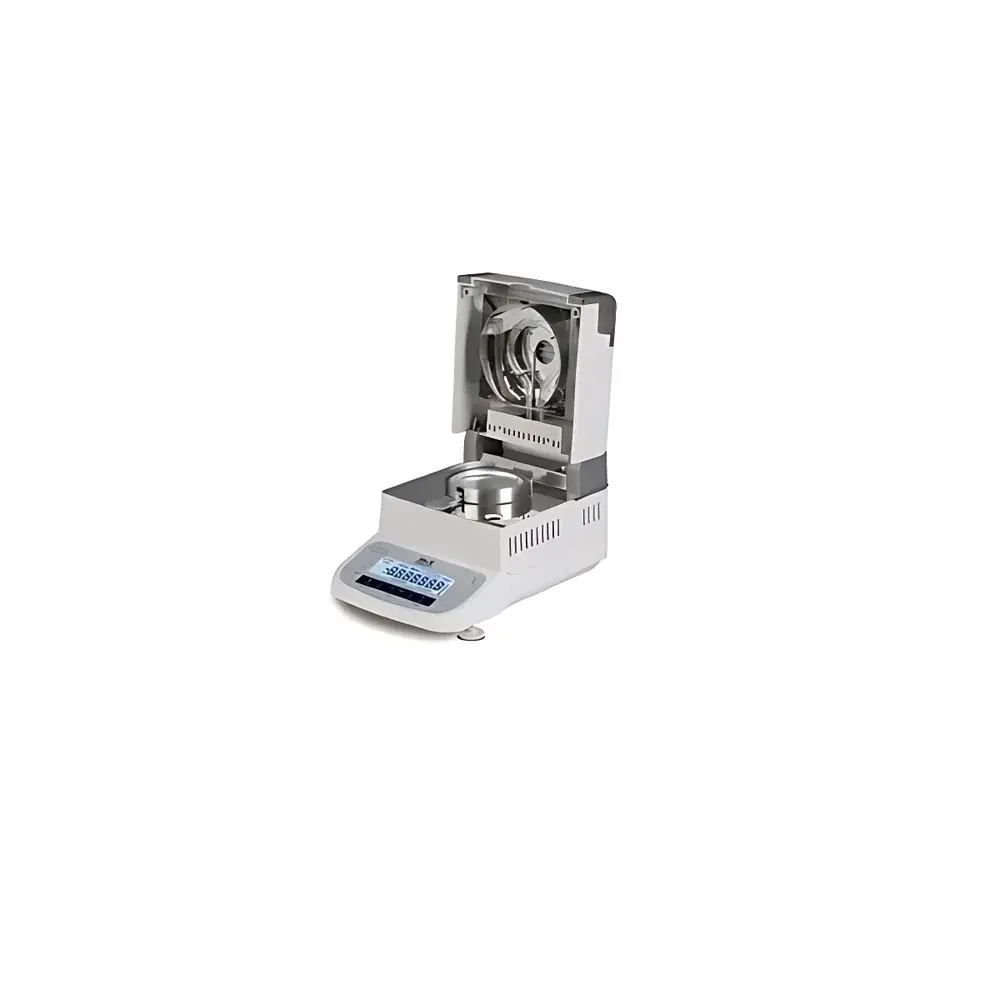
D&A ES-F101 Halogen Moisture Analyzer
| Brand | D&A (De’an Te) |
|---|---|
| Model | ES-F101 |
| Origin | Tianjin, China |
| Type | Halogen-based Thermogravimetric Moisture Analyzer |
| Maximum Capacity | 120 g |
| Readability | 10 mg |
| Moisture Content Readability | 0.1% |
| Sample Pan Diameter | Ø90 mm |
| Heating Source | Circular 450 W Halogen Lamp |
| Temperature Range | 60–160 °C (1 °C increments) |
| Drying Modes | Standard, Step, Rapid |
| Termination Modes | Auto-stop (loss-on-drying threshold), Manual Stop, Timer Stop |
| Calibration | External weight calibration |
| Interface | RS232 bidirectional serial port |
| Operating Temperature | 13–25 °C |
| Warm-up Time | 30–60 min |
| Display | LCD with real-time parameter indicators (%MC, %DC, %AD, %AM, Program ID, stability status) |
Overview
The D&A ES-F101 Halogen Moisture Analyzer is a thermogravimetric instrument engineered for rapid, reliable quantification of moisture content in solid and semi-solid materials via loss-on-drying (LOD) methodology. It integrates a high-precision electromagnetic force-compensation balance with a circular 450 W halogen heating system, enabling uniform thermal energy distribution across the sample surface. Unlike convection or infrared ovens, the halogen lamp delivers immediate radiant heat transfer with minimal thermal inertia—reducing drying time while maintaining reproducible temperature control within ±1 °C across the 60–160 °C operating range. The analyzer complies with core principles outlined in ASTM D4442, ISO 4611, and USP , supporting routine QC testing where speed, repeatability, and traceable methodology are critical. Its design prioritizes operational robustness in regulated environments—featuring temperature and humidity compensation algorithms to mitigate ambient drift, and a stable mechanical architecture suitable for daily use in food, feed, pharmaceutical, and industrial raw material laboratories.
Key Features
- High-stability electromagnetic balance with 10 mg readability and 120 g maximum capacity, optimized for LOD precision under dynamic thermal load
- Circular halogen heating module (450 W) ensuring radial thermal uniformity and reduced edge-effect drying artifacts
- Real-time moisture calculation engine displaying %MC (moisture content), %DC (dry matter), %AD (drying rate), and %AM (moisture regain) simultaneously
- Three programmable drying profiles: Standard (constant temperature), Step (multi-stage ramp), and Rapid (optimized power ramping)
- Intelligent termination logic including auto-stop based on mass change threshold (e.g., ≤0.1 mg/30 s), user-defined timer, or manual intervention
- LCD interface with contextual icons (Max, OK, d, g) and dedicated program identifier field (e.g., “Program 01”) for method traceability
- Integrated environmental compensation: dual-sensor monitoring of ambient temperature and relative humidity to correct for buoyancy and evaporation kinetics
Sample Compatibility & Compliance
The ES-F101 accommodates diverse sample matrices—including granular grains, ground feedstuffs, minced meat, tobacco leaves, dried fungi, paper pulp, construction aggregates, and seafood products—within its Ø90 mm aluminum sample pan. It supports both free and loosely bound water determination but is not intended for bound-water quantification (e.g., crystalline hydrates) without method validation. The instrument meets functional requirements for GLP-compliant workflows: all measurement events—including start/stop timestamps, program parameters, final mass values, and moisture percentages—are timestamped and exportable. While not pre-certified for FDA 21 CFR Part 11, its RS232 interface enables integration into validated LIMS or ELN systems when paired with audit-trail-enabled software. Routine verification follows manufacturer-recommended protocols using certified reference standards (e.g., sodium tartrate dihydrate for moisture recovery checks).
Software & Data Management
Data output is transmitted via RS232 serial interface at configurable baud rates (default 9600 bps, 8N1), compatible with Windows-based data acquisition tools, Excel macros, and laboratory information management systems (LIMS). Each record includes: date/time stamp, program name, initial/final mass (g), moisture content (%MC), dry matter (%DC), drying duration (min:ss), and stability confirmation flag. No proprietary software is bundled; however, ASCII-formatted output allows direct parsing into CSV or database tables. For GxP environments, users may implement third-party middleware that logs transmission metadata, enforces user authentication, and generates electronic signatures per ALCOA+ principles.
Applications
- Food manufacturing: In-line verification of dough hydration, snack crispness, cereal moisture stability, and seasoning blend consistency
- Animal nutrition: Feed pellet moisture specification (ASTM E2027), silage dry matter estimation, and premix homogeneity screening
- Agricultural QA: Grain moisture grading (ISO 712), rice husk moisture compliance, and mushroom drying endpoint detection
- Tobacco processing: Leaf moisture profiling prior to threshing and re-drying process validation
- Building materials: Sand, clay, and gypsum board moisture acceptance testing per ASTM C561
- Pharmaceutical excipients: LOD screening of lactose monohydrate, microcrystalline cellulose, and starch derivatives
FAQ
What standards does the ES-F101 align with for moisture testing?
It implements thermogravimetric LOD principles consistent with ASTM D4442 (wood), ISO 4611 (plastics), and USP (pharmaceuticals); method validation is required for regulatory submission.
Can the ES-F101 be used for volatile organic compound (VOC) analysis?
No—it measures total mass loss assumed to be water; co-evaporation of volatiles will overestimate %MC unless corrected via complementary GC or Karl Fischer titration.
Is external calibration mandatory before each test series?
External calibration with Class M2 weights is recommended daily or per shift, especially after ambient temperature shifts exceeding 5 °C.
How does the instrument compensate for ambient humidity fluctuations?
An integrated capacitive RH sensor feeds real-time correction factors into the mass stability algorithm, reducing drift caused by hygroscopic pan or air density changes.
What is the minimum sample mass required for 0.1% moisture resolution?
Based on instrument specifications, ≥2 g samples yield ≤5% RSD for moisture content; 10 g samples achieve ≤2% RSD as stated in technical documentation.




