
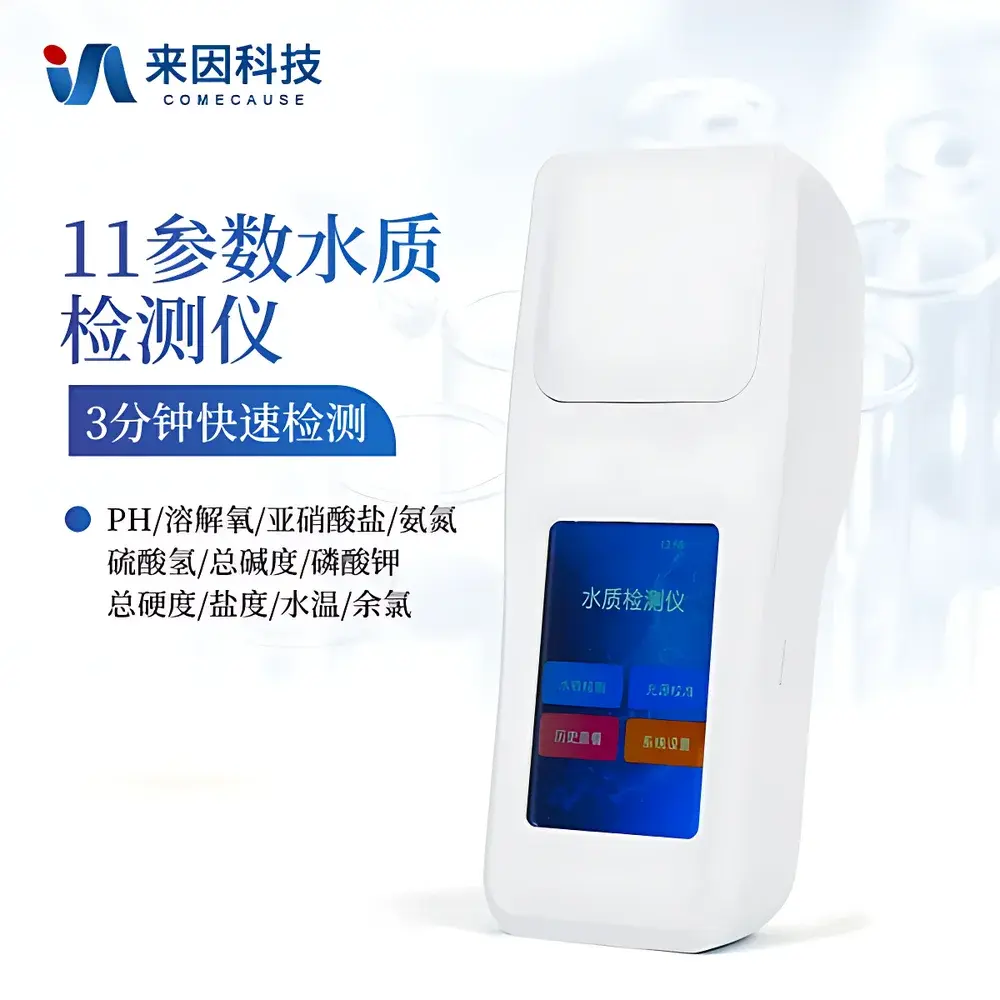
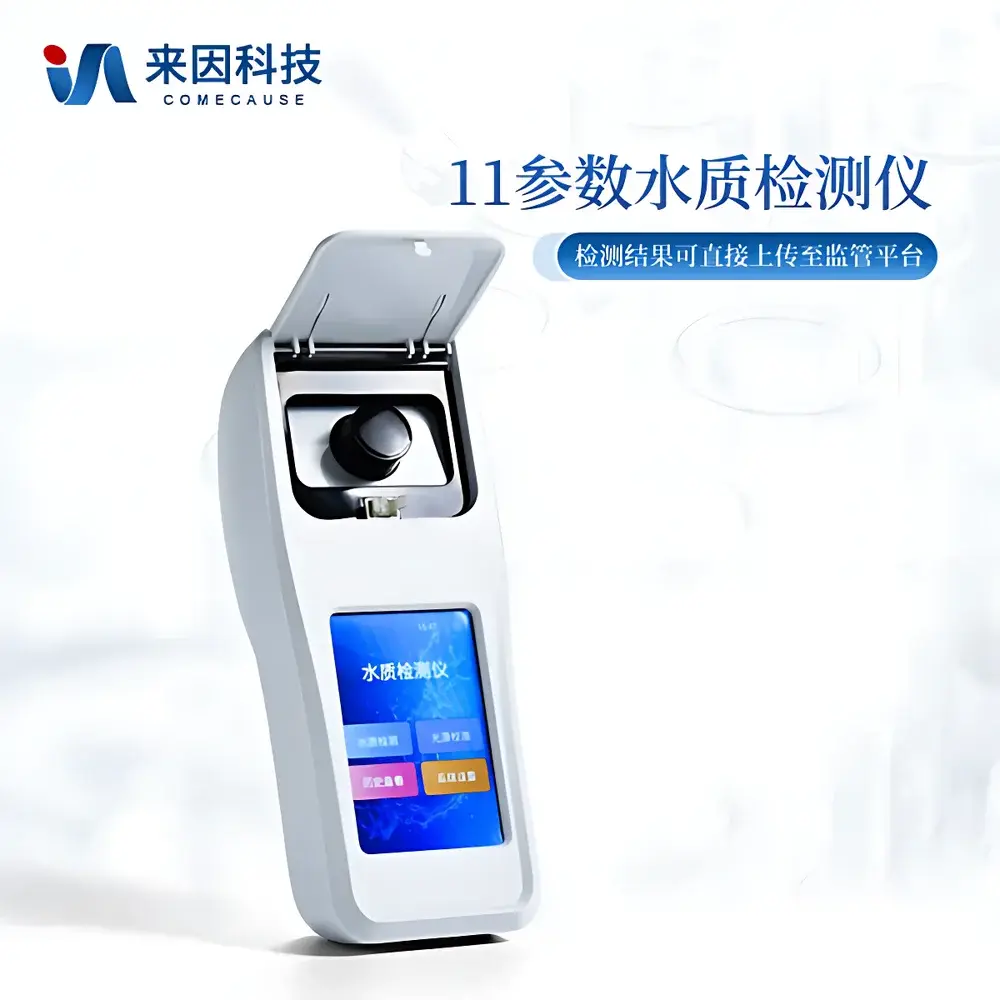
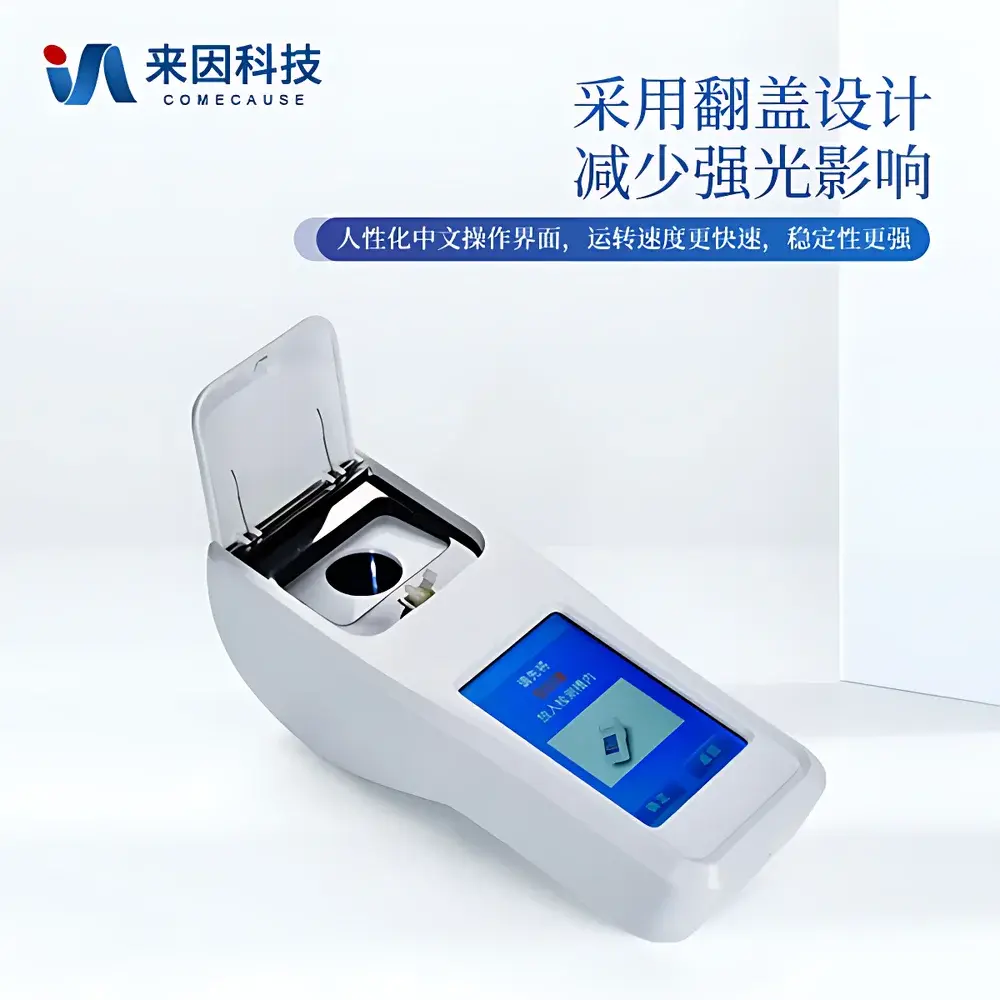
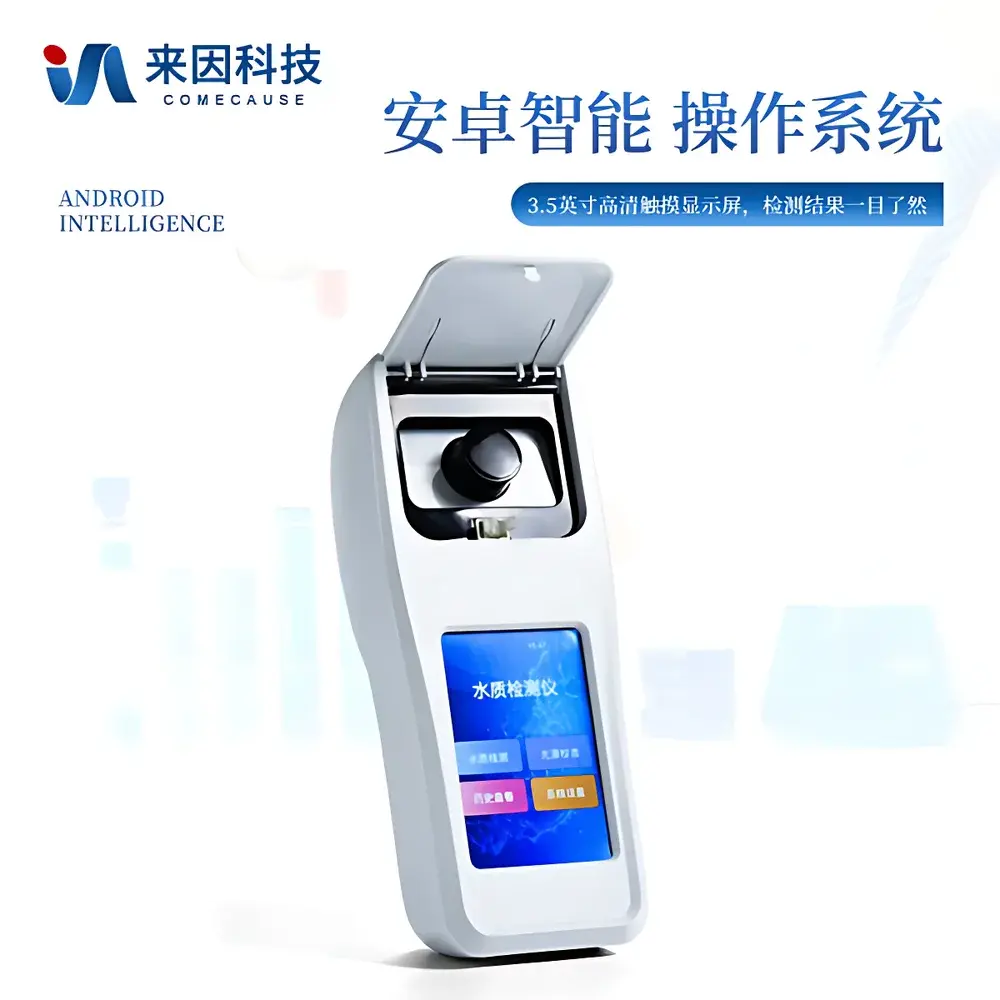
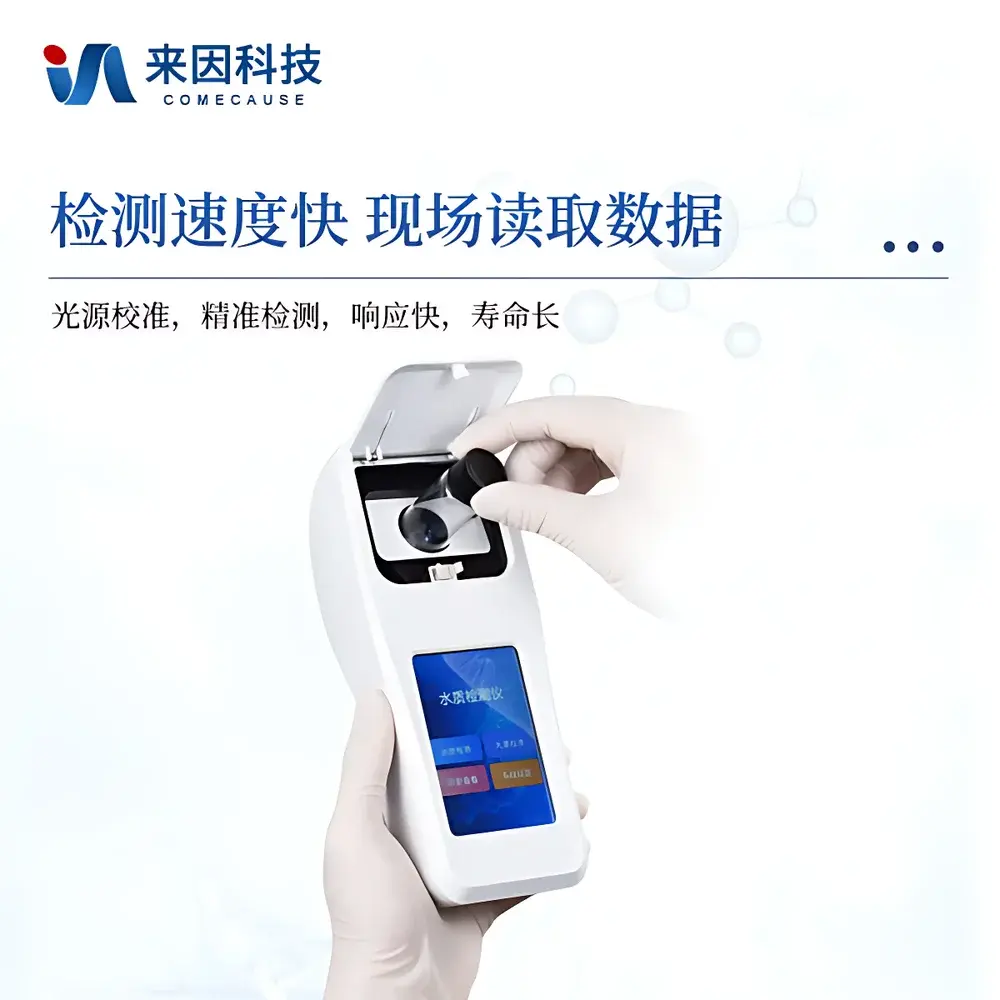
COMECAUSE IN-SS11 Portable 11-Parameter Water Quality Analyzer
| Brand | COMECAUSE |
|---|---|
| Origin | Shandong, China |
| Manufacturer Type | Direct Manufacturer |
| Product Category | Domestic |
| Model | IN-SS11 |
| Instrument Type | Portable / Handheld Water Quality Analyzer |
| Detection Parameters | pH, Dissolved Oxygen (DO), Ammonia-Nitrogen (NH₃-N), Nitrite (NO₂⁻), Total Alkalinity, Hydrogen Sulfide (H₂S), Salinity, Phosphate (PO₄³⁻), Total Hardness, Water Temperature, Residual Chlorine |
| Optical System | Imported Cold Light Source |
| Wavelength Range | 340–800 nm |
| Detection Method | Photometric Colorimetry |
| Display | 3.5-inch Color LCD |
| Operating System | Android-based Embedded OS |
| Data Storage Capacity | >80,000 Records |
| Connectivity | USB Type-C, Wi-Fi, Bluetooth |
| Battery | 5600 mAh Li-ion |
| Continuous Operation Time | ≥12 h |
| Operating Environment | 0–50 °C, 0–90% RH |
| Optical Stability | <0.5% |
| Absorbance Sensitivity | 0.001 AU |
| Dimensions | 180 × 80 × 65 mm |
| Weight | 700 g |
| Language Support | English / Simplified Chinese |
Overview
The COMECAUSE IN-SS11 Portable 11-Parameter Water Quality Analyzer is a field-deployable photometric colorimeter engineered for rapid, on-site assessment of critical water quality indicators in aquaculture, municipal water monitoring, environmental surveillance, and industrial effluent management. It operates on the principle of standardized colorimetric reactions—where analyte-specific reagents react with target species in water samples to generate chromogenic complexes whose absorbance is quantified across a broad spectral range (340–800 nm). The instrument integrates an imported cold light source with high optical stability (<0.5% drift) and 0.001 AU absorbance resolution, ensuring reproducible quantification under variable ambient conditions. Designed for operational simplicity without compromising analytical rigor, the IN-SS11 eliminates the need for laboratory infrastructure while maintaining traceability to conventional wet-chemistry reference methods.
Key Features
- Integrated Android-based embedded operating system with intuitive touchscreen interface—no external PC or prior training required.
- Pre-programmed assay workflows for all 11 parameters: pH, dissolved oxygen (DO), ammonia-nitrogen (NH₃-N), nitrite (NO₂⁻), total alkalinity, hydrogen sulfide (H₂S), salinity, phosphate (PO₄³⁻), total hardness, water temperature, and residual chlorine.
- Automated wavelength selection and real-time calibration verification minimize operator-induced error and support method compliance.
- Robust portable architecture: 700 g mass, 180 × 80 × 65 mm footprint, IP65-rated enclosure for dust/moisture resistance during outdoor deployment.
- Long-duration power management: 5600 mAh lithium-ion battery enables ≥12 hours of continuous operation; supports hot-swappable charging via 5 V DC input.
- Multi-modal data export: Local storage (>80,000 records), USB Type-C bulk transfer, Wi-Fi cloud synchronization, and Bluetooth pairing with mobile diagnostic apps.
Sample Compatibility & Compliance
The IN-SS11 accepts standard aqueous matrices including freshwater, brackish water, recirculating aquaculture system (RAS) effluents, municipal swimming pool water, and pretreated industrial discharge. Sample preparation follows EPA-approved colorimetric protocols—for example, NH₃-N quantification via indophenol blue method (EPA 350.1), NO₂⁻ via diazotization (EPA 354.1), and PO₄³⁻ via ascorbic acid reduction (EPA 365.3). While not certified for regulatory submission under ISO/IEC 17025, the analyzer meets functional equivalence to ASTM D1293 (pH), D888 (DO), and D515 (phosphate) when used with validated reagent kits. Its design supports GLP-aligned documentation practices, including timestamped measurement logs, user ID tagging, and audit-ready data export formats (CSV, PDF reports).
Software & Data Management
The embedded Android OS hosts a purpose-built analytical suite featuring guided test initiation, dynamic calibration curve generation, and automatic interference correction algorithms (e.g., turbidity compensation for H₂S assays). All measurements are time-stamped, geotagged (via paired smartphone), and stored with full metadata—including reagent lot numbers, operator ID, and environmental conditions. Data export conforms to FAO Aquaculture Monitoring Framework requirements and integrates natively with Microsoft Excel, LabArchives ELN, and custom LIMS via API-enabled Wi-Fi sync. Firmware updates are delivered over-the-air (OTA), ensuring long-term alignment with evolving method standards such as ISO 7888 (chlorine), ISO 9963-1 (alkalinity), and USP <643> (conductivity-coupled salinity estimation).
Applications
- Aquaculture risk mitigation: Real-time tracking of NH₃-N and NO₂⁻ spikes in shrimp or tilapia ponds to preempt toxicity events.
- Swimming pool safety assurance: Simultaneous residual chlorine and pH verification per CDC Model Aquatic Health Code (MAHC) thresholds.
- River basin health screening: Field-level assessment of eutrophication markers (phosphate, nitrite) and oxygen depletion zones.
- Drinking water distribution integrity: Spot-checking for chlorine decay and hardness scaling potential in secondary networks.
- Wastewater treatment process control: Monitoring influent/effluent alkalinity and DO to optimize aeration energy use.
- Research-grade comparative studies: Cross-validation against benchtop spectrophotometers (e.g., Hach DR3900) in multi-site field trials.
FAQ
Is the IN-SS11 compliant with FDA 21 CFR Part 11 for electronic records?
No—the device does not implement electronic signature controls or audit-trail encryption required for regulated GxP environments. It is intended for operational monitoring, not final release testing.
Can the instrument measure seawater salinity directly without conversion?
Yes—it uses conductivity-based salinity calculation calibrated to PSS-78 standards and displays results in practical salinity units (PSU) without manual adjustment.
What is the shelf life of the included reagent kits?
Unopened reagent vials retain stability for 18 months when stored at 2–8 °C; post-opening stability is 6 months under refrigeration with desiccant protection.
Does the analyzer support third-party reagents?
Only COMECAUSE-certified reagent sets are validated for optical pathlength, reaction kinetics, and interference profiles; non-OEM reagents may compromise accuracy and void warranty.
How frequently must the optical system be recalibrated?
Factory calibration remains stable for ≥12 months under normal use; users perform daily zero-point verification using supplied blank solution before each measurement session.
Related Products







