
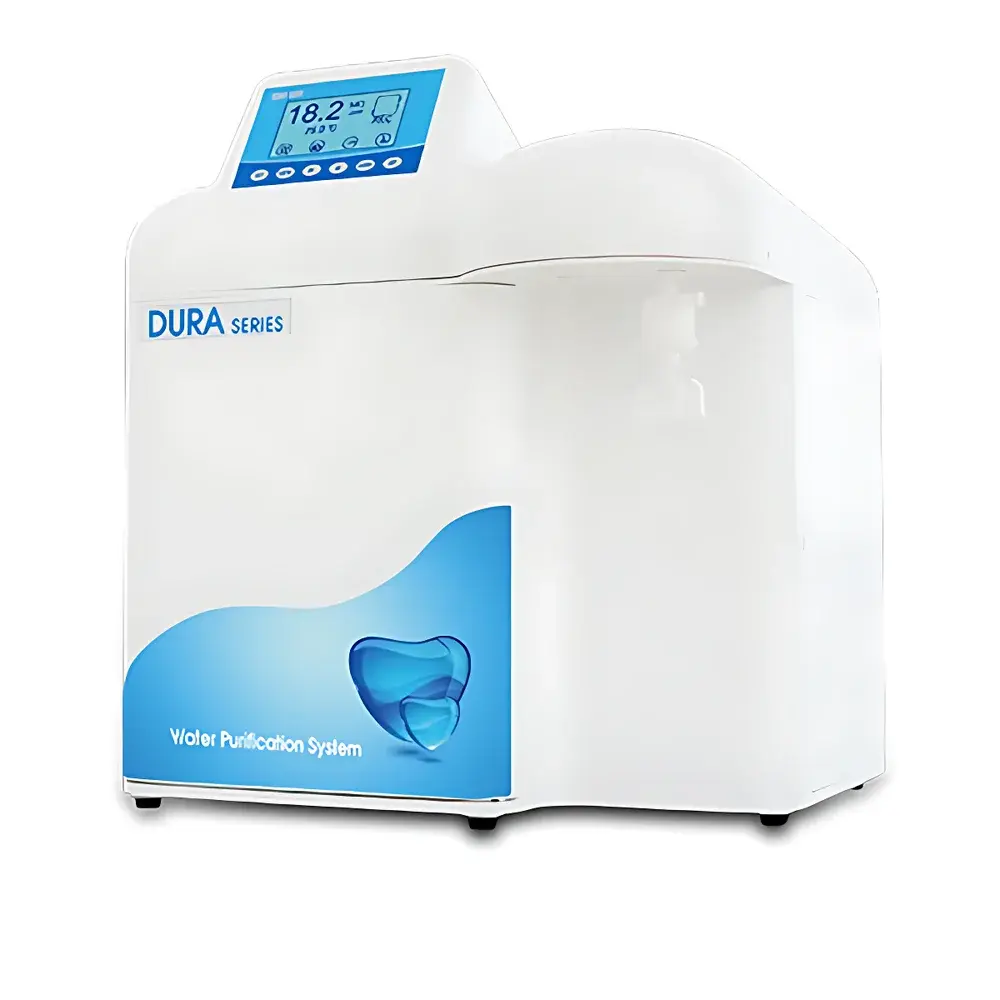
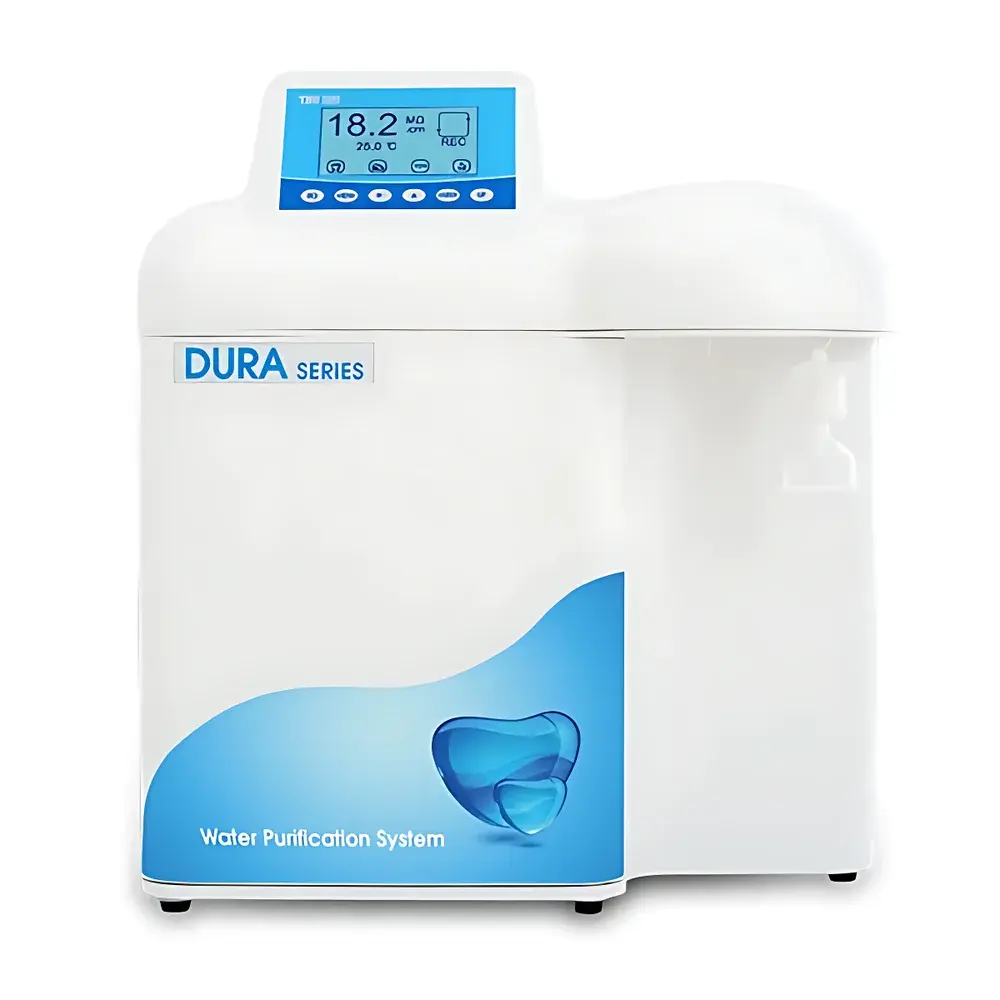
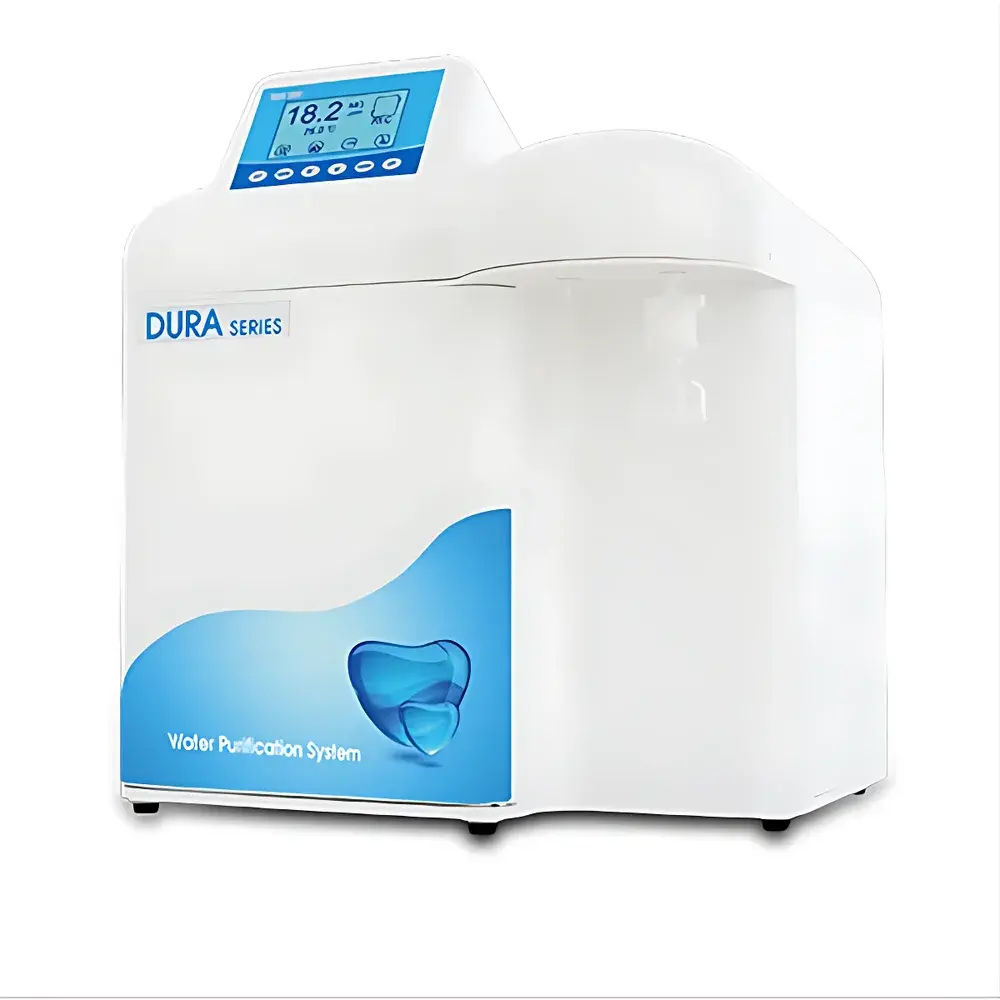
Zelab Dura 12/24 Ultra-Pure Water System
| Brand | Zelab / The Lab |
|---|---|
| Origin | USA |
| Model | Dura 12/24 |
| Pure Water Grade | Type I (ASTM D1193-20, USP <1231>, ISO 3696:1987, CLSI EP22-A, CAP) |
| Resistivity | 18.2 MΩ·cm @ 25°C |
| Heavy Metals & Soluble Silica | <0.01 ppb |
| Total Organic Carbon (TOC) | <3 ppb |
| Microbial Count | <0.001 CFU/mL |
| Endotoxins | <0.001 EU/mL |
| Particles (>0.1 µm) | <1 particle/mL |
| RO Output Conductivity | 1–5 µS/cm (2nd stage) |
| Flow Rate | 12 or 24 L/h (RO), up to 2.0 L/min (UP) |
Overview
The Zelab Dura 12/24 Ultra-Pure Water System is an integrated, benchtop-grade laboratory water purification platform engineered for consistent production of Type I ultrapure water (UPW) per ASTM D1193-20, USP , ISO 3696:1987, CLSI EP22-A, and CAP guidelines. It employs a validated dual-stage reverse osmosis (RO) architecture—featuring two independent high-efficiency RO membranes, dedicated booster pumps, and an intermediate storage tank—to ensure stable feedwater conditioning regardless of municipal source variability. This design achieves robust rejection of ions, organics, colloids, and microorganisms while minimizing waste stream volume and energy consumption. The system further refines RO permeate through sequential deionization (DI), dual-wavelength UV oxidation (185 nm + 254 nm), ultrafiltration (MWCO 5,000 Da), and terminal 0.45 + 0.1 µm PES membrane filtration. Final UPW meets stringent specifications for critical applications including HPLC mobile phase preparation, cell culture media formulation, molecular biology assays, and trace elemental analysis.
Key Features
- Dual-stage RO with independent booster pumps and intermediate PE storage tank ensures stable RO output conductivity (1–5 µS/cm) even under variable inlet water quality.
- Integrated triple-pump architecture: primary RO booster, secondary RO booster, and recirculation/disinfection pump enabling full-system sanitization and low-bioburden operation.
- Two-tiered water storage: 5.8 L vented PE tank with 0.2 µm air filter + 12 L pressurized polyethylene reservoir—both NSF-certified—minimizing atmospheric contamination and maximizing footprint efficiency.
- Modular, snap-fit consumable cartridges—including pre-treatment (5 µm PP + KDF + coconut-shell activated carbon), RO membranes (Dow FilmTec™), and integrated UP polishing columns (Dow ion-exchange resins)—enable rapid, tool-free replacement with extended service intervals.
- Real-time, three-point conductivity monitoring (feedwater, RO permeate, UP outlet) with configurable alarm thresholds and automatic logging via RS232/USB interface compliant with GLP data integrity requirements (21 CFR Part 11-ready).
- Automated RO membrane antiscalant flush cycle (startup + timed), programmable UP water dispensing (time: 1–99 min; resistivity setpoint: 0.1–18.2 MΩ·cm), and password-protected parameter configuration (dual-level access control).
- NSF-certified fluid path components—including tubing, fittings, and UV chamber (316L stainless steel housing)—guarantee minimal TOC leaching and chemical compatibility.
Sample Compatibility & Compliance
The Dura 12/24 accepts potable municipal tap water (5–45 °C, 1.0–4.0 kgf/cm² inlet pressure) as feedstock. Its multi-barrier purification train delivers water fully compliant with Type I specifications defined in ASTM D1193-20, USP , ISO 3696:1987, EP 2.2.43, and CLSI EP22-A. Optional configurations include endotoxin-removal (UF + double-layer PES filtration) and nuclease-free variants (RNase/DNase <1 pg/mL and <5 pg/mL respectively). All wetted materials comply with FDA 21 CFR §177.1520 (food-contact plastics) and NSF/ANSI Standard 58 (RO systems). System validation documentation supports IQ/OQ/PQ protocols required under GMP/GLP environments.
Software & Data Management
The 106 × 57 mm LCD display provides animated real-time visualization of system status, flow rates, temperature, and all three conductivity channels. Internal memory logs timestamped water temperature and conductivity data at user-defined intervals. Exportable CSV files via USB or RS232 support audit-ready recordkeeping. Built-in alarm history retains timestamps for critical events—including low feed pressure, tank overfill, resistivity deviation, and consumable exhaustion—enabling root-cause analysis and preventive maintenance scheduling. Firmware supports GLP-compliant electronic signatures and audit trail generation when connected to validated LIMS or ELN platforms.
Applications
- HPLC, UHPLC, and LC-MS mobile phase and blank preparation where low TOC and ionic background are essential.
- Mammalian and stem cell culture media formulation requiring endotoxin-free, nuclease-free water.
- PCR, qRT-PCR, NGS library prep, and CRISPR workflows demanding RNase/DNase-free conditions.
- Atomic absorption spectroscopy (AAS), ICP-OES, and ICP-MS calibration standard dilution.
- Electrophysiology buffer preparation and nanoparticle synthesis requiring ultra-low particulate counts.
- Pharmaceutical QC testing per USP and EP 2.2.43 monographs.
FAQ
What feedwater quality is required?
Potable municipal water meeting EPA or WHO drinking water standards is sufficient. Inlet TDS should not exceed 500 ppm; iron <0.1 ppm and chlorine <0.5 ppm recommended for optimal prefilter life.
Can the system be integrated with external storage tanks?
Yes—pressure tank and level-sensing reservoir interfaces are supported via optional adapters. Maximum external capacity: 100 L.
How often must consumables be replaced?
Pre-filters: 6–12 months depending on inlet water quality; RO membranes: 2–3 years; UP polishing cartridges: 6–18 months based on usage and TOC/resistivity trends.
Is remote monitoring supported?
Not natively—but analog voltage outputs (0–5 V) for conductivity and temperature enable connection to third-party SCADA or building management systems.
Does the system meet FDA 21 CFR Part 11 requirements?
Hardware and firmware support electronic signature capture, audit trails, and role-based access control. Full compliance requires site-specific validation and documented SOPs.



