
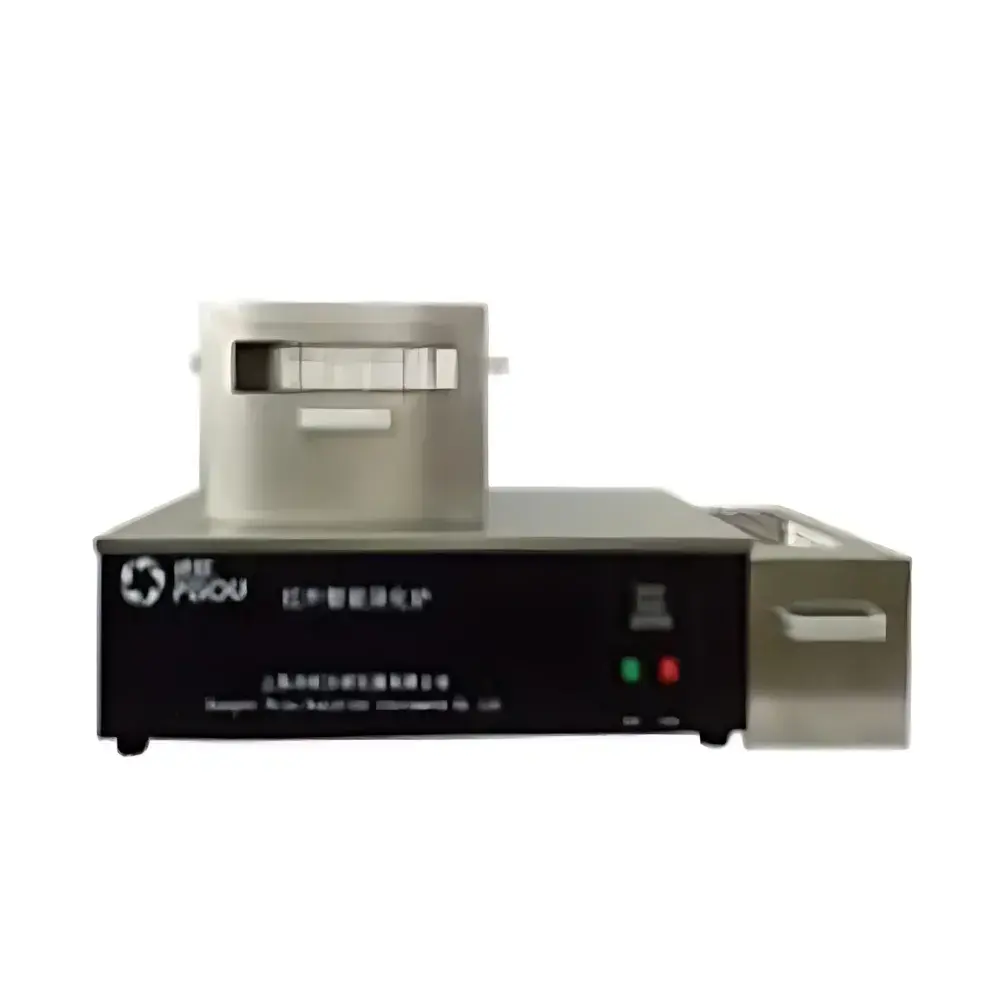
Peiou SKD-48S2 Infrared Quartz Digestion Furnace
| Brand | Peiou |
|---|---|
| Origin | Shanghai, China |
| Model | SKD-48S2 |
| Number of Digestion Positions | 48 |
| Temperature Range | Ambient to 680 °C |
| Heating Rate | 22 min (to 400 °C, empty chamber) |
| Temperature Uniformity | ±1 °C |
| Voltage | AC 220 V |
| Power Rating | 1950 W |
| Digestion Tube Dimensions | 25 mm × 300 mm |
Overview
The Peiou SKD-48S2 Infrared Quartz Digestion Furnace is an engineered solution for high-throughput, thermally precise sample digestion in Kjeldahl nitrogen analysis, heavy metal determination (e.g., EPA 3050B, ISO 11466), and other acid-based sample preparation workflows. Unlike conventional conduction-heated digesters, the SKD-48S2 employs a proprietary far-infrared (FIR) heating architecture based on opal-white quartz tubes. These tubes absorb >97% of visible and near-infrared radiation emitted by embedded resistive heating elements, converting it into resonant Si–O bond vibrational energy that emits broadband far-infrared radiation (peak emission ~3–8 µm). This mechanism delivers rapid, directional, and highly efficient thermal transfer directly to digestion tubes—minimizing thermal lag, eliminating hot-spot formation, and ensuring uniform energy coupling across all 48 positions. The furnace operates without coatings, volatile binders, or catalytic surfaces, preserving chemical inertness under aggressive H₂SO₄, HNO₃, or HClO₄ conditions up to 680 °C.
Key Features
- 48-position parallel digestion capacity with independent thermal zoning for batch reproducibility
- Far-infrared quartz heating system: zero contamination risk, no outgassing, no surface degradation after prolonged use at ≥600 °C
- Temperature control accuracy: ±1 °C over full range (ambient to 680 °C), verified per ASTM E220 calibration protocol
- Fast thermal response: reaches 400 °C in ≤22 minutes (empty chamber), enabling rapid method cycling
- Low thermal inertia design: supports programmable ramp-hold profiles for optimized organic matrix decomposition
- Robust insulation architecture: multi-layer ceramic fiber + reflective aluminum foil barrier ensures stable cavity temperature and minimal external surface heating
- Integrated safety system: dual independent overtemperature cutoffs, earth leakage protection (30 mA), short-circuit and overcurrent monitoring per IEC 61010-1
Sample Compatibility & Compliance
The SKD-48S2 accommodates standard 25 mm × 300 mm borosilicate or quartz digestion tubes used in AOAC 984.27, ISO 5983-1, and USP <467> residual solvent preparation. Its open-top cavity geometry allows unobstructed tube insertion and visual process monitoring. All wetted components—including heating elements, support trays, and insulation—are certified non-reactive under acidic fuming conditions (pH < 1, 300 °C+). The instrument complies with GLP documentation requirements through optional RS-232/USB data logging (timestamped temperature traces), supporting audit readiness for ISO/IEC 17025-accredited laboratories. It meets electromagnetic compatibility (EMC) Class B limits per EN 61326-1 and carries CE marking for laboratory equipment.
Software & Data Management
While the base SKD-48S2 operates via front-panel digital controller with 5-stage programmable ramp-hold capability, optional PC connectivity enables full traceability. The companion software (v3.2+) records real-time temperature profiles for each digestion cycle, stores user-defined methods (including hold times, ramp rates, and endpoint alerts), and exports CSV-formatted logs compatible with LIMS integration. Audit trail functionality includes operator ID tagging, parameter change history, and electronic signature support aligned with FDA 21 CFR Part 11 requirements when deployed with validated authentication protocols.
Applications
- Kjeldahl nitrogen determination in food, feed, soil, and wastewater samples
- Acid digestion of environmental solids (sediments, sludges, particulates) prior to ICP-OES or ICP-MS analysis
- Preparation of biological tissues for trace metal quantification (Cd, Pb, As, Hg) per EPA Method 3050B
- Organic matter removal from geological matrices prior to XRF fusion
- Controlled thermal decomposition of polymers and pharmaceutical excipients in stability studies
FAQ
What distinguishes far-infrared quartz heating from aluminum block or graphite heating?
Far-infrared radiation provides direct, volumetric energy coupling to digestion tubes—eliminating thermal resistance at solid–solid interfaces. Aluminum blocks rely on conduction, introducing thermal lag and inter-hole gradients; graphite exhibits poor lateral conductivity, leading to positional temperature variance (>±5 °C typical). The SKD-48S2 achieves ≤±1 °C uniformity across all 48 positions.
Can the SKD-48S2 be used for mercury digestion per EPA 7470A?
Yes—its rapid cooldown capability (<15 min from 600 °C to 100 °C) and absence of catalytic surfaces prevent Hg recombination or volatilization loss during controlled ramp-down sequences.
Is calibration verification supported?
Yes—NIST-traceable PT100 probe ports are provided at three spatial locations (center, left, right) for periodic uniformity validation using external reference thermometers per ISO/IEC 17025 clause 6.5.2.
What maintenance is required for long-term FIR performance?
None beyond routine cleaning of quartz tube exteriors with ethanol; the opal-white quartz maintains consistent emissivity (>0.92) over >5,000 operational hours without spectral shift or coating delamination.



