
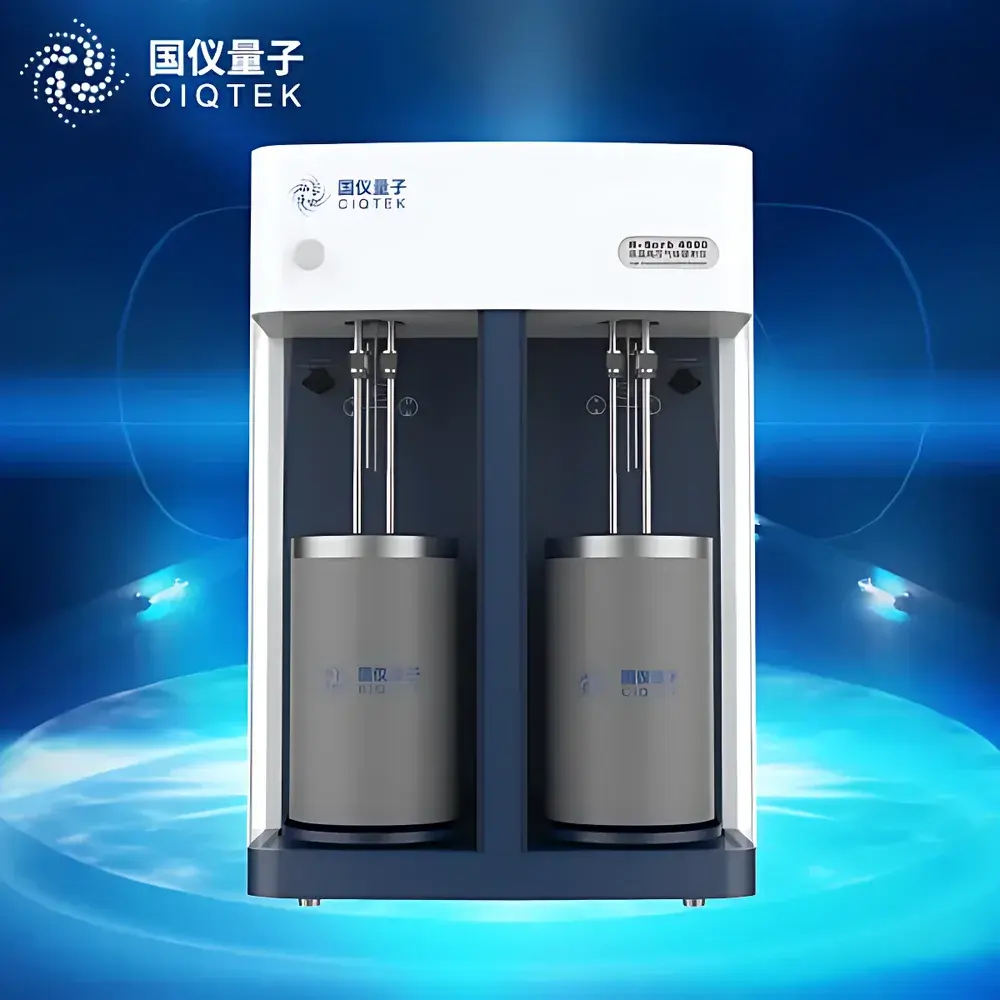
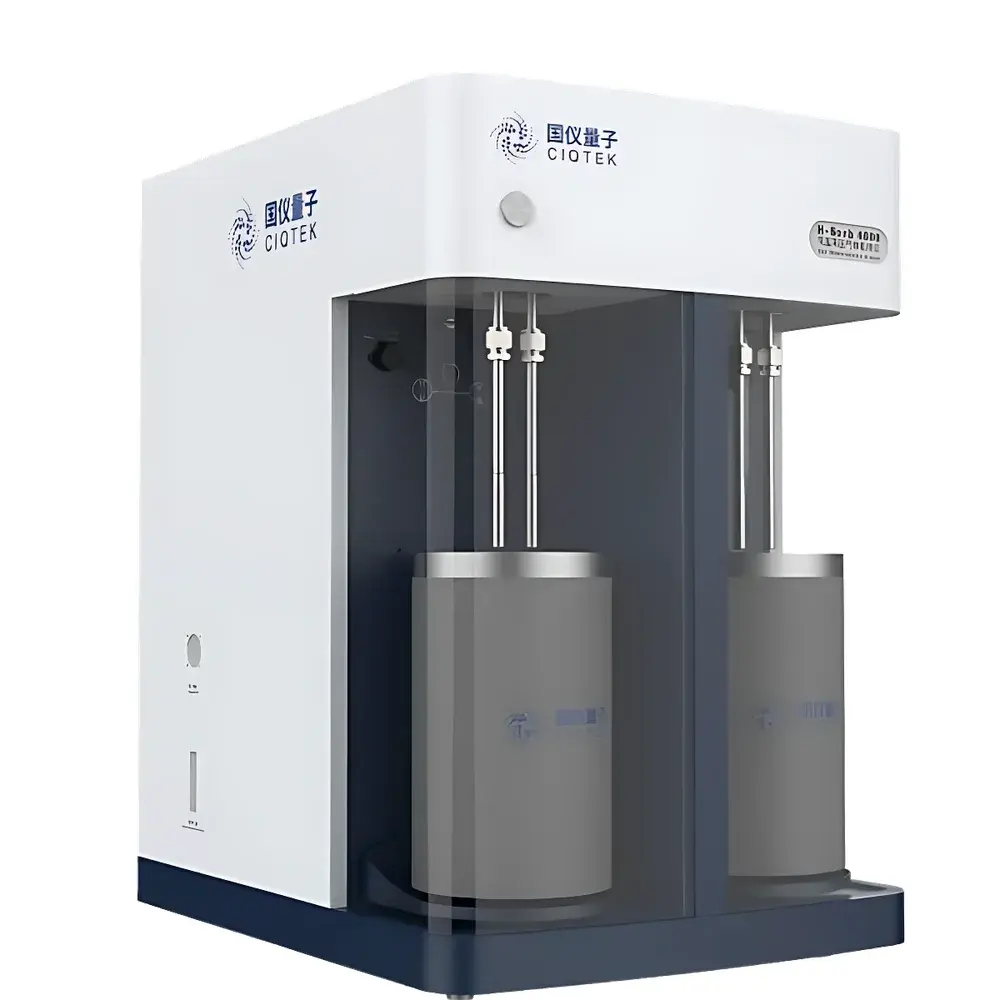
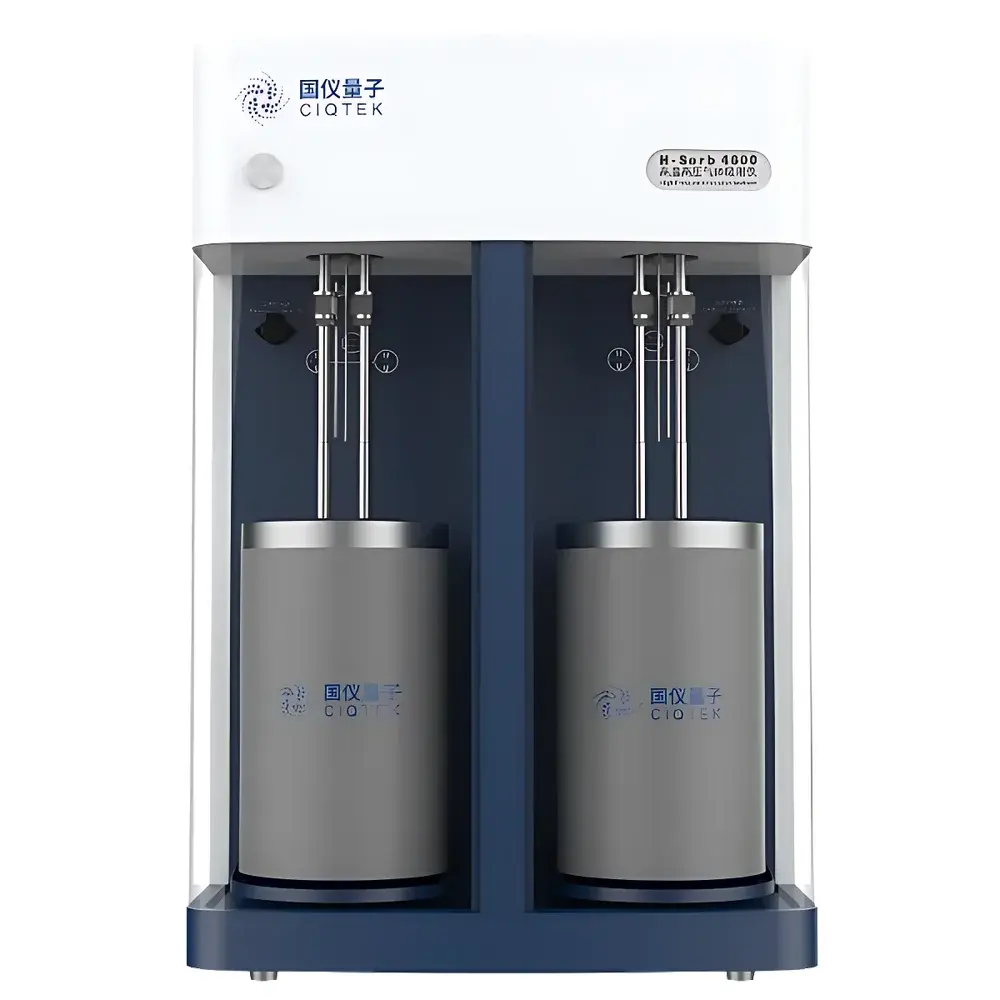
CIQTEK H-Sorb 4600 High-Pressure Adsorption Analyzer
| Brand | CIQTEK |
|---|---|
| Origin | Beijing, China |
| Manufacturer Type | Direct Manufacturer |
| Model | H-Sorb 4600 |
| Measurement Method | Static Volumetric Method |
| Temperature Range | –196 °C to 350 °C (standard heating jacket |
| Pressure Range | Ultra-High Vacuum (≤5×10⁻⁶ Pa with extended molecular pump) to 200 bar |
| Sample Tube Material | Electropolished 316L Stainless Steel with Micro-Welded Construction |
| Sealing | VCR Metal-to-Metal Face Seal |
Overview
The CIQTEK H-Sorb 4600 is a high-precision, static volumetric high-pressure adsorption analyzer engineered for rigorous thermodynamic and kinetic characterization of gas–solid interactions under extreme conditions. It operates on the fundamental principle of pressure-decay equilibration within a calibrated reference volume and sample cell, enabling accurate determination of adsorption isotherms (e.g., Langmuir, BET, D-R, Toth), desorption hysteresis, and dynamic uptake/release profiles. Designed for research-grade reproducibility, the instrument supports measurements across an exceptionally wide operational envelope: from cryogenic temperatures (–196 °C, using liquid nitrogen) to elevated temperatures (up to 350 °C standard; optional ceramic fiber furnace extends to 800 °C), and pressures spanning ultra-high vacuum (<5×10⁻⁶ Pa) to 200 bar. Its architecture meets the metrological demands of gas storage, geological sequestration, catalytic surface science, and advanced materials development—particularly where trace-level sample mass (milligram to gram scale), high system integrity, and long-term unattended operation are critical.
Key Features
- Ultra-Stable Pressure Metrology: Digitally outputting piezoresistive pressure sensors (RS485/RS232) with <0.01 % FS full-scale accuracy, minimal thermal drift (<0.005 % FS/°C), and immunity to electromagnetic interference—enabling reliable quantification even at sub-millibar vacuum and near-critical 200 bar regimes.
- Vacuum Integrity Engineering: Fully electropolished 316L stainless steel micro-welded manifold and sample tubing; leak rate ≤1×10⁻¹⁰ Pa·m³/s (per ISO 20483); VCR metal face seals eliminate elastomer outgassing and degradation issues inherent in O-ring systems under prolonged vacuum or high-temperature cycling.
- Thermal Management & Safety: Soft-wrap heating jacket (0–350 °C) with PID-controlled uniformity ±1 °C; optional rigid ceramic furnace for >350 °C applications; interlocked safety door prevents accidental contact with hot/cold zones and mitigates ambient thermal perturbation during measurement.
- Sample Handling Robustness: Triple-stage anti-splash protection: (1) internal gas baffle within sample tube, (2) removable secondary VCR-mounted particulate filter, and (3) upstream primary sintered metal frit—ensuring valve longevity and data fidelity for powders, granules, rock cores, and fragile nanomaterials (e.g., MOFs, activated carbons, graphene aerogels).
- Operational Efficiency: Dual independent sample preparation stations allow degassing and conditioning concurrent with active analysis; automated sequence execution supports multi-day unattended runs (≥7 days) with real-time error detection and dynamic compensation algorithms embedded in firmware.
Sample Compatibility & Compliance
The H-Sorb 4600 accommodates heterogeneous solid samples—including coal cores, shale fragments, metal–organic frameworks (MOFs), hydrogen storage alloys (e.g., LaNi₅, MgH₂), zeolites, carbon nanotubes, and catalyst supports—within standardized 10 mL micro-welded sample tubes (custom volumes available). Its design conforms to key international standards governing adsorption measurement: ASTM D3663 (gas adsorption on activated carbon), ISO 15901-2 (high-pressure gas adsorption), and USP <643> (residual solvents in pharmaceutical excipients). The digital sensor architecture, audit-trail-enabled software, and hardware-level calibration traceability support compliance with GLP and GMP environments, including FDA 21 CFR Part 11 requirements for electronic records and signatures when deployed with validated software modules.
Software & Data Management
Built-in embedded Linux OS drives a dedicated 10-inch capacitive touchscreen interface with intuitive workflow navigation. Data acquisition, real-time pressure/temperature compensation, isotherm fitting (nonlinear regression), and kinetic modeling (e.g., pseudo-first-order, Avrami) are performed natively without external PC dependency. Raw sensor logs (timestamped, 10 Hz resolution), processed isotherms, and metadata (calibration history, seal integrity tests, purge cycles) are stored in open-format CSV and HDF5 files. Export options include ASTM E29–compliant uncertainty reporting, ISO 15901-compliant data templates, and direct integration with third-party platforms (e.g., MATLAB, Python via REST API) for advanced statistical analysis or machine learning–based material property prediction.
Applications
- Energy Geoscience: Methane adsorption isotherms on coal and shale cores under reservoir-relevant P–T conditions (e.g., 30–100 °C, 1–20 MPa) to estimate in-situ gas-in-place (GIP), diffusion coefficients, and desorption kinetics for production forecasting.
- Hydrogen Storage R&D: Pressure–Composition–Temperature (PCT) curves and hysteresis analysis of complex hydrides and porous scaffolds; determination of equilibrium plateau pressures, enthalpy of formation (via van’t Hoff plots), and cyclic stability over >100 absorption/desorption cycles.
- Catalysis & Separation Science: CO₂ capture capacity screening of amine-functionalized sorbents at flue-gas conditions (0.1–1 bar, 25–75 °C); selectivity assessment via multi-component breakthrough simulation using ideal adsorbed solution theory (IAST) inputs.
- Advanced Materials Characterization: Surface area and pore size distribution (PSD) of ultralow-density aerogels and defective 2D materials using high-resolution low-pressure N₂/Ar isotherms combined with DFT kernel libraries.
FAQ
What gases can be used with the H-Sorb 4600?
The system is compatible with non-corrosive, non-reactive gases (e.g., N₂, Ar, CH₄, H₂, CO₂, He) and inert carrier gases for degassing. Reactive or corrosive gases (e.g., NH₃, Cl₂, SO₂) require custom wetted-material validation and are not covered under standard warranty.
Is the instrument suitable for regulatory submission data?
Yes—when operated with validated software configurations, documented calibration protocols, and full audit trail activation, datasets comply with GLP, ISO/IEC 17025, and FDA 21 CFR Part 11 requirements for regulated laboratories.
Can the H-Sorb 4600 measure adsorption kinetics?
Yes—it captures time-resolved pressure transients during stepwise gas dosing, enabling calculation of uptake rates, diffusion coefficients, and surface reaction barriers via model-based curve fitting.
What is the minimum sample mass required for reliable data?
As low as 10 mg for high-surface-area materials (e.g., MOFs >1000 m²/g); 50–200 mg recommended for low-surface-area geological samples (e.g., coal <10 m²/g) to ensure signal-to-noise ratio ≥20:1.
Does the system support automated multi-point isotherm generation?
Yes—fully programmable pressure stepping (linear, logarithmic, or user-defined), automatic equilibration validation (pressure drift <0.001 kPa/min), and adaptive dwell time adjustment based on measured uptake rate.



