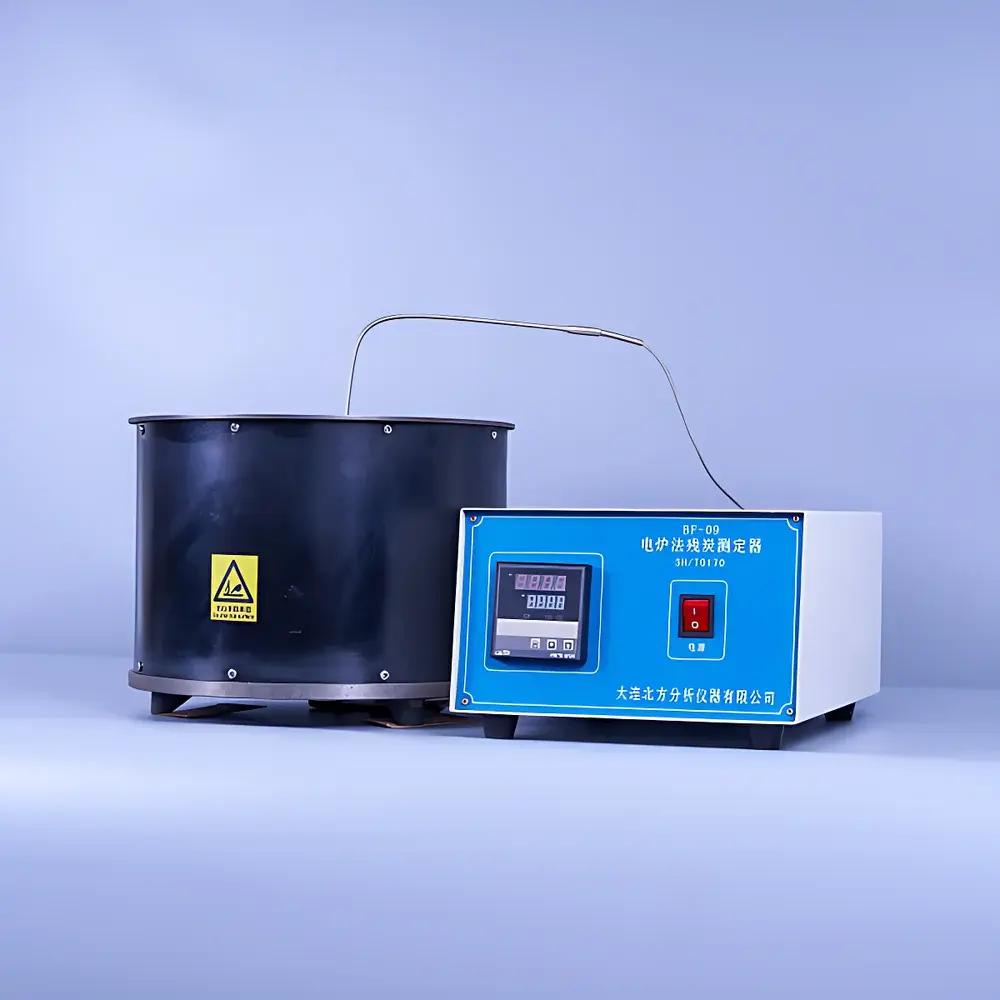
North BF-09 Carbon Residue Tester (Electric Furnace Method)
| Brand | North |
|---|---|
| Origin | Liaoning, China |
| Manufacturer Type | Authorized Distributor |
| Country of Manufacture | China |
| Model | BF-09 |
| Pricing | Available Upon Request |
| Power Supply | AC 220 V ±10%, 50 Hz |
| Input Power | ≤2000 W |
| Thermocouple Type | K-type |
| Temperature Control Range | Ambient to 800 °C |
| Temperature Control Accuracy | ±1 °C |
Overview
The North BF-09 Carbon Residue Tester (Electric Furnace Method) is a precision-engineered instrument designed and validated in strict accordance with SH/T 0170—2022, the standard test method for determining carbon residue of petroleum products by the electric furnace method. It implements a gravimetric thermal decomposition protocol: a weighed sample of lubricating oil, heavy fuel oil, or other residual petroleum fractions is heated under controlled inert conditions (typically nitrogen atmosphere, though not integrated into the base unit) to drive off volatile components, followed by controlled pyrolysis at 500 °C ± 2 °C for 20 minutes. The non-volatile carbonaceous residue remaining after combustion and cooling is quantified as a mass percentage relative to the original sample weight. This measurement serves as a critical indicator of coke-forming tendency during high-temperature processing—particularly relevant for refinery operations, catalyst life prediction, and fuel quality assessment per ASTM D524, ISO 10370, and IP 14.
Key Features
- Modular dual-unit architecture: physically separated heating chamber and digital control console enable safe operation, simplified maintenance, and reduced thermal interference with electronics.
- Integrated metal constant-temperature bath with embedded electric resistance heating elements ensures uniform radial and axial temperature distribution across the crucible zone—essential for reproducible thermal decomposition kinetics.
- Precision K-type thermocouple (IEC 60584-1 compliant) directly monitors bath temperature at the crucible support level, feeding real-time data to the PID-controlled digital temperature regulator.
- Digital temperature controller provides simultaneous display of setpoint and actual bath temperature with 0.1 °C resolution; supports manual offset correction to compensate for sensor drift or positional thermal gradients.
- Robust mechanical design includes stainless-steel crucible holders, ceramic-insulated furnace lining, and heat-resistant alloy bath housing rated for continuous operation up to 800 °C.
- Compliant electrical interface: 220 V ±10 %, 50 Hz input with built-in overcurrent protection and thermal cutoff switches meeting IEC 61000-4 immunity requirements.
Sample Compatibility & Compliance
The BF-09 accommodates standard 10-mL porcelain crucibles (ASTM D524-compliant geometry) and supports sample masses ranging from 5.00 g to 10.00 g, depending on expected residue yield. It is validated for use with mineral oils, cracked distillates, marine fuels (IFO 180/380), and vacuum residua. While the instrument itself does not include an integrated inert gas purge system, it is routinely operated in conjunction with external nitrogen supply lines to meet SH/T 0170’s requirement for oxygen-limited pyrolysis. All operational procedures—including crucible pre-conditioning, sample loading, ramp profiles, soak duration, and post-test cooling protocols—are fully traceable to SH/T 0170 and aligned with GLP documentation practices. Audit-ready calibration records and temperature mapping reports can be generated per internal QA protocols.
Software & Data Management
The BF-09 operates via standalone hardware control without embedded software or network connectivity. However, its analog/digital hybrid architecture supports integration into laboratory-wide data acquisition systems through optional 4–20 mA or RS-485 output modules (available as accessories). Temperature logging is performed externally using calibrated chart recorders or PC-based DAQ systems compliant with FDA 21 CFR Part 11 when used in regulated environments. All manual test entries—including operator ID, sample ID, initial/final crucible weights, ambient humidity, and observed residue morphology—are documented in paper-based or LIMS-linked worksheets adhering to ISO/IEC 17025 clause 7.7 requirements for result reporting.
Applications
- Refinery QC labs assessing coking propensity of vacuum gas oils prior to FCC feed blending.
- Fuel testing laboratories verifying compliance of residual marine fuels with ISO 8217 Table 2 carbon residue limits (≤18.0 wt%).
- Lubricant formulation R&D evaluating additive package stability under severe thermal stress.
- Third-party certification bodies performing accredited testing per CNAS-CL01:2018 (equivalent to ISO/IEC 17025).
- Research institutions studying thermal degradation mechanisms of heavy hydrocarbon fractions via residue morphology analysis (e.g., using optical microscopy post-test).
FAQ
Does the BF-09 include an integrated inert gas delivery system?
No—the instrument is designed for external nitrogen or argon supply via standard 6-mm compression fittings. A flowmeter and pressure regulator are required but not supplied.
What crucible type and dimensions are specified for SH/T 0170 conformance?
Standard 10-mL porcelain crucibles conforming to ASTM D524 geometry (height: 33 mm ± 1 mm; top diameter: 33 mm ± 0.5 mm; bottom diameter: 18 mm ± 0.5 mm) must be used.
Is temperature calibration traceable to national standards?
Yes—factory calibration uses NIST-traceable reference thermocouples; users are advised to perform quarterly verification using a secondary standard thermometer per ISO/IEC 17025 section 6.6.
Can the BF-09 be used for Conradson Carbon Residue (CCR) testing?
No—CCR (ASTM D189) requires a different furnace geometry, flame-heated crucible placement, and atmospheric oxidation step; the BF-09 is strictly configured for micro-method electric furnace residue (Ramsbottom or SH/T 0170 variants).
What maintenance intervals are recommended for sustained accuracy?
Crucible holder alignment check every 200 tests; thermocouple replacement every 12 months or after exposure to >750 °C for >50 hours; bath insulation integrity inspection annually.