
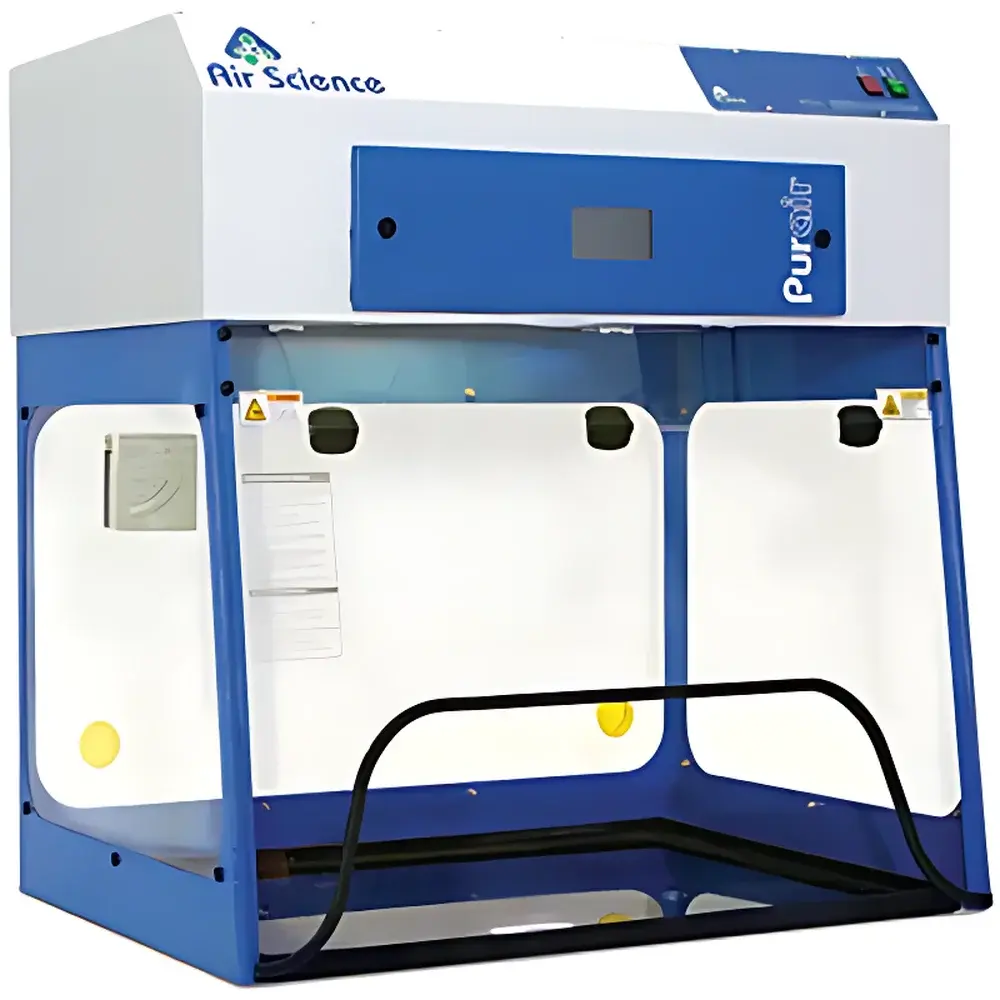
Air Science Purair Basic Ductless Fume Hood
| Brand | Air Science |
|---|---|
| Origin | USA |
| Model | Purair Basic |
| Cabinet Type | Single-Face Ductless Fume Hood |
| Construction | Steel-and-Wood (Epoxy-Coated Steel Frame with Optional Polypropylene Interior) |
| Voltage Options | 110 V, 60 Hz or 220 V, 50 Hz |
| Filter Technology | Aerocell™ Multi-Stage Filtration System |
| Pre-Filter Efficiency | 91% for 1–3 µm particles |
| Optional Safety Filters | Activated Carbon, HEPA, or ULPA |
| Airflow Monitoring | Continuous Low-Airflow Alarm with Visual Indicator |
| Lighting | Energy-Efficient LED |
| Work Surface Options | Stainless Steel or Polypropylene (White/Black) |
| Mobility Option | Locking Casters (Optional) |
Overview
The Air Science Purair Basic Ductless Fume Hood is an engineered containment solution designed for low-to-moderate volatility chemical handling in research laboratories, academic institutions, forensic facilities, and quality control environments. Unlike conventional ducted hoods requiring external exhaust infrastructure, the Purair Basic operates on a closed-loop recirculation principle: ambient air is drawn across the work surface, passed through a multi-stage filtration system—comprising an electrostatic pre-filter and application-specific main filters—and returned to the laboratory environment. This design eliminates structural modifications, reduces HVAC load, and lowers total cost of ownership while maintaining operator protection against vapors, aerosols, and particulates. Its performance is validated per ANSI/ASHRAE 110–2016 and complies with OSHA 29 CFR 1910.1450 and EN 14175–3 for ductless fume hood safety criteria.
Key Features
- Patented Aerocell™ Multi-Stage Filtration: Integrates electrostatic pre-filtration (91% efficiency for 1–3 µm particles) with replaceable activated carbon, HEPA, or ULPA main filters—configured based on chemical class and exposure risk.
- ebm-papst EC Blower System: Electronically commutated motor delivers precise, energy-efficient airflow control with extended service life and low acoustic output (<55 dB(A) at 1 m).
- Dual-Pressure Zone Architecture: A dynamically balanced filtration chamber maintains positive pressure in the fan plenum and negative pressure in the filter cavity—preventing bypass leakage and ensuring zero unfiltered air egress.
- Intuitive Electronic Control Panel: Includes dedicated toggle switches for blower operation and low-airflow alarm reset, real-time status LEDs, and optional analog face velocity meter (0–150 fpm range) mounted within operator line-of-sight.
- Full 360° Visibility Design: Transparent rear and side panels enhance ambient light penetration, improve spatial awareness, and support visual monitoring of experiments without compromising containment integrity.
- Chemical-Resistant Structural Framework: Epoxy-coated steel support frame provides mechanical rigidity and corrosion resistance; fully polypropylene construction is available for high-acid or halogenated solvent applications.
- Secure Filter Access & Management: Tamper-resistant filter door key prevents unauthorized removal; front-access filter ID window displays installed filter part number and installation date—supporting ISO/IEC 17025-compliant maintenance logging.
Sample Compatibility & Compliance
The Purair Basic accommodates standard benchtop procedures involving solvents (e.g., acetone, ethanol, methanol), dilute acids/bases, and low-volatility organics. It is not intended for perchloric acid, hydrofluoric acid, radioactive materials, or uncontained exothermic reactions. All configurations meet or exceed ANSI Z9.5–2022 (Laboratory Ventilation), EN 14175–3:2022 (Ductless Fume Hoods), and OSHA’s Laboratory Standard 29 CFR 1910.1450. Optional HEPA/ULPA secondary filtration enables compliance with ISO 14644–1 Class 5 cleanroom adjunct use. The unit supports GLP/GMP documentation workflows via timestamped filter change logs and alarm event records.
Software & Data Management
While the Purair Basic operates as a standalone hardware platform without embedded software, its electronic control architecture supports integration into facility-wide environmental monitoring systems via dry-contact alarm outputs. The low-airflow alarm signal can be wired to building management systems (BMS) or laboratory information management systems (LIMS) for centralized incident tracking. Filter replacement timestamps—recorded manually using the front ID window—are compatible with paper-based or digital audit trails aligned with FDA 21 CFR Part 11 requirements when paired with controlled electronic logbooks.
Applications
- Undergraduate and graduate teaching labs conducting routine organic synthesis, titrations, and reagent dispensing.
- Forensic evidence processing stations requiring vapor containment during solvent-based sample preparation.
- Pharmaceutical QC labs performing dissolution testing, standard solution preparation, and stability-indicating assays.
- Environmental testing facilities handling EPA Method 8081/8270 compounds under non-ducted constraints.
- Electronics R&D labs using flux removers, solder pastes, and low-boiling-point cleaning agents.
FAQ
What types of chemicals can be safely used in the Purair Basic?
It is validated for low-to-moderate volatility substances including alcohols, ketones, esters, and dilute aqueous acids/bases. High-hazard agents such as perchloric acid, HF, cyanides, or pyrophorics require ducted or specialized containment.
How often must the filters be replaced?
Replacement frequency depends on usage intensity and chemical load. Pre-filters typically last 6–12 months; carbon filters range from 3–12 months; HEPA/ULPA filters may last 1–3 years. The low-airflow alarm and filter ID window support predictive maintenance scheduling.
Can the Purair Basic be moved between labs?
Yes—when equipped with the optional mobile cart featuring locking casters, it retains full containment integrity and meets ANSI transport stability requirements for ductless enclosures.
Is third-party certification available?
Air Science provides factory-issued test reports per ANSI/ASHRAE 110–2016 tracer gas containment testing. Independent verification by accredited labs (e.g., UL, TÜV) is available upon request for regulatory submission purposes.
Does it comply with international electrical standards?
Dual-voltage models (110 V/60 Hz and 220 V/50 Hz) are CE-marked and certified to IEC 61010–1 for laboratory electrical safety, including overcurrent protection and dielectric strength validation.



