
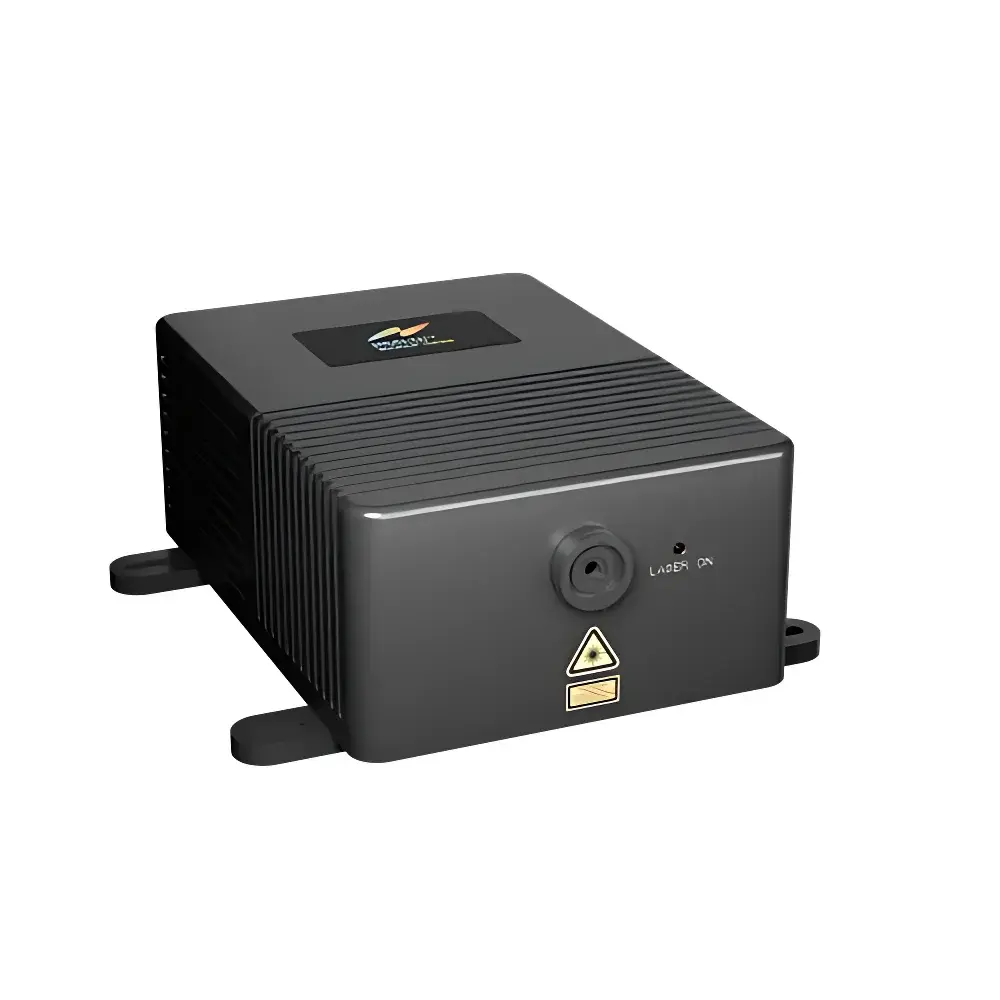
AeroNose QSweep Tunable Pulsed External-Cavity Quantum Cascade Laser Module
| Brand | AeroNose |
|---|---|
| Model | QSweep |
| Category | Optical Instrument Component |
| Origin | Zhejiang, China |
| Manufacturer Type | Original Equipment Manufacturer (OEM) |
| Laser Type | Pulsed External-Cavity Quantum Cascade Laser (EC-QCL) |
| Wavelength Range | 5–12 µm |
| Output Power | 500 mW (peak) |
| Pulse Width | 150–500 ns (10 ns step) |
| Repetition Rate | 10–100 kHz (adjustable) |
| Spectral Resolution | 1 cm⁻¹ |
| Wavenumber Sweep Speed | up to 20,000 cm⁻¹/s |
| Beam Pointing Stability | < 2 mrad |
| Operating Temperature | 10–30 °C |
| Storage Temperature | −10–55 °C |
| Dimensions | 30 × 27 × 13 cm |
| Cooling | Thermoelectrically self-cooled (no external chiller required) |
| Control Interface | USB/RS-232/Ethernet |
| Software | Integrated GUI for wavelength selection, ramp scanning, and real-time calibration logging |
Overview
The AeroNose QSweep is a high-performance, tunable pulsed external-cavity quantum cascade laser (EC-QCL) module engineered for precision mid- to long-wave infrared (MWIR–LWIR) spectroscopy. Operating across a broad spectral range of 5–12 µm (2000–833 cm⁻¹), the QSweep leverages quantum cascade gain media integrated into a robust, thermally stabilized Littrow-type external cavity configuration. Unlike conventional fixed-wavelength QCLs or broadly tunable optical parametric oscillators (OPOs), the QSweep achieves continuous, mode-hop-free wavelength tuning via precision grating rotation—enabling direct access to fundamental vibrational absorption bands of gases (e.g., CO, NOx, CH4, NH3, SF6), liquids (e.g., hydrocarbons, solvents), and solid-phase functional groups (e.g., C=O, N–H, C–F). Its pulse-driven architecture supports time-resolved detection schemes including photoacoustic spectroscopy (PAS), quartz-enhanced photoacoustic spectroscopy (QEPAS), and heterodyne detection—making it suitable for both laboratory-based molecular fingerprinting and field-deployable trace-gas sensing platforms.
Key Features
- Ultra-Broad Tunability: Covers 5–12 µm (2000–833 cm⁻¹) in a single module—spanning the strongest fundamental rovibrational transitions of most industrially and environmentally relevant molecules.
- High Spectral Fidelity: Delivers ≤1 cm⁻¹ optical resolution with real-time wavelength calibration referenced to internal HCN or CO2 absorption lines—ensuring traceable accuracy compliant with ISO 17025 metrological requirements.
- Rapid, Linear Wavenumber Sweeping: Achieves sweep speeds up to 20,000 cm⁻¹/s with sub-millisecond linearity (<0.5% deviation), enabling high-throughput gas chromatography–infrared (GC-IR) coupling and dynamic process monitoring.
- Thermoelectric Self-Cooling Architecture: Integrates multi-stage Peltier elements and passive heat-sinking to maintain junction temperature stability without liquid cooling or cryogens—reducing system footprint and power overhead while ensuring >10,000-hour MTBF.
- Pulsed Operation Optimization: Adjustable pulse width (150–500 ns, 10 ns steps) and repetition rate (10–100 kHz) allow precise control of peak power, average power, and duty cycle—critical for minimizing thermal lensing in multipass cells and maximizing signal-to-noise ratio in lock-in-amplified detection.
- Beam Quality & Pointing Stability: M² < 1.3 at 30 cm from aperture; pointing drift < 2 mrad over 8-hour operation—supporting alignment-insensitive integration into FTIR accessories, interferometers, and free-space optical benches.
Sample Compatibility & Compliance
The QSweep is compatible with standard infrared sampling interfaces including multipass gas cells (Herriott, White), attenuated total reflectance (ATR) crystals (ZnSe, Ge), transmission cuvettes (CaF2, BaF2), and reflective substrates for diffuse reflectance measurements. Its output beam meets ANSI Z136.1 Class 4 laser safety requirements when enclosed per IEC 60825-1:2014. The module complies with electromagnetic compatibility standards EN 61326-1 (industrial environments) and RoHS 2015/863/EU. Firmware supports audit-trail logging for GLP/GMP workflows, with timestamped calibration records exportable in CSV format—facilitating FDA 21 CFR Part 11 compliance when deployed in regulated QC laboratories.
Software & Data Management
AeroNose provides the QSweep Control Suite—a platform-independent application supporting Windows, Linux, and macOS. The GUI enables intuitive selection of discrete wavelengths, linear or logarithmic wavenumber ramps, and user-defined scan sequences. All parameter sets are saved as XML profiles with embedded metadata (operator ID, timestamp, ambient conditions). An open API (C/C++, Python, MATLAB) allows integration with LabVIEW, EPICS, or custom SCADA systems. Raw spectral data streams are acquired at ≥10 kHz sampling rates and synchronized with external triggers (TTL input/output). Calibration logs include reference line positions, cavity temperature, and grating encoder counts—ensuring full traceability for ISO/IEC 17025 accreditation.
Applications
- Real-time emission monitoring of stack gases (NOx, SO2, CO, VOCs) per EPA Method 320 and EN 15267-3.
- In-line chemical reaction monitoring during pharmaceutical synthesis and polymerization processes.
- Non-invasive breath analysis for biomarker detection (e.g., acetone for diabetes, NO for asthma).
- Standoff detection of hazardous vapors and explosives via retroreflective or backscatter configurations.
- Fundamental studies of ultrafast vibrational dynamics using pump–probe IR spectroscopy.
- Calibration source for Fourier-transform infrared (FTIR) spectrometers and dispersive IR imagers.
FAQ
Is the QSweep compatible with existing FTIR spectrometers?
Yes—the QSweep’s collimated 3 mm beam (M² < 1.3) couples efficiently into standard FTIR input ports via adjustable kinematic mounts; optional fiber-pigtailed versions (with ZrF4 or Chalcogenide fibers) are available upon request.
Does the module require external water cooling or cryogenic support?
No—its integrated thermoelectric cooler (TEC) and low-thermal-resistance mechanical design enable stable operation at ambient temperatures between 10–30 °C without auxiliary chillers.
Can multiple QSweep modules be synchronized for multi-laser heterodyne detection?
Yes—via shared 10 MHz reference clock input and programmable trigger delay (0–100 ms, 1 ns resolution), enabling phase-coherent multi-source excitation for dual-comb or multi-species discrimination.
What maintenance is required during routine operation?
None beyond periodic verification of wavelength calibration using certified gas cells; no consumables, optics cleaning, or alignment adjustments are needed under normal operating conditions.
Is firmware update capability supported remotely?
Yes—over Ethernet or USB-C, with signed firmware packages and rollback functionality to ensure system integrity during updates.




