
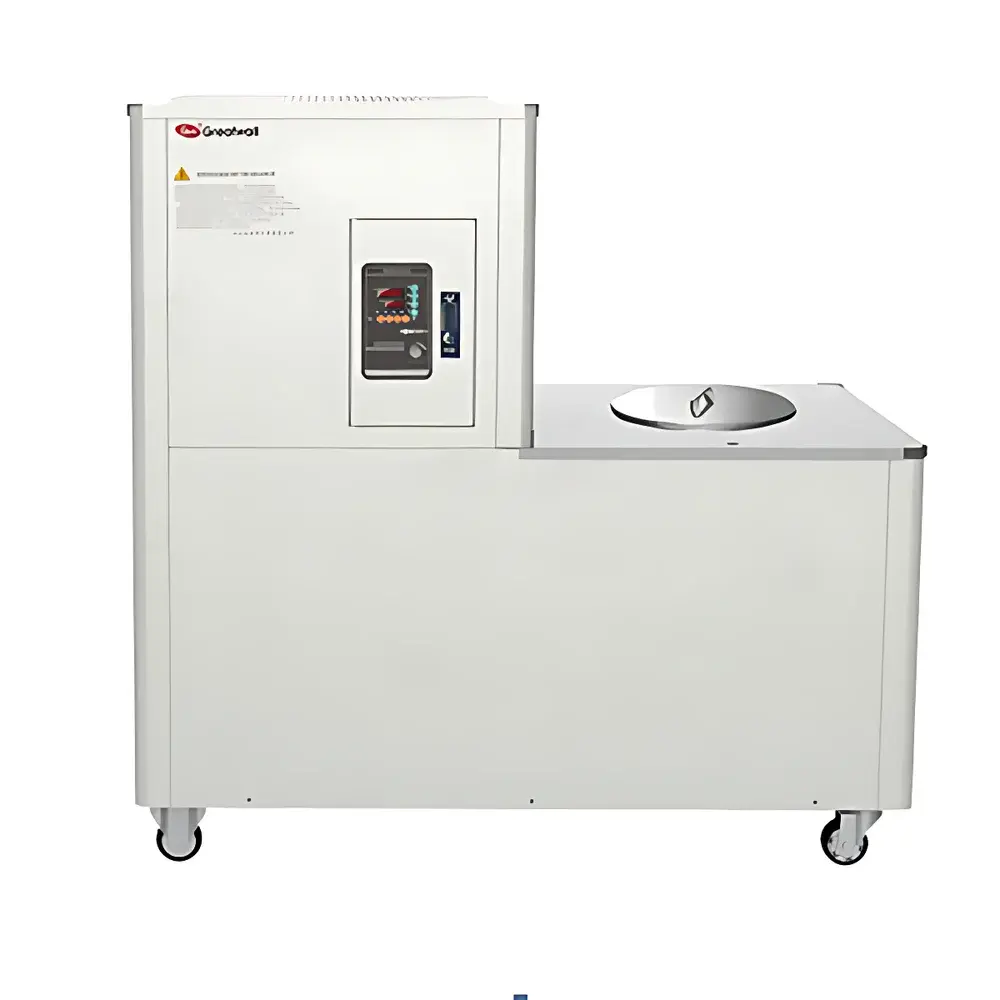
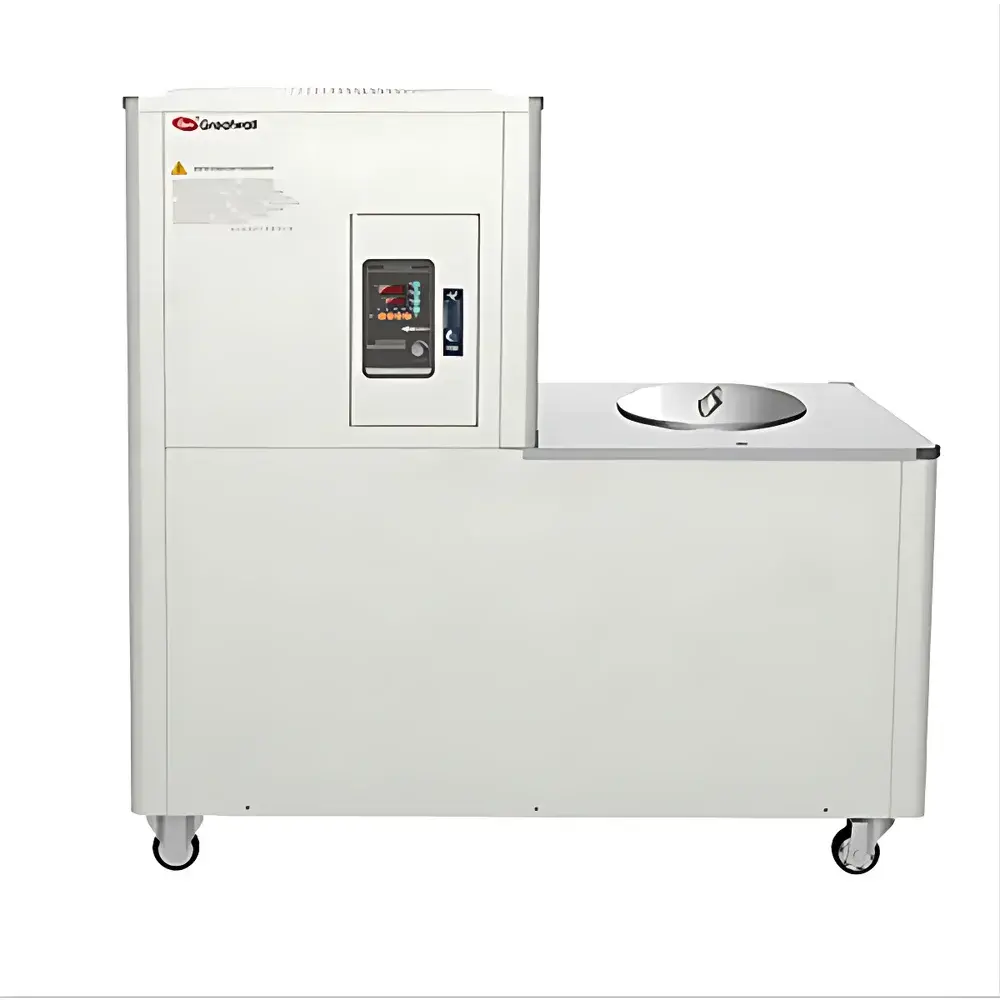
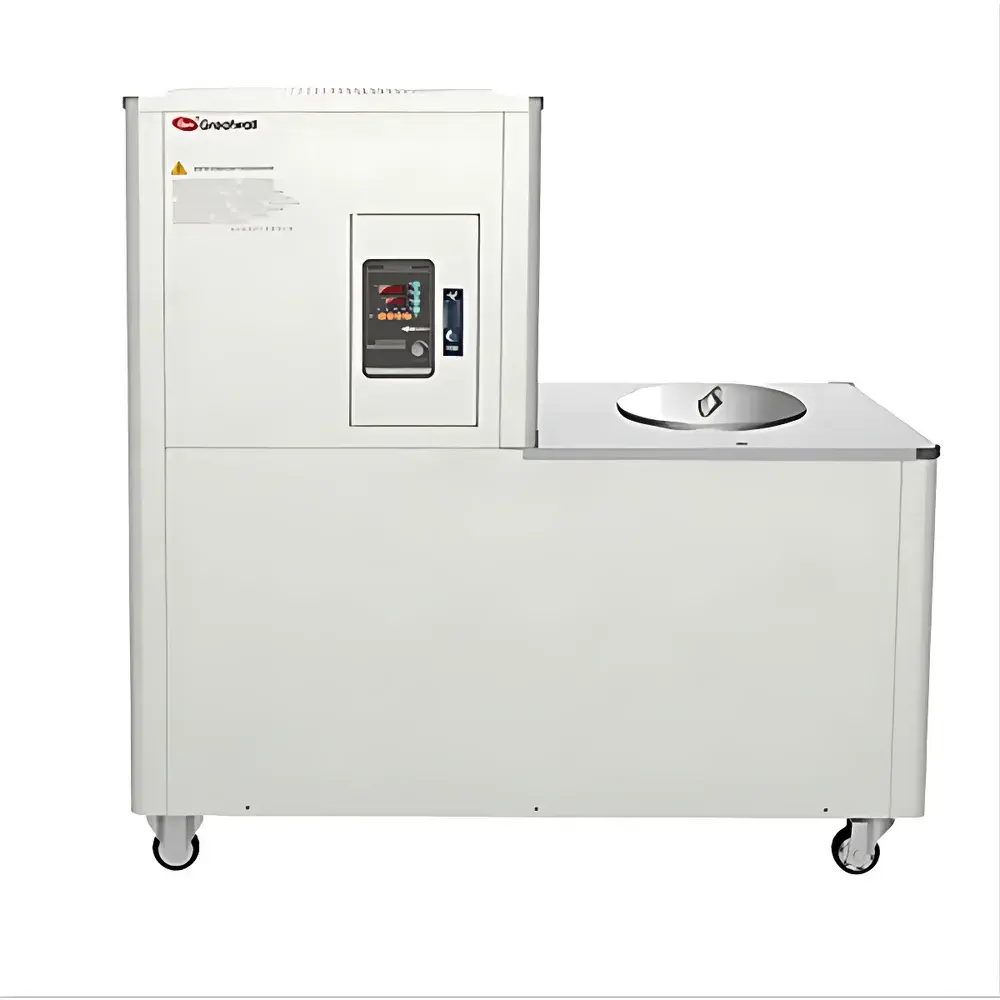
The Great Wall DHJF-1250 Low-Temperature Constant-Temperature Stirred Reaction Bath
| Brand | The Great Wall |
|---|---|
| Origin | Henan, China |
| Manufacturer Type | Authorized Distributor |
| Country of Origin | China |
| Model | DHJF-1250 |
| Cooling Capacity | 700 W at −60 °C, 580 W at −80 °C, 420 W at −100 °C, 125 W at −120 °C |
| Temperature Range | −120 °C to −60 °C |
| Temperature Stability | ±2 °C |
| Bath Volume | 50 L |
| Circulation Flow Rate | 20 L/min |
| Max. Pressure | 0.4 bar |
| Pump Power | 100 W |
| Total Power | 4000 W |
| Display Resolution | 0.1 °C |
| Evaporator Type | Coil-in-tank (stainless steel immersion coil) |
| Compressor | Hermetic scroll compressor |
| Condenser | Air-cooled finned-tube with oxygen-free copper tubing |
| Refrigerant | Mixed cryogenic refrigerant blend |
| External Port | 1/2″ NPT |
| Bath Opening Diameter | 400 mm |
| Bath Dimensions (Ø × H) | 450 × 320 mm |
| Max. Flask Capacity | 20 L |
| Bath Material | 304 stainless steel |
| Unit Dimensions (W × D × H) | 1340 × 820 × 1310 mm |
| Net Weight | 265 kg |
| Ambient Operating Conditions | 5–35 °C, ≤70% RH |
| Power Supply | 3-phase, 380 V, 50 Hz |
| Safety Protections | Phase sequence, overcurrent, overtemperature, delayed startup, thermal overload |
Overview
The Great Wall DHJF-1250 Low-Temperature Constant-Temperature Stirred Reaction Bath is an integrated cryogenic circulation system engineered for precise temperature control and active mixing in demanding low-temperature chemical synthesis, material characterization, and reaction kinetics studies. Unlike conventional chillers or static baths, the DHJF-1250 integrates a single-stage compression cascade architecture with serial condensation technology—enabling stable operation down to −120 °C using a proprietary mixed-refrigerant blend. Its core thermodynamic design employs a hermetic scroll compressor coupled with an air-cooled finned-tube condenser (constructed from oxygen-free copper tubing with proprietary expansion-bonding), a multi-section串联 heat exchanger array, capillary tube expansion, and a submerged coil-type evaporator directly immersed in the 304 stainless steel bath reservoir. This configuration ensures high thermal efficiency, mechanical robustness, and intrinsic safety: the evaporator remains structurally intact even if the heat transfer fluid (e.g., ethylene glycol/methanol mixtures) solidifies below −90 °C—a critical safeguard during ultra-low-temperature hold conditions.
Key Features
- Ultra-low temperature capability: Certified operational range from −120 °C to −60 °C with ±2 °C stability across the full span
- Integrated stirring function: Built-in explosion-proof, low-temperature-rated stainless steel shielded circulation pump (100 W, 20 L/min flow, 0.4 bar max pressure)
- Cryogenically optimized fluid path: Entire wetted loop constructed from ASTM A240 304 stainless steel—including reservoir, piping, and external 1/2″ NPT ports—to resist embrittlement and corrosion at sub-zero temperatures
- Intelligent digital controller: Full-numeric Chinese-language interface (configurable firmware supports English localization) with 0.1 °C display resolution, programmable ramp/soak profiles, and real-time fault diagnostics
- Multi-layer safety architecture: Dual redundant thermal protection (compressor internal overload + external bath sensor), phase-sequence monitoring, current-limiting circuitry, and controlled soft-start sequencing to prevent voltage surge damage
- Service-oriented mechanical design: Fully welded refrigeration circuitry with minimal brazed joints; modular heat exchanger assembly accessible without refrigerant recovery; front-serviceable pump and controller modules
Sample Compatibility & Compliance
The DHJF-1250 accommodates standard laboratory glassware up to 20 L volume via its 400 mm diameter open-top reservoir—compatible with jacketed reactors, double-walled flasks, and custom cold-finger assemblies. All contact surfaces meet ISO 8502-3 cleanliness requirements for non-contaminating metal exposure. While not certified to UL/CSA or CE for standalone medical or explosive-atmosphere use, the system complies with IEC 61000-6-3 (EMC emissions) and IEC 61000-6-2 (immunity). Its control logic supports audit-ready event logging (timestamped temperature setpoint changes, alarm triggers, and power cycles), facilitating alignment with GLP documentation workflows. When operated within specified ambient limits (5–35 °C, ≤70% RH), the unit meets ISO 17025 clause 5.4.2 for environmental condition control during calibration-sensitive procedures.
Software & Data Management
The DHJF-1250 operates autonomously via its embedded microcontroller; no PC connection is required for basic operation. However, optional RS485 Modbus RTU output enables integration into centralized LabVantage or Siemens Desigo CCMS environments for remote monitoring and setpoint synchronization. Logged data—including bath temperature, compressor runtime, fault codes, and cycle counts—is retained in non-volatile memory for ≥30 days and exportable via USB flash drive (FAT32 format). All firmware updates are performed offline using signed binary packages to ensure integrity. Though not natively 21 CFR Part 11 compliant, the system’s deterministic behavior, hardware-enforced password protection (three-tier access: operator/engineer/service), and immutable event logs provide foundational traceability suitable for pre-audit readiness assessments.
Applications
- Low-temperature Grignard and organolithium reactions requiring strict thermal confinement below −100 °C
- Cryogenic polymerization studies where monomer solubility and chain propagation kinetics are temperature-dependent
- Calibration of infrared spectrometers and FTIR detectors using blackbody reference sources stabilized at fixed cryogenic points
- Material testing per ASTM D746 (impact brittleness of plastics at low temperatures) and ISO 974 (determination of脆化 temperature)
- Pre-cooling of superconducting magnet dewars and vacuum chamber shrouds prior to cooldown cycles
- Stabilization of quantum sensing platforms (e.g., NV-center diamond sensors) requiring vibration-damped, drift-compensated thermal sinks
FAQ
Can the DHJF-1250 operate continuously at −120 °C?
Yes—provided ambient conditions remain within specification (≤35 °C, ≤70% RH) and the heat transfer fluid is properly formulated (e.g., 30% methanol/70% ethylene glycol by volume). Continuous operation at −120 °C delivers 125 W of net cooling capacity; extended holds require periodic defrost cycling to maintain condenser efficiency.
Is external stirring compatible with the built-in pump?
No—the integrated shielded pump serves exclusively for internal bath circulation and external fluid delivery. For reactor-specific agitation, users must employ separate overhead or magnetic stirrers rated for cryogenic service (−120 °C minimum).
What refrigerant is used, and is it ozone-safe?
Azeotropic mixed refrigerant meeting ASHRAE Standard 34 safety classification A1 (non-toxic, non-flammable) with zero ODP and low GWP—fully compliant with EU F-Gas Regulation (EU) No 517/2014 Annex III.
Does the unit support external temperature feedback control?
Not natively. The controller regulates solely based on internal bath sensor input. For jacketed reactor control, a secondary PID controller with external probe input must be deployed in master-slave configuration.
What maintenance intervals are recommended?
Compressor oil analysis every 12 months; condenser coil cleaning every 6 months (compressed air only); refrigerant leak check via halogen detector annually; pump impeller inspection every 24 months under continuous operation.



