
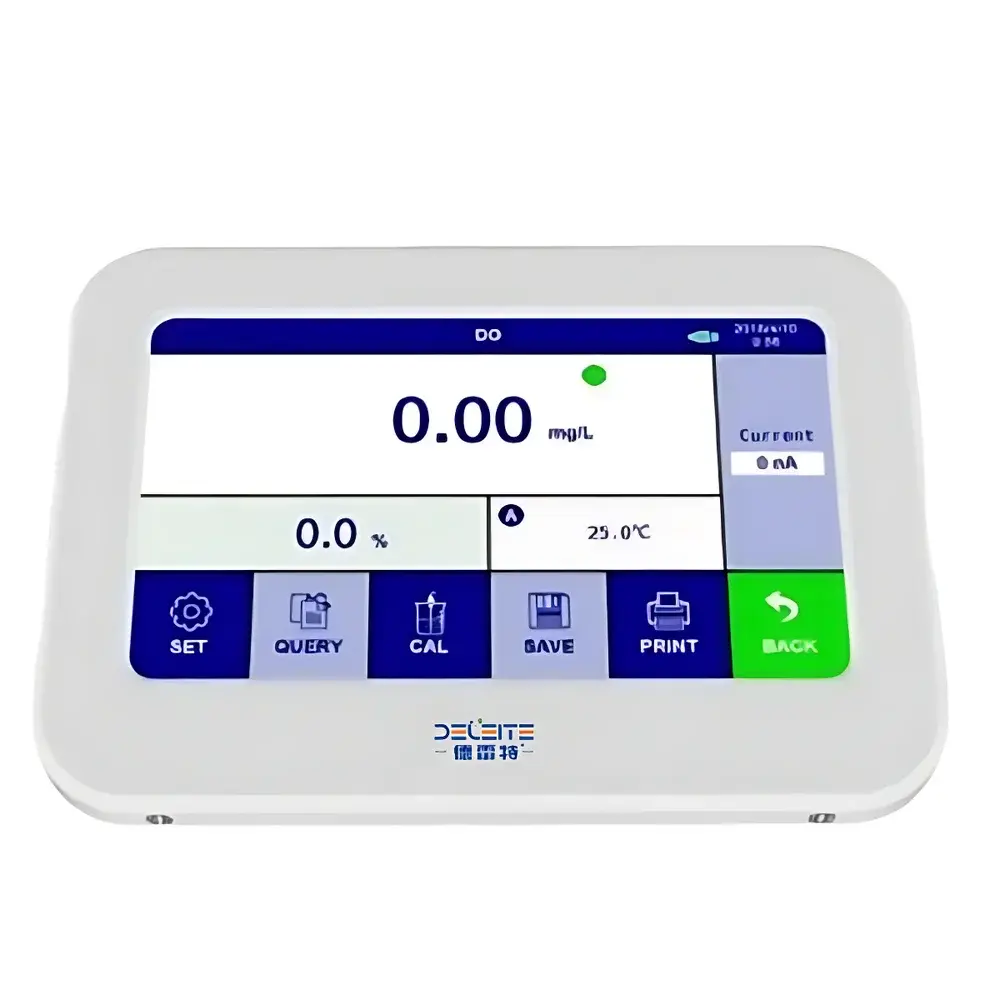
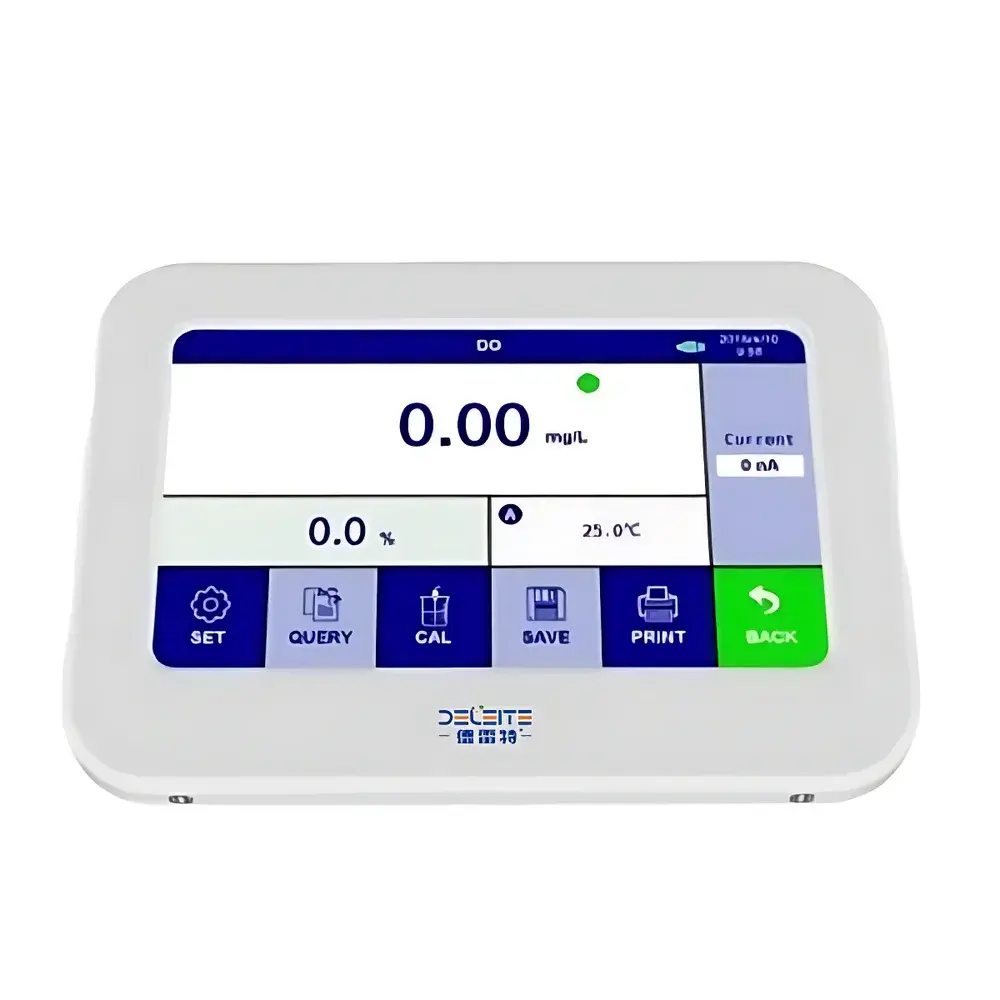
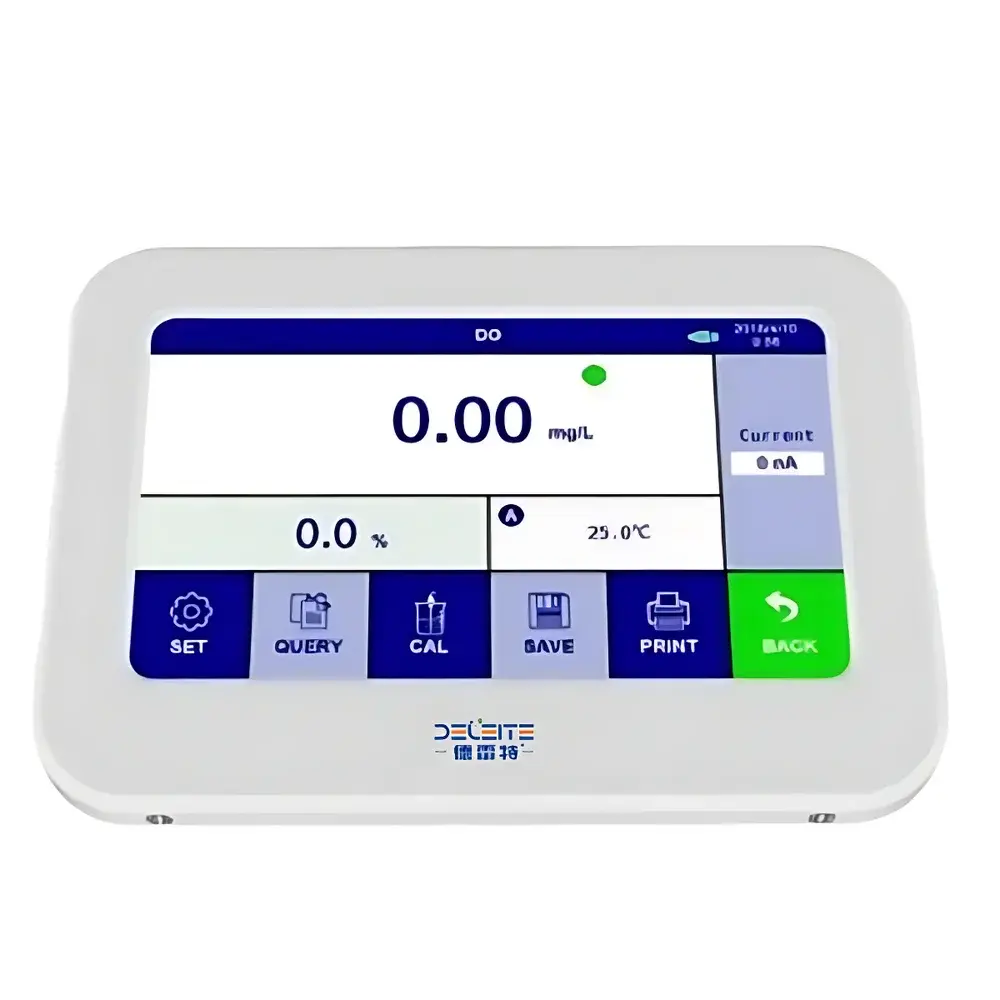
DELEITE PDO-J10T Portable Dissolved Oxygen Meter
| Brand | DELEITE |
|---|---|
| Origin | Shanghai, China |
| Model | PDO-J10T |
| Instrument Type | Portable |
| Measurement Principle | Electrochemical Probe — Clark-type Polarographic |
| DO Range | 0.00–20.00 mg/L (ppm) |
| DO Saturation Range | 0.0–200.0% |
| Temperature Range | 0.0–100.0 °C |
| DO Accuracy (Meter) | ±0.10 mg/L |
| (System w/ Probe) | ±0.40 mg/L |
| Saturation Accuracy | ±2.0% FS |
| Temperature Accuracy | ±0.1 °C |
| Barometric Pressure Accuracy | ±2% |
| DO Resolution | 0.01/0.1 mg/L |
| Saturation Resolution | 0.1% |
| Temperature Resolution | 0.1 °C |
| Response Time (90%) | ≤30 s at 25 °C |
| Stability | ±0.07 mg/L per hour |
| Data Storage Capacity | 2000 datasets (internal) |
| Compensations | Automatic temperature, manual salinity (0–45 ppt), manual barometric pressure (0–200 kPa) |
| IP Rating | IP54 |
| Power | Rechargeable 3.7 V / 1800 mAh Li-ion battery |
| Dimensions & Weight | 160 × 190 × 70 mm / 880 g |
Overview
The DELEITE PDO-J10T Portable Dissolved Oxygen Meter is a field-deployable, high-precision electrochemical analyzer engineered for reliable dissolved oxygen (DO) quantification in aqueous environments using the Clark-type polarographic principle. It employs a membrane-covered, gold-cathode and silver-anode sensor assembly that generates a diffusion-limited current proportional to the partial pressure of molecular oxygen dissolved in the sample. This current is converted into concentration (mg/L or ppm), saturation (% air saturation), and concurrently measured temperature (°C/°F). Designed for rigorous environmental monitoring workflows, the PDO-J10T meets the operational demands of aquaculture management, municipal wastewater treatment plant effluent verification, surface water quality assessment, drinking water source surveillance, and academic environmental science laboratories. Its robust architecture supports deployment under variable ambient conditions while maintaining metrological integrity across its full measurement range.
Key Features
- 7-inch capacitive touchscreen display (1024 × 600 resolution) with intuitive, menu-driven navigation—optimized for glove-compatible operation in field settings.
- PEEK polymer housing: chemically inert, UV-stable, and resistant to thermal degradation up to 150 °C—ensuring long-term mechanical integrity in corrosive or humid environments.
- ARM32-bit microprocessor with digital filtering and sliding-window averaging algorithms to suppress noise and improve signal stability without compromising response time.
- Surface-mount technology (SMT) printed circuit board assembly for enhanced thermal management, vibration resistance, and manufacturing consistency.
- Integrated polarographic DO probe with co-located Pt1000 temperature sensor—enabling simultaneous, cross-compensated measurements in a single immersion step.
- Modular membrane cap design: rapid replacement of the Teflon/PVC gas-permeable membrane without recalibration or electrolyte refill—reducing downtime and consumable handling errors.
- Triple compensation capability: automatic temperature compensation (0–100 °C), manual salinity input (0–45 ppt), and manual barometric pressure entry (0–200 kPa)—critical for accurate DO reporting across elevation gradients and saline matrices.
- IP54-rated enclosure: dust-protected and splash-resistant—validated for use in outdoor sampling stations, wet laboratories, and mobile monitoring vehicles.
- Rechargeable lithium-ion battery (3.7 V / 1800 mAh) supporting >12 hours of continuous operation; compatible with standard USB-C power banks and AC adapters.
Sample Compatibility & Compliance
The PDO-J10T is validated for use with freshwater, seawater, brackish water, activated sludge supernatant, pond effluents, and potable water samples. It complies with fundamental performance criteria outlined in ASTM D888-22 (Standard Test Methods for Dissolved Oxygen in Water) and ISO 5814:2012 (Water quality — Determination of dissolved oxygen — Electrochemical probe method). While not certified to GLP or GMP as a standalone system, its data logging architecture—including timestamped entries, operator ID fields (via software), and audit-ready CSV exports—supports alignment with laboratory quality systems requiring traceability per ISO/IEC 17025:2017 Annex A. The instrument’s self-diagnostic routines continuously monitor electrode polarization status, membrane integrity, and electrolyte depletion indicators—providing actionable feedback prior to measurement deviation.
Software & Data Management
Internal memory stores up to 2000 complete measurement records, each containing DO concentration, saturation %, temperature, pressure/salinity inputs, date/time stamp, and calibration status flags. Data export is performed via USB mass storage mode—generating UTF-8 encoded CSV files directly readable in Microsoft Excel, LibreOffice Calc, or LIMS platforms without proprietary software. Optional Bluetooth 5.0 module enables wireless streaming to Android/iOS tablets running DELEITE’s companion application (v2.1+), which provides real-time graphing, multi-parameter trend analysis, and batch export to cloud storage (Google Drive, OneDrive). All exported files include metadata headers compliant with FAIR data principles (Findable, Accessible, Interoperable, Reusable). No vendor lock-in: raw data retains native precision (e.g., “12.47 mg/L”, not rounded values), enabling third-party statistical analysis or regulatory submission.
Applications
- Aquaculture: Routine DO profiling in recirculating aquaculture systems (RAS), hatcheries, and net-pen operations—supporting hypoxia risk mitigation and feed optimization protocols.
- Municipal Wastewater: In-situ verification of aerobic zone DO levels in activated sludge basins, oxidation ditches, and membrane bioreactors (MBRs).
- Environmental Field Surveys: EPA Region-specific surface water monitoring (e.g., NPDES permit compliance), groundwater discharge characterization, and wetland health assessments.
- Drinking Water Distribution: Residual DO mapping in storage reservoirs and pipeline networks to assess corrosion potential and biofilm formation risk.
- Academic Research: Undergraduate and graduate-level instruction in limnology, biogeochemistry, and environmental instrumentation—paired with documented calibration procedures and uncertainty budget templates.
FAQ
What calibration standards are required for routine operation?
A two-point calibration using zero-oxygen (sodium sulfite solution) and saturated-air (100% air-saturated water at known temperature/pressure) standards is recommended before each field session or daily in lab use.
Does the instrument support automatic pressure compensation without external sensors?
No—barometric pressure must be manually entered using local weather service data or a calibrated handheld barometer; no integrated pressure transducer is included.
Can the DO probe be used in viscous or suspended-solid-rich samples?
Yes—provided the membrane cap remains unobstructed; gentle stirring during measurement is advised to maintain boundary layer equilibrium per ISO 5814 requirements.
Is the internal clock synchronized with GPS or NTP servers?
No—the real-time clock is quartz-based and requires manual time/date setting; however, all timestamps remain persistent across power cycles.
What is the expected service life of the polarographic electrode under normal field use?
With proper storage (in KCl solution), regular membrane replacement every 3–6 months, and avoidance of abrasive cleaning agents, the sensor typically delivers ≥18 months of stable performance before cathode passivation necessitates refurbishment.







