
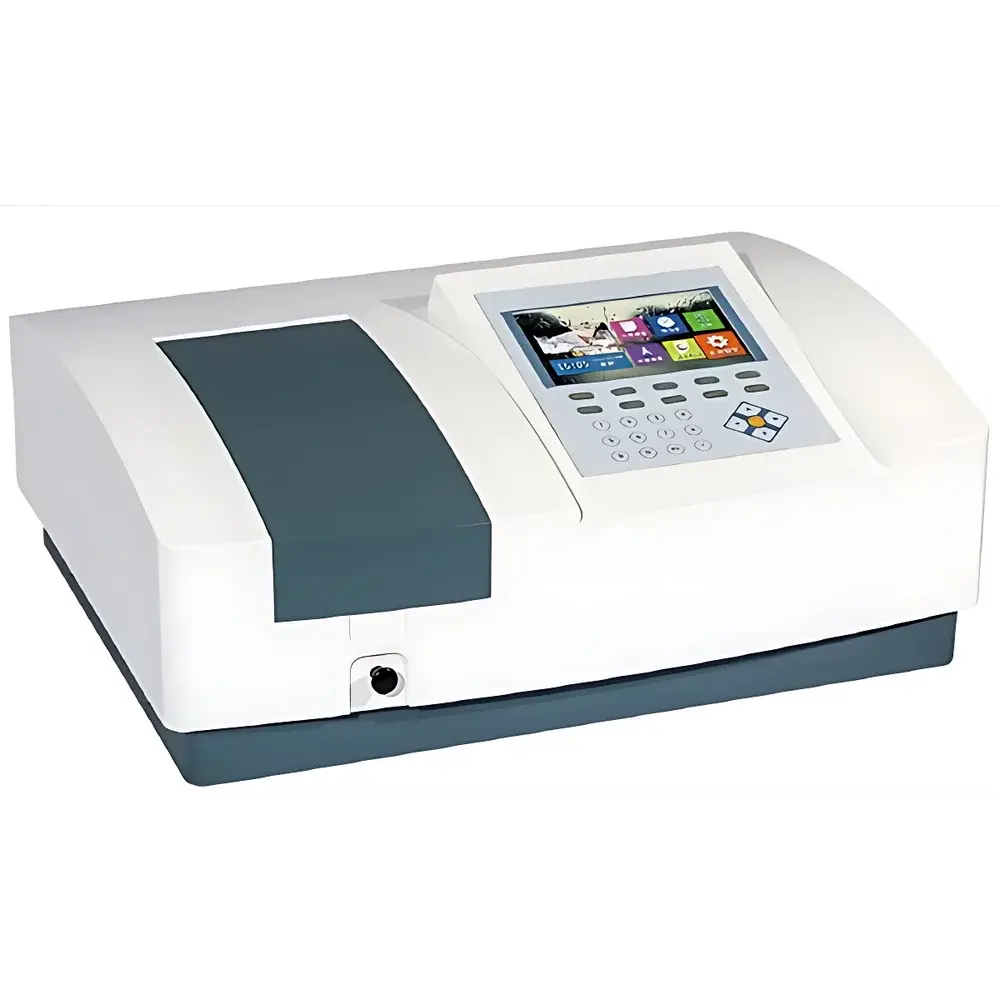
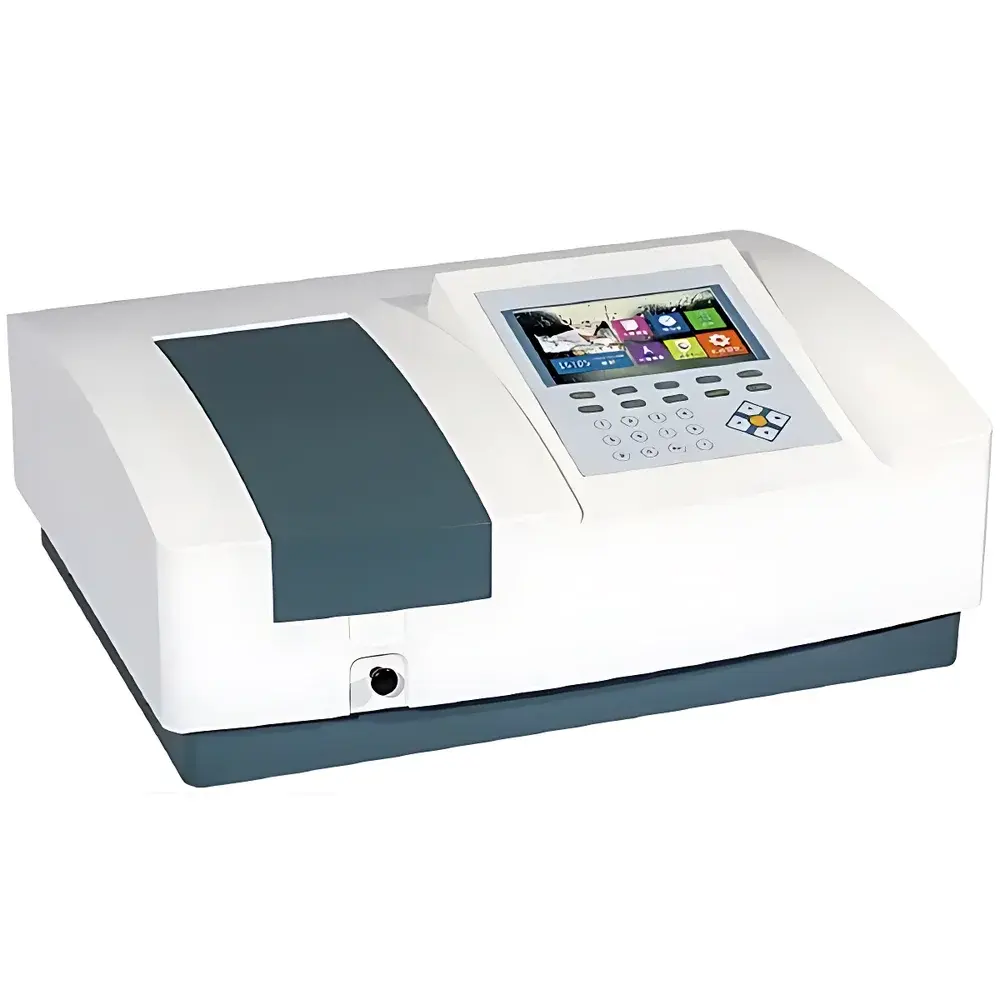
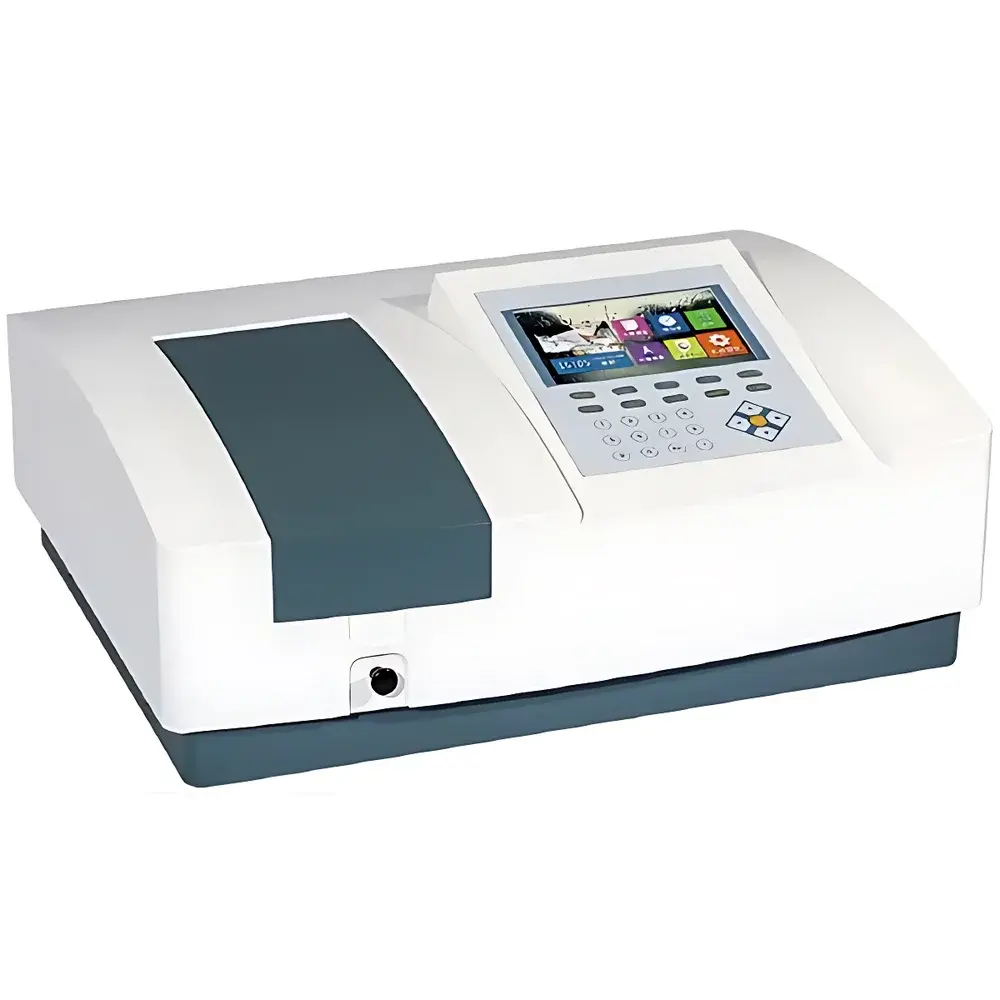
Yoke T-N6000 Ultraviolet-Visible Spectrophotometer
| Brand | Yoke |
|---|---|
| Origin | Shanghai, China |
| Model | T-N6000 |
| Optical Design | Single-beam |
| Detector | Photodiode Array (PDA) |
| Wavelength Range | 190–1100 nm |
| Wavelength Accuracy | ±0.3 nm |
| Wavelength Repeatability | ≤0.1 nm |
| Spectral Bandwidth | 1 nm |
| Stray Light | ≤0.03% (at 220 nm, using NaI solution) |
| Display | 7-inch color TFT touchscreen |
| Data Storage | Internal 8 GB flash memory (supports ≥5000 absorbance readings or ≥500 calibration curves) |
| Processor | 32-bit ARM Cortex-M3 @ 120 MHz |
| Lamp Life | ≥2000 hours (dual-lamp auto-switching with usage logging) |
| Grating | 1200 lines/mm plane holographic grating |
| Interface | RS-232, USB Host (Type-B), USB Device (Type-A), optional thermal printer port |
Overview
The Yoke T-N6000 Ultraviolet-Visible Spectrophotometer is a single-beam, PDA-based analytical instrument engineered for precision quantitative and qualitative analysis across the ultraviolet and visible spectral regions (190–1100 nm). It employs a sealed, self-aligning Czerny-Turner (CT) optical architecture with a high-efficiency 1200 lines/mm plane holographic grating to deliver high photometric stability and low stray light performance (<0.03% at 220 nm, measured per ASTM E387 with sodium iodide solution). The instrument’s optical path is mechanically isolated via a suspended optical bench design—minimizing sensitivity to environmental vibration or thermal drift—and incorporates an automated dual-lamp system (deuterium and tungsten-halogen) with real-time usage tracking and seamless spectral-range switching. Its core measurement principle relies on Beer-Lambert law-based absorbance determination, calibrated against NIST-traceable standards, supporting compliance with ISO/IEC 17025 requirements for laboratory competence in routine UV-Vis analysis.
Key Features
- 7-inch high-resolution color TFT touchscreen interface enabling full instrument control, real-time spectrum visualization, kinetic scanning, and multi-wavelength quantitation without external PC dependency
- Sealed, maintenance-free CT monochromator with optimized optical alignment—eliminating need for periodic wavelength recalibration under standard operating conditions
- Integrated 32-bit ARM Cortex-M3 processor (120 MHz clock speed) ensuring rapid spectral acquisition (≤1.5 s for full 190–1100 nm scan) and deterministic response during method execution
- Dual-lamp auto-selection logic with embedded lamp-hour logging and socket-style replacement—reducing downtime and supporting GLP-compliant instrument usage records
- Expandable sample compartment accommodating up to 8-position rotating carousel or 5-cell wide-format cuvette holder (10 mm pathlength standard); compatible with fiber-optic probes, integrating spheres, and temperature-controlled cells
- Onboard data management: stores ≥5000 absorbance values or ≥500 user-defined calibration curves; supports direct export to USB mass storage in CSV, QUA (Yoke native format), TXT, and BMP formats—no proprietary software required for data review or report generation
Sample Compatibility & Compliance
The T-N6000 accommodates standard 10 mm square quartz or glass cuvettes (pathlengths from 1 mm to 50 mm via optional holders), microvolume adapters (down to 0.5 µL), and solid-sample reflectance accessories. Its photometric linearity spans 0–3.5 A (at 340 nm, using neutral density filters per ISO 9022-13), with noise performance ≤0.0003 A (RMS, 500 nm, 1 s integration). The instrument meets key international specifications including ASTM E275 (spectrophotometer terminology), ASTM E387 (stray light assessment), and ISO 6223 (performance verification of UV-Vis instruments). Its firmware architecture supports audit trail-enabling configurations aligned with FDA 21 CFR Part 11 requirements when deployed with validated PC software—making it suitable for QC laboratories operating under GMP or GLP frameworks.
Software & Data Management
Instrument operation is fully self-contained via the embedded GUI, but optional Windows-compatible PC software extends functionality to advanced spectral deconvolution, multi-component regression, DNA/protein concentration calculators (based on Warburg, Edelhoch, or Gill & von Hippel models), and method validation templates compliant with ICH Q2(R2). All exported files—including CSV (tabular absorbance vs. wavelength), QUA (full metadata-rich binary), TXT (ASCII summary), and BMP (publication-ready spectra)—are natively readable in Microsoft Excel, LibreOffice Calc, or scientific plotting tools (e.g., Origin, GraphPad Prism). Firmware updates are delivered via secure HTTP download and verified via SHA-256 checksum prior to installation—ensuring integrity and traceability in regulated environments.
Applications
The T-N6000 serves as a primary analytical tool in academic teaching labs, pharmaceutical QC units, environmental testing facilities, and food & beverage R&D centers. Typical use cases include: determination of nucleic acid purity (A260/A280, A260/A230 ratios), enzyme kinetics (NADH/NADPH monitoring at 340 nm), colorimetric assays (e.g., BCA, Bradford, p-nitrophenol hydrolysis), dissolution testing (USP ), heavy metal quantification via complexometric reagents (e.g., Fe²⁺/1,10-phenanthroline at 510 nm), and spectral identification of organic dyes and pigments. Its 1 nm spectral bandwidth and sub-0.1 nm wavelength repeatability enable reliable differentiation of closely spaced absorption maxima in conjugated systems.
FAQ
Does the T-N6000 support compliance with FDA 21 CFR Part 11?
Yes—when operated with the validated PC software package (optional), the system provides electronic signatures, audit trails, and role-based access control required for Part 11 adherence.
Can the instrument perform kinetic measurements over time?
Yes—it supports time-scan mode with adjustable interval (0.1–600 s), duration (up to 9999 points), and wavelength selection (single or multi-point), exporting full kinetic datasets in CSV or QUA format.
Is external calibration required after lamp replacement?
No—the auto-alignment optical design and built-in wavelength verification routine (using holmium oxide or didymium filters) allow immediate post-replacement validation without manual intervention.
What file formats are supported for spectral export?
CSV (comma-separated values), QUA (Yoke-native binary with metadata), TXT (plain ASCII summary), and BMP (24-bit raster image)—all directly readable without proprietary viewers.
How is photometric accuracy verified during routine use?
Users may run internal verification using preloaded reference filters (e.g., neutral density, holmium oxide) or certified reference materials traceable to NIST SRM 930e; results are logged with timestamps and operator ID.




