
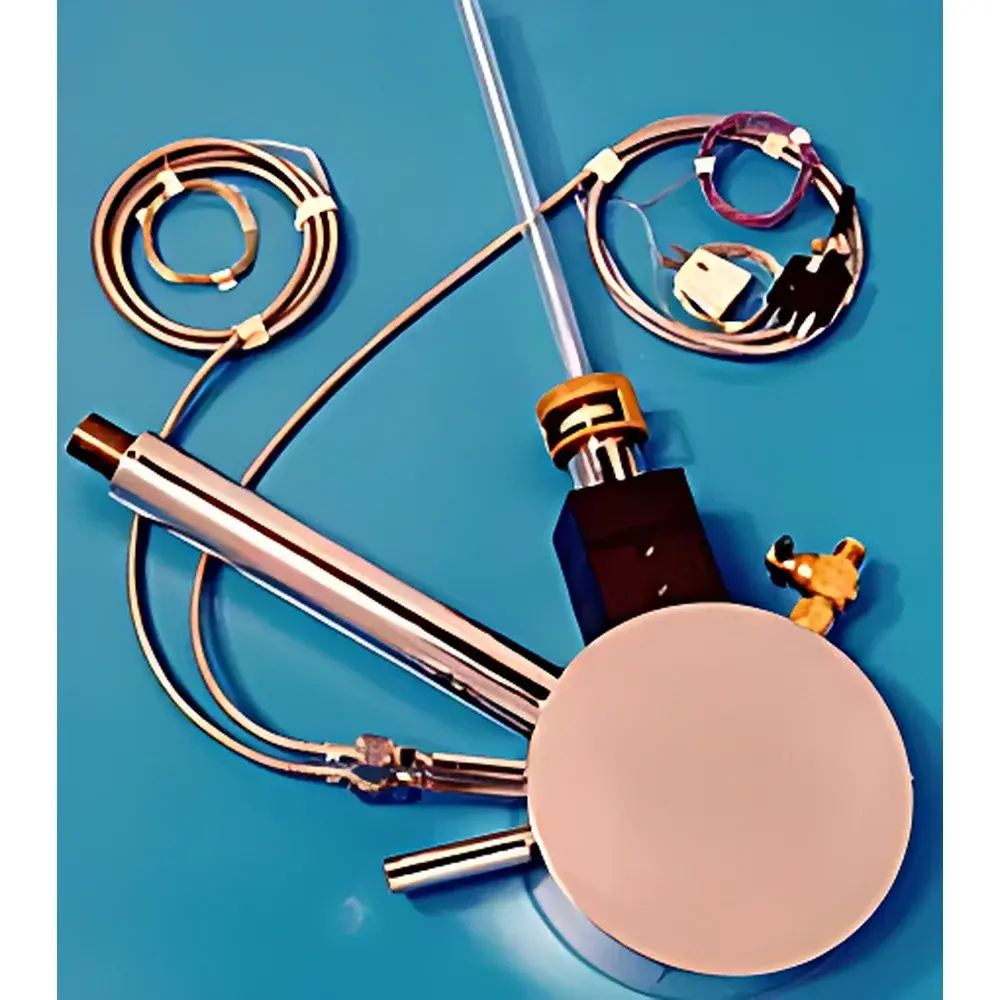
American Rotating Systems (ARS) LTR Liquid Helium Cryogenic Thermostat for X-band EPR/ESR Spectroscopy
| Brand | ARS |
|---|---|
| Origin | USA |
| Model | LTR |
| Cooling Medium | Liquid Helium |
| Operating Temperature | 4.2 K |
| Helium Consumption | 0.75 L/hr |
| Compatible Cavities | Bruker, Varian, JEOL X-band Resonators |
| Cooling Method | Continuous-flow Liquid Helium Jet through Quartz Dewar Insert |
| Temperature Sensing | Gold-Chromel Thermocouple |
| Heating Element | 36 Ω Thin-Film Heater |
| Electrical Feedthrough | 10-pin |
| Flow Control | Precision Needle Valve + Flowmeter Panel |
| Structural Housing | Stainless Steel Instrument Skirt |
| Thermal Shielding | Liquid Helium Jacketed Transfer Line |
| Customization Options | Cavity Adapters, Dewar Adapters, Sensor Configurations, Wiring Harnesses, High-Flow Helium Lines |
Overview
The ARS LTR is a purpose-engineered continuous-flow liquid helium cryogenic thermostat designed specifically for high-sensitivity X-band electron paramagnetic resonance (EPR) and electron spin resonance (ESR) spectroscopy. Unlike closed-cycle refrigerators or liquid nitrogen pre-cooled systems, the LTR delivers stable, vibration-minimized 4.2 K operation via direct liquid helium jet cooling through a quartz sample dewar insert—ensuring optimal thermal coupling and minimal microwave perturbation. Its architecture follows the proven mechanical and thermal design principles of the ARS LT3 platform, integrating coaxial liquid helium transfer lines with integrated cryogenic shielding and precision flow regulation to suppress thermal gradients and parasitic heat loads. The system is engineered for seamless integration into standard superconducting or electromagnet-based EPR spectrometers, supporting both horizontal and vertical magnet configurations. It does not incorporate mechanical compressors or pulse-tube coolers; instead, it relies on externally supplied liquid helium delivered under regulated pressure, enabling long-duration, ultra-low-noise measurements essential for detecting weak spin signals, narrow linewidths, and temperature-dependent relaxation phenomena.
Key Features
- Optimized for X-band (9–10 GHz) EPR/ESR resonators from Bruker, Varian, and JEOL—includes cavity-specific quartz dewars and mechanical adapters.
- Continuous-flow liquid helium cooling at nominal 4.2 K, with thermal stability better than ±0.1 K over multi-hour acquisitions when paired with appropriate temperature controllers.
- Dual-stage thermal management: primary liquid helium jet impinges directly on the sample holder inside the quartz dewar, while a secondary liquid helium jacket surrounds the transfer line to minimize conductive and radiative heat influx.
- Precision flow control via stainless steel needle valve and calibrated flowmeter panel, enabling reproducible helium consumption (typical 0.75 L/hr at 4.2 K) and fine-tuned thermal response.
- Integrated 10-pin electrical feedthrough for simultaneous thermometry, heating, and optional sensor signal routing—compatible with industry-standard PID controllers.
- Gold-Chromel thin-film thermocouple provides traceable, low-drift temperature measurement with <10 mK resolution; paired with a 36 Ω thin-film heater for active feedback control.
- Stainless steel instrument skirt ensures mechanical rigidity, electromagnetic compatibility, and vacuum integrity in UHV-compatible EPR environments (≤1×10⁻⁶ mbar).
Sample Compatibility & Compliance
The LTR accommodates standard 3 mm or 4 mm quartz EPR tubes mounted within vendor-specific dewar inserts. All glassware is fabricated from high-purity fused silica to minimize dielectric loss and microwave absorption. Mechanical interfaces comply with Bruker ER 4118X-MD, Varian E-109, and JEOL JES-PE series cavity flange dimensions. The system supports GLP-compliant operation when integrated with validated temperature controllers featuring audit-trail logging (e.g., compliant with FDA 21 CFR Part 11 requirements for electronic records). While the LTR itself carries no intrinsic regulatory certification, its modular design enables full traceability of calibration parameters—including thermocouple NIST-traceable calibration certificates and helium flowmeter calibration reports—upon request.
Software & Data Management
The LTR operates as a hardware-peripheral subsystem: temperature setpoint, ramp rate, and stabilization logic are managed externally via third-party PID controllers (e.g., Lakeshore 336, Eurotherm 2416) or LabVIEW-based DAQ platforms. All analog and digital I/O signals—including thermocouple voltage, heater current, and flowmeter output—are accessible through the 10-pin feedthrough. Optional firmware upgrades support RS-232 or Ethernet-enabled controllers with SCPI command sets, enabling automated temperature sweeps synchronized with spectrometer acquisition triggers. Data synchronization adheres to IEEE 1588 (PTP) time-stamping standards where applicable, ensuring sub-millisecond alignment between thermal state and spectral acquisition timestamps.
Applications
- Low-temperature characterization of transition metal complexes, organic radicals, and defect centers in semiconductors (e.g., NV⁻ in diamond, SiV).
- Spin-lattice (T₁) and spin-spin (T₂) relaxation studies across 4.2–300 K ranges using controlled variable-temperature ramps.
- In-situ photoinduced EPR experiments requiring cryogenic stabilization during laser irradiation.
- Quantitative g-factor and hyperfine coupling constant determination under minimized thermal broadening.
- Validation of quantum coherence times in molecular qubit candidates under static magnetic fields up to 1.5 T.
FAQ
What is the minimum achievable base temperature?
The LTR achieves a stable base temperature of 4.2 K under standard liquid helium supply conditions (≥2 bar inlet pressure, ≤150 K helium gas return temperature). With sub-atmospheric pumping of the helium vapor phase, temperatures down to ~1.6 K may be reached using pumped helium-4.
Is the system compatible with superconducting magnets?
Yes—the LTR’s stainless steel construction and non-magnetic components ensure safe operation inside the bore of superconducting magnets up to 12 T, provided proper field homogeneity and quench protection protocols are observed.
Can the LTR be retrofitted to existing EPR spectrometers?
All mechanical and thermal interfaces are modular; ARS provides site surveys and custom adapter kits for legacy Bruker EMX, ELEXSYS, and JEOL JES-FA200 installations.
Does the system include vacuum insulation?
The LTR requires connection to an external high-vacuum pump (≤1×10⁻⁶ mbar) via a CF-63 or ISO-KF40 port on the instrument skirt; vacuum jacketing is integral to thermal performance but not self-contained.
Are NIST-traceable calibration documents available?
Yes—calibration certificates for thermocouples, flowmeters, and heater resistance are available upon order, aligned with ISO/IEC 17025-accredited laboratories.



