
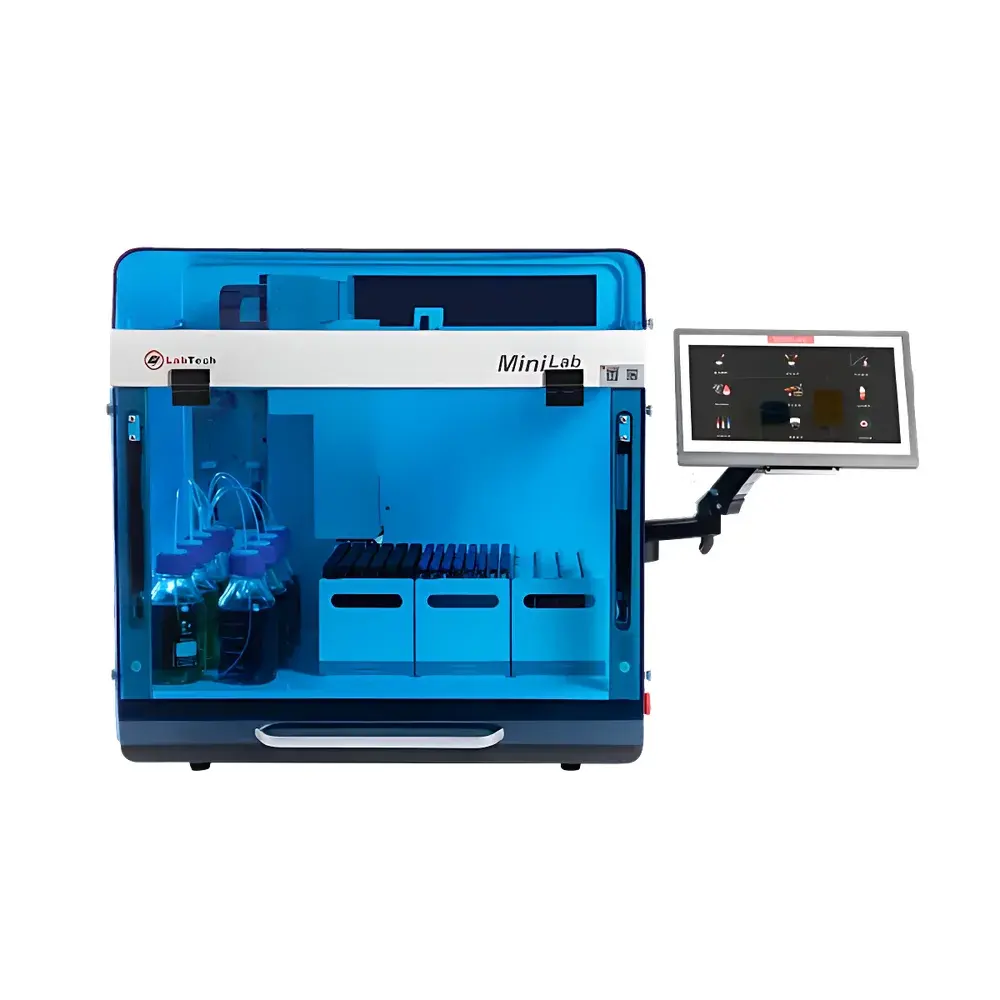
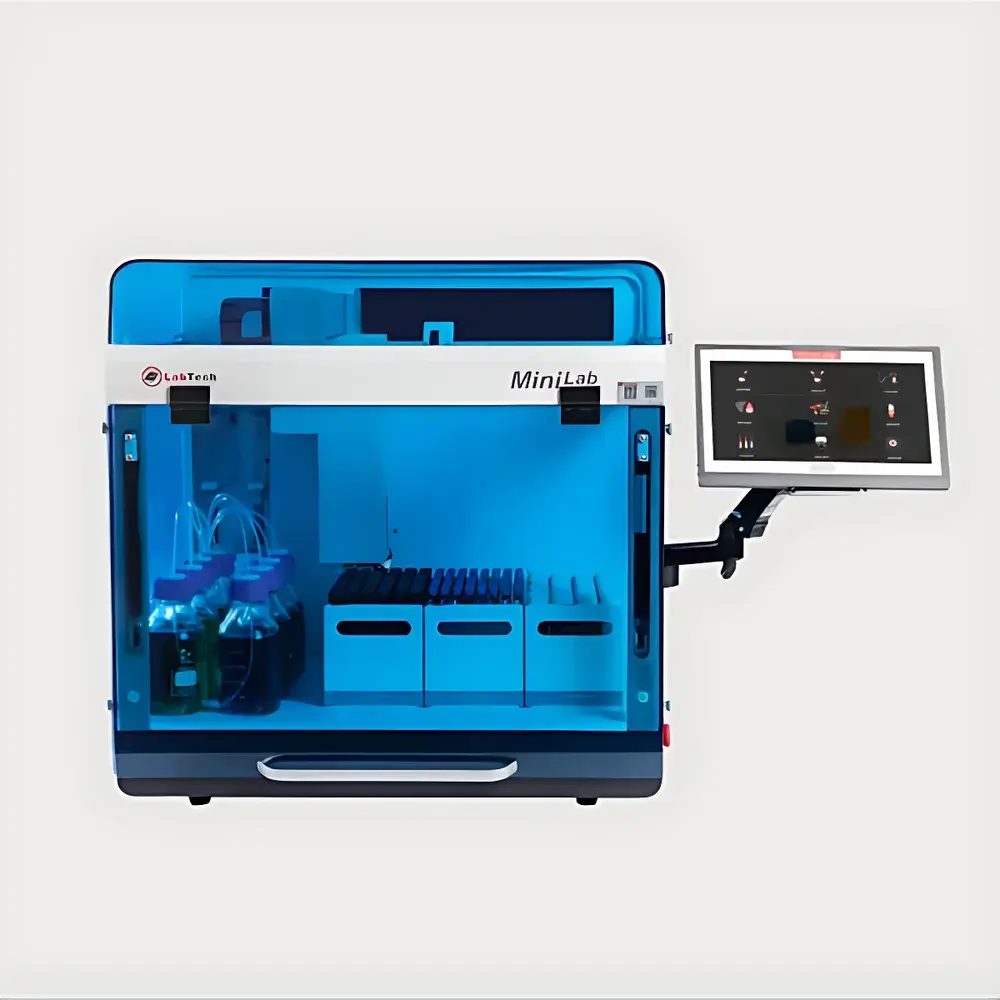
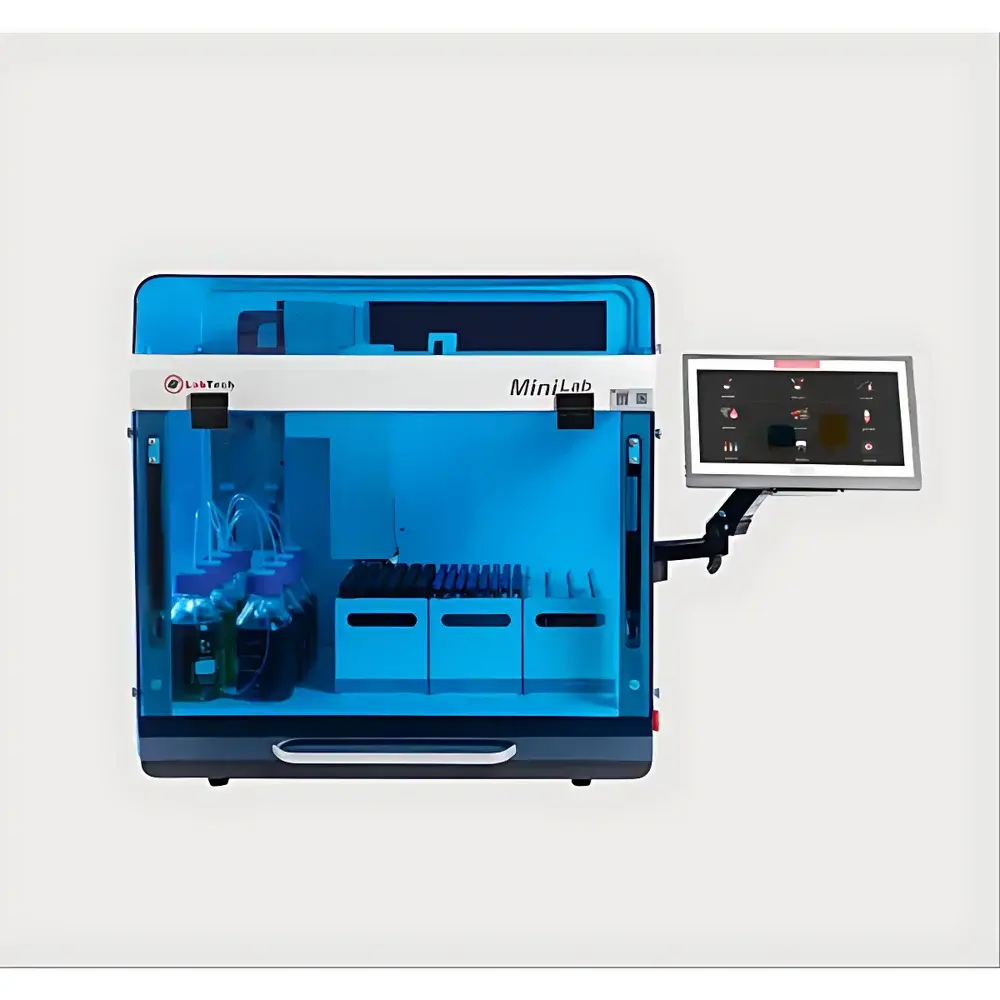
LabTech MiniLab3000 Automated Liquid Handling Platform
| Brand | LabTech |
|---|---|
| Origin | Beijing, China |
| Manufacturer Type | Authorized Distributor |
| Country of Origin | China |
| Model | MiniLab3000 |
| Pricing | Available Upon Request |
| XYZ Stage | Custom-configurable precision linear motor-driven stage with ±0.1 mm positional repeatability |
| Liquid Handling Accuracy | ≤±0.5% CV at 10 µL–1000 µL |
| Dispense Precision | ≤±0.3% CV |
| Needle Wash | Dual-stage internal/external rinse with active waste evacuation pump |
| Sample Capacity | Up to 288 × 2 mL vials (standard configuration) |
| Vial Compatibility | 2 mL–100 mL screw-cap or crimp-top vials |
| Mixing Method | Contactless orbital vortexing (programmable speed/duration) |
| Temperature Control Option | Integrated Peltier-based sample deck heating/cooling module (–10 °C to +80 °C, ±0.5 °C stability) |
| Compliance | Designed for GLP/GMP environments |
Overview
The LabTech MiniLab3000 Automated Liquid Handling Platform is an integrated, programmable workstation engineered for high-precision, unattended liquid manipulation in regulated analytical laboratories. Based on positive-displacement dual-syringe pump architecture, it delivers traceable volumetric accuracy across a 10 µL–1000 µL range—critical for preparing calibration standards, QC samples, internal standard additions, and multi-analyte mixed reference solutions prior to GC, LC, or ICP-MS analysis. Its closed-system design employs septum-piercing needle technology to maintain solvent integrity and prevent volatile loss during dilution and serial standard preparation. The platform operates under deterministic motion control via a high-resolution XYZ stage, enabling repeatable positioning across heterogeneous vial formats without manual intervention. Unlike air-displacement pipettors, the MiniLab3000’s syringe-based fluidics ensure consistent delivery regardless of liquid viscosity, vapor pressure, or surface tension—making it especially suitable for organic solvents, pesticide mixtures, and viscous biological matrices.
Key Features
- Dual independent syringe pumps with auto-switching capability: Enables seamless transition between low-volume (500 µL) dispensing protocols without recalibration.
- Septum-piercing closed-loop dispensing: Eliminates headspace exposure during vial access, minimizing evaporation of volatile solvents (e.g., acetone, hexane, ethyl acetate) and preserving concentration integrity over extended runs.
- Contactless orbital vortex mixing station: Programmable rotation speed (300–2500 rpm) and duration (1–300 s) ensures homogeneous dissolution of poorly soluble analytes—including organochlorine pesticides, PAHs, and mycotoxins—without mechanical contact or cross-contamination risk.
- Multi-level needle cleaning system: Integrated internal flush (via dedicated wash solvent channel), external surface rinse (with adjustable spray angle), and active waste evacuation via peristaltic discharge pump—validated to reduce carryover to <0.001% (tested with chlorpyrifos-methyl in acetonitrile).
- Scalable deck layout: Supports up to 288 positions for 2 mL vials (standard), with modular adaptability for 4 mL, 15 mL, and 100 mL containers using certified LabTech accessory carriers.
- Optional temperature-controlled sample deck: Peltier-based thermal management enables cold-chain preservation of labile standards (e.g., nitrosamines, aldehydes) or heated dissolution of waxy residues (e.g., parabens, sterols).
Sample Compatibility & Compliance
The MiniLab3000 accommodates a broad spectrum of sample types including aqueous standards, organic extracts (e.g., QuEChERS supernatants), acid-digested environmental matrices, and protein-rich biological fluids—provided viscosity remains below 20 mPa·s and particulate load is filtered to ≤5 µm. It complies with ISO/IEC 17025:2017 requirements for automated equipment validation and supports full IQ/OQ/PQ documentation packages. When operated with LabTech LIMS-Link™ software, the system meets FDA 21 CFR Part 11 criteria for electronic records and signatures—including role-based access control, immutable audit trails, and user-defined retention policies. All fluid-contact materials (sapphire-tipped needles, PTFE-lined syringes, chemically resistant tubing) are USP Class VI certified and compatible with common HPLC-grade solvents.
Software & Data Management
Controlled via LabTech MethodStudio™—a Windows-based GUI supporting drag-and-drop protocol builder, real-time run monitoring, and error logging with timestamped event capture. Protocols store full metadata: syringe calibration coefficients, tip type, wash cycles, mixing parameters, and environmental conditions (ambient temp/humidity). Raw execution logs export in CSV/JSON format for integration with laboratory information management systems (LIMS) or ELN platforms. Optional LIMS-Link™ add-on provides bi-directional data exchange, automatic result annotation, and electronic signature workflows compliant with GLP audit requirements.
Applications
- Multi-residue pesticide analysis: Automated preparation of 100+ component mixes for GC-MS/MS screening in food safety labs (aligned with EU SANTE/11312/2021).
- Environmental contaminant quantification: Standard curve generation for PCBs, dioxins, and brominated flame retardants in soil/sediment extracts.
- Pharmaceutical impurity profiling: Precise spiking of genotoxic impurities (GTIs) into drug substance batches per ICH M7 guidelines.
- Clinical toxicology: Dilution series for calibrators in LC-MS/MS assays measuring opioids, benzodiazepines, and stimulants.
- Method development support: Rapid iteration of dilution factors, internal standard ratios, and matrix-matched calibration schemes.
FAQ
What validation documentation is provided with the MiniLab3000?
LabTech supplies a comprehensive Equipment Qualification Package including Factory Acceptance Test (FAT) reports, Installation Qualification (IQ) templates, and Operational Qualification (OQ) test scripts covering accuracy, precision, carryover, and positional repeatability.
Can the MiniLab3000 handle viscous samples such as glycerol or serum?
Yes—when configured with low-speed aspiration/dispense profiles and pre-wetted tips, it reliably handles liquids up to 20 mPa·s viscosity; optional heated deck further reduces effective viscosity for temperature-sensitive matrices.
Is remote monitoring supported?
Yes—MethodStudio™ includes secure HTTP(S) API endpoints for status polling and alarm notification via email/SMS; integration with enterprise IT infrastructure requires TLS 1.2+ and LDAP authentication.
How often does the syringe require recalibration?
Under routine use (≤8 hrs/day), syringe calibration is recommended every 6 months or after 5000 dispense cycles—verified using gravimetric NIST-traceable standards per ASTM E2758-19.
Does the system support custom vial rack configurations?
Yes—LabTech offers CAD-supported custom carrier design services for non-standard containers, validated through mechanical clearance testing and positional accuracy mapping.



