
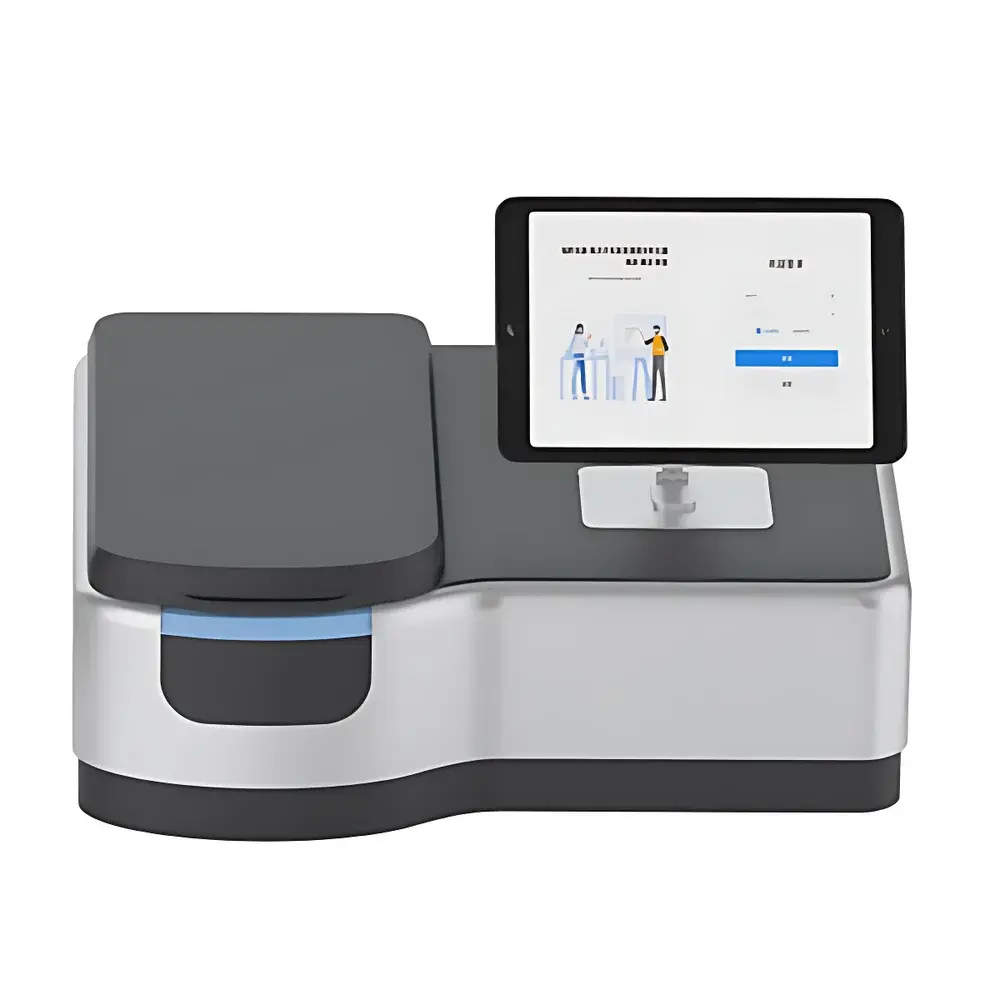
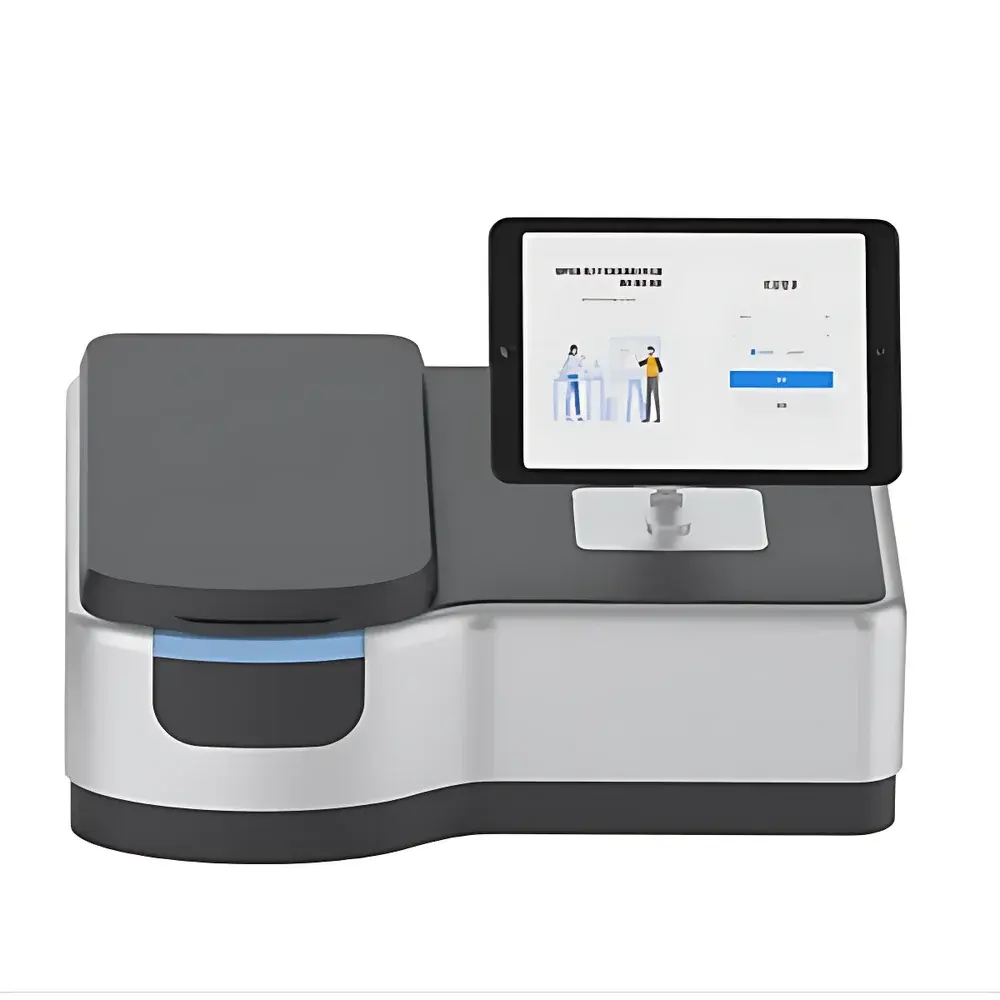
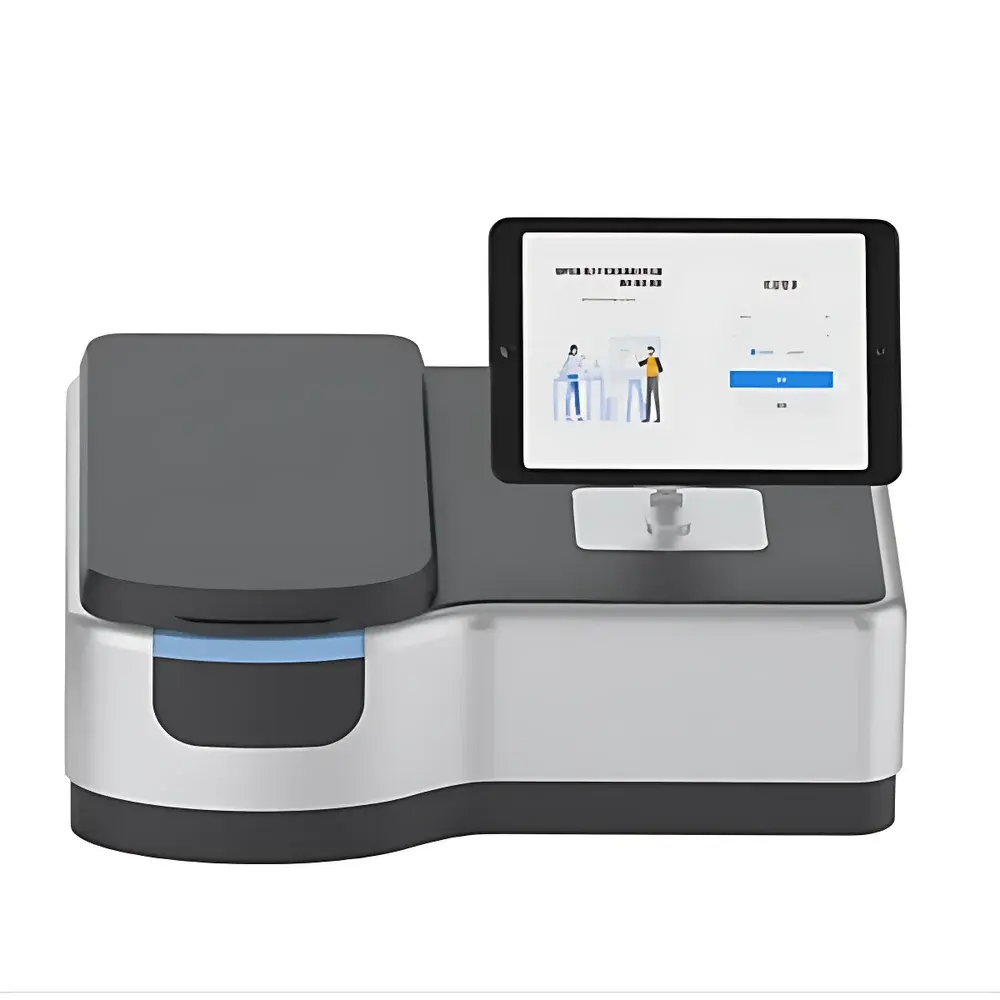
Yoke M6S Dual-Beam Ultraviolet-Visible Spectrophotometer
| Brand | Yoke |
|---|---|
| Origin | Shanghai, China |
| Model | M6S |
| Optical System | Dual-Beam |
| Detector | Photomultiplier Tube (PMT) |
| Wavelength Range | 190–1100 nm |
| Wavelength Accuracy | ±0.3 nm |
| Wavelength Repeatability | ≤0.1 nm |
| Spectral Bandwidth | 1 nm (standard), adjustable from 0.1 to 5 nm |
| Stray Light | ≤0.03% at 220 nm (using NaI solution) |
| Photometric Resolution | 0.00001 Abs |
| Auto-Wavelength Scanning | Yes |
| Light Sources | Deuterium Lamp + Tungsten-Halogen Lamp |
| Display | Integrated 11-inch 2.8K tablet with Bluetooth connectivity |
| Compliance | Designed for ISO/IEC 17025-aligned laboratory environments, supports GLP/GMP data integrity requirements including user-level access control and audit trail-ready operation |
Overview
The Yoke M6S Dual-Beam Ultraviolet-Visible Spectrophotometer is an engineered analytical instrument designed for high-fidelity absorbance, transmittance, and reflectance measurements across the full UV-Vis spectrum (190–1100 nm). Its optical architecture employs a true dual-beam configuration—splitting the light path into sample and reference channels simultaneously—to deliver real-time baseline correction and exceptional photometric stability during extended scans or kinetic assays. The system utilizes a high-efficiency deuterium lamp for the ultraviolet region (190–350 nm) and a tungsten-halogen lamp for the visible and near-infrared range (350–1100 nm), both optimized for longevity and spectral continuity. Coupled with a low-noise photomultiplier tube (PMT) detector and precision monochromator optics, the M6S achieves photometric resolution down to 0.00001 Abs—enabling detection of minute concentration changes in trace analysis applications such as environmental monitoring, pharmaceutical QC, and biomolecular quantification.
Key Features
- Dual-beam optical design with real-time reference compensation for enhanced baseline stability and reduced drift during long-duration experiments.
- Integrated 11-inch 2.8K-resolution tablet interface with intuitive multi-language support (auto-switching between English and Chinese), Bluetooth-paired operation, and responsive touch-based navigation.
- Adjustable spectral bandwidth (0.1–5 nm in seven discrete steps), allowing users to balance resolution and signal-to-noise ratio per application requirement—critical for compliance with ASTM E275, ISO 6425, and USP method validation protocols.
- Advanced photometric accuracy: wavelength accuracy ±0.3 nm and repeatability ≤0.1 nm, verified against NIST-traceable holmium oxide and didymium filters.
- Intelligent diagnostics engine that performs automated performance verification—including lamp intensity, wavelength calibration, and stray light assessment—and logs results with timestamped metadata for internal QA audits.
- Configurable alert system supporting email and SMS notifications upon instrument fault detection or out-of-spec measurement outcomes, facilitating remote lab oversight.
Sample Compatibility & Compliance
The M6S accommodates a broad range of sample formats via optional accessories: automatic 8-cell cuvette changers, temperature-controlled cell holders (±0.1 °C stability), integrating spheres for diffuse reflectance, variable-pathlength cells (1–100 mm), and solid-sample stages with adjustable incidence angles. It complies with core regulatory expectations for analytical instrumentation used in regulated environments: user authentication with role-based permissions (administrator, analyst, viewer), electronic signature support, and immutable audit trails aligned with FDA 21 CFR Part 11 principles. Data export adheres to ASTM E1382-compliant CSV and XML formats, ensuring interoperability with LIMS and ELN platforms. All firmware and software updates follow documented change control procedures suitable for ISO/IEC 17025 accreditation.
Software & Data Management
The embedded software suite provides native implementation of all standard UV-Vis measurement modes: photometric mode, quantitative analysis (single/multi-point calibration, equation-based concentration calculation), kinetic time-scan, full spectral scanning, multi-wavelength quantitation, 3D contour mapping, and dedicated nucleic acid/protein analysis workflows (A260/A280 ratio, extinction coefficient-based calculations). Raw and processed data are stored with embedded metadata—including operator ID, instrument serial number, date/time stamp, and parameter configuration—ensuring full traceability. Export options include PDF reports with embedded spectra, spreadsheet-compatible files, and secure encrypted backups. Software architecture supports periodic automated backup to network drives or cloud storage endpoints compliant with institutional IT security policies.
Applications
The M6S serves diverse sectors requiring precise molecular absorption characterization: environmental laboratories performing COD, nitrate, phosphate, and heavy metal speciation assays; pharmaceutical manufacturers conducting raw material identification, dissolution testing, and stability-indicating methods per ICH Q2(R2); academic research groups studying enzyme kinetics, ligand binding, and nanoparticle plasmonics; and food & beverage QA labs verifying colorants, preservatives, and nutrient fortification levels. Its robust stray light suppression (<0.03% at 220 nm) ensures reliable quantitation in high-absorbance regions critical for DNA/RNA purity assessment and protein denaturation studies.
FAQ
Does the M6S support GLP-compliant data handling?
Yes—the system enforces multi-tier user authentication, records all operational events in a tamper-evident audit trail, and retains full metadata with each measurement.
Can the spectral bandwidth be adjusted during a scan?
No—bandwidth is set prior to acquisition but can be reconfigured between scans to match method requirements (e.g., 0.5 nm for high-resolution peak deconvolution, 2 nm for rapid screening).
Is the tablet interface replaceable or upgradable?
The integrated tablet is factory-calibrated and sealed within the instrument housing; replacement requires authorized service personnel to maintain optical alignment and software certification.
What validation documentation is provided with the instrument?
Each unit ships with a Factory Performance Verification Report, Certificate of Conformance, and IQ/OQ protocol templates compatible with GxP implementation.
How is lamp lifetime managed?
The software includes programmable lamp auto-shutdown timers and usage-hour tracking; deuterium lamps typically exceed 2,000 hours under standard operating conditions.
Related Products




