
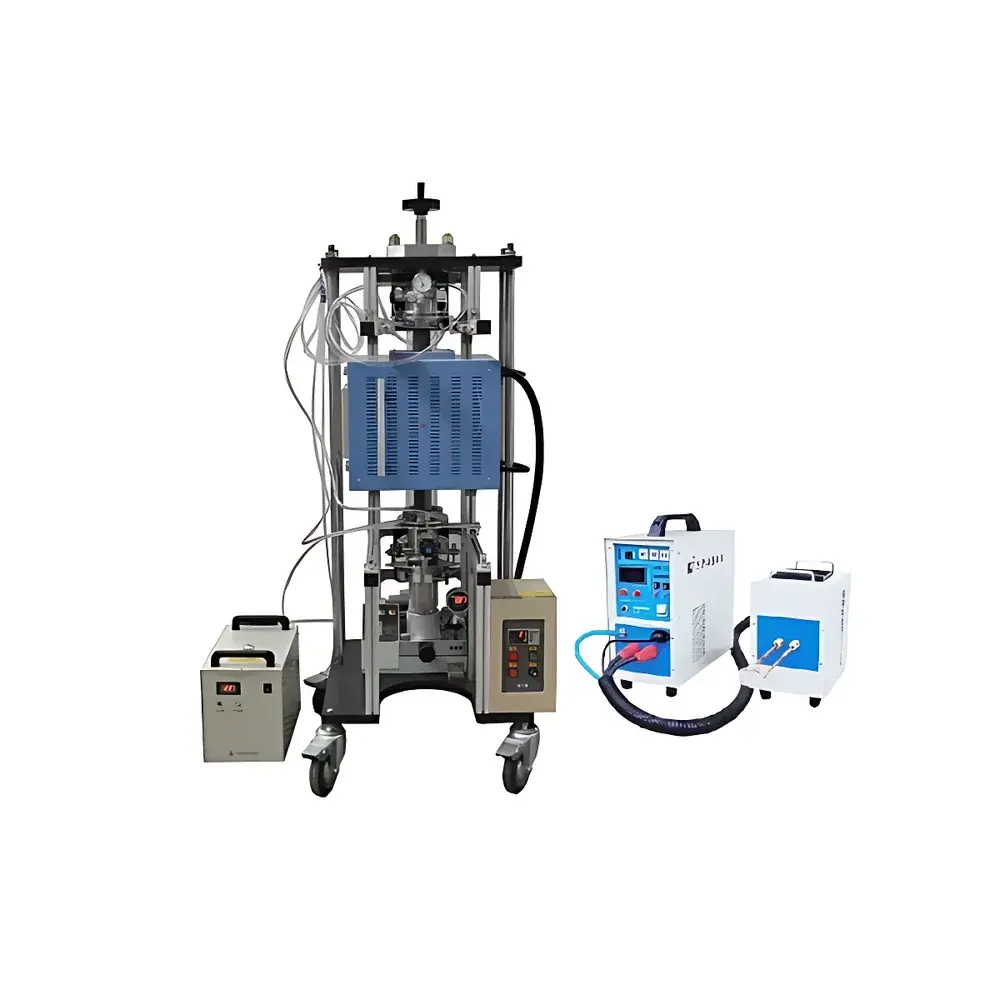
KJG OTF-1700X-RHP4 Vacuum Rapid Hot Pressing Furnace
| Brand | KJG (Hefei Kejing) |
|---|---|
| Origin | Anhui, China |
| Model | OTF-1700X-RHP4 |
| Max Temperature | 1700°C |
| Pressure Capacity | 5 T (hydraulic), up to 20 T optional |
| Heating Method | Induction heating |
| Max Power | 15 kW |
| Temp Control Accuracy | ±1°C (PID, 30-segment programmable) |
| Heating Rate | 10°C/min (to 1700°C) |
| Chamber Dimensions | 100 mm OD × 95 mm ID × 1200 mm L (quartz tube) |
| Vacuum Level | 1×10⁻⁵ Torr (with turbomolecular pump), 1×10⁻² Torr (with mechanical pump) |
| Cooling | Water-cooled flanges & optional recirculating chiller |
| Compliance | CE-marked design, compatible with ISO/IEC 17025 lab environment requirements |
Overview
The KJG OTF-1700X-RHP4 Vacuum Rapid Hot Pressing Furnace is an integrated high-temperature, high-pressure sintering system engineered for the fabrication of dense ceramic, intermetallic, and composite materials under controlled vacuum or inert gas atmospheres. It combines induction heating with synchronized uniaxial hydraulic pressure application inside a sealed quartz reaction tube—enabling simultaneous thermal densification and mechanical consolidation. The furnace operates on the principle of resistive induction heating of graphite tooling within a thermally insulated vacuum chamber, coupled with real-time pressure feedback control via an electro-hydraulic actuator. This architecture supports rapid thermal cycling (up to 10°C/min ramp rates in mid-temperature ranges) while maintaining dimensional stability of the hot zone during pressurization—critical for minimizing grain coarsening and preserving nanostructured features in advanced ceramics and MAX-phase composites.
Key Features
- Induction heating system rated at 15 kW, operating at 30–80 kHz frequency with 80% duty cycle; delivers uniform axial temperature profiles across the 1200 mm hot zone.
- Electro-hydraulic press module with dual-range capability: standard 5 T nominal force (adjustable up to 20 T with optional upgrade); 25 mm diameter top ram, 15 mm stroke, and programmable pressure ramping (0.1–5 MPa/s).
- Water-cooled stainless steel flanges with integrated mechanical vacuum gauges, stainless steel isolation valves, and bellows-coupled piston assembly enabling dynamic pressure transmission into vacuum without seal degradation.
- Quartz reaction tube (100 mm OD × 95 mm ID × 1200 mm L) rated for continuous operation up to 1100°C; supported by high-purity graphite spacers and mica shims for thermal decoupling between tooling and flange interfaces.
- B-type thermocouple (Pt/Rh–Pt) with alumina ceramic protection sheath, calibrated to NIST-traceable standards; PID-based controller supporting 30-segment heating/cooling/holding profiles with over-temperature and thermocouple-failure safety interlocks.
- Comprehensive safety architecture: water-flow monitoring, over-current cutoff (60 A breaker required), over-power shutdown, and real-time thermal runaway detection.
Sample Compatibility & Compliance
The OTF-1700X-RHP4 accommodates cylindrical samples up to Ø12.7 mm (½ inch) using standardized graphite dies, with scalable tooling options available for Ø25 mm and Ø50 mm configurations. Graphite dies are fabricated from high-density, low-ash isotropic graphite (purity >99.995%), rated for sustained service at 50 MPa compressive stress below 1700°C. The system meets fundamental requirements for ISO 17025-accredited laboratories conducting sintering process validation, including traceable temperature calibration, pressure transducer linearity verification, and documented maintenance logs. While not certified to ASME BPVC Section VIII, its pressure containment design follows recognized mechanical integrity guidelines for Class I laboratory-scale hot presses. Vacuum performance aligns with ASTM E595 outgassing specifications when operated with appropriate bake-out protocols.
Software & Data Management
Temperature and pressure profiles are recorded synchronously via RS485-modbus interface to optional PC-based acquisition software (supplied). Raw data export is supported in CSV format with timestamps referenced to UTC. The controller firmware includes audit-trail functionality—logging all parameter changes, alarm events, and manual overrides with user ID and timestamp. For GLP/GMP-aligned environments, optional 21 CFR Part 11-compliant software modules are available upon request, providing electronic signatures, role-based access control, and immutable data archiving. All firmware updates undergo version-controlled release testing and are distributed with associated validation reports.
Applications
This system is routinely deployed in academic and industrial R&D labs for solid-state synthesis of ultra-high-temperature ceramics (e.g., ZrB₂–SiC, HfC–TaC), spark plasma sintering (SPS)-alternative densification of nanocrystalline powders, fabrication of functionally graded materials (FGMs), and consolidation of metal matrix composites (MMCs) with thermally sensitive reinforcements (e.g., CNTs, graphene flakes). Its rapid heating capability enables kinetic suppression of interdiffusion in multilayer thin-film stacks, while vacuum compatibility ensures minimal oxygen partial pressure during reactive sintering of nitrides and carbides. Process repeatability has been validated across >200 cycles in third-party inter-laboratory round-robin studies targeting ASTM C1322 flexural strength certification of sintered Si₃N₄.
FAQ
What vacuum level can be achieved, and which pumping configuration is recommended for sintering oxide ceramics?
A base pressure of ≤1×10⁻⁵ Torr is attainable using a turbomolecular pump backed by a dry scroll pump—recommended for oxygen-sensitive processes such as Ti₃SiC₂ synthesis. For routine non-reactive sintering (e.g., Al₂O₃), a two-stage rotary vane pump achieves stable 1×10⁻² Torr and suffices.
Is the quartz tube replaceable, and what is its expected service life under cyclic operation?
Yes—the quartz tube is a field-replaceable component. Under proper thermal ramping (<10°C/min) and avoidance of thermal shock, typical service life exceeds 150 cycles at 1600°C; replacement intervals are logged in the maintenance dashboard.
Can the system be integrated into an automated materials synthesis platform?
Yes—digital I/O ports and Modbus TCP support enable integration with PLC-controlled glovebox interfaces, robotic sample loaders, and centralized MES systems for Industry 4.0 process orchestration.
What documentation is provided for IQ/OQ validation?
Factory acceptance test (FAT) reports, as-built schematics, calibration certificates for thermocouples and load cells, and a URS-mapped validation protocol template are included with shipment.
Are graphite die sets available in custom geometries?
Yes—custom graphite tooling (including stepped, multi-level, and crucible-style dies) can be fabricated per customer drawings, with lead times of 4–6 weeks and full material certification (ASTM D7028 carbon purity analysis).



