
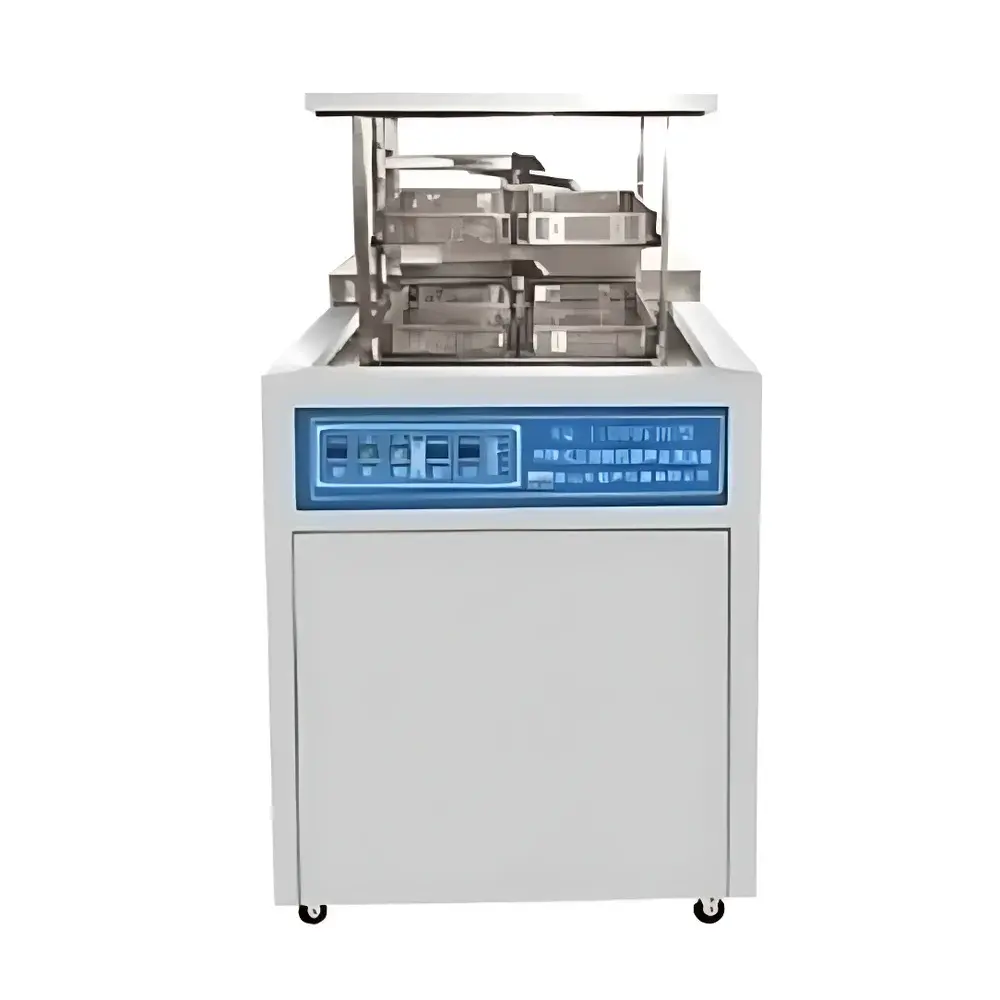
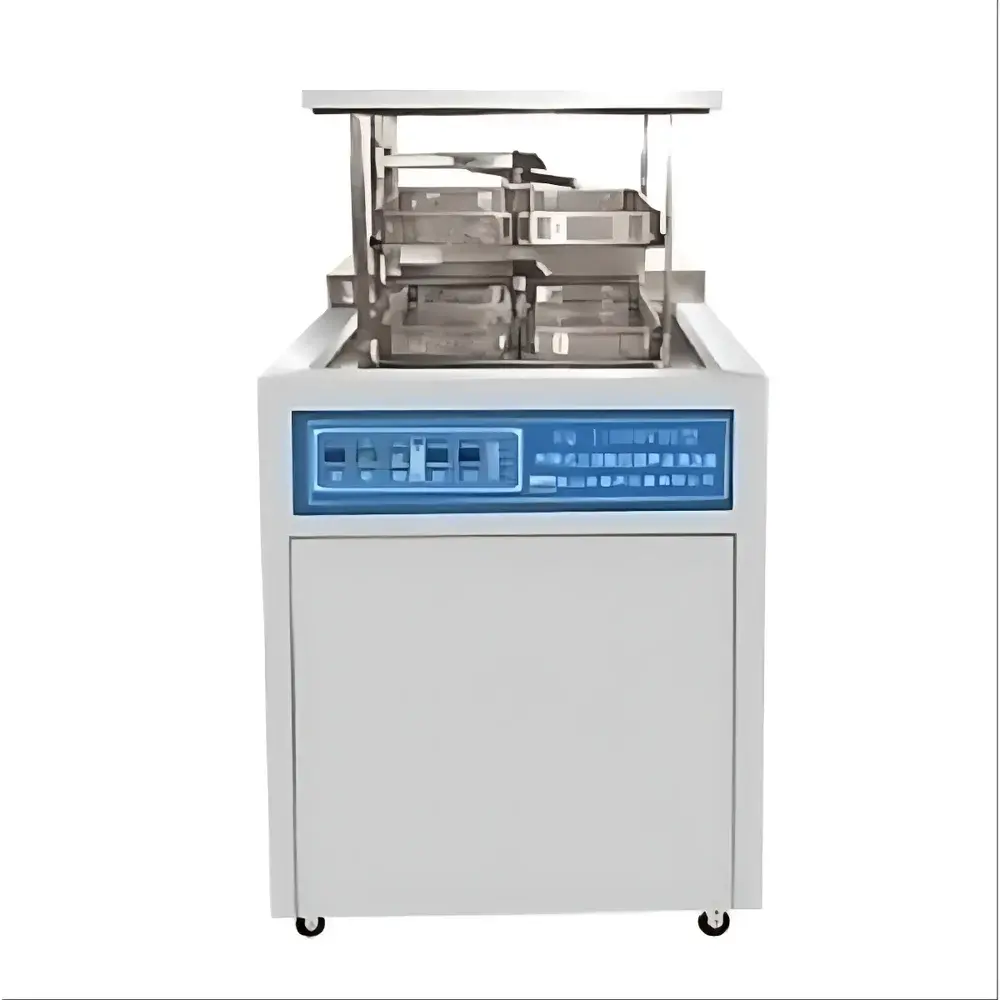
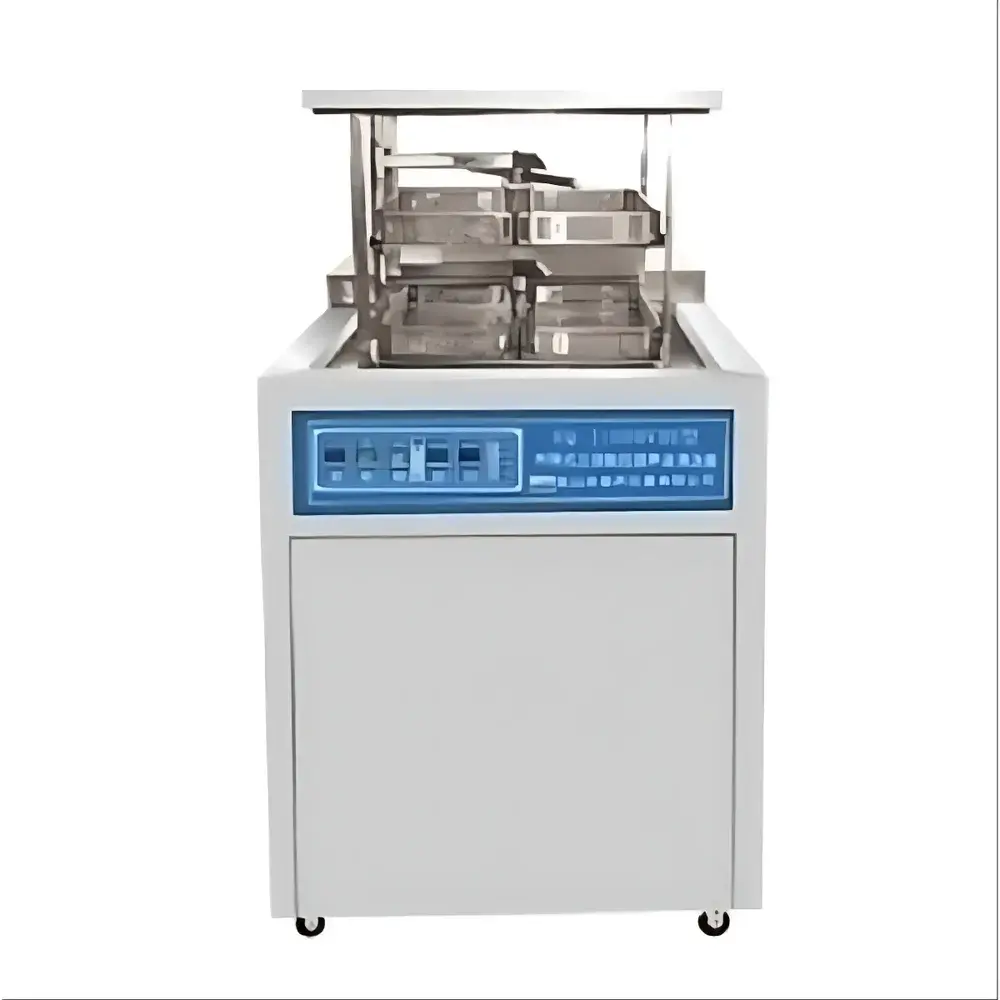
Supmile KQ-J2000VDE Dual-Frequency Lift-Actuated Ultrasonic Cleaner
| Brand | Supmile |
|---|---|
| Origin | Jiangsu, China |
| Manufacturer Type | Authorized Distributor |
| Product Category | Domestic |
| Model | KQ-J2000VDE |
| Instrument Type | General-Purpose |
| Capacity | 144 L |
| Ultrasonic Frequencies | 45 kHz / 80 kHz |
| Ultrasonic Power Output | 2000 W |
| Power Adjustment Range | 40–100% (stepless) |
| Temperature Control Range | 10–80 °C |
| Timer Range | 1–480 min |
| Sound-Dampening Lid | Integrated electrically actuated |
| Drain & Fill | Electrically controlled inlet/outlet valves |
| Optional Feature | High-Pressure Water Spray Rinse System |
Overview
The Supmile KQ-J2000VDE is a dual-frequency, lift-actuated ultrasonic cleaner engineered for high-throughput laboratory and industrial cleaning applications requiring reproducible, non-destructive particulate removal. It operates on the principle of cavitation-induced microjetting and acoustic streaming generated by piezoelectric transducers bonded to the stainless-steel tank base. The system simultaneously supports two discrete ultrasonic frequencies—45 kHz (optimized for macro-particulate dislodgement and heavy soiling) and 80 kHz (suited for fine contaminant removal from delicate surfaces and complex geometries). Its vertically actuated basket and sound-dampening lid are fully motorized via programmable electric linear actuators, eliminating manual handling and minimizing operator exposure to solvents, heat, and airborne aerosols. Designed as a floor-standing unit with structural rigidity and thermal insulation, it meets foundational ergonomic and safety expectations for Class II laboratory equipment used in QC/QA, medical device reprocessing, and precision component preparation.
Key Features
- Dual-frequency ultrasonic generation (45 kHz and 80 kHz), selectable via front-panel interface or software command
- 2000 W total ultrasonic power output with continuous 40–100% amplitude modulation for process optimization across diverse substrate types
- Electrically driven lift mechanism for both the stainless-steel mesh basket (304 grade) and insulated acoustic lid—enabling repeatable immersion depth control and safe, hands-free operation
- Integrated high-pressure water spray rinse module (optional configuration), delivering laminar flow during or immediately after sonication to prevent redeposition of loosened contaminants
- Precision digital temperature regulation (10–80 °C ±1.5 °C) with PT100 sensor feedback and PID-controlled heating elements (6000 W max)
- Programmable timer (1–480 minutes) with automatic shutdown and audible end-of-cycle alert
- Electronically controlled fill/drain system with adjustable liquid-level setpoint (1–300 mm), supporting automated batch processing and solvent recovery integration
- Full 304 stainless-steel construction: tank, basket, spray arms, and housing—ensuring corrosion resistance, cleanability, and compliance with ISO 13485 pre-cleaning requirements
Sample Compatibility & Compliance
The KQ-J2000VDE accommodates a broad range of sample formats—including glassware (vials, flasks, cuvettes), metallic components (surgical instruments, calibration standards), ceramic substrates, and polymer-based devices—without risk of surface pitting or dimensional distortion when operated within validated parameters. Its sealed chamber design and low-noise enclosure (<65 dB(A) at 1 m) align with OSHA 29 CFR 1910.95 occupational noise exposure guidelines. While not certified to UL/CSA or CE for standalone medical device reprocessing, the unit supports GLP/GMP-aligned workflows when integrated into validated cleaning protocols per ISO 15883-1 (washer-disinfectors) and ASTM F3127 (ultrasonic cleaning verification). All wetted surfaces comply with USP extractables testing prerequisites for pharmaceutical contact materials.
Software & Data Management
The embedded microcontroller provides local parameter storage (up to 99 user-defined programs), real-time display of bath temperature, elapsed time, frequency mode, and power level. RS-232 and optional RS-485 interfaces enable remote monitoring and script-based sequence execution via LabVIEW, Python, or custom SCADA systems. Audit trail functionality logs timestamped events—including program start/stop, parameter changes, lid position status, and temperature excursions—for traceability in regulated environments. Though not natively 21 CFR Part 11 compliant, the system supports external electronic signature and data archiving solutions when deployed with validated third-party middleware.
Applications
- Pre-analytical cleaning of HPLC vials, GC autosampler trays, and ICP-MS sample introduction components
- Decontamination of reusable surgical tools prior to sterilization in hospital central supply departments
- Removal of polishing compounds and oxide layers from optical lenses and semiconductor wafers
- Extraction aid for residual solvents in polymer film substrates prior to FTIR or DSC analysis
- Routine maintenance of viscometers, rheometers, and particle size analyzers requiring solvent-free residue elimination
- Supporting ASTM D2624, ISO 10523, and USP particulate matter testing preparation protocols
FAQ
Is the KQ-J2000VDE suitable for cleaning delicate MEMS devices?
Yes—when operated at 80 kHz with reduced power (≤60%) and aqueous, low-surface-tension detergent formulations, it delivers effective cleaning without mechanical damage to microstructures.
Can the unit be integrated into an automated lab workflow?
Yes—via its serial communication ports and discrete I/O signals, it accepts external trigger commands and reports operational status for synchronization with robotic arms or conveyor-linked systems.
Does the spray rinse function require external water pressure?
No—the integrated booster pump supplies consistent 0.3–0.6 MPa pressure; only standard tap water connection (with optional filtration) is required.
What validation documentation is provided?
Factory test reports include transducer resonance verification, temperature uniformity mapping (at 3 points), and acoustic power calibration certificate per ASTM E1000. IQ/OQ templates are available upon request.
Is deionized water compatible with long-term use in this system?
Yes—however, periodic descaling using citric acid solution is recommended if DI water is used exclusively to prevent transducer face fouling from mineral nucleation.



