
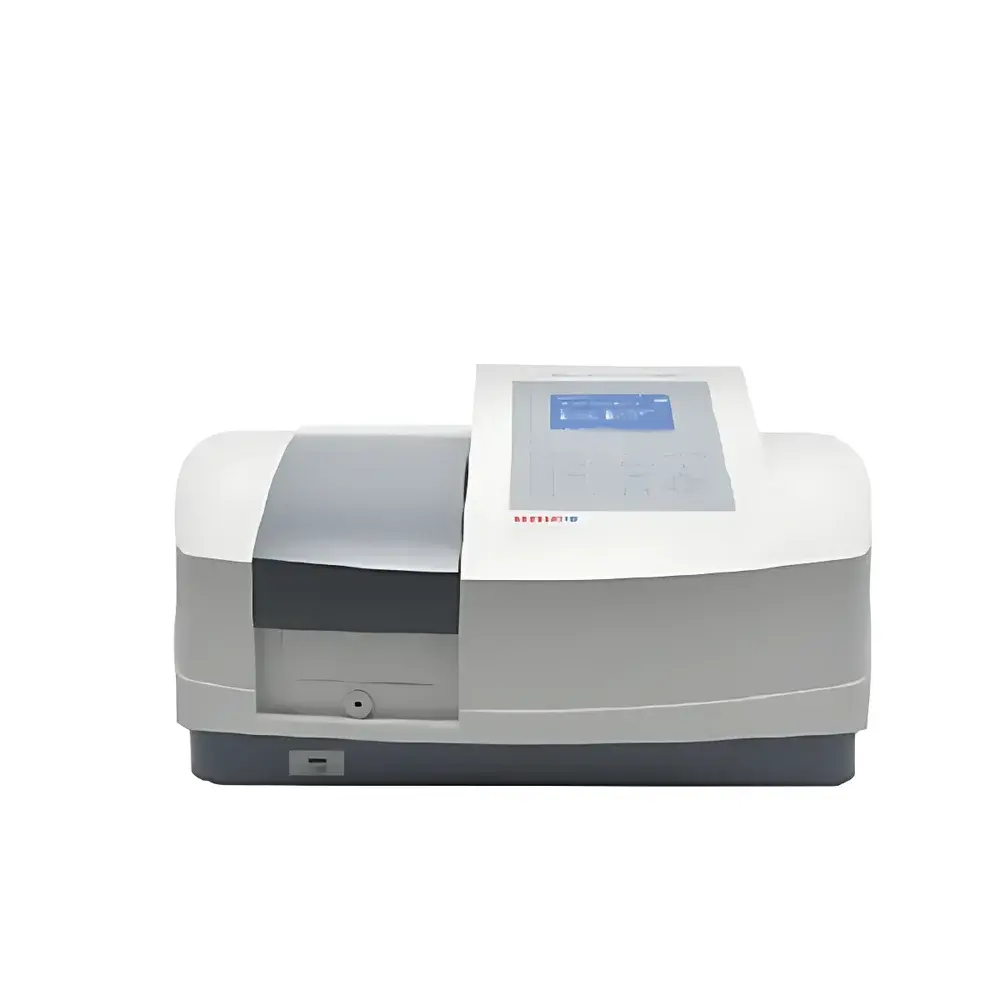
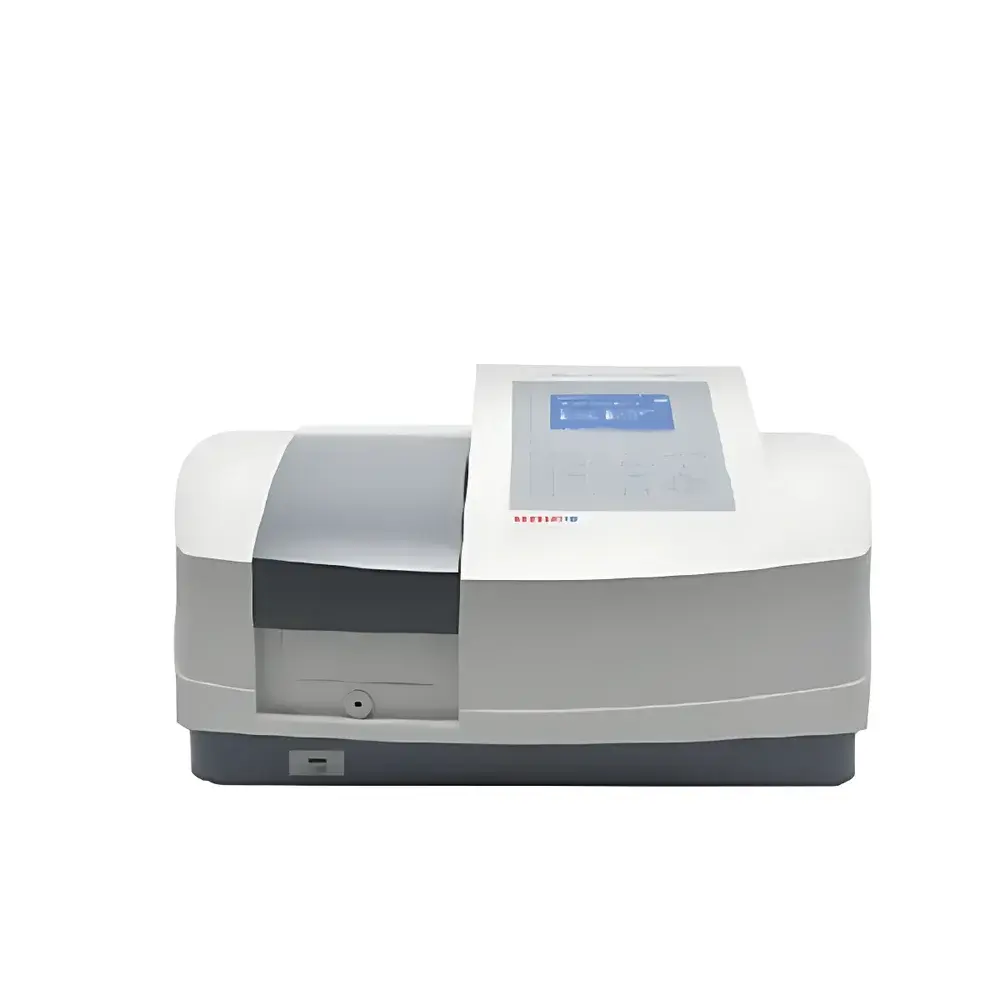
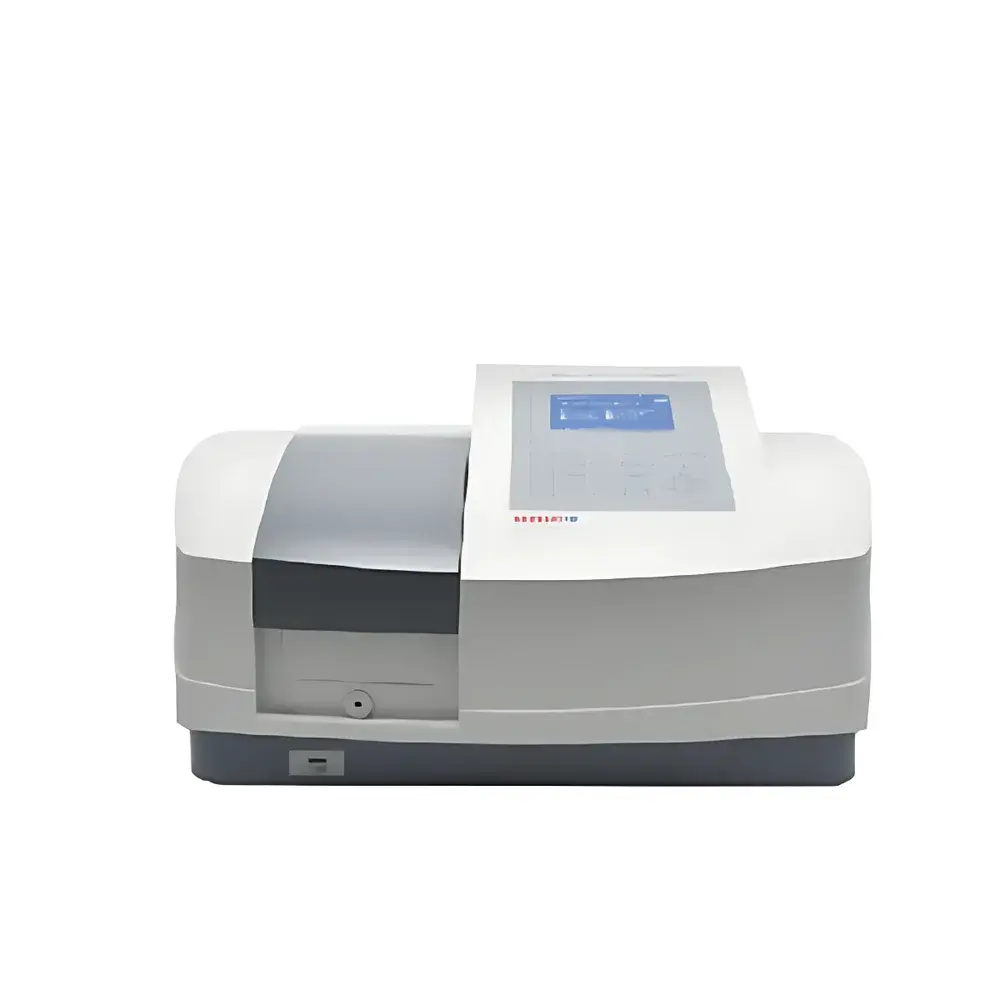
UniCo UV-4800 Dual-Beam Ultraviolet-Visible Spectrophotometer
| Brand | UniCo |
|---|---|
| Origin | Shanghai, China |
| Model | UV-4800 |
| Optical System | Dual-Beam |
| Detector Type | Photocell |
| Wavelength Range | 190–1100 nm |
| Wavelength Accuracy | ±0.5 nm |
| Wavelength Repeatability | ±0.2 nm |
| Spectral Bandwidth | 1.8 nm |
| Stray Light | ≤0.1% T |
| Photometric Accuracy | ±0.004 Abs (0–0.5 Abs), ±0.004 Abs (0.5–1.0 Abs), ±0.5% T |
| Photometric Repeatability | ±0.001 Abs (0–0.5 Abs), ±0.002 Abs (0.5–1.0 Abs), ±0.2% T |
| Baseline Stability | ±0.002 A/h (at 500 nm, after warm-up) |
| Baseline Linearity | ±0.001 A |
| Display | 320 × 240 graphical LCD |
| Data Interface | USB port |
| Dimensions (W × D × H) | 545 × 245 × 260 mm |
| Weight | 22 kg |
Overview
The UniCo UV-4800 is a dual-beam ultraviolet-visible (UV-Vis) spectrophotometer engineered for precision absorbance, transmittance, and concentration measurements across the full spectral range of 190–1100 nm. Its dual-beam optical architecture continuously compares sample and reference beam intensities in real time, compensating for source drift, detector instability, and environmental fluctuations—ensuring high photometric reproducibility and long-term baseline stability (±0.002 A/h at 500 nm post-warm-up). The instrument employs a 1200-line/mm holographic grating monochromator and a silicon photocell detector, delivering consistent spectral resolution with a fixed 1.8 nm spectral bandwidth. Designed for routine laboratory use in quality control, academic research, and pharmaceutical analysis, the UV-4800 supports compliance-critical workflows through traceable wavelength calibration (±0.5 nm accuracy) and low stray light performance (≤0.1% T), essential for accurate quantitation of low-absorbance samples and high-concentration assays.
Key Features
- Dual-beam optical design with real-time reference compensation for enhanced photometric stability and reduced measurement variability
- High-resolution 320 × 240 graphical LCD display with intuitive menu navigation and on-screen spectrum visualization
- Integrated USB interface enabling direct data export to USB flash drives—no external PC required for basic operation or report generation
- Touch-sensitive keypad for rapid parameter entry, method selection, and function activation—minimizing operator input errors
- Comprehensive built-in measurement modes: photometric scanning (absorbance, %T, concentration), wavelength scanning, multi-wavelength analysis, kinetic (time-based) monitoring, and nucleic acid/protein quantification (A260/A280 ratio calculations)
- Pre-installed UniCo Advanced Spectroscopy Software (licensed via hardware dongle) for extended data processing, calibration curve fitting (linear, quadratic, cubic), and GLP-compliant reporting
Sample Compatibility & Compliance
The UV-4800 accommodates standard 10-mm pathlength cuvettes—including supplied quartz (for UV-range measurements below 350 nm) and optical glass cells (for visible-range applications). Its optical design supports both liquid and solution-phase samples in accordance with ASTM E275, ISO 6425, and USP guidelines for spectrophotometric instrumentation validation. Wavelength accuracy (±0.5 nm) and photometric linearity (±0.001 A baseline deviation) meet requirements for routine QC testing under GMP and GLP environments. While the system does not include native 21 CFR Part 11 audit trail functionality in standalone mode, the optional UniCo Advanced Software provides electronic signature support, user access controls, and immutable data logging when deployed on validated Windows platforms.
Software & Data Management
The included UniCo Advanced Spectroscopy Software (v3.x or later) runs on Windows OS and connects via USB or RS-232. It enables full instrument control, spectral overlay, derivative spectroscopy, peak identification, and quantitative analysis using up to six-point standard curves. All measurement sessions are timestamped and stored with metadata (operator ID, date/time, method name, cuvette pathlength, wavelength settings). Raw absorbance and transmittance data export in CSV and XML formats ensures interoperability with LIMS and statistical analysis tools (e.g., JMP, Minitab). Encrypted dongle-based licensing guarantees authorized usage and facilitates multi-seat deployment in shared lab environments.
Applications
- Pharmaceutical assay development and release testing per USP monographs (e.g., dissolution, impurity profiling, excipient compatibility)
- Environmental water quality analysis (nitrate, phosphate, COD estimation) following EPA-approved UV-Vis methods
- Biochemical quantification of DNA (260 nm), RNA, and proteins (280 nm), including purity assessment via A260/A280 ratios
- Chemical kinetics studies requiring time-scan acquisition at user-defined intervals (0.1–9999 s resolution)
- Colorimetric enzyme assays (e.g., ELISA, LDH, ALP) and dye-binding protocols (Bradford, Lowry, BCA)
- Educational laboratories for teaching Beer-Lambert law fundamentals, spectral deconvolution, and method validation principles
FAQ
What is the minimum detectable absorbance change supported by the UV-4800?
The instrument achieves photometric repeatability of ±0.001 Abs in the 0–0.5 Abs range, enabling reliable detection of sub-millimolar analyte concentration changes in optimized systems.
Can the UV-4800 perform spectral scanning below 190 nm?
No—the lower limit of the wavelength range is fixed at 190 nm due to atmospheric oxygen absorption and quartz cell transmission constraints; vacuum UV operation requires specialized purged or deuterium-lamp-equipped instruments.
Is the supplied software compatible with Windows 11 and 64-bit architectures?
Yes—UniCo Advanced Spectroscopy Software v3.4+ is certified for Windows 10/11 (64-bit) and supports high-DPI displays and modern USB host controllers.
How is wavelength calibration verified and maintained?
Calibration is performed using NIST-traceable holmium oxide and didymium oxide filters; the instrument supports user-initiated wavelength verification routines with pass/fail reporting against ISO 8579-1 criteria.
Does the UV-4800 support automatic cuvette recognition or position sensing?
No—it relies on manual placement in the fixed 10-mm cell holder; however, the dual-beam design inherently minimizes positioning-related photometric error compared to single-beam systems.




