
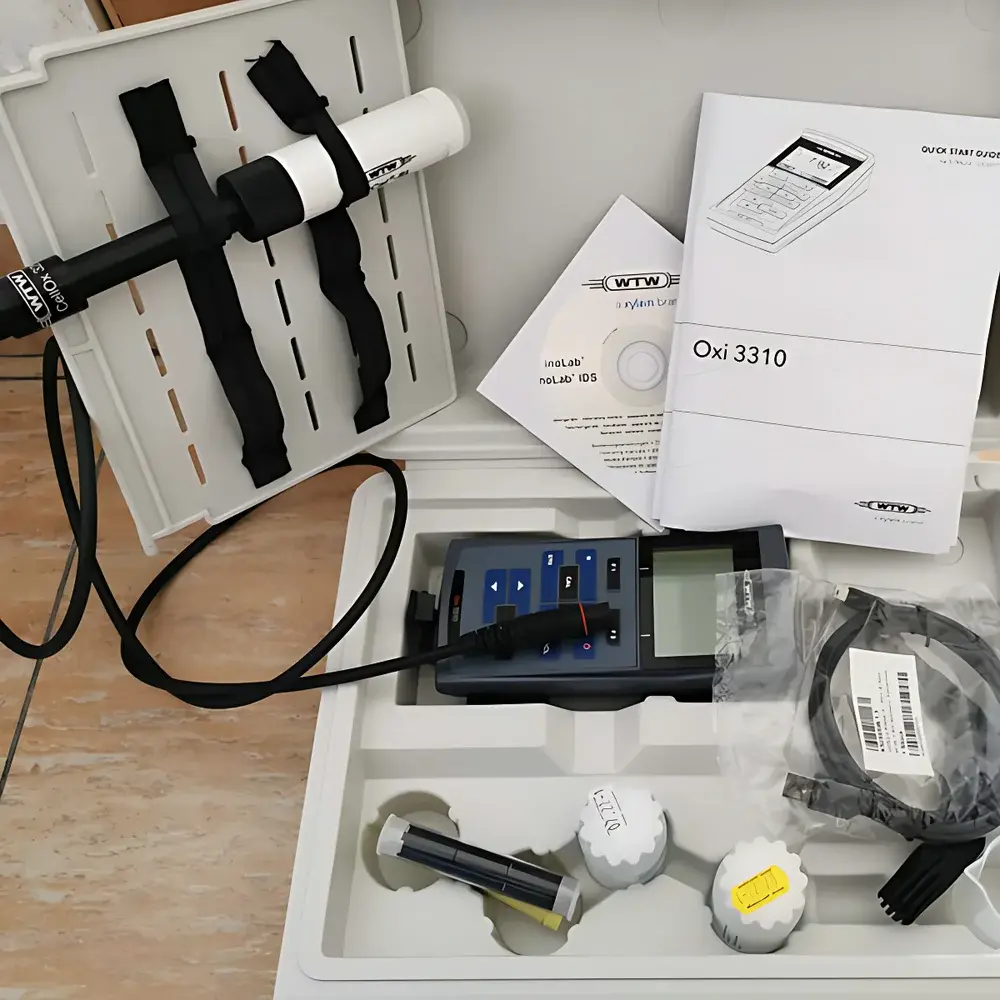
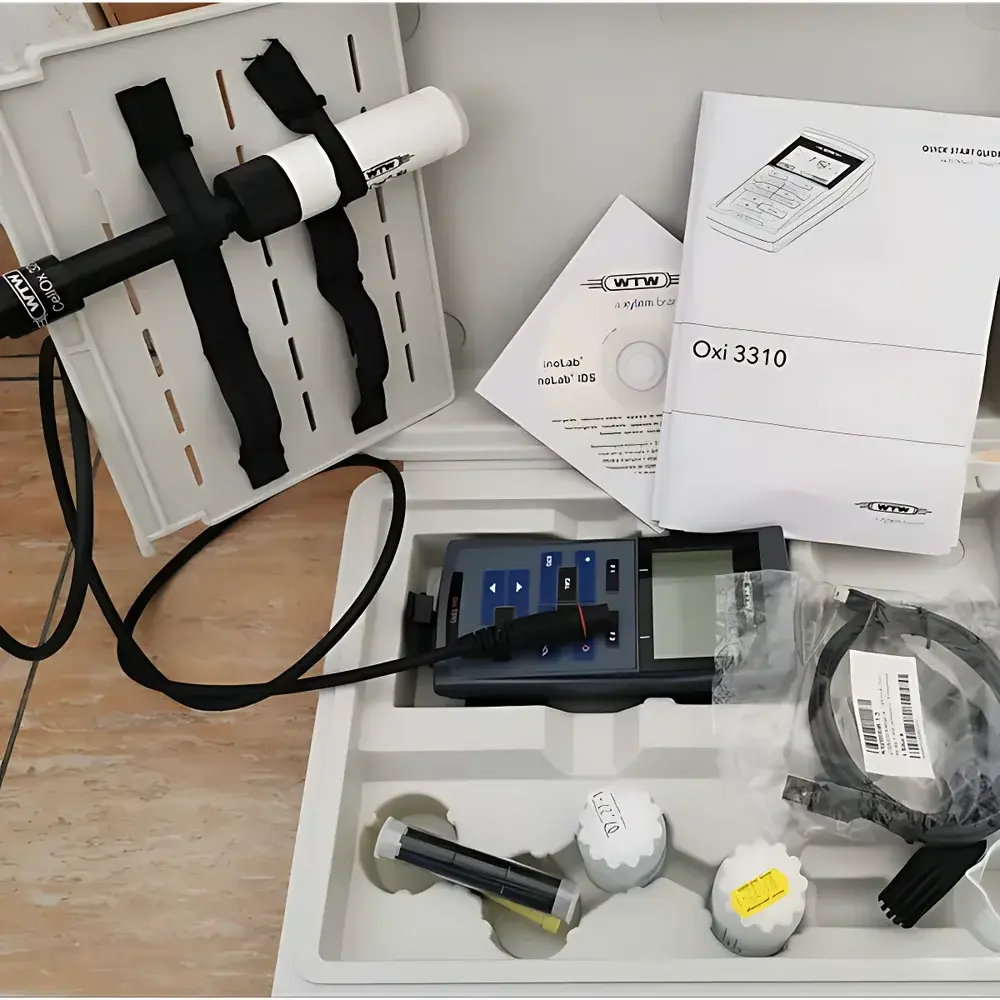
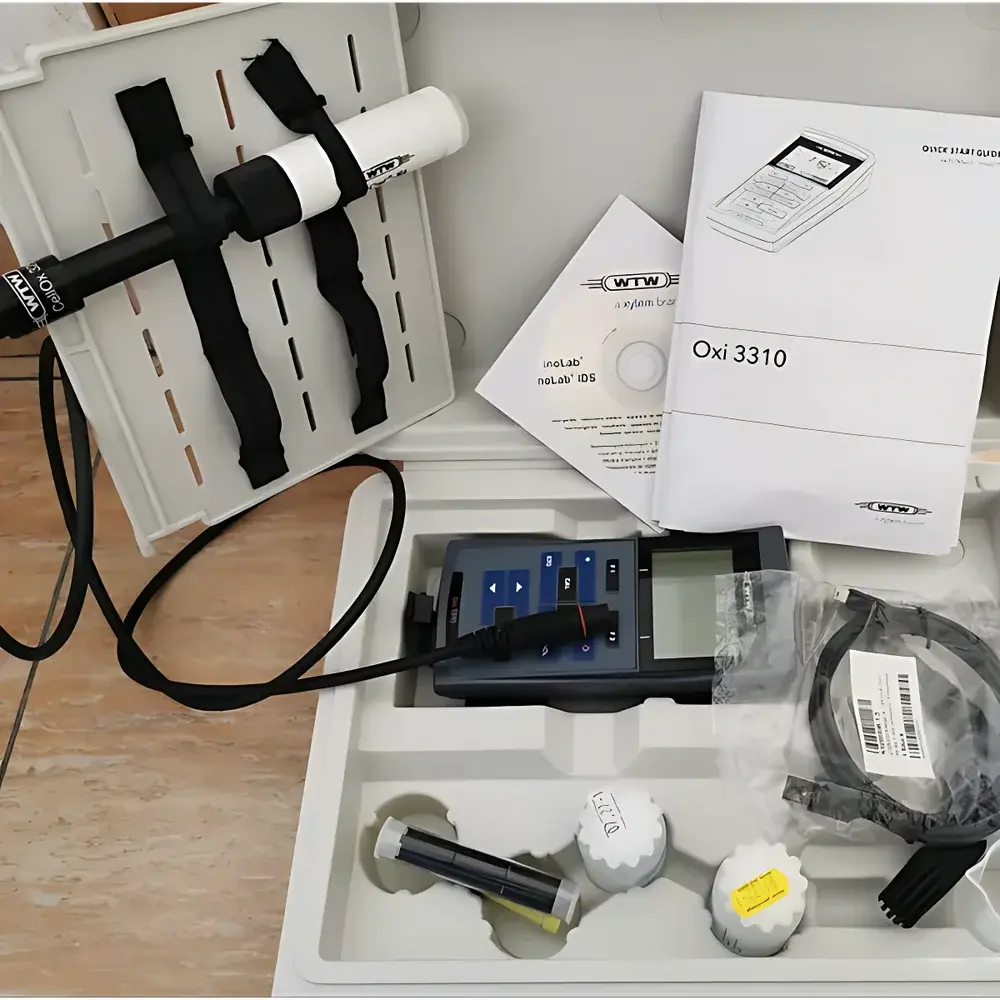
WTW Oxi 3310 Portable Dissolved Oxygen Meter with Integrated pH Measurement Capability
| Brand | WTW |
|---|---|
| Origin | Germany |
| Model | Oxi 3310 |
| Instrument Type | Portable |
| Measurement Principle | Electrochemical Clark-type Polarographic Sensor |
| DO Range | 0.00–19.99 mg/L (extended range up to 90 mg/L) |
| Accuracy | ±0.5% of reading |
| Saturation Range | 0.0–199.9% (extended to 600%) |
| Partial Pressure Range | 0–199.9 hPa / 0–1250 hPa |
| Temperature Range | −5.0 to +105.0 °C (±0.1 °C) |
| Data Storage | 200 manual + 5,000 automatic records |
| IP Rating | IP66/IP67 |
| Power Supply | 4 × 1.5 V alkaline or 4 × 1.2 V rechargeable batteries |
| Battery Life | up to 1000 h (150 h with backlight enabled) |
| Interface | Waterproof USB 2.0 |
| Calibration | Automatic timer-based OxiCal protocol with CellOx/DurOx probes |
| Temperature Compensation | ATC (Automatic Temperature Compensation) |
Overview
The WTW Oxi 3310 is a field-deployable, high-integrity portable dissolved oxygen (DO) meter engineered for rigorous environmental and industrial water quality monitoring. It employs a Clark-type polarographic electrochemical sensor principle—where molecular oxygen diffuses through a gas-permeable membrane to a cathode surface, generating a current proportional to the partial pressure of dissolved O₂. This fundamental electrochemical transduction ensures stable, drift-resistant measurements across variable salinity, temperature, and pressure conditions. Designed for compliance-critical workflows, the Oxi 3310 delivers traceable, reproducible data in accordance with standard methods including ISO 5814, ASTM D888, and EN 25814. Its integrated capability to simultaneously record temperature and calculate % saturation and partial pressure (hPa) supports multi-parameter interpretation required in regulatory reporting and process validation.
Key Features
- Triple-parameter measurement: Dissolved oxygen concentration (mg/L), saturation (%), and partial pressure (hPa), all referenced to real-time temperature (−5.0 to +105.0 °C) with ±0.1 °C accuracy.
- High-resolution display: 7-segment LCD with backlight; DO resolution down to 0.01 mg/L in standard range (0.00–19.99 mg/L), extended to 90 mg/L for high-oxygen applications such as ozonation or hyperoxic aquaculture systems.
- Robust field architecture: IP66/IP67-rated enclosure with silicone keypad—fully sealed against dust, rain, and temporary submersion. Designed for operation under extreme ambient conditions, including freezing temperatures and tropical humidity.
- Intelligent calibration management: Built-in OxiCal timer enforces scheduled recalibration intervals; post-calibration screen displays electrode status (e.g., membrane integrity, electrolyte level, cathode response slope) to support GLP-compliant maintenance logs.
- Continuous Measurement Control (CMC): Real-time validation logic compares each reading against the calibrated working range; visual indicators confirm validity, while audible/visual alerts trigger upon deviation—ensuring data integrity prior to storage or export.
- Extended data stewardship: Stores 200 manually triggered entries and up to 5,000 time-stamped automatic records (interval programmable from 1 second to 60 minutes), each containing DO value, temperature, date/time stamp, sample ID, calibration status flag, and pressure-compensated hPa output.
- Secure connectivity: Fully waterproof USB 2.0 interface enables direct transfer to Windows-based PCs or tablets without external housings or adapters—compatible with WTW LabX® Light software for audit-trail-enabled data review per FDA 21 CFR Part 11 requirements.
Sample Compatibility & Compliance
The Oxi 3310 is validated for use across heterogeneous aqueous matrices, including wastewater effluents, surface and groundwater, recirculating aquaculture systems (RAS), pharmaceutical process water, ultrapure water loops in semiconductor manufacturing, and potable distribution networks. Its CellOx 325 and DurOx probe family features replaceable membranes and optimized electrolyte formulations that minimize fouling in turbid or organic-rich samples. The instrument’s automatic barometric pressure compensation (500–1100 mbar) corrects for altitude-related oxygen solubility shifts—critical for field campaigns spanning mountainous or coastal zones. Regulatory alignment includes adherence to ISO/IEC 17025 documentation practices, USP for pharmaceutical water testing, and EPA Method 360.1 for wastewater DO analysis. All firmware and calibration routines are version-controlled and traceable via embedded device logging.
Software & Data Management
Data acquisition and post-processing are supported by WTW’s LabX® Light software suite—a lightweight, installation-free application that imports .csv or native .wtw files directly from the Oxi 3310. LabX® Light provides timestamped audit trails, user-defined report templates (PDF/Excel), statistical summaries (mean, SD, min/max), and trend visualization with configurable X/Y axes. Each exported dataset retains metadata fields: operator ID, location tag, probe serial number, calibration history reference, and environmental context (T, P, salinity if entered). For laboratories operating under GMP/GLP frameworks, optional LabX® Full Edition adds electronic signatures, role-based access control, and 21 CFR Part 11-compliant electronic record archiving with immutable hash verification.
Applications
- Wastewater treatment: Monitoring aeration basin DO profiles, nitrification/denitrification control, and final effluent compliance.
- Drinking water distribution: Verifying residual oxygen stability in cast-iron vs. PVC mains and detecting stagnation-induced anaerobic zones.
- Aquaculture & fisheries: Real-time DO mapping in ponds, raceways, and hatcheries to prevent hypoxia stress and optimize feeding cycles.
- Pharmaceutical manufacturing: Routine testing of purified water (PW) and water-for-injection (WFI) per USP , including microbial growth inhibition validation.
- Electronics-grade water systems: Ensuring sub-ppb-level oxygen control in rinse tanks and tool cooling loops where oxidation must be minimized.
- Environmental site assessment: Field screening of groundwater plumes, sediment porewater redox gradients, and stream reaeration capacity modeling.
FAQ
What calibration methods does the Oxi 3310 support?
The instrument implements WTW’s standardized OxiCal procedure using saturated air or zero-oxygen solutions (e.g., sodium sulfite), with automatic recognition of CellOx/DurOx probe types and built-in calibration timers to enforce frequency compliance.
Is temperature compensation fully automated?
Yes—ATC (Automatic Temperature Compensation) is integral to all DO calculations; the integrated Pt1000 sensor continuously adjusts for thermal effects on membrane permeability and diffusion kinetics.
Can the Oxi 3310 operate submerged?
It meets IP67 rating: fully dust-tight and capable of withstanding immersion in 1 m of freshwater for up to 30 minutes—ideal for wade-in river sampling or tank inspections.
How is pressure compensation handled during field use?
Barometric pressure is either manually entered or automatically detected via an internal sensor (500–1100 mbar range); compensation algorithms apply the Weiss equation to derive true dissolved concentration independent of elevation.
Does the device support multi-user environments?
While the Oxi 3310 itself does not feature onboard user accounts, LabX® Light software enables operator-specific login sessions, ensuring traceability when exporting datasets for QA/QC review.
Related Products







