
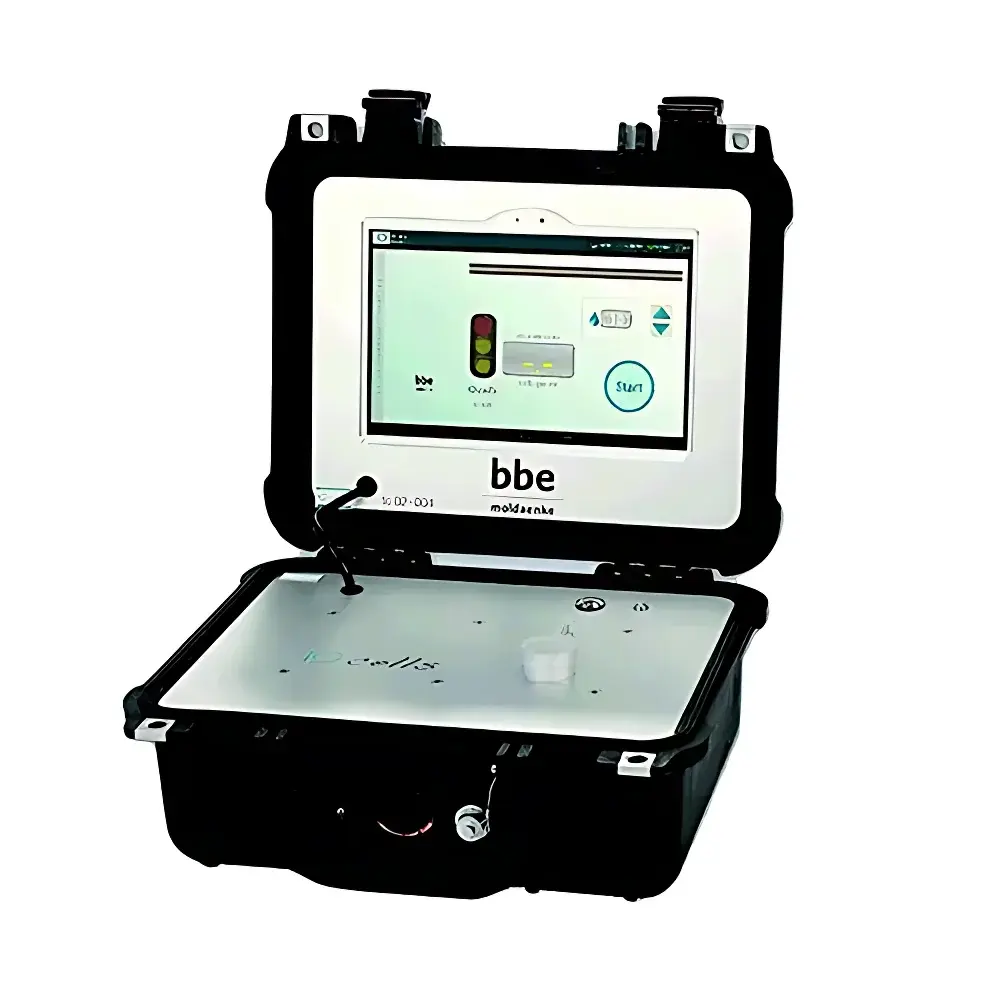
BBE Moldaenke TC Algal Cell Counter
| Brand | BBE Moldaenke |
|---|---|
| Origin | Germany |
| Manufacturer Type | Original Equipment Manufacturer (OEM) |
| Product Category | Imported Instrument |
| Model | TC |
| Instrument Type | Algal Cell Counter |
| Detection Principle | In Vivo Chlorophyll-a Fluorescence Analysis |
| Measurement Range | 0–20,000 cells/mL |
| Resolution | 1 cell/mL |
| Weight | 2.5 kg |
| Dimensions (H×W×D) | 258 × 243 × 117 mm |
| Power Supply | 100–240 V AC, 50/60 Hz |
| Protection Rating | IP54 (lid closed), IP22 (lid open) |
| Interface | USB |
| Sample Temperature Range | 5–55 °C |
| Ambient Operating Temperature | 5–35 °C |
| Data Storage Capacity | >100,000 measurements |
| Storage Temperature | 5–45 °C |
| Accessories Included | User Manual, 50 µm Filter, Power Adapter, 50-Filter Kit |
| Optional Accessory | 50-Filter Kit |
Overview
The BBE Moldaenke TC Algal Cell Counter is a field-deployable, benchtop-capable instrument engineered for rapid, reagent-free quantification of viable phytoplankton cells in water matrices. It operates on the principle of in vivo chlorophyll-a fluorescence excitation and spectral discrimination—leveraging the intrinsic photosynthetic pigment fluorescence signature of live algal cells. Unlike conventional microscopy or flow cytometry-based methods, the TC system applies pulsed blue LED excitation (typically ~450 nm) to induce chlorophyll-a fluorescence emission, followed by real-time spectral deconvolution across defined emission bands (e.g., 680 nm for green algae, 650 nm for cyanobacteria, and 710 nm for diatoms). This enables taxon-specific cell enumeration without staining, fixation, or centrifugation. The instrument delivers quantitative results in under 60 seconds per sample, with a detection limit of 1 cell/mL and linear dynamic range spanning 0–20,000 cells/mL—making it suitable for low-biomass applications such as drinking water source monitoring and ballast water compliance screening.
Key Features
- Direct measurement of physiologically active algal cells via native chlorophyll-a fluorescence—no dyes, fixatives, or chemical reagents required
- Integrated optical path with temperature-stabilized LEDs and narrow-band photodetectors ensuring high signal-to-noise ratio and inter-unit reproducibility
- Rugged, portable design certified to IP54 (closed) and IP22 (open), validated for use in field laboratories, water treatment plants, and onboard vessels
- Onboard rechargeable battery enabling >8 hours of continuous operation; also supports AC power for extended benchtop use
- Embedded data logger with >100,000 measurement storage capacity, timestamped and indexed by sample ID, operator, and calibration status
- USB interface compliant with USB 2.0 standards for seamless data export to Windows-based PCs; compatible with BBE’s proprietary TC Manager software (v3.2+)
- Pre-calibrated at factory using NIST-traceable algal reference suspensions; user-accessible calibration verification protocol included
Sample Compatibility & Compliance
The TC Algal Cell Counter accepts raw, unfiltered water samples—including potable water, surface water, treated effluent, and ballast water—with minimal volume requirements (typically 10–20 mL). A built-in 50 µm stainless-steel mesh filter prevents debris interference while retaining all relevant phytoplankton taxa (e.g., Microcystis, Anabaena, Chlamydomonas, Scenedesmus). The instrument complies with ISO 10260:2022 (water quality — determination of phytoplankton — fluorescence-based enumeration), supports GLP-aligned audit trails, and meets key elements of IMO G8 Ballast Water Management Convention Annex IV verification protocols. Its reagent-free methodology avoids regulatory constraints associated with hazardous chemical handling, aligning with EU REACH and US EPA Method 1623.2 supplemental guidance for non-destructive viability assessment.
Software & Data Management
TC Manager software provides full control over measurement parameters, calibration management, spectral library updates, and report generation. Each measurement record includes raw fluorescence spectra, peak intensity ratios, calculated cell density, confidence metrics, and environmental metadata (sample temperature, operator ID, GPS coordinates if connected via external module). Export formats include CSV, PDF (with embedded spectral plots), and XML for LIMS integration. Audit trail functionality satisfies FDA 21 CFR Part 11 requirements for electronic records and signatures when configured with user authentication and role-based access controls. Firmware updates are delivered via signed packages with SHA-256 verification.
Applications
- Real-time monitoring of algal blooms in reservoirs and distribution networks to support early-warning systems
- Ballast water treatment efficacy verification per IMO D-2 standard and USCG Type Approval testing
- Quality assurance in ultrapure water systems used in pharmaceutical manufacturing (ISO 8573-1 Class 2 compressed air–adjacent processes)
- Ecological research on phytoplankton community dynamics across trophic gradients
- Regulatory compliance reporting for municipal water utilities under national drinking water directives (e.g., EU Drinking Water Directive 2020/2184, US EPA Surface Water Treatment Rule)
FAQ
Does the TC require daily calibration?
No—factory calibration remains stable for ≥6 months under normal operating conditions. A quick verification test using supplied reference suspension is recommended before each analytical session.
Can the TC distinguish between cyanobacteria and eukaryotic algae?
Yes—via multi-band fluorescence ratio analysis (e.g., F650/F680), enabling semi-quantitative classification into major functional groups without morphological identification.
Is filtration mandatory for every sample?
A 50 µm filter is standard for particulate removal but may be omitted for clear, low-turbidity samples (e.g., finished drinking water); instrument firmware automatically adjusts gain and integration time accordingly.
How is data integrity ensured during field deployment?
All measurements are cryptographically timestamped and stored locally with CRC-32 checksum validation; USB transfer initiates automatic file integrity verification prior to export.
What maintenance is required?
Annual optical path inspection and LED output verification by authorized BBE service centers; no consumables beyond optional filter kits.
Related Products







