
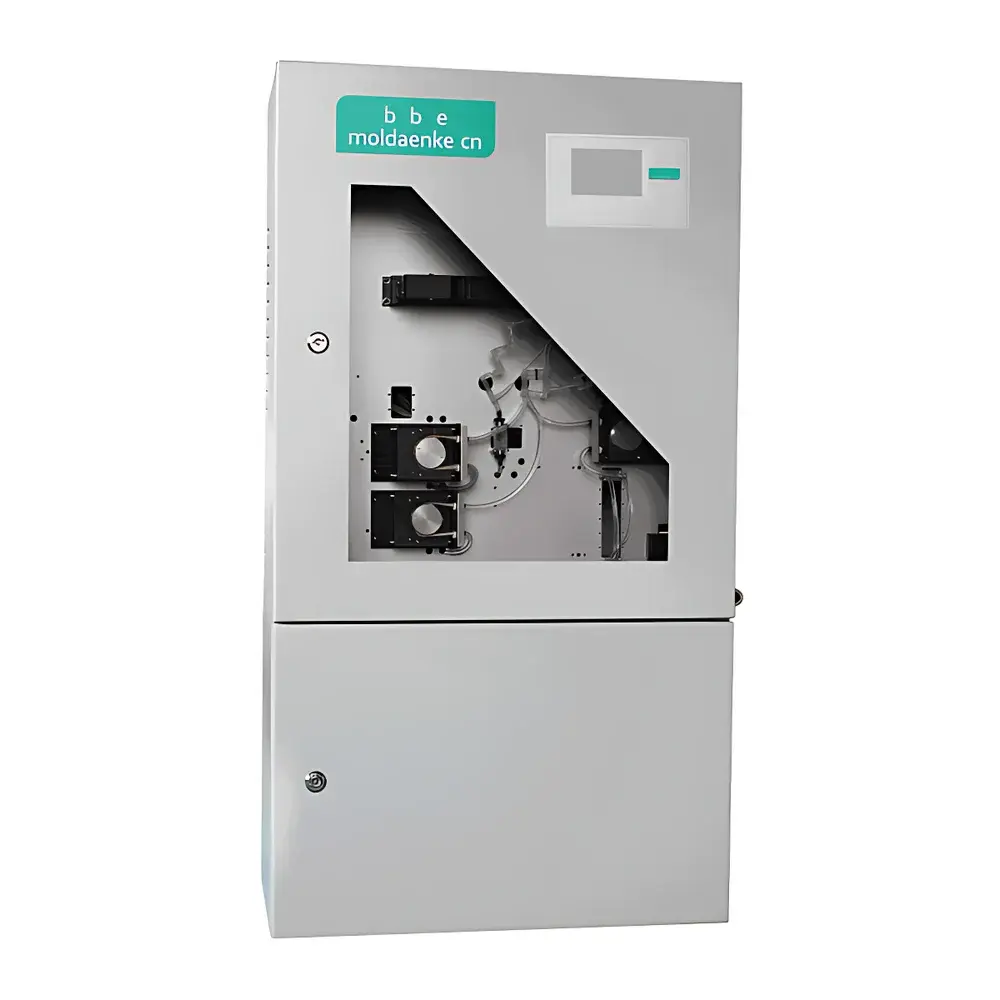
bbe TN—PWR II Online Total Nitrogen Water Quality Analyzer
| Brand | BBE / bbe Moldaenke |
|---|---|
| Origin | Germany |
| Manufacturer Type | Original Equipment Manufacturer (OEM) |
| Product Origin | Imported |
| Model | bbe TN—PWR II |
| Instrument Type | Online Water Quality Analyzer |
| Measured Parameter | Total Nitrogen (TN) |
| Measurement Principle | Alkaline Potassium Persulfate Digestion + UV-Vis Spectrophotometry |
| Measurement Range | 0–2.5 / 10 / 50 / 350 mg/L TN (selectable) |
| Accuracy | ≤ ±3% FS or ±0.05 mg/L (whichever is greater) |
| Repeatability | ≤2% RSD |
| Detection Limit | 0.05 mg/L (at lowest range) |
| Zero Drift | ≤3% FS/24 h |
| Span Drift | ≤3% FS/24 h |
| Measurement Cycle Time | 21 minutes |
| Resolution | 0.01 mg/L (at lowest range) |
| Dimensions (H×L×W) | 1190 × 600 × 310 mm |
| Weight | ~45 kg |
| Sample Requirements | Oil-free, low-suspended solids |
| Temp. | 2–40 °C |
| Pressure | 0–0.1 bar |
| Flow Rate | 1.5–3.0 L/min |
| Output Interfaces | 4–20 mA analog output, RS232/RS485 serial communication |
| Protocol Support | MODBUS RTU/TCP (optional), TCP/IP (optional) |
| Key Features | Full-spectrum UV-Vis detection (220 nm, 275 nm, 400 nm, 700 nm), turbidity interference correction, integrated UV-assisted digestion, automatic calibration & cleaning, touchscreen HMI, remote status monitoring & QC verification (optional), power-fail recovery |
Overview
The bbe TN—PWR II Online Total Nitrogen Water Quality Analyzer is an industrial-grade, fully automated instrumentation system engineered for continuous, real-time quantification of total nitrogen (TN) in aqueous matrices including surface water, drinking water, municipal wastewater, and industrial effluents. It implements the standardized alkaline potassium persulfate digestion method followed by dual-wavelength ultraviolet–visible (UV-Vis) spectrophotometric detection — a technique aligned with ISO 11905-1, EPA Method 353.2, and DIN EN ISO 11905-1. The analyzer performs complete chemical oxidation of organic and inorganic nitrogen species (e.g., ammonia, nitrate, nitrite, and organically bound nitrogen) into nitrate under high-pH, high-temperature UV-enhanced digestion conditions. Subsequent photometric measurement at 220 nm (nitrate absorption peak) and 275 nm (correction for dissolved organic carbon interference) enables precise, matrix-compensated TN calculation. Its robust architecture supports unattended operation in demanding environmental monitoring stations, water treatment plants, and regulatory compliance laboratories.
Key Features
- Integrated UV-assisted alkaline persulfate digestion module ensuring complete oxidation across diverse nitrogen speciation profiles
- Full-spectrum UV-Vis photometer with programmable wavelength selection (220 nm, 275 nm, 400 nm, 700 nm) for multi-point spectral correction
- Proprietary turbidity interference compensation algorithm based on 700 nm reference channel measurement
- Automated daily calibration using certified standard solutions and zero-point verification with deionized water
- Self-cleaning fluidic path with configurable rinse cycles to minimize carryover and biofilm formation
- Industrial-grade 7-inch capacitive touchscreen HMI with intuitive navigation, multilingual interface support (EN/DE/FR/ES), and embedded diagnostic logs
- Fail-safe power recovery: automatic reinitialization and resumption of scheduled measurement cycles after power interruption
- Modular hardware design enabling field-replaceable components (digestion cell, optical module, peristaltic pump heads) without system recalibration
Sample Compatibility & Compliance
The bbe TN—PWR II is validated for use with low-turbidity, oil-free water samples meeting specified physical constraints: temperature range 2–40 °C, pressure head 0–0.1 bar, and volumetric flow rate 1.5–3.0 L/min. It complies with IEC 61326-1 (EMC for laboratory and industrial environments) and IEC 61000-6-2/-4 (immunity to electrostatic discharge, fast transients, and surge). For regulated applications, the system supports audit-ready data integrity features when configured with optional GLP/GMP-compliant software modules, including electronic signatures, 21 CFR Part 11–compliant user access control, and immutable audit trails for calibration events, maintenance logs, and measurement history.
Software & Data Management
The analyzer operates on embedded Linux-based firmware with local data storage (≥6 months of 15-minute interval records). Standard communication protocols include isolated 4–20 mA analog outputs and RS485 Modbus RTU for integration into SCADA or DCS platforms. Optional Ethernet connectivity enables MODBUS TCP and native TCP/IP socket communication for direct cloud telemetry or centralized data lakes. Remote monitoring capabilities — available via optional bbe Connect™ gateway — deliver real-time instrument status, consumables life tracking, QC check results, and predictive maintenance alerts through secure HTTPS web interface or RESTful API endpoints.
Applications
- Continuous TN monitoring at influent/effluent points of municipal wastewater treatment plants (WWTPs) for regulatory reporting (e.g., EU Urban Wastewater Treatment Directive, US Clean Water Act NPDES permits)
- In-process control of denitrification efficiency in biological nutrient removal (BNR) systems
- Drinking water source protection programs requiring early warning of agricultural runoff or sewage infiltration
- Industrial pretreatment compliance verification for food processing, pharmaceutical, and chemical manufacturing facilities
- Long-term ecological trend analysis in lake and river monitoring networks under national water framework directives
FAQ
What digestion method does the bbe TN—PWR II employ?
It uses alkaline potassium persulfate digestion enhanced by UV irradiation to ensure quantitative conversion of all nitrogen forms to nitrate.
Can the instrument be calibrated remotely?
Yes — with optional remote access configuration, users can initiate manual calibrations, adjust measurement parameters, and review calibration certificates via secure web interface.
Is the system compatible with existing plant SCADA systems?
Yes — standard Modbus RTU over RS485 and optional Modbus TCP enable seamless integration with most industrial automation platforms.
How often does the system require maintenance?
Scheduled maintenance intervals are every 3 months for consumables (digestion reagents, tubing, filters); full functional verification is recommended semiannually per ISO/IEC 17025 guidelines.
Does the analyzer meet US EPA or ISO method equivalency requirements?
Its analytical methodology conforms to the principles of EPA Method 353.2 and ISO 11905-1; formal method validation reports are available upon request for site-specific regulatory submission.
Related Products







