
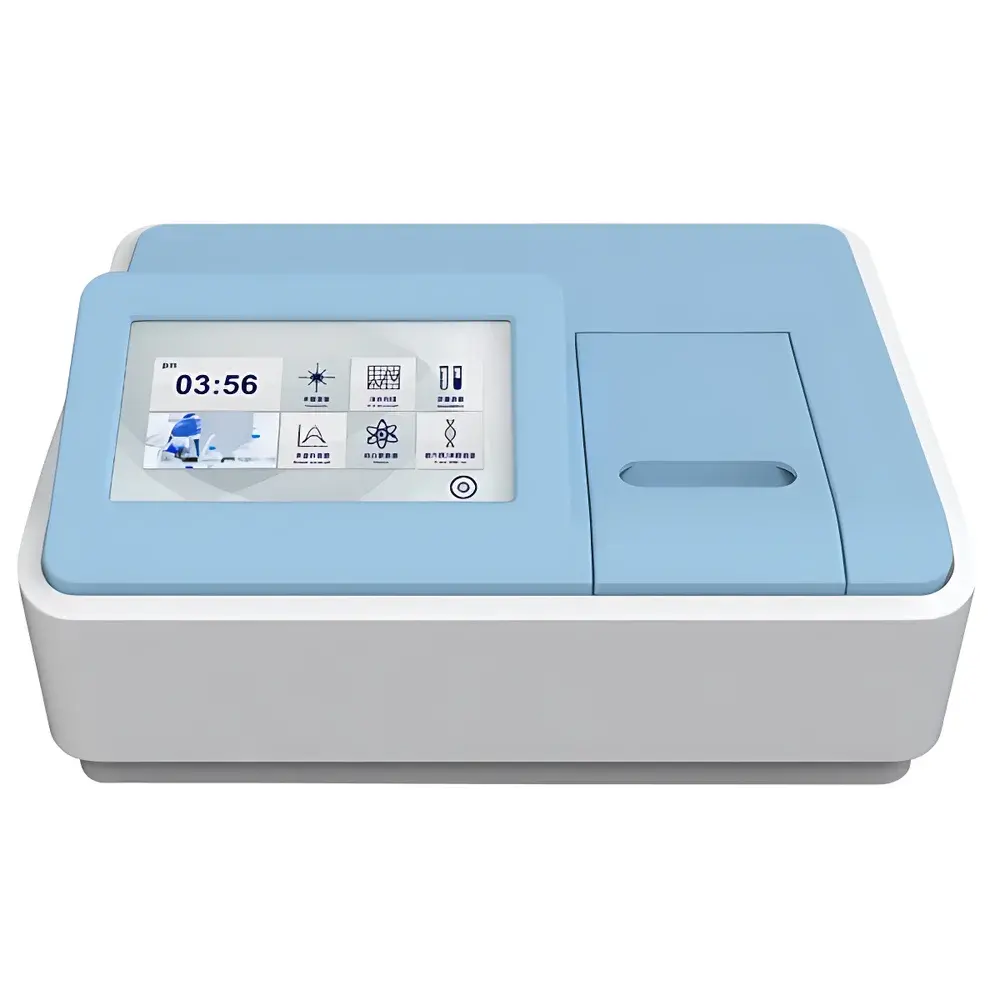
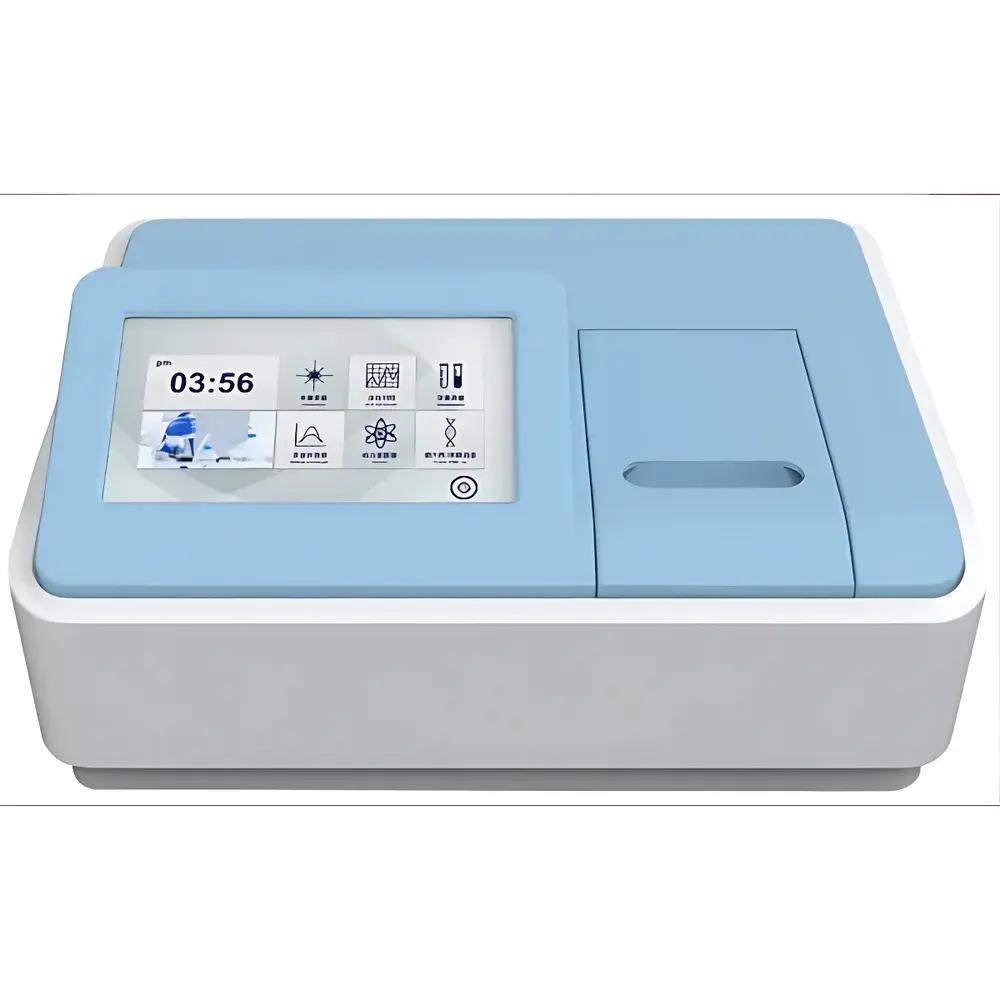
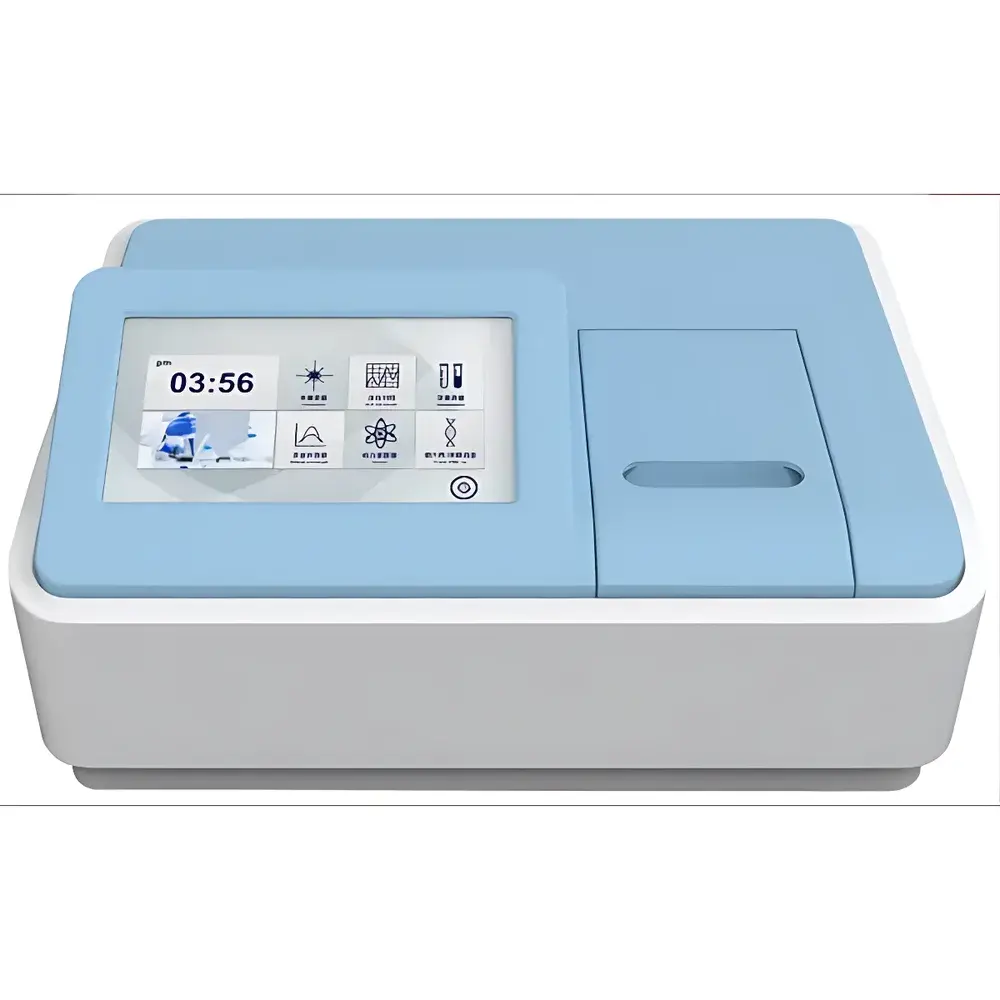
Yoke L8 Series UV-Vis Spectrophotometer
| Brand | Yoke |
|---|---|
| Origin | Shanghai, China |
| Manufacturer Type | Authorized Distributor |
| Country of Origin | China |
| Model | L8 Series |
| Price | USD 2,500 (FOB Shanghai) |
| Optical Design | Dual-Beam Ratio System |
| Detector | Photodiode Array (PDA) |
| Wavelength Range | 190–1100 nm |
| Wavelength Accuracy | ±0.3 nm |
| Wavelength Repeatability | ≤0.1 nm |
| Spectral Bandwidth | 1 nm |
| Stray Light | ≤0.03% T (at 220 nm, using NaI solution) |
| Display | 10-inch capacitive touchscreen (1024 × 800 resolution) |
| Data Storage | Internal memory for up to 5,000 absorbance readings or 500 calibration curves |
| Connectivity | RS-232C (printer), USB Device (PC connection), USB Host (U-disk support) |
| File Export Formats | CSV, QUA, TXT, BMP |
| Optional Accessories | 8-position automated cuvette changer, integrated flow cell module |
Overview
The Yoke L8 Series UV-Vis Spectrophotometer is a dual-beam ratio spectrophotometric instrument engineered for precision quantitative and qualitative analysis in routine laboratory environments. Based on the Czerny-Turner monochromator architecture and employing a photodiode array (PDA) detector, it delivers high-fidelity spectral acquisition across a broad wavelength range from 190 nm to 1100 nm—covering deep ultraviolet through near-infrared regions. Its dual-beam optical design continuously compensates for source intensity drift and environmental fluctuations by simultaneously measuring sample and reference beams, thereby ensuring long-term baseline stability and measurement reproducibility. The instrument conforms to core performance criteria outlined in ISO 6425, ASTM E275, and USP , supporting method validation under GLP-compliant workflows.
Key Features
- 10-inch high-resolution capacitive touchscreen (1024 × 800) enables fully standalone operation—no external PC required for spectrum scanning, kinetic assays, multi-wavelength quantitation, or time-based measurements.
- Solid-state optical platform featuring suspended optical bench construction mounted on reinforced aluminum baseplate—minimizes mechanical drift induced by thermal expansion or vibration.
- Electronically isolated dual-layer chassis separates optical path components from power and signal circuitry, reducing electromagnetic interference and enhancing signal-to-noise ratio.
- Integrated ARM12 high-performance embedded processor supports real-time data processing, onboard storage of up to 5,000 absorbance values or 500 user-defined calibration curves, and seamless firmware updates via USB.
- Comprehensive data export capability: direct saving to USB flash drives in four native formats—CSV (for spreadsheet integration), QUA (Yoke proprietary spectral format), TXT (ASCII-readable), and BMP (publication-ready image).
- Expandable configuration options include an 8-position motorized cuvette changer with precise optical centering alignment and an optional integrated flow cell system for continuous monitoring applications.
Sample Compatibility & Compliance
The L8 Series accommodates standard 10 mm square quartz, glass, or plastic cuvettes (pathlengths: 1–100 mm). It supports both transmission and reflectance measurements when paired with appropriate accessories (e.g., integrating sphere, variable-angle holder). All optical components comply with RoHS Directive 2011/65/EU. Instrument performance verification protocols align with ISO/IEC 17025 requirements for testing laboratories. Data integrity safeguards—including timestamped audit trails, operator ID logging, and immutable file naming conventions—facilitate compliance with FDA 21 CFR Part 11 where electronic records are subject to regulatory review.
Software & Data Management
The embedded operating system provides intuitive graphical interface navigation for method creation, spectral overlay, derivative plotting, peak detection, and concentration calculation using single/multi-point calibration models. Raw spectral data are stored with metadata (date/time, operator ID, instrument serial number, lamp status, slit width, scan speed). USB-host functionality permits direct transfer of datasets to networked storage or LIMS without intermediate software layers. For advanced analysis, exported CSV files integrate natively with MATLAB, Python (NumPy/Pandas), or commercial chemometrics platforms such as Unscrambler or SIMCA.
Applications
This spectrophotometer serves critical roles in pharmaceutical QC (e.g., assay of active ingredients per USP monographs), environmental water quality testing (nitrate, phosphate, COD determination), food & beverage analysis (color index, preservative quantification), academic research (enzyme kinetics, ligand binding studies), and materials science (thin-film transmittance/absorbance profiling). Its 1 nm spectral bandwidth and ≤0.03% stray light specification make it suitable for low-transmittance measurements at UV extremes—particularly relevant for nucleic acid purity assessment (A260/A280, A260/A230 ratios) and protein quantitation via Bradford or BCA assays.
FAQ
Does the L8 Series support GLP-compliant data handling?
Yes—the instrument logs all measurement events with timestamps, operator IDs, and system configuration parameters. Audit trail export is available in CSV format for internal QA review.
Can third-party software control the instrument via USB or RS-232?
No—the L8 operates exclusively via its embedded OS; external PC control is not supported. However, exported data files are fully interoperable with common analytical software packages.
What is the recommended maintenance interval for the deuterium and tungsten lamps?
Lamp lifetime is rated at ≥2,000 hours under typical usage. Automatic lamp switching occurs at 340 nm; users receive on-screen alerts when lamp energy falls below 70% of nominal output.
Is the 8-position cuvette changer compatible with non-standard cuvette dimensions?
The changer accepts only standard 12.5 × 12.5 mm rectangular cuvettes. Custom holders for microvolume or flow cells require factory-order accessory kits.
How does the suspended optical system improve measurement stability?
By decoupling the monochromator and detector assembly from the main chassis using elastomeric mounts, the design attenuates sub-micron displacements caused by ambient vibration or thermal gradients—critical for maintaining ≤0.1 nm wavelength repeatability over extended runs.
Related Products




