
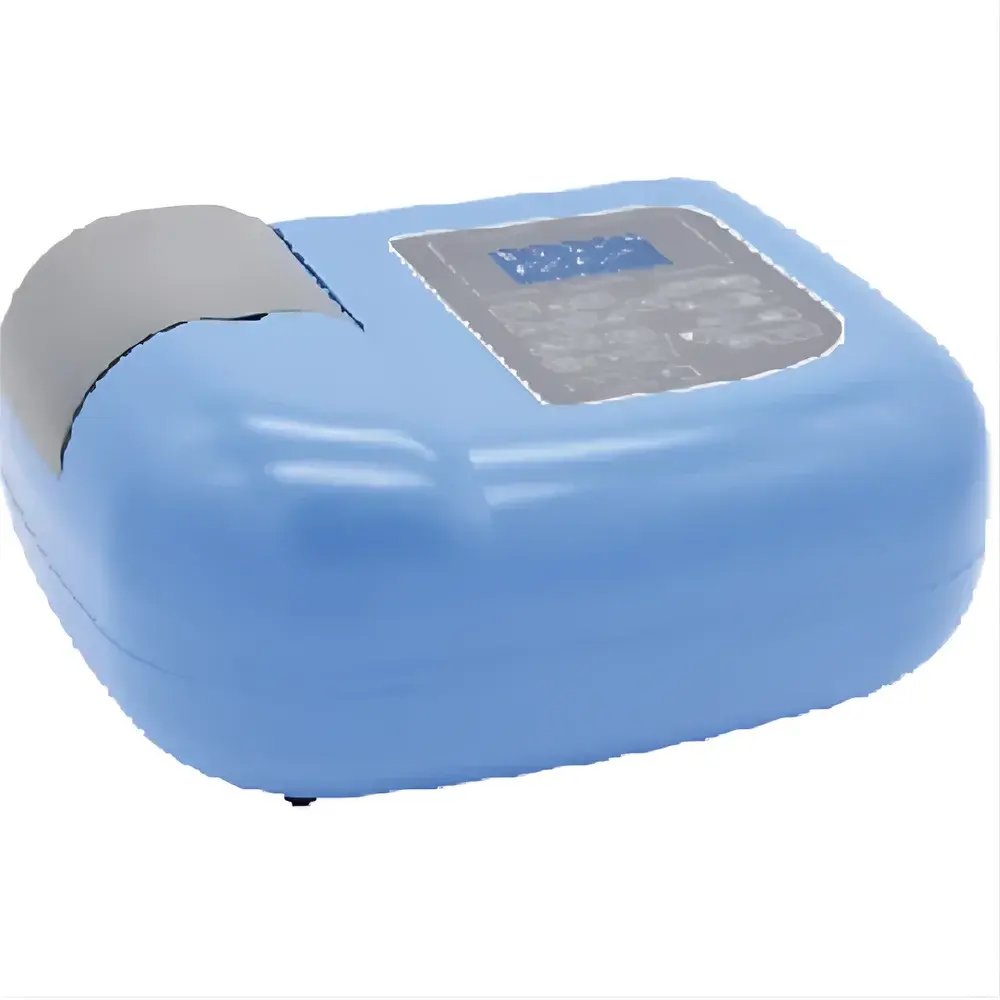
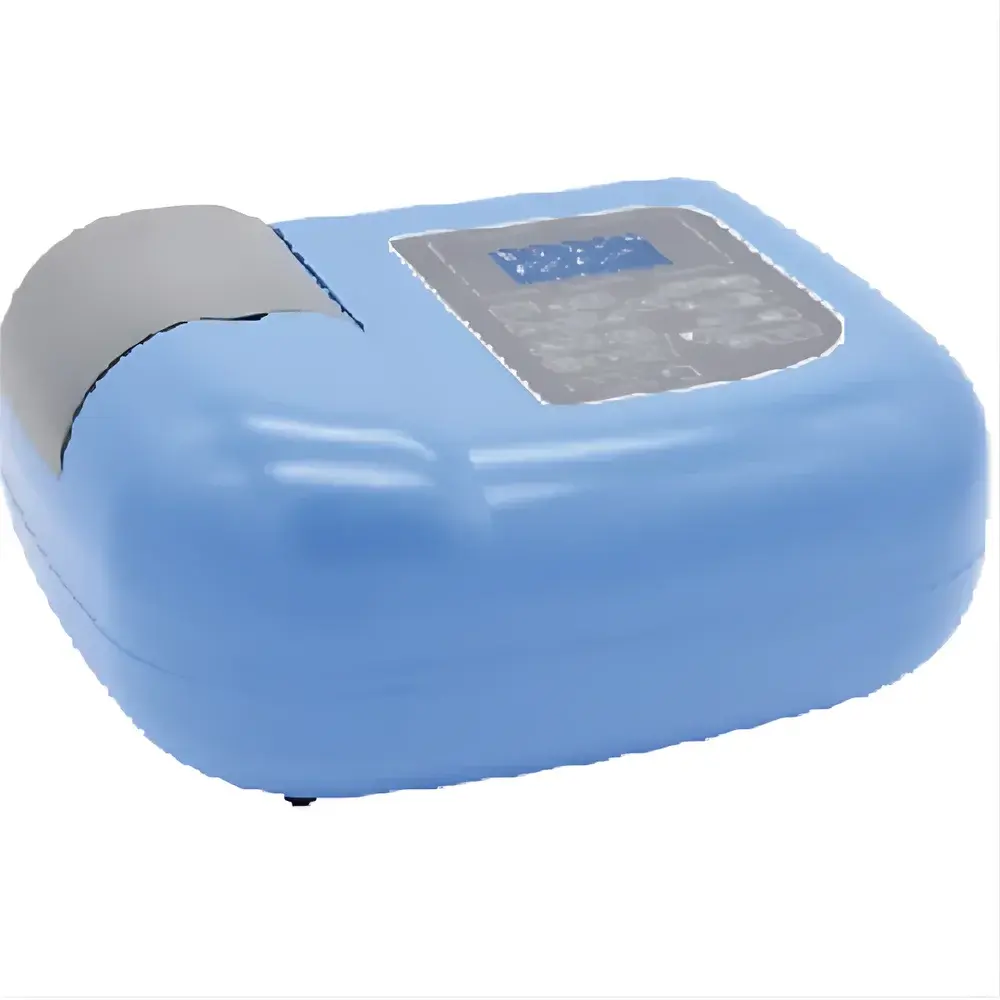
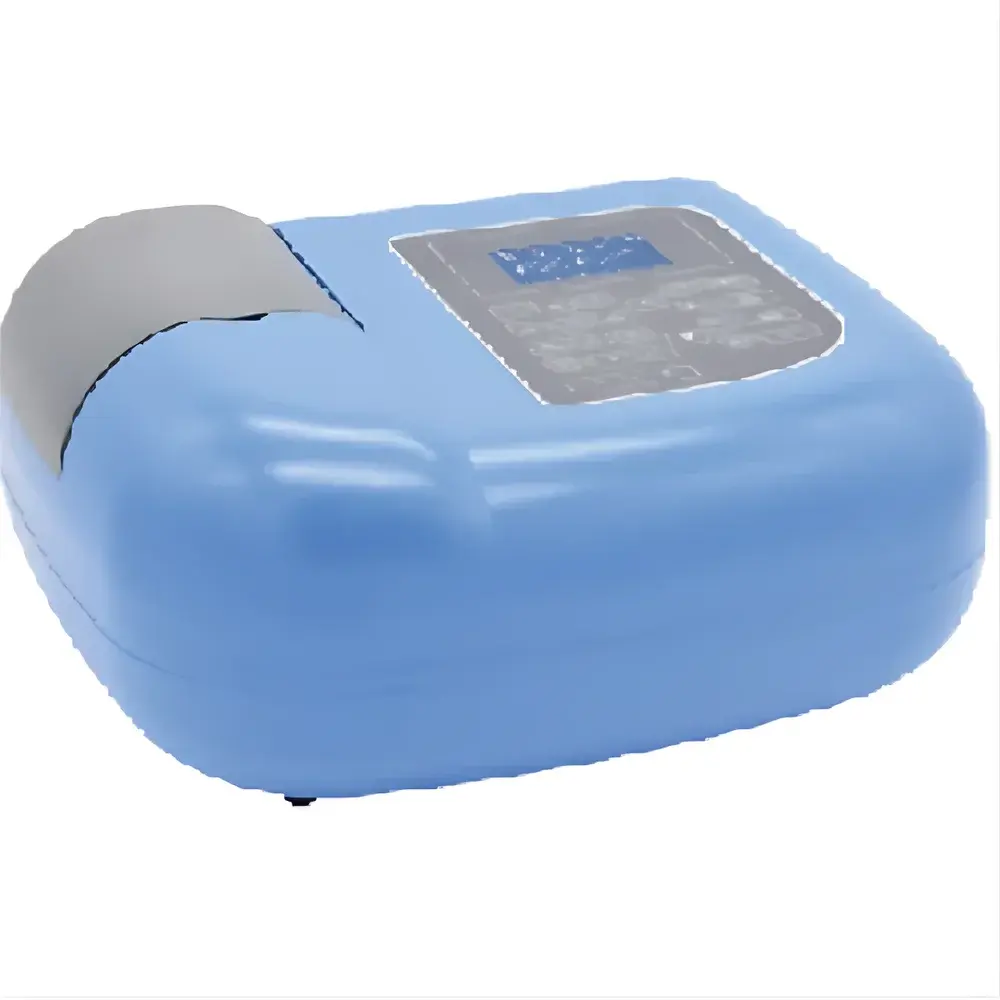
UniCov V1600 Portable Visible Spectrophotometer
| Brand | UniCov |
|---|---|
| Origin | Shanghai, China |
| Model | V1600 |
| Optical System | Single-beam |
| Wavelength Range | 325–1000 nm |
| Spectral Bandwidth | 2 nm / 4 nm |
| Wavelength Accuracy | ±2 nm |
| Wavelength Repeatability | 1 nm |
| Stray Light | ≤0.4% T (at 360 nm) |
| Photometric Accuracy | ±0.002 Abs (0–0.5 Abs), ±0.005 Abs (0.5–1.0 Abs), ±0.5% T |
| Photometric Repeatability | ±0.001 Abs (0–0.5 Abs), ±0.002 Abs (0.5–1.0 Abs), ±0.2% T |
| Baseline Linearity | ±0.002 A |
| Drift | ±0.002 A/h (at 500 nm, after warm-up) |
| Display | Large LCD with 1 nm wavelength resolution |
| Dimensions | 360 × 280 × 180 mm |
| Weight | Not specified |
Overview
The UniCov V1600 Portable Visible Spectrophotometer is a compact, single-beam optical instrument engineered for rapid, field-deployable quantitative analysis in the visible spectral region. Operating on the principle of Beer–Lambert law-based absorbance measurement, it utilizes a 1200-line/mm diffraction grating monochromator to deliver precise wavelength selection across a continuous range from 325 nm to 1000 nm. Designed for environments where laboratory infrastructure is unavailable—such as environmental monitoring sites, food safety inspection points, educational field labs, and emergency response units—the V1600 integrates robust optical alignment, thermal stabilization, and low-power electronics to maintain measurement integrity under variable ambient conditions. Its single-beam architecture ensures mechanical simplicity and long-term optical path stability, while the fixed-slit design supports consistent spectral bandwidth performance at either 2 nm or 4 nm—configurable per application requirements for optimal balance between resolution and signal-to-noise ratio.
Key Features
- Portable form factor (360 × 280 × 180 mm) with optional rechargeable battery pack and AC adapter for uninterrupted operation in remote or mobile settings.
- Large backlit LCD display with 1 nm wavelength resolution and real-time photometric readout in transmittance (%T), absorbance (A), concentration (C), or factor (F) modes.
- Automated wavelength initialization and zero/100%T calibration routines reduce operator dependency and minimize setup errors.
- Onboard memory stores up to 200 user-defined test methods—including standard curve parameters, calibration coefficients, and sample ID templates—enabling rapid method recall without external software.
- Light-touch membrane keypad provides tactile feedback and reduces mechanical wear compared to traditional mechanical switches.
- RS-232 serial interface supports bidirectional communication with PCs or LIMS for automated data logging, report generation, and audit trail compliance.
Sample Compatibility & Compliance
The V1600 accommodates standard 10 mm pathlength cuvettes (glass or plastic), including those supplied in the standard configuration (1 cm matched glass cuvettes and dedicated cuvette holder). It meets fundamental performance criteria outlined in ISO 6223:2021 (Spectrophotometers — Performance verification) and ASTM E275-22 (Standard Practices for Describing and Measuring Performance of Ultraviolet, Visible, and Near Infrared Spectrophotometers). While not certified for regulated GMP/GLP environments out-of-the-box, its stable baseline (±0.002 A/h at 500 nm post-warm-up), low stray light (<0.4% T at 360 nm), and traceable photometric accuracy support use in quality control workflows compliant with ISO/IEC 17025 when paired with documented calibration procedures and NIST-traceable reference standards.
Software & Data Management
Data acquisition and method management are supported via UniCov’s proprietary PC-based software suite (compatible with Windows 10/11), which enables full instrument control, spectral scanning, kinetic assay monitoring, and multi-point standard curve fitting (linear, quadratic, or cubic regression). All raw absorbance values, calibration timestamps, operator IDs, and instrument configuration logs are timestamped and exportable in CSV or XML format. The RS-232 interface allows integration into laboratory information management systems (LIMS) and supports basic FDA 21 CFR Part 11 functionality—including electronic signatures and audit trail generation—when deployed with validated software configurations and access-controlled user accounts.
Applications
- Environmental field testing: Nitrate, phosphate, and iron concentration analysis in surface water and wastewater using colorimetric reagents.
- Food and beverage QC: Determination of colorants (e.g., tartrazine, sunset yellow), antioxidant capacity (FRAP assay), and turbidity-related haze measurements.
- Educational laboratories: Teaching spectroscopic principles, Beer’s law validation, and enzyme kinetics (e.g., NADH oxidation at 340 nm).
- Pharmaceutical pre-screening: Excipient purity checks and dissolution profile verification in non-GMP pilot studies.
- Industrial process support: On-site verification of dye concentrations in textile effluents or pigment dispersion homogeneity in coatings.
FAQ
What is the minimum detectable absorbance change this instrument can resolve?
The photometric repeatability specification of ±0.001 Abs (0–0.5 Abs range) indicates reliable discrimination of absorbance differences ≥0.002 Abs under controlled conditions.
Can the V1600 perform time-based kinetic measurements?
Yes—when connected to a host PC running UniCov’s software, the instrument supports programmable time-scan mode with user-defined intervals from 0.1 s to 600 s per data point.
Is the 2 nm spectral bandwidth factory-configurable or user-selectable?
Bandwidth is hardware-determined by slit width; the V1600 offers two fixed optical configurations (2 nm or 4 nm), selected at time of order—no in-field switching capability.
Does the instrument include NIST-traceable calibration standards?
No—certified reference materials (e.g., holmium oxide filters, neutral density filters) must be procured separately to establish traceability per ISO/IEC 17025 requirements.
What is the warm-up time required to achieve specified stability?
Optimal photometric stability (±0.002 A/h) is achieved after a 30-minute warm-up period at ambient temperatures between 15–30 °C.





