
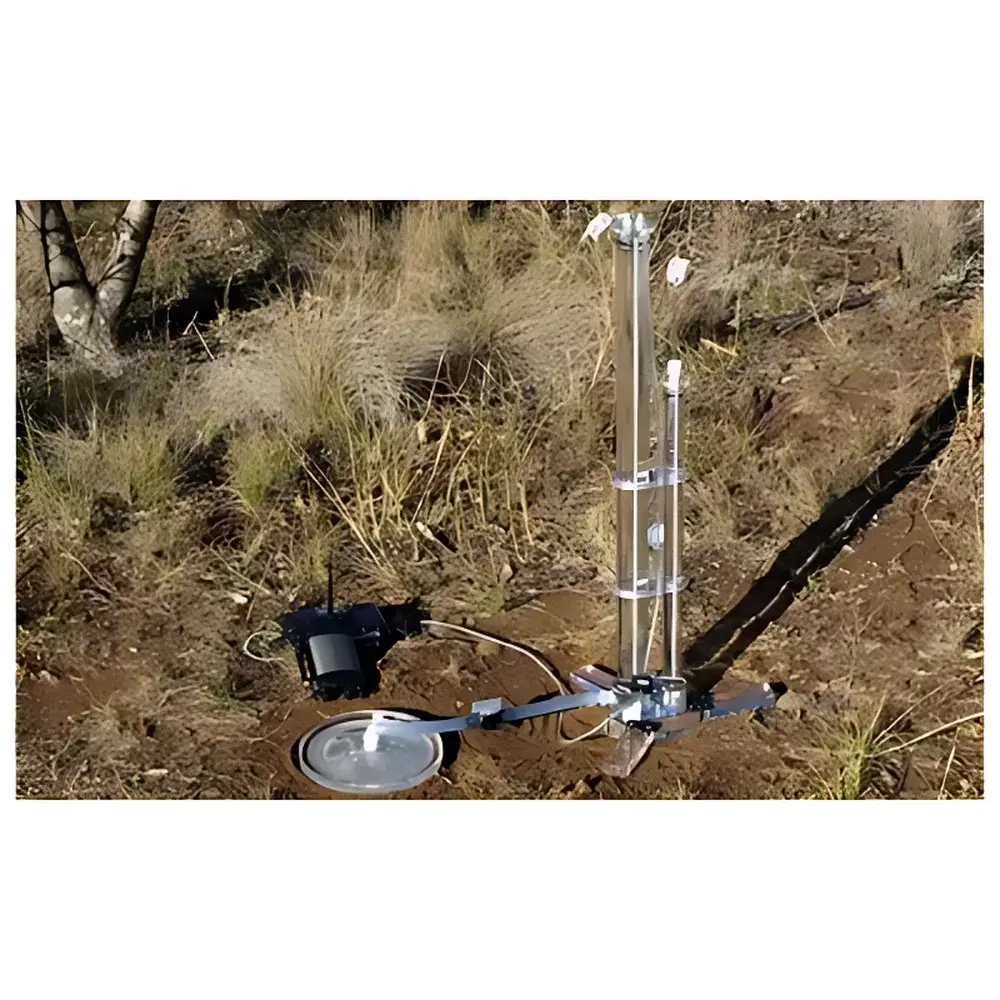
ICT International AIM Automated Soil Infiltration Meter
| Brand | ICT International |
|---|---|
| Model | AIM |
| Origin | Australia |
| Data Acquisition Channels | 5 differential or 10 single-ended analog inputs |
| Resolution | 24-bit (0.00001 V) |
| Accuracy | ±0.001 V |
| Minimum Sampling Interval | 1 s |
| Maximum Sampling Rate | 10 Hz |
| Data Storage | 4 GB internal + microSD card (FAT32, up to 64 GB) |
| Communication | USB 2.0 & 2.4 GHz wireless |
| Power Supply | 12 V DC non-polarized (24 V charger compatible) |
| Battery | Rechargeable polymer Li-ion with auto-variable charging (50–200 mA) |
| Operating Temperature | −40 °C to +80 °C |
| Humidity Range | 0–100% RH |
| Enclosure Rating | IP65 (sensor interface rated IP68) |
| Software Platform | Windows XP/Vista/7 |
| Data Format | CSV |
| Sensor Compatibility | Up to 5 ICT GT3-1 tensiometric infiltration sensors (±7 kPa, ±1% FS, 0.01 kPa resolution) |
Overview
The ICT International AIM Automated Soil Infiltration Meter is an engineered field-deployable data acquisition system designed for continuous, high-temporal-resolution measurement of unsaturated soil hydraulic conductivity and cumulative infiltration rates. It operates on the principle of tensiometric infiltration monitoring—leveraging precise pressure transducer feedback from tension infiltrometers to quantify water movement into variably saturated soil matrices under natural boundary conditions. Unlike manual ring-infiltrometer methods reliant on stopwatch timing and subjective visual interpretation, the AIM system automates both sensor excitation and real-time conversion of raw voltage outputs into physically meaningful infiltration depth (cm) versus time (s) series. This enables robust quantification of infiltration dynamics across heterogeneous field sites—including agricultural plots, reclaimed mine soils, riparian buffers, and managed aquifer recharge zones—without requiring constant operator presence.
Key Features
- Standalone operation with integrated 4 GB flash memory and expandable microSD storage (FAT32, up to 64 GB)
- 24-bit analog-to-digital resolution across five differential (or ten single-ended) input channels, supporting simultaneous monitoring of up to five ICT GT3-1 tensiometric sensors
- Programmable sampling logic: fixed-interval acquisition, delayed start, and adaptive triggering based on user-defined thresholds
- Dual communication architecture: direct USB 2.0 connection for configuration and data retrieval; optional 2.4 GHz wireless module for remote telemetry in mesh-compatible deployments
- Industrial-grade enclosure rated IP65 (with IP68-rated sensor interface connectors), validated for long-term exposure to rain, dust, and thermal cycling
- Intelligent power management system featuring auto-variable solar charging (50–200 mA range), real-time battery voltage and charge current telemetry, and low-power sleep modes extending field autonomy to >72 hours on internal battery
- Non-polarized 12 V DC input compatibility, eliminating wiring polarity errors during rapid deployment
Sample Compatibility & Compliance
The AIM system is optimized for use with ICT GT3-1 tensiometric infiltration sensors, which employ ceramic membranes (bubble point: 30 kPa) and a calibrated 81 cm water column to maintain controlled negative pressure at the soil–infiltrometer interface. This design ensures measurements reflect true matrix-driven flow behavior—not preferential flow through macropores—thereby satisfying requirements for ISO 11274 (soil physical properties) and ASTM D3385 (field infiltration testing). The system supports third-party analog pressure transducers (0–5 V or 4–20 mA output) via configurable input scaling, provided they meet minimum signal stability and noise-floor specifications (<0.005 V RMS). All firmware and data handling routines comply with GLP-aligned traceability principles: each dataset includes embedded timestamps, sensor ID tags, calibration coefficients, and hardware revision metadata. While not FDA 21 CFR Part 11-certified out-of-the-box, audit-ready logging features (e.g., immutable event logs, user-access controls via Windows credential integration) facilitate validation in regulated environmental monitoring programs.
Software & Data Management
The AIM is operated via ICT’s proprietary Windows-based configuration and visualization suite (v3.2+, compatible with Windows XP through Windows 10). The software provides intuitive channel mapping, real-time waveform preview, on-device script loading for custom acquisition logic, and batch export of time-stamped CSV files—structured with headers including “Timestamp_UTC”, “Sensor_ID”, “Raw_Voltage_V”, “Calibrated_Pressure_kPa”, and “Cumulative_Infiltration_cm”. No proprietary file formats are used; all outputs open natively in Excel, Python (pandas), R, or MATLAB without conversion. Firmware updates are delivered as signed binary packages loaded via USB—each release includes SHA-256 checksums and version-controlled changelogs. Data integrity is preserved through cyclic redundancy checks (CRC-32) on all stored records and automatic bad-sector remapping on microSD media.
Applications
- Parameterization of Richards’ equation-based models for unsaturated zone hydrology
- Quantifying surface runoff generation and deep percolation fluxes in watershed-scale water balance studies
- Evaluating irrigation efficiency and scheduling thresholds in precision agriculture systems
- Monitoring infiltration recovery post-disturbance (e.g., post-mining reclamation, wildfire burn scars)
- Validating vadose zone transport simulations for contaminant fate modeling (e.g., nitrate leaching, pesticide mobility)
- Supporting regulatory reporting under EPA Method 1311 (TCLP) and ISO 17493 (field-saturated hydraulic conductivity)
FAQ
Can the AIM operate unattended for extended periods in remote locations?
Yes—the combination of low quiescent current draw (~20 mA), intelligent solar charging, and ruggedized housing enables multi-week deployments without maintenance, provided ambient light conditions support average daily energy harvest ≥15 Wh.
Is sensor calibration traceable to NIST standards?
ICT GT3-1 sensors ship with individual calibration certificates referencing ASME B40.200 and ISO 9001-accredited pressure standard laboratories; AIM firmware preserves calibration coefficients in non-volatile memory and applies them automatically during data conversion.
Does the system support synchronization across multiple units for spatially distributed networks?
While the AIM lacks built-in GPS timing, external 1PPS signals can be fed into its digital trigger port to align sampling clocks across nodes within ±10 ms, enabling coherent spatial-temporal analysis when paired with synchronized deployment protocols.
What happens if the microSD card fails during acquisition?
All data are mirrored to internal flash memory in parallel; upon card insertion or replacement, the system resumes logging without data loss and auto-reconciles any gaps using timestamp interpolation.
Are there restrictions on CSV file structure for third-party analysis pipelines?
No—the exported CSV follows RFC 4180 compliance with UTF-8 encoding, comma delimiters, quoted text fields, and no embedded line breaks; column order and naming conventions are fully documented in the user manual and remain stable across firmware versions.
Related Products







