
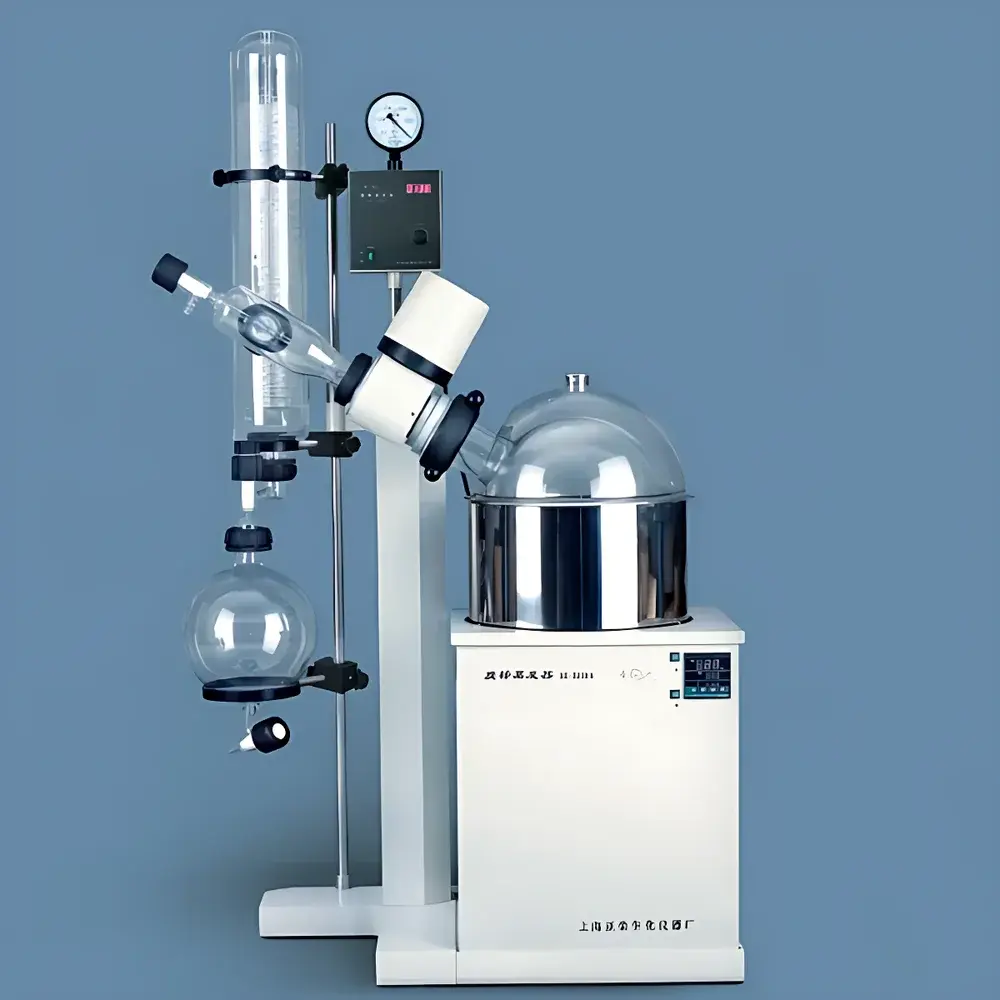
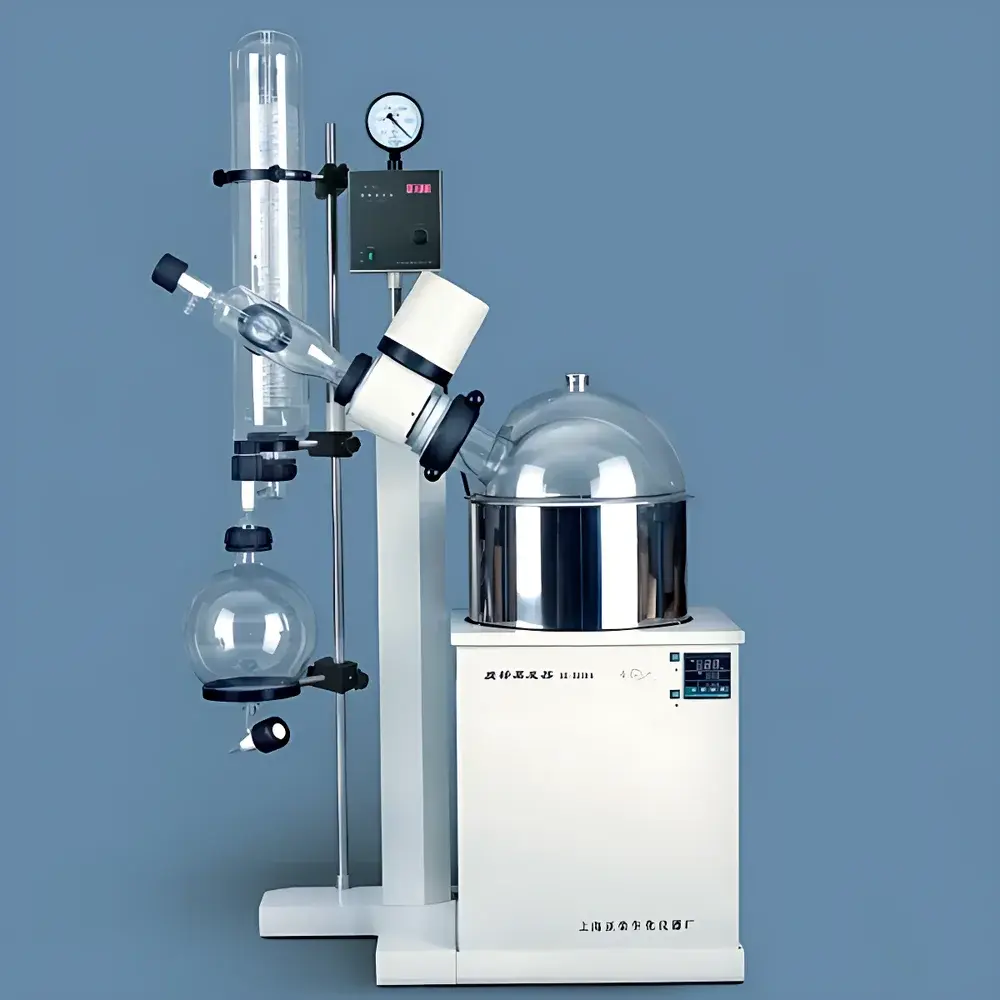
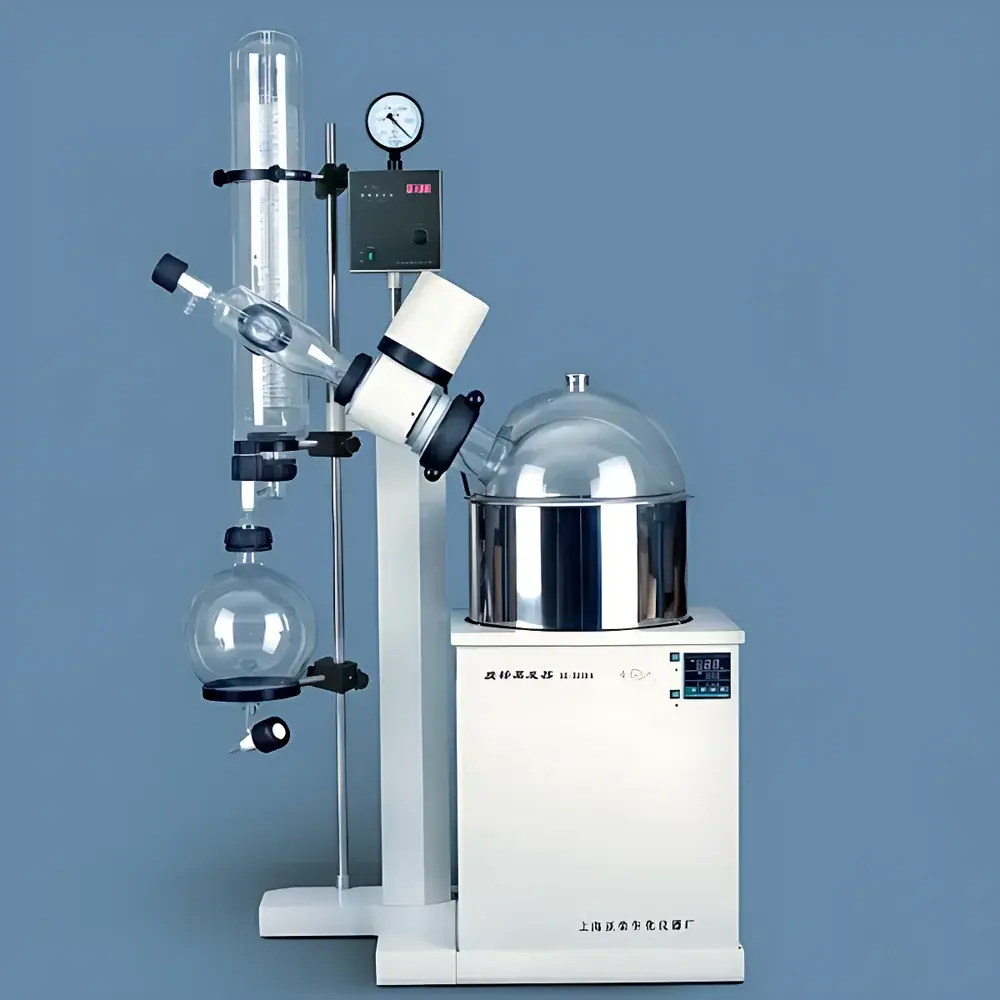
Yarong RE-5210A Rotary Evaporator
| Brand | Yarong |
|---|---|
| Origin | Shanghai, China |
| Manufacturer Type | Authorized Distributor |
| Country of Manufacture | China |
| Model | RE-5210A |
| Pricing | Available Upon Request |
| Rotating Flask Capacity | 10 L (Φ75 mm standard taper joint) |
| Collecting Flask Capacity | 5 L |
| Temperature Control Range | Ambient to 99 °C ±1 °C (PID digital display) |
| Rotation Speed | 0–138 rpm (frequency-controlled, imported inverter, digital readout) |
| Vacuum Range | –0.01 to –0.095 MPa (accuracy: ±0.2–0.5%) |
| Rotating Motor | 120 W single-phase AC induction motor (220 V / 50 Hz) |
| Condenser Type | Vertical dual-reflux high-efficiency condenser |
| Water Bath | One-piece stainless steel, motorized vertical lift (0–180 mm travel) |
| Heating Power | 3000 W |
| Dimensions (W×D×H) | 950 × 550 × 1650 mm |
Overview
The Yarong RE-5210A Rotary Evaporator is an engineered laboratory system designed for efficient solvent removal, concentration, and recovery under controlled reduced-pressure conditions. Operating on the principle of thin-film evaporation—where rotation generates a uniform liquid film across the inner surface of a heated, evacuated flask—the instrument maximizes heat transfer and mass transfer rates while minimizing thermal degradation. Its integration of precise PID temperature regulation, variable-speed rotation, and high-efficiency dual-reflux condensation ensures reproducible performance in applications requiring gentle yet rapid volatiles separation. The RE-5210A is widely deployed in pharmaceutical R&D, fine chemical synthesis, food science laboratories, environmental analysis, and academic research settings where batch processing of moderate-volume samples (up to 10 L) demands robustness, operational safety, and compliance-ready functionality.
Key Features
- 10 L rotating flask with standardized 75 mm outer diameter ground-glass joint (ISO KF-70 compatible), enabling secure, leak-tight coupling and scalable process development;
- Motorized vertical lift mechanism for the water bath (0–180 mm stroke), facilitating safe, repeatable positioning without manual adjustment or mechanical strain;
- Dual-reflux vertical condenser with extended surface area and optimized coolant flow path—designed to achieve >95% condensation efficiency across common solvents (e.g., ethanol, acetone, ethyl acetate, dichloromethane) at typical operating vacuum levels;
- Frequency-controlled rotation drive using an imported industrial-grade inverter, delivering stable speed control from 0 to 138 rpm with <±1 rpm repeatability and low-vibration operation;
- One-piece seamless stainless steel water bath tank (304 grade), corrosion-resistant and thermally uniform, rated for continuous heating up to 99 °C with ±1 °C stability;
- Integrated valve-type feed tube and collecting flask assembly—enabling solvent addition, fractional collection, and rapid discharge without breaking vacuum or disassembling the system;
- Digital PID temperature controller with real-time display, auto-tuning capability, and over-temperature cutoff protection;
- Structural rigidity ensured by an aluminum alloy square column support frame mounted on a T-shaped heavy-duty base, accommodating long-term use in shared lab environments.
Sample Compatibility & Compliance
The RE-5210A accommodates a broad range of organic and aqueous solutions, including heat-sensitive extracts, polymer solutions, natural product isolates, and reaction mixtures. Its design conforms to general laboratory safety standards for rotary evaporation systems (e.g., IEC 61010-1 for electrical safety). While not certified for GMP manufacturing environments out-of-the-box, the unit supports GLP-aligned workflows through traceable parameter logging (when paired with optional external data acquisition), vacuum monitoring, and temperature calibration records. It meets typical requirements for ASTM E2654 (Standard Guide for Validation of Aqueous Extraction Processes) and ISO 17025-compliant method development when integrated into validated SOPs.
Software & Data Management
The RE-5210A operates as a standalone analog-digital hybrid system: all core parameters (bath temperature, rotation speed, vacuum level via optional gauge) are monitored and adjusted manually or semi-automatically. For enhanced traceability, users may integrate third-party vacuum controllers (e.g., VAT or MKS-compatible digital gauges) and RS485/Modbus-enabled temperature loggers. When connected to a laboratory information management system (LIMS) or ELN via serial interface, the device supports time-stamped operational metadata capture—including start/stop timestamps, setpoint deviations, and duration-weighted average vacuum values—supporting FDA 21 CFR Part 11 audit trails when paired with compliant software infrastructure.
Applications
- Concentration of natural product extracts (e.g., botanical tinctures, algal lipid fractions) prior to HPLC or GC-MS analysis;
- Solvent recovery and reuse in multi-step organic synthesis, reducing waste disposal costs and improving EHS metrics;
- Removal of low-boiling solvents (e.g., hexane, diethyl ether) from reaction quenches under mild thermal conditions;
- Lyophilization pre-concentration steps for unstable biomolecules or peptides;
- Teaching laboratories: demonstration of phase equilibria, vapor pressure depression, and mass transfer kinetics under reduced pressure;
- Small-batch pilot-scale processing in contract development labs handling API intermediates or specialty chemicals.
FAQ
What is the maximum recommended operating vacuum for the RE-5210A?
The system is rated for continuous operation between –0.01 MPa and –0.095 MPa; optimal condensation efficiency is achieved above –0.08 MPa for most low-to-medium volatility solvents.
Can the RE-5210A be used with corrosive solvents such as concentrated HCl or brominated compounds?
Standard configuration uses borosilicate glass (Duran 3.3 or equivalent) and PTFE seals; however, prolonged exposure to strong acids, halogens, or oxidizers requires custom fluoropolymer-coated condensers and vacuum line components.
Is the water bath temperature calibration traceable to NIST standards?
The built-in sensor is factory-calibrated; users may perform field verification using a NIST-traceable PT100 probe inserted into the bath medium—documentation templates for calibration logs are available upon request.
Does the RE-5210A include vacuum pump compatibility guidance?
Yes—recommended pairing includes two-stage oil-sealed rotary vane pumps (e.g., 2–4 m³/h capacity) or dry scroll pumps for solvent-laden exhaust streams; vacuum hose connections comply with ISO-KF25 standards.
What maintenance intervals are advised for long-term reliability?
Biannual inspection of PTFE valve seals, annual lubrication of lift mechanism gears, and quarterly verification of motor insulation resistance (per IEC 60034-1) are recommended for continuous-use environments.



