
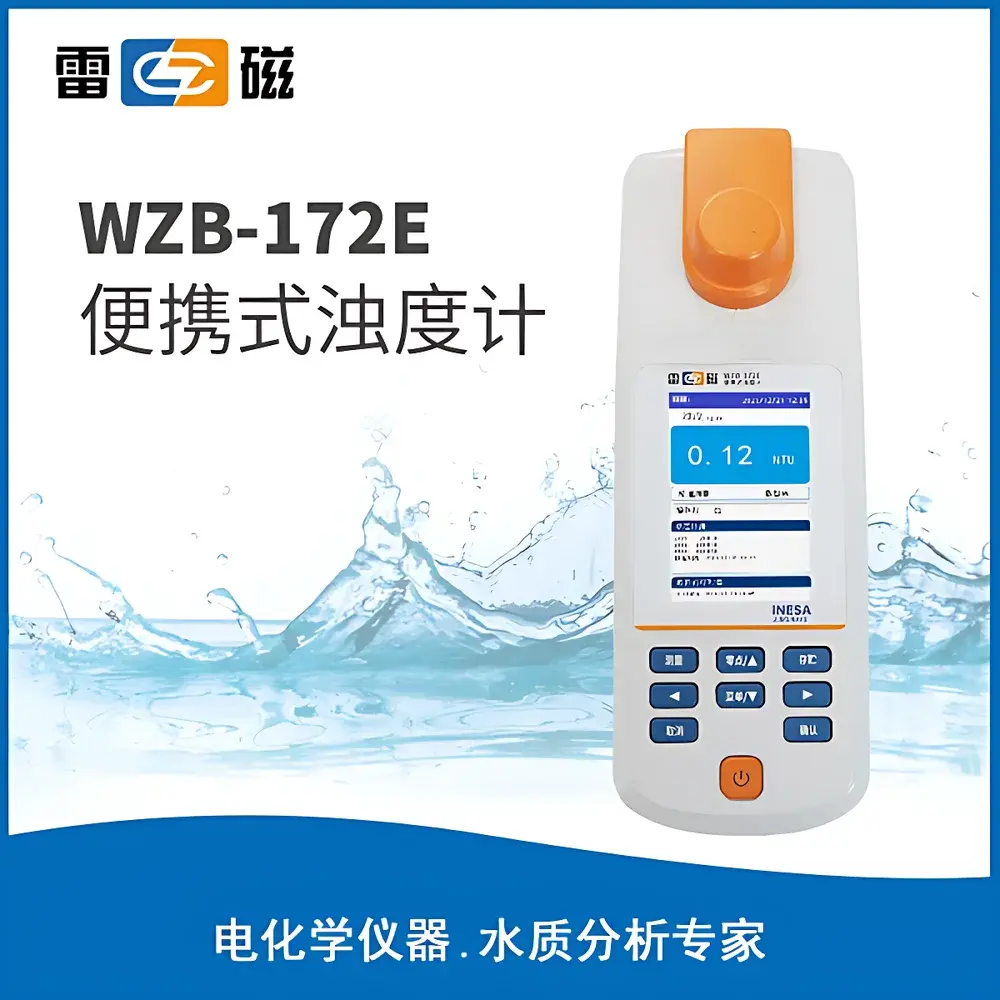
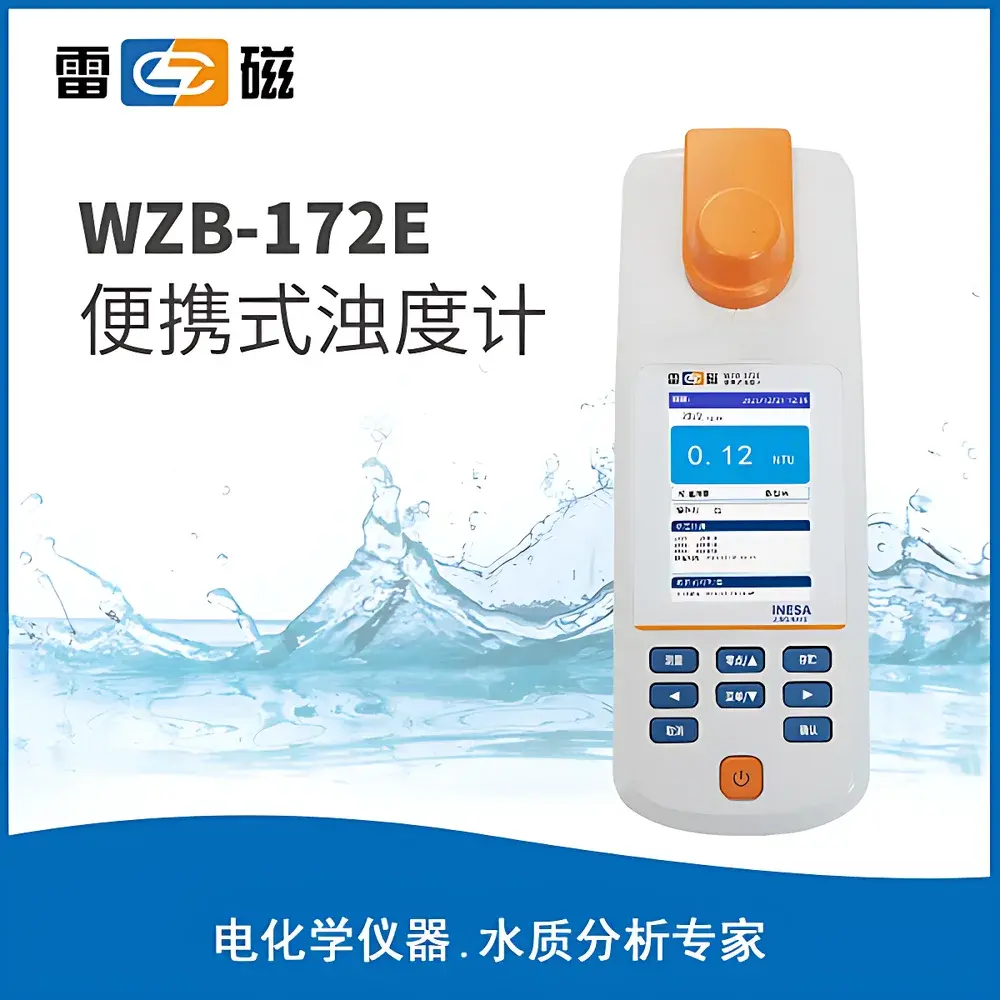
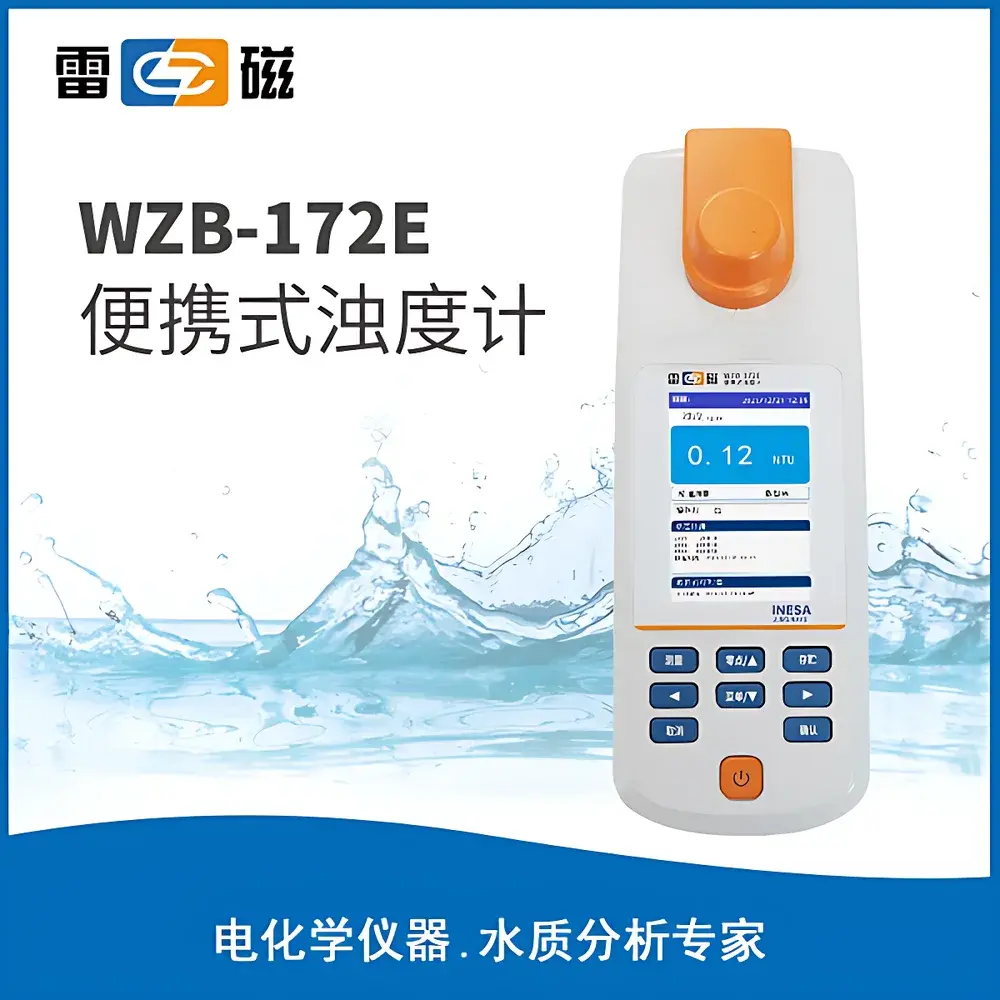
Leici WZB-172E Portable Turbidimeter
| Brand | Leici |
|---|---|
| Origin | Shanghai, China |
| Model | WZB-172E |
| Type | Portable |
| Measurement Range | 0.00–9.99 NTU |
| Resolution | 0.01 NTU |
| Operating Temperature | 5–40 °C |
| Accuracy | ±6% |
| Light Source | Tungsten Lamp |
| Measurement Principle | Nephelometric (90° scattered light) and Ratio Nephelometric (scattered + transmitted light) |
| Compliance | HJ 1075–2019, USEPA Method 180.1, JJG 880–2006 |
| IP Rating | IP65 |
| Data Storage | 1000 datasets |
| Interface | Micro-USB, RS-232 |
| Power | Rechargeable Li-ion battery with PC/mobile power bank charging capability |
Overview
The Leici WZB-172E Portable Turbidimeter is a field-deployable, precision optical instrument engineered for reliable turbidity measurement in drinking water, wastewater, surface water, and process streams. It operates on the principle of nephelometry—quantifying the intensity of light scattered at 90° by suspended particles—as defined in USEPA Method 180.1 and HJ 1075–2019. For improved accuracy across varying particle size distributions and concentrations, the instrument supports dual-mode operation: standard 90° scatter detection and ratio nephelometry, which simultaneously measures scattered and transmitted light to minimize interference from color, absorbance, or high particle loading. Its tungsten halogen lamp provides stable, broadband illumination optimized for compliance with regulatory photometric requirements, while the integrated optical path design ensures minimal stray light and thermal drift under ambient conditions.
Key Features
- 3.5-inch full-color LCD display with intuitive icon-based navigation and real-time graphical feedback
- IP65-rated enclosure for dust resistance and protection against low-pressure water jets—suitable for outdoor and industrial environments
- Auto-ranging measurement circuitry eliminates manual range selection and reduces operator error
- Multi-unit support: NTU (Nephelometric Turbidity Units), FNU (Formazin Nephelometric Units), and EBC (European Brewery Convention units), configurable per application requirement
- Dual calibration modes: single-point verification and multi-point calibration using certified formazin standards (20, 200, and 500 NTU)
- Zero-point calibration function with dedicated blank vial compensation to correct for cuvette imperfections and background scatter
- Built-in calibration curve storage and factory reset capability for traceable instrument configuration management
- Integrated battery status indicator and charging state notification via LED and on-screen prompts
Sample Compatibility & Compliance
The WZB-172E accepts standard 25-mm round glass vials (included) and is compatible with ASTM D6508-compliant sample containers. It meets the metrological requirements of JJG 880–2006 (Chinese National Verification Regulation for Turbidimeters) and adheres to the analytical methodology stipulated in HJ 1075–2019 and USEPA Method 180.1. Its optical architecture satisfies the spectral and geometric criteria for nephelometric turbidity measurement—including detector angular acceptance (±2.5° around 90°), source collimation, and minimum signal-to-noise ratio—ensuring data integrity for environmental monitoring programs subject to regulatory reporting. The instrument’s firmware implements GLP-compliant data handling protocols, including time-stamped records, user ID tagging (where enabled via software), and immutable audit trails for calibration and measurement events.
Software & Data Management
Data generated by the WZB-172E is stored internally (up to 1000 measurements) with full timestamp, unit, mode, and calibration metadata. Through its Micro-USB interface and bundled PC communication software, users can export datasets in CSV format for integration into LIMS or statistical analysis platforms. RS-232 output enables direct connection to serial printers for hard-copy documentation during field audits or QA/QC inspections. All exported data retains embedded calibration history and measurement mode flags—supporting full traceability under ISO/IEC 17025 and EPA-approved quality assurance frameworks. No proprietary drivers are required; the device enumerates as a standard CDC ACM class USB device for cross-platform compatibility (Windows, macOS, Linux).
Applications
- Drinking water treatment plant effluent monitoring per WHO guidelines and national regulatory thresholds
- In-field verification of membrane filtration performance and coagulation-flocculation efficiency
- Environmental sampling campaigns in rivers, lakes, and reservoirs under HJ 1075–2019 protocols
- Process control in food & beverage production where suspended solids affect product clarity (e.g., brewing, juice clarification)
- Educational laboratories requiring a rugged, standards-aligned platform for teaching optical scattering principles
- Emergency response teams assessing post-flood or post-disaster water safety prior to distribution
FAQ
Does the WZB-172E comply with US EPA Method 180.1 for regulatory reporting?
Yes—the optical design, detector geometry, light source stability, and calibration traceability align with all critical specifications in USEPA Method 180.1 for field-portable nephelometers.
Can the instrument store calibration curves from multiple standard sets?
It supports one active calibration curve at a time, but allows restoration of factory-default zero and calibration values; multi-point calibrations are retained until overwritten.
Is the included calibration kit NIST-traceable?
The supplied 20/200/500 NTU formazin standards are manufactured to ISO 7027 specifications and accompanied by batch-specific certificate of analysis with uncertainty statements.
What is the battery life under continuous use?
Typical operation yields ≥12 hours of measurement time per full charge, verified at 25 °C ambient; runtime decreases gradually below 10 °C due to lithium-ion chemistry limitations.
Does the device support FDA 21 CFR Part 11 compliance?
While the standalone instrument does not implement electronic signatures or role-based access control, its data export architecture and audit-ready metadata enable integration into Part 11–compliant laboratory systems when deployed with validated software and procedural controls.




