
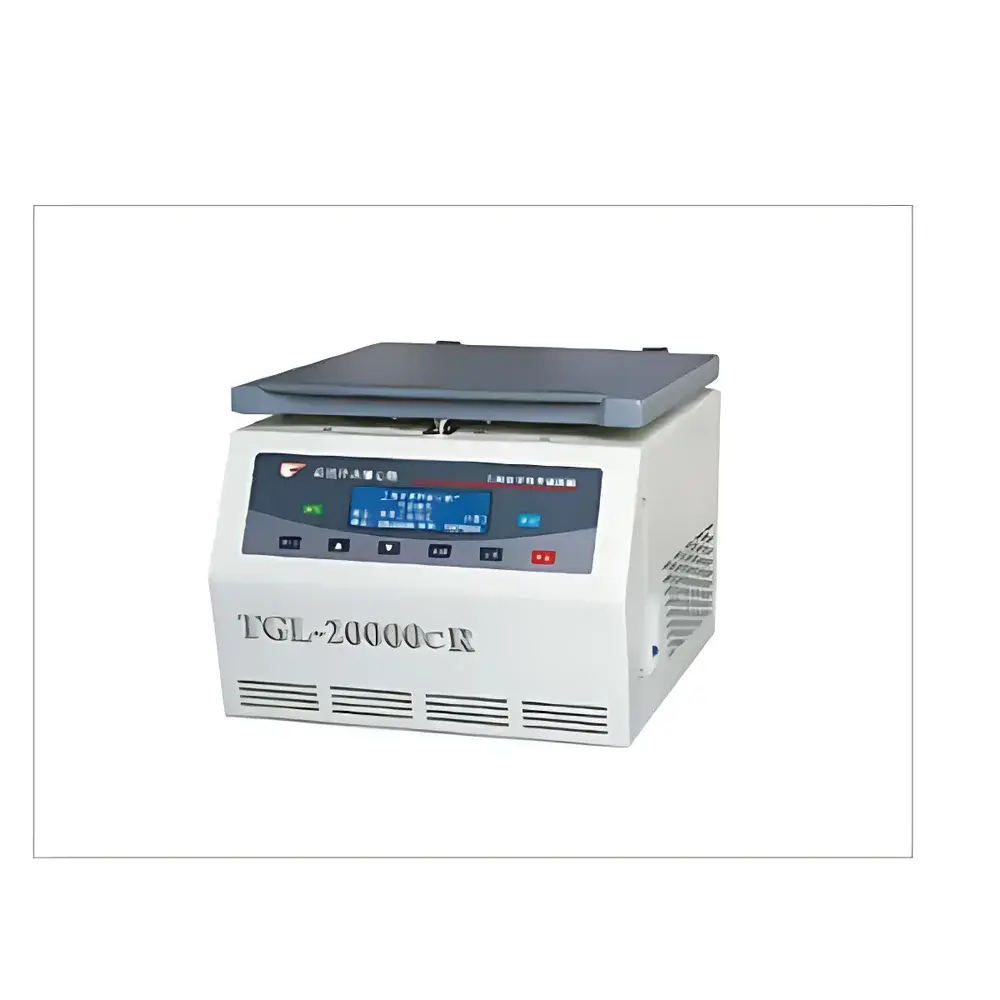
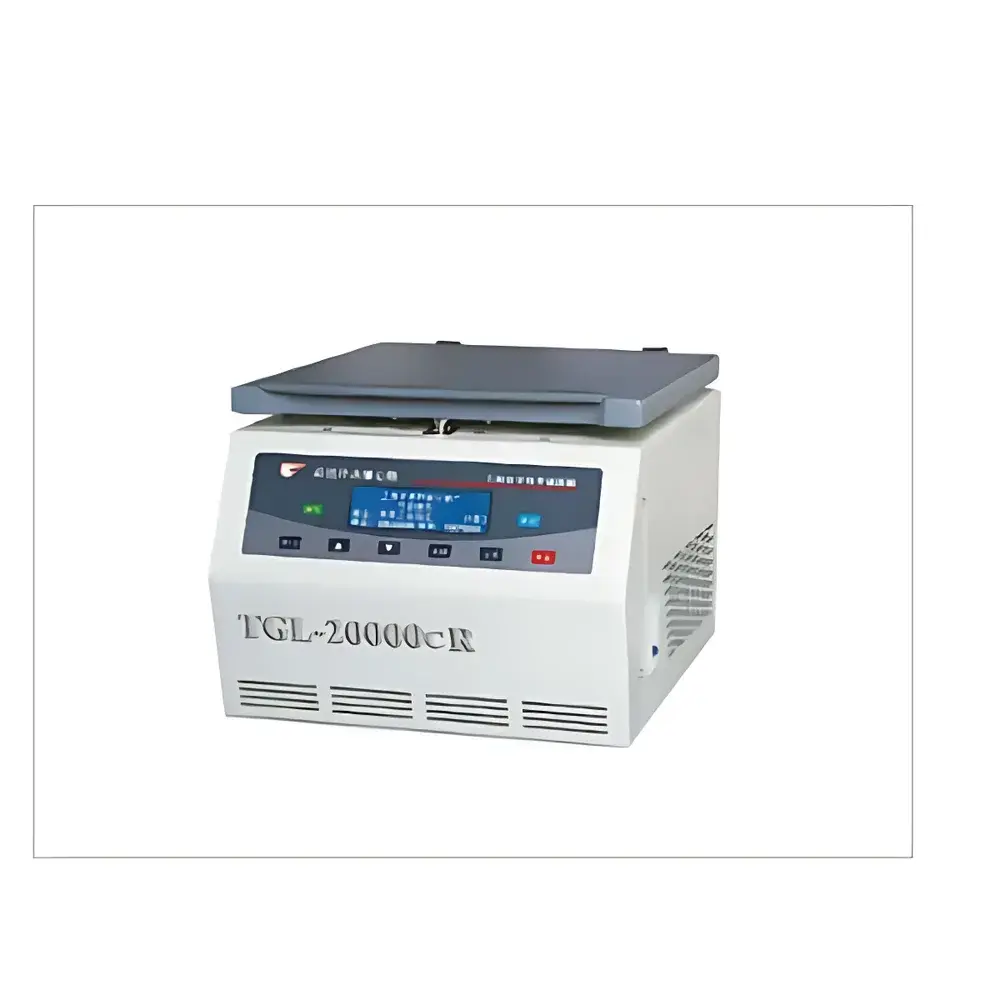
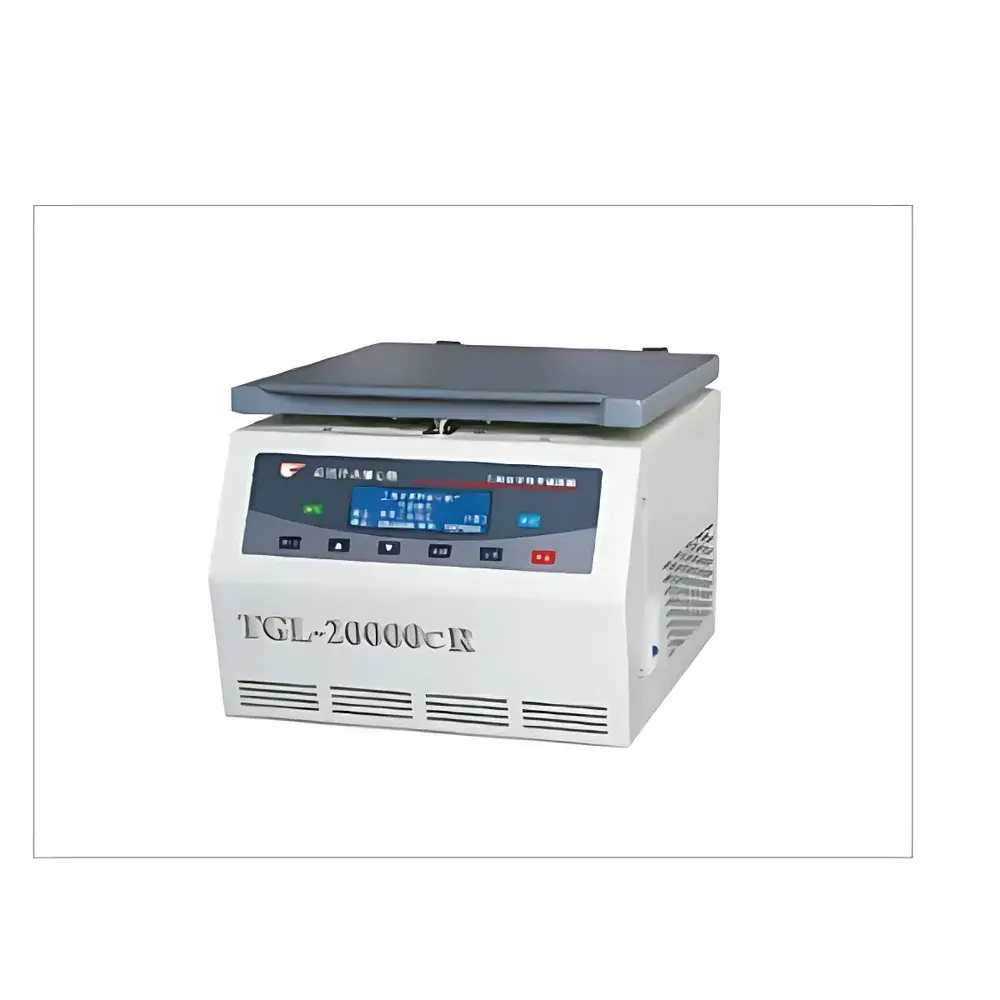
AnTing TGL-20000CR High-Speed Refrigerated Benchtop Centrifuge
| Brand | AnTing |
|---|---|
| Origin | Shanghai, China |
| Model | TGL-20000CR |
| Instrument Type | Benchtop Centrifuge |
| Category | High-Speed Refrigerated Centrifuge (10,000–30,000 rpm) |
| Max Speed | 20,000 rpm |
| Max RCF | 29,068 ×g |
| Max Capacity | 100 mL × 4 |
| Temperature Range | −20 °C to +30 °C |
| Temp. Accuracy | ±2 °C |
| Timer Range | 0–99 min |
| Noise Level | <70 dB(A) |
| Power Supply | 220 V, 50 Hz, 1.5 kW |
| Dimensions (L×W×H) | 700 mm × 500 mm × 395 mm |
| Weight | 85 kg |
| Rotor Compatibility | Five standard angle rotors (1.5/2 mL × 12 at 20,000 rpm |
| Rotor Material | Metal, gas-tight, autoclavable |
| Door Lock | Dual-mode electronic + manual emergency release |
| Acceleration/Deceleration Time | ≤14 s / ≤15 s |
| Refrigerant | CFC-free, imported compressor unit |
| Data Storage | ≥20 user-programmable protocols |
Overview
The AnTing TGL-20000CR is a high-performance benchtop refrigerated centrifuge engineered for precision separation of biological, clinical, and research samples under controlled thermal conditions. It operates on the principle of sedimentation force generation via high-speed rotational motion, where sample components separate based on differences in density, size, and shape under defined relative centrifugal force (RCF). With a maximum speed of 20,000 rpm and an RCF of up to 29,068 ×g, the TGL-20000CR supports demanding applications requiring rapid pelleting of subcellular organelles, viral particles, nucleic acids, and protein complexes. Its integrated refrigeration system maintains precise temperature control from −20 °C to +30 °C—critical for preserving thermolabile biomolecules during extended runs. Designed for ISO 13485-aligned laboratories and compliant with general safety requirements for Class II medical laboratory equipment, the unit meets foundational mechanical and electrical safety standards applicable to CE-marked benchtop centrifuges.
Key Features
- High-efficiency CFC-free refrigeration system using an imported compressor, ensuring stable low-temperature operation without environmental compromise.
- Dual-lock door mechanism: electronically interlocked for operational safety, plus a certified manual override for emergency access—designed to meet IEC 61010-2-020 safety requirements for centrifuge doors.
- Variable-frequency drive (VFD) motor enabling smooth acceleration/deceleration (≤14 s acceleration, ≤15 s deceleration), minimizing sample disturbance and rotor stress.
- Stainless steel chamber interior and reinforced metal housing for corrosion resistance, mechanical durability, and ease of decontamination.
- Gas-tight, autoclavable aluminum angle rotors compatible with standard biosafety protocols; all rotors validated for repeated sterilization at 121 °C, 15 psi for 20 minutes.
- Intuitive LCD interface with real-time display of speed, RCF, temperature, time remaining, and rotor identification—supporting GLP-compliant documentation practices.
- Onboard memory stores ≥20 customizable protocols, including speed, temperature, run time, and brake profile—enabling reproducible workflows across shifts and users.
- Integrated condensate management system prevents internal water accumulation, mitigating corrosion risks and extending service life.
Sample Compatibility & Compliance
The TGL-20000CR accommodates a broad range of sample formats through five interchangeable angle rotors, supporting volumes from 1.5 µL microtubes to 100 mL conical tubes. Its rotor configuration enables routine use in molecular biology (e.g., plasmid DNA isolation, RNA purification), clinical diagnostics (serum/plasma separation), cell culture (harvesting adherent or suspension cells), and pharmaceutical QC (particle removal from formulations). While not certified to FDA 21 CFR Part 11 out-of-the-box, the instrument’s programmable parameters, audit-ready timer logs, and non-volatile protocol storage support traceability frameworks required under GLP and GMP environments. All rotors conform to ISO 15530-3 dimensional metrology standards for interchangeability and balance verification.
Software & Data Management
The TGL-20000CR operates independently without external software dependencies. Its embedded firmware provides full local control, parameter logging, and error diagnostics—including overspeed detection, imbalance alerts, lid-open interlock status, and refrigeration fault codes. Timestamped run records (date, time, rotor ID, setpoints, actual RCF, final temperature) are retained in non-volatile memory and can be manually transcribed for lab notebook integration. For facilities implementing LIMS or ELN systems, the centrifuge’s consistent parameter output and standardized rotor nomenclature facilitate structured data entry. Optional RS-232 or USB-to-serial adapters (sold separately) allow basic command-line interaction for automated script triggering in validated environments.
Applications
- Isolation of mitochondria, lysosomes, and other subcellular fractions from tissue homogenates.
- Clarification of bacterial lysates prior to chromatographic purification of recombinant proteins.
- Routine separation of whole blood into serum, plasma, and cellular components in clinical labs.
- Concentration of lentiviral or AAV vectors for gene therapy process development.
- Pelleting of nanoparticles and exosomes from conditioned media in extracellular vesicle research.
- Removal of insoluble aggregates from monoclonal antibody formulations during stability studies.
FAQ
What is the maximum allowable imbalance tolerance for safe operation?
The TGL-20000CR is rated for ≤2 g imbalance per rotor position when operated within published speed limits—consistent with ISO 21501-3 recommendations for angle rotors.
Can the unit maintain −20 °C while running at maximum speed?
Yes—the refrigeration system is sized to sustain −20 °C setpoint across the full speed range, verified under continuous 60-minute operation with 100 mL loads.
Are rotor certificates of conformance available upon request?
Yes. Each rotor ships with a manufacturer-issued certificate listing batch number, material grade, burst test results, and dimensional validation against ISO 15530-3.
Does the centrifuge support remote monitoring or network connectivity?
No native Ethernet or Wi-Fi interface is included; however, third-party hardware gateways may be integrated via the optional serial port for basic status polling in facility-wide monitoring systems.
How often does the refrigeration system require maintenance?
Compressor oil and filter replacement is recommended every 24 months or after 5,000 operating hours—whichever occurs first—per the maintenance schedule aligned with IEC 62304 Class B software lifecycle guidance.



