
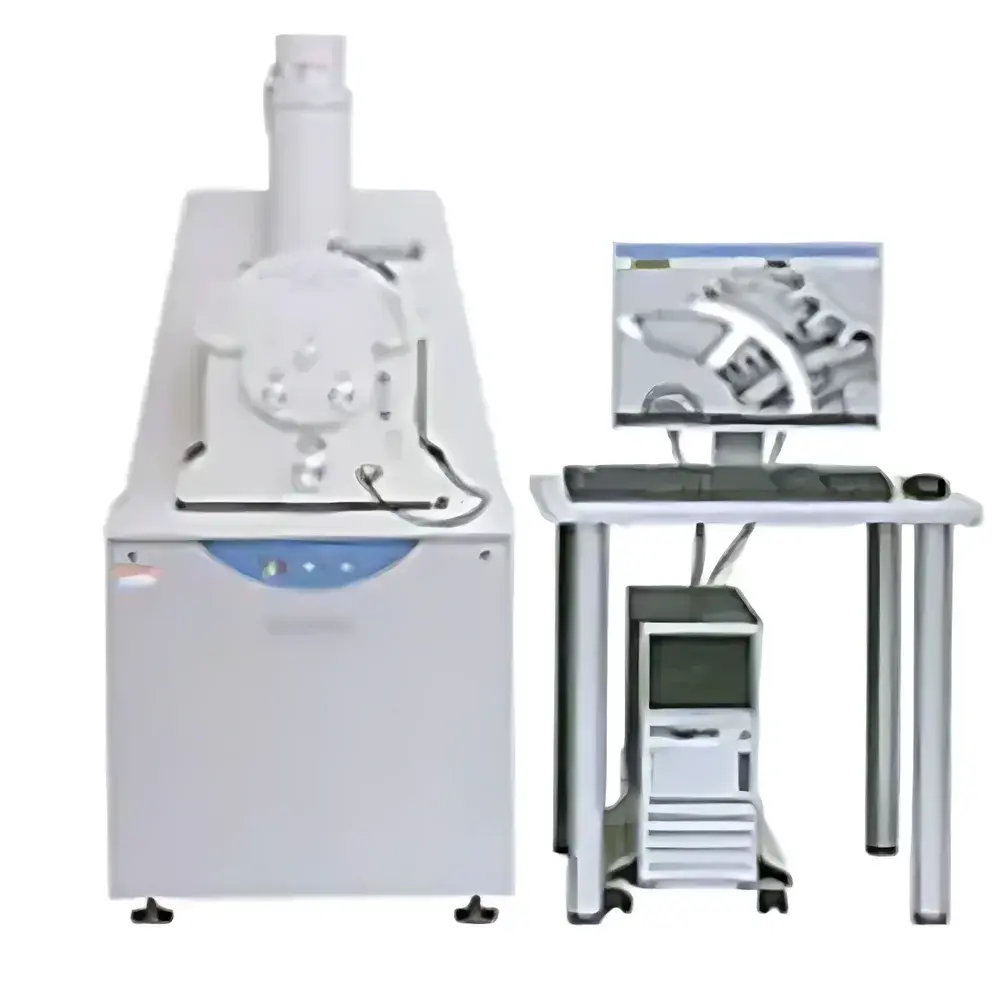
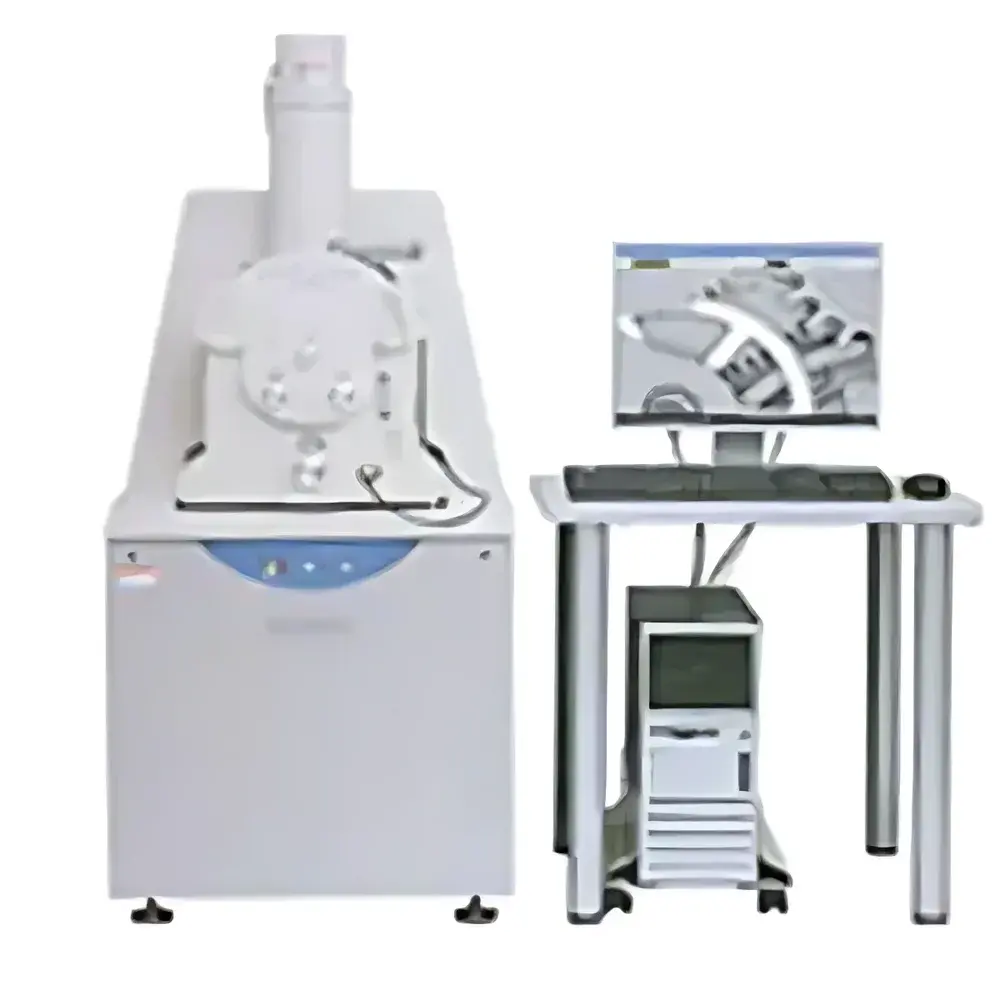
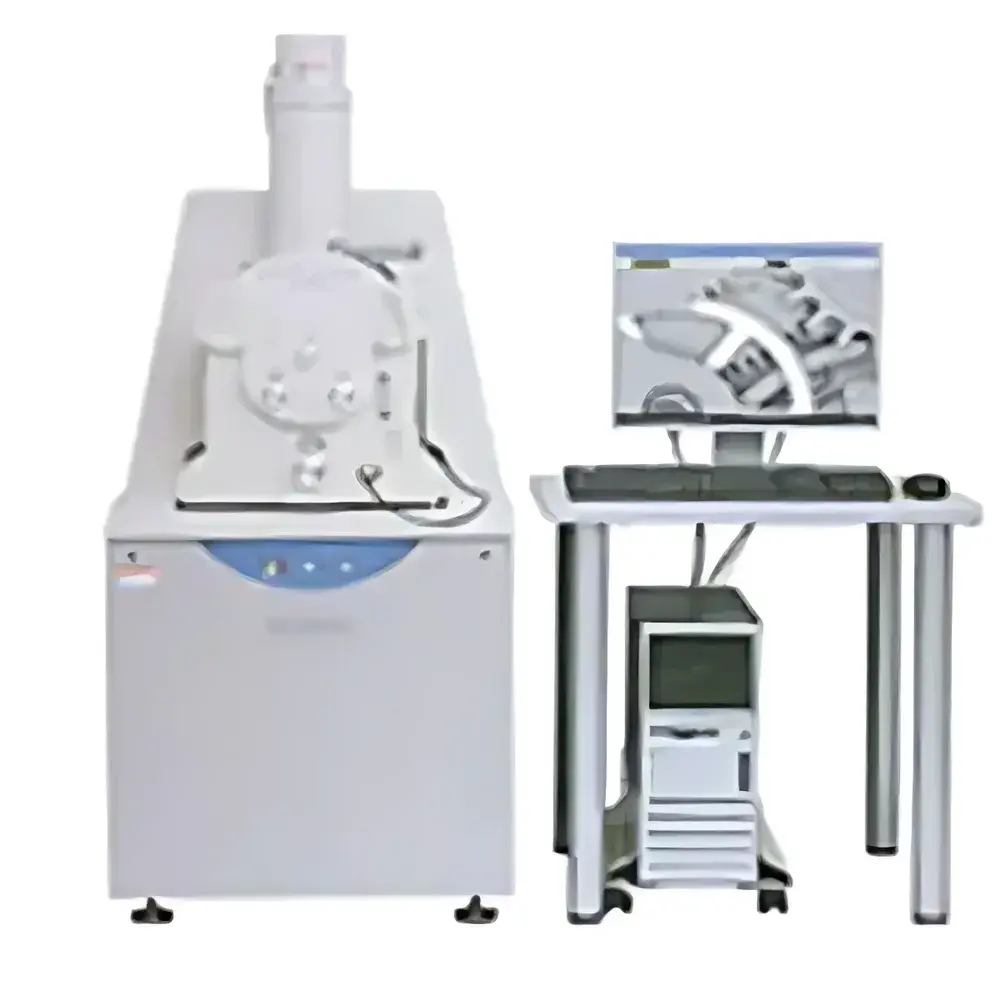
BM U1510 Desktop Scanning Electron Microscope
| Brand | BM |
|---|---|
| Origin | Shanghai, China |
| Model | U1510 |
| Instrument Type | Floor-standing SEM |
| Electron Source | Tungsten Filament |
| Vacuum Modes | High Vacuum & Variable Pressure (6–270 Pa) |
| Secondary Electron Resolution | 3.0 nm @ 30 kV (High Vacuum) |
| Backscattered Electron Resolution | 4.0 nm @ 30 kV (6 Pa, Low Vacuum) |
| Magnification Range | 5× to 300,000× |
| Accelerating Voltage | 0.3–30 kV |
| Max Sample Diameter | 153 mm |
| Stage Travel | X 0–80 mm, Y 0–40 mm, Z 5–50 mm, T –20° to +90°, R 360° |
| Standard Detectors | Everhart-Thornley-type Secondary Electron Detector (SED), High-Sensitivity Semiconductor Backscattered Electron Detector (BSE) |
| Vacuum System | Single Turbo-Molecular Pump + Rotary Mechanical Pump |
| Safety Features | Power Failure Protection, Leakage Current Interlock, Automatic Shutdown |
Overview
The BM U1510 is a floor-standing scanning electron microscope engineered for academic laboratories, quality control facilities, and industrial R&D environments requiring reliable high-resolution imaging with operational flexibility. Based on conventional thermionic tungsten filament emission and electromagnetic beam scanning, the U1510 employs a dual-mode vacuum architecture—capable of both high-vacuum operation (<1×10⁻³ Pa) and variable-pressure mode (6–270 Pa)—to enable direct observation of non-conductive, hydrated, or outgassing specimens without metal coating. Its compact footprint (55 cm width) reduces spatial requirements while maintaining full functionality, including integrated stage tilt (–20° to +90°) and continuous 360° rotation—features critical for multi-angle morphological assessment and cross-sectional analysis. The system achieves a verified secondary electron resolution of 3.0 nm at 30 kV under high vacuum, and 4.0 nm in low-vacuum mode at identical accelerating voltage, supporting routine microstructural characterization across metallurgy, geology, polymer science, and failure analysis.
Key Features
- Compact floor-standing design (55 cm width) with reduced installation footprint—ideal for space-constrained labs.
- Dual-mode vacuum operation: seamless switching between high vacuum (<1×10⁻³ Pa) and variable pressure (6–270 Pa) via software interface.
- Tungsten filament electron source offering stable emission, extended lifetime, and cost-effective maintenance—optimized for routine and teaching applications.
- Integrated mechanical stage with motorized or manual control options: X (0–80 mm), Y (0–40 mm), Z (5–50 mm), tilt (–20° to +90°), and full 360° rotation for comprehensive sample positioning.
- Clean vacuum architecture featuring a single turbo-molecular pump backed by a rotary vane mechanical pump—minimizing hydrocarbon contamination and enabling rapid pump-down times.
- Intuitive mouse-driven GUI: all core functions—including focus, stigmation, contrast/brightness, magnification, and vacuum mode selection—are fully operable via point-and-click interface.
- Pre-aligned tungsten filament and four-position variable aperture objective lens—supporting consistent beam convergence and optimized signal-to-noise ratio across magnifications.
Sample Compatibility & Compliance
The U1510 accommodates specimens up to 153 mm in diameter and 60 mm in height (at working distance = 15 mm), with maximum field-of-view coverage of 126 mm (XYR combined). Its low-vacuum capability permits uncoated imaging of insulators (e.g., ceramics, polymers, biological tissues), powders, and porous materials—eliminating artifacts from sputter coating and preserving native surface chemistry. The system complies with IEC 61000-6-3 (EMC emissions) and IEC 61010-1 (safety requirements for electrical equipment used in measurement, control, and laboratory use). While not certified for GLP/GMP production environments, its vacuum interlocks, power-failure recovery logic, and leakage current protection meet baseline safety expectations for ISO/IEC 17025-accredited testing laboratories performing non-regulated material characterization.
Software & Data Management
The U1510 operates under BM’s proprietary acquisition and analysis platform, supporting real-time image capture, annotation, measurement (line, area, particle count), and export in TIFF, BMP, and JPEG formats. Image metadata—including kV, WD, magnification, vacuum mode, detector type, and timestamp—is embedded in EXIF headers for traceability. The software includes basic EDS integration support (via optional EDX module at WD = 15 mm, TOA = 35°), allowing elemental mapping alignment with SE/BSE images. Audit trail functionality records user logins, parameter changes, and acquisition events—facilitating internal documentation protocols. Data export adheres to ASTM E1558-22 guidelines for digital micrography metadata preservation.
Applications
- Morphological analysis of fracture surfaces in metals, alloys, and composites per ASTM E3-22.
- Particle size distribution and shape characterization in pharmaceutical excipients and catalyst supports.
- Coating thickness verification and interface inspection in layered thin-film devices.
- Soil aggregate structure and pore network visualization in environmental geoscience studies.
- Quality assurance of additive-manufactured parts—evaluating surface roughness, porosity, and unmelted powder residues.
- Forensic examination of tool marks, textile fibers, and gunshot residue morphology.
FAQ
What vacuum modes does the U1510 support, and how is mode switching performed?
The U1510 supports high vacuum (<1×10⁻³ Pa) and variable-pressure mode (6–270 Pa). Switching is executed via a single menu command in the acquisition software—no hardware reconfiguration is required.
Can the U1510 be used for energy-dispersive X-ray spectroscopy (EDS)?
Yes—when equipped with an optional silicon drift detector (SDD) EDS system, the U1510 supports qualitative and semi-quantitative elemental analysis at a fixed working distance of 15 mm and take-off angle of 35°.
Is motorized stage control standard or optional?
Manual stage control is standard; two-axis motorized X-Y translation is available as a factory-configurable option.
What is the typical pump-down time from atmosphere to high vacuum?
Using the integrated turbo-molecular pump and mechanical backing pump, the system achieves high vacuum in ≤6 minutes under standard ambient conditions.
Does the U1510 include beam alignment tools?
Yes—the system features pre-aligned tungsten filament geometry and automated gun bias optimization (fixed-ratio, manual, and auto-four-point bias modes) to maintain beam stability across operating voltages.





