
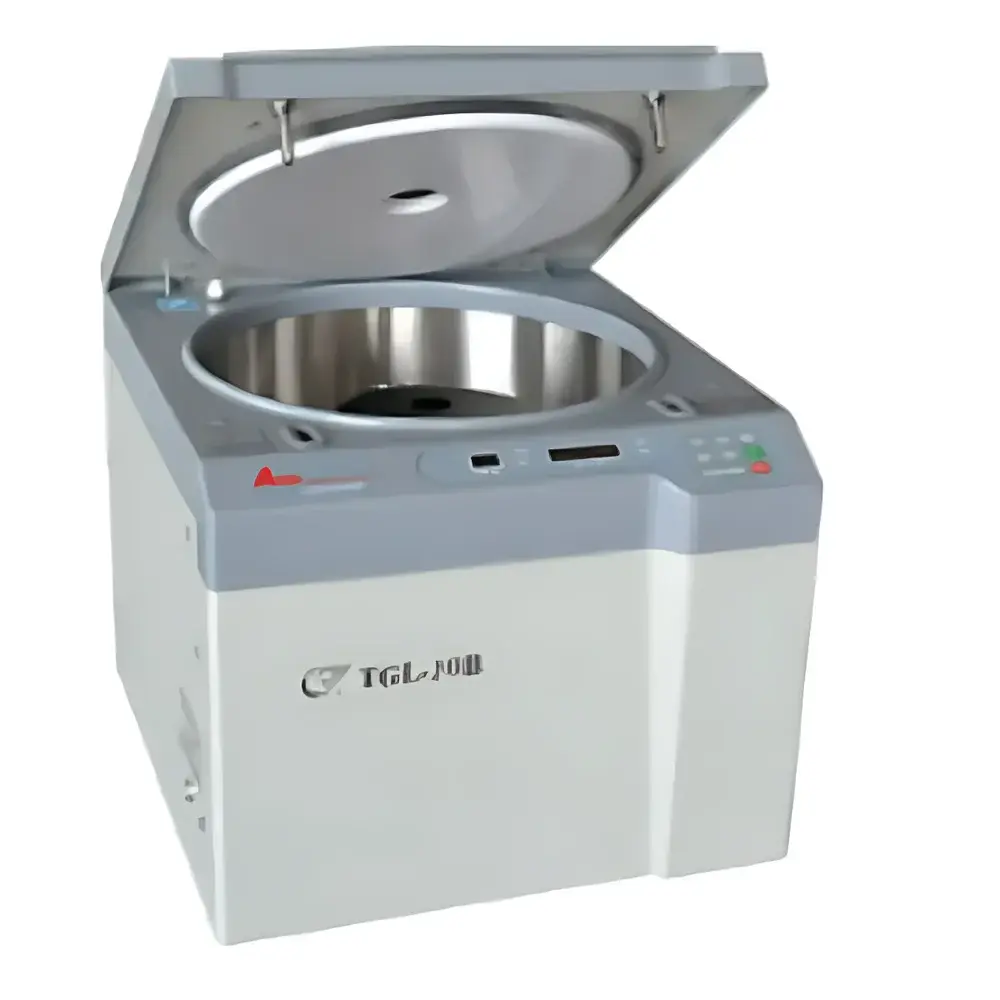
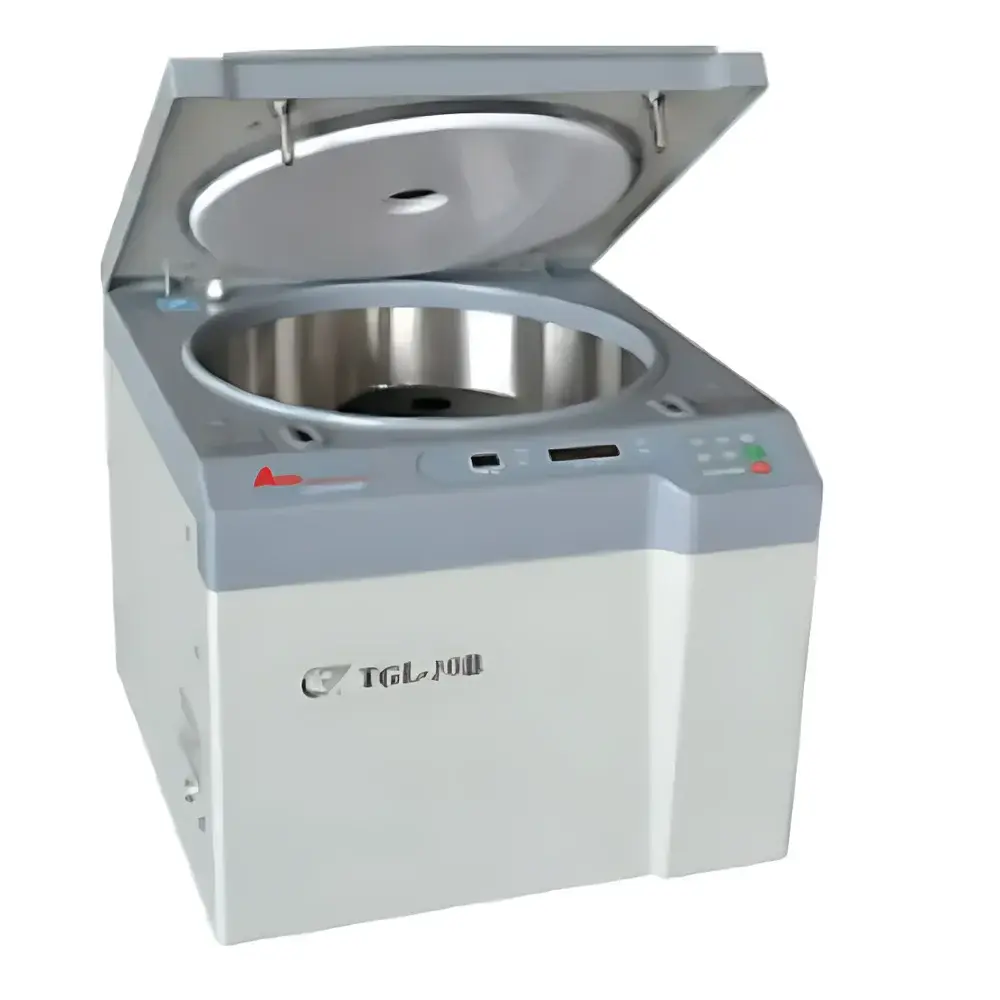
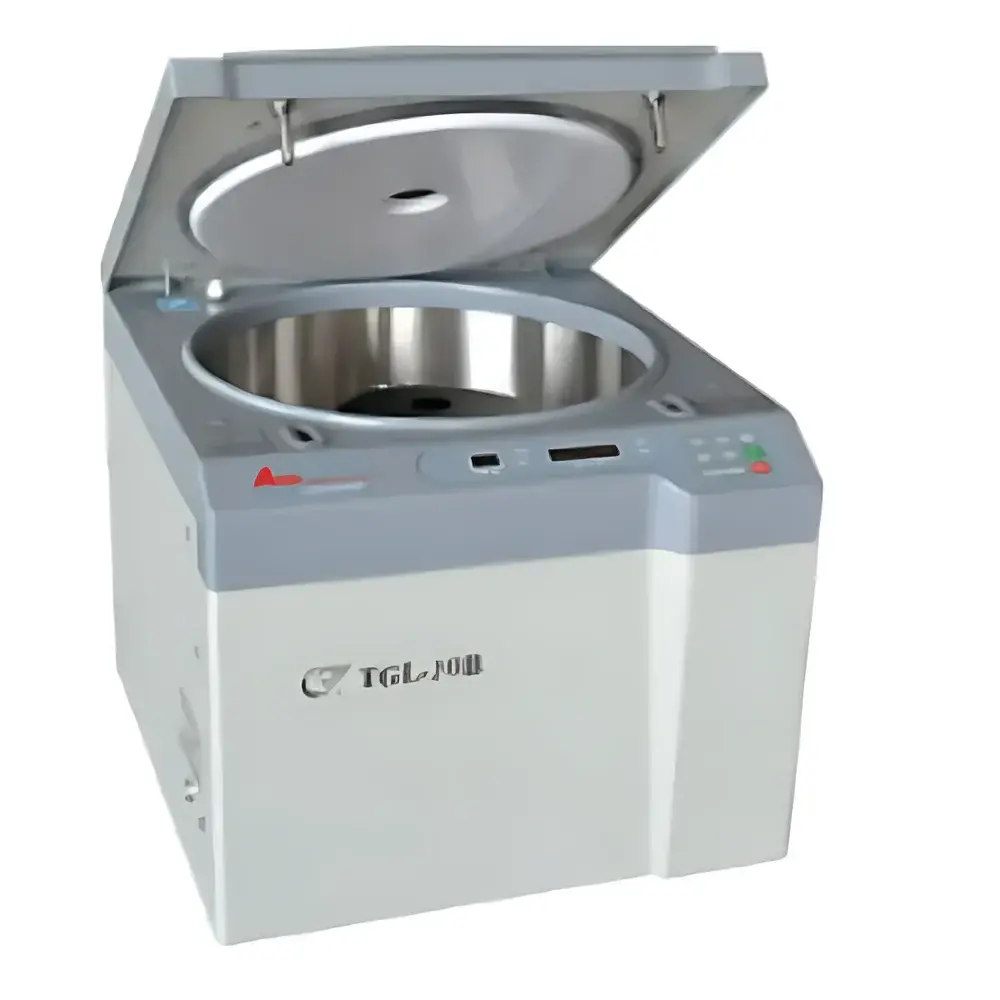
AnTing TGL-10B High-Speed Benchtop Centrifuge
| Brand | AnTing |
|---|---|
| Origin | Shanghai, China |
| Model | TGL-10B |
| Type | Benchtop Centrifuge |
| Category | High-Speed Centrifuge (10,000–30,000 rpm range) |
| Max Speed | 10,000 rpm |
| Max RCF | 8,944 × g |
| Capacity | 100 mL × 4 |
| Timer Range | 0–99 min |
| Noise Level | < 70 dB(A) |
| Power Supply | 220 V, 50 Hz |
| Dimensions (L×W×H) | 500 mm × 540 mm × 570 mm |
| Weight | 63 kg |
| Rotor Configuration | Fixed-angle rotors only |
| Safety | Electronic door interlock system |
| Construction | Reinforced polymer housing |
Overview
The AnTing TGL-10B High-Speed Benchtop Centrifuge is an engineered solution for routine and research-grade separation tasks in academic laboratories, quality control environments, and small-scale production facilities. Designed around a robust brushless DC motor and precision-machined rotor assembly, the TGL-10B operates on the principle of sedimentation under controlled centrifugal force—enabling efficient phase separation of heterogeneous mixtures based on particle density, size, and shape. With a maximum rotational speed of 10,000 rpm and a peak relative centrifugal force (RCF) of 8,944 × g, it supports standard protocols requiring moderate to high g-forces, including cell pelleting, nucleic acid precipitation, microfiltration support, and clarification of protein or enzyme solutions. Its compact benchtop footprint and fixed-angle rotor architecture prioritize operational stability, thermal management, and mechanical reproducibility—critical attributes for method transfer across GLP-compliant workflows.
Key Features
- Brushless DC motor with closed-loop speed regulation ensures consistent rotational accuracy and extended service life under repeated duty cycles.
- Electronic door interlock system prevents operation unless the rotor chamber is fully sealed—meeting IEC 61010-1 safety requirements for laboratory equipment.
- Reinforced polymer housing provides structural rigidity while minimizing vibrational transmission; optimized mass distribution contributes to low-noise operation (< 70 dB[A] at 1 m).
- Digital timer with 1-minute resolution supports precise protocol adherence; auto-brake function enables rapid deceleration without overshoot.
- Three pre-calibrated fixed-angle rotors included: No.1 (10 mL × 12, rated to 10,000 rpm), No.2 (50 mL × 6, rated to 8,000 rpm), and No.3 (100 mL × 4, rated to 6,000 rpm)—each certified per ISO 15195:2019 for rotor integrity and balancing tolerance.
- Front-panel LED display provides real-time monitoring of speed (rpm), RCF (×g), elapsed time, and error codes—including over-speed, imbalance, and temperature anomaly alerts.
Sample Compatibility & Compliance
The TGL-10B accommodates common laboratory tube formats—including polypropylene conical tubes (10–100 mL), PCR strip-compatible microtubes, and standard centrifuge bottles—without adapter modification. All rotors are manufactured from aerospace-grade aluminum alloy and undergo dynamic balancing to ≤0.5 g·mm residual unbalance. The instrument complies with electromagnetic compatibility (EMC) standards EN 61326-1 and electrical safety standard EN 61010-1. While not designed for biosafety containment (e.g., BSL-2+ aerosol mitigation), its sealed rotor chamber and drip tray facilitate decontamination between runs per CDC/NIH biosafety guidelines. It supports documentation practices aligned with FDA 21 CFR Part 11 when integrated with external audit-trail-capable LIMS systems.
Software & Data Management
The TGL-10B operates as a standalone instrument with no embedded software stack or network interface. All parameter settings and runtime logs are retained locally via non-volatile memory and accessible through front-panel navigation. For traceability-critical applications, users may pair the centrifuge with third-party electronic lab notebooks (ELNs) or QC data platforms using manual entry or barcode-scanned run records. Rotor usage history—including cumulative run time and maximum speed exposure—is tracked via physical logbooks or optional RFID-tagged rotor identification (retrofittable via aftermarket kits). Firmware updates are performed exclusively by authorized AnTing service technicians using proprietary diagnostic hardware.
Applications
- Routine cell harvesting from suspension cultures (e.g., E. coli, CHO, HEK293) at 3,000–6,000 × g for downstream lysis or cryopreservation.
- Clarification of crude lysates prior to affinity chromatography or SDS-PAGE analysis.
- Sedimentation of precipitated DNA/RNA in ethanol/isopropanol-based extractions.
- Separation of lipid emulsions, nanoparticle suspensions, or colloidal dispersions where differential settling kinetics inform formulation stability assessment.
- Pre-analytical sample preparation for clinical chemistry analyzers requiring serum/plasma isolation from whole blood (using 10 mL or 50 mL tubes).
- Quality assurance testing of excipients, suspensions, or ophthalmic solutions per USP particulate matter criteria.
FAQ
What is the maximum recommended operating time per cycle?
The TGL-10B is rated for continuous operation up to 99 minutes per run. For extended protocols exceeding 60 minutes, allow ≥15 minutes of cooling interval between consecutive runs to maintain bearing longevity and thermal stability.
Can this centrifuge accommodate swinging-bucket rotors?
No—the TGL-10B is configured exclusively for fixed-angle rotor use. Swinging-bucket compatibility is not supported due to mechanical and drive-train design constraints.
Is rotor calibration required before first use?
Each rotor is factory-balanced and supplied with a certificate of conformity referencing ISO 15195:2019. Users must verify rotor model number against the instrument’s type plate and confirm torque specifications for bolted assemblies prior to initial operation.
Does the unit meet CE marking requirements for export to the EU?
Yes—the TGL-10B carries CE marking under the Low Voltage Directive (2014/35/EU) and EMC Directive (2014/30/EU), verified by TÜV Rheinland test report No. R50412125 (available upon request from AnTing technical support).
How often should maintenance be scheduled?
AnTing recommends biannual inspection by certified service personnel, including vibration analysis, brake pad wear assessment, and rotor thread integrity verification—especially after >500 cumulative hours of operation at speeds above 8,000 rpm.
Related Products



