
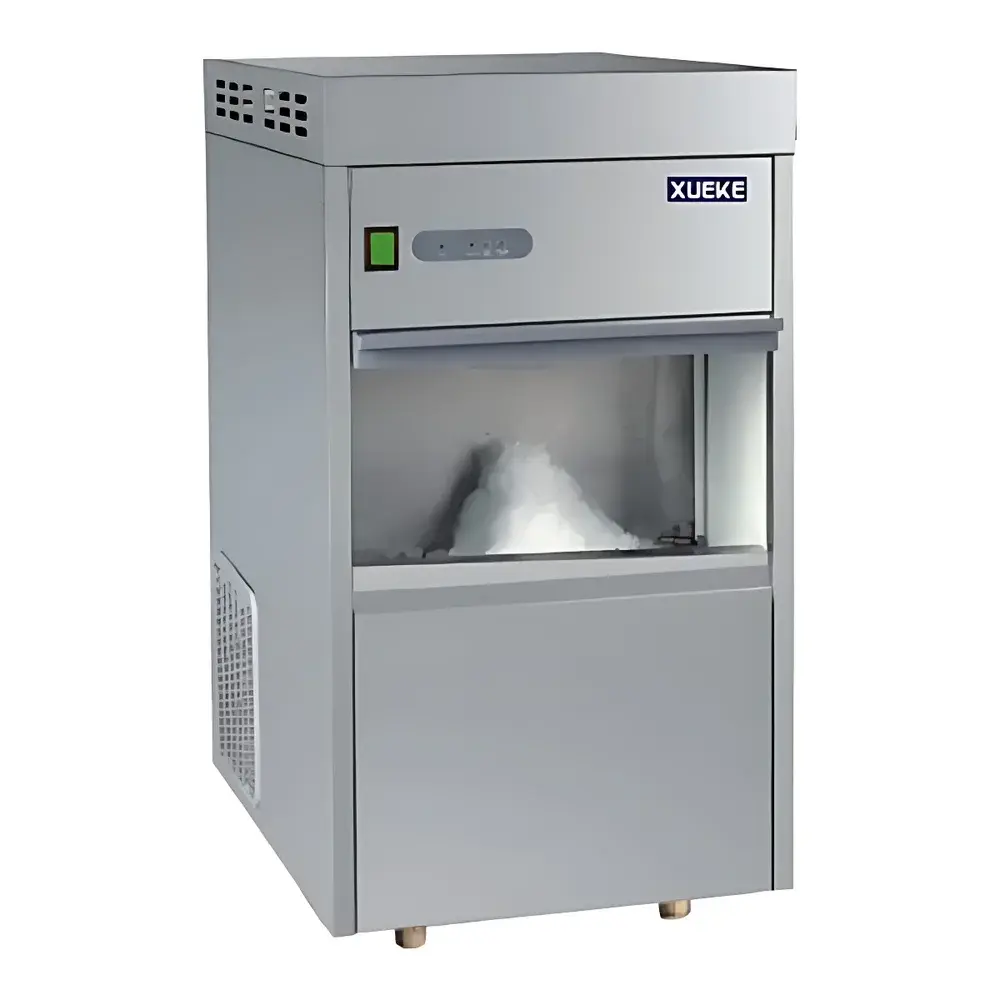
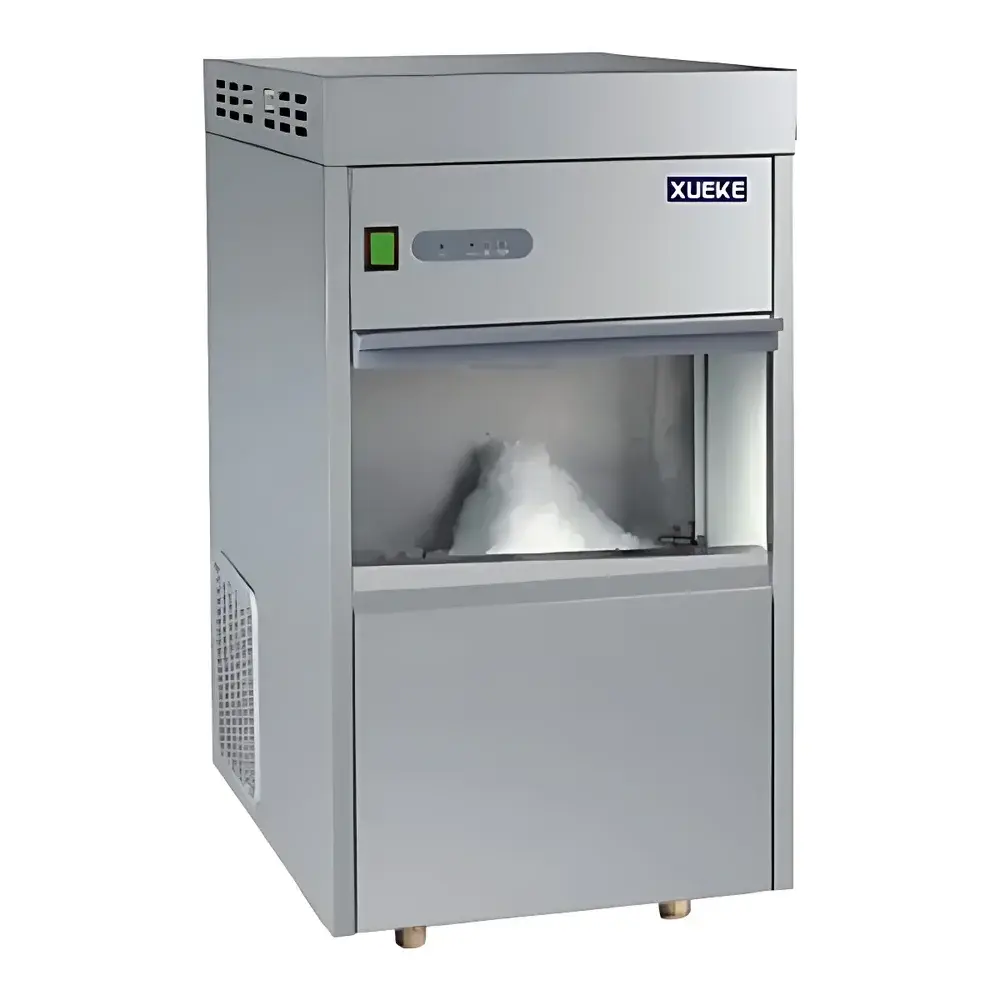
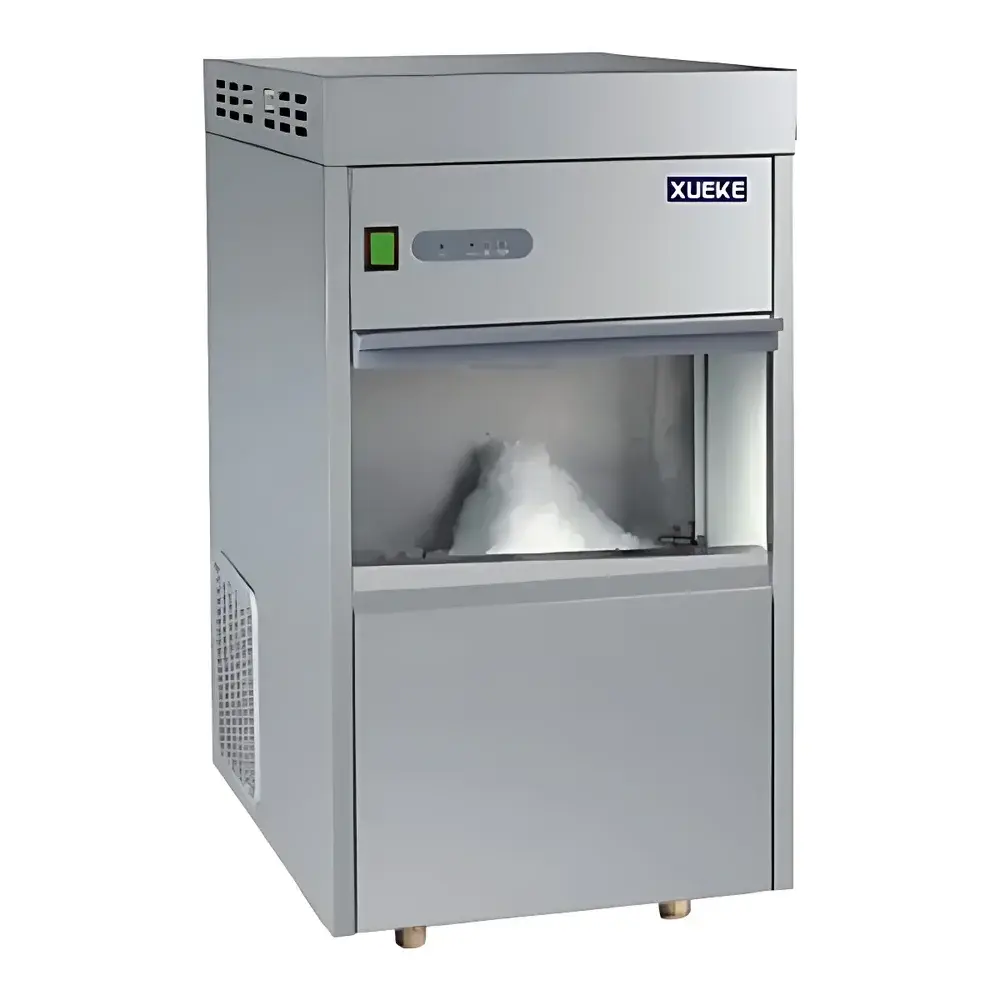
XUEKE IMS-40 Laboratory Flake Ice Machine
| Brand | XUEKE |
|---|---|
| Origin | Jiangsu, China |
| Model | IMS-40 |
| Ice Production Capacity | 40 kg/24 h |
| Ice Storage Capacity | 15 kg |
| Water Consumption | 1.6 L/h |
| Cooling Method | Air-cooled |
| Power Consumption | 280 W |
| Dimensions (W×D×H) | 380 × 543 × 722 mm |
| Net Weight | 40 kg |
| Enclosure Material | Stainless Steel (304) |
| Compressor Type | High-efficiency R290 hydrocarbon refrigerant compressor |
| Control System | Microprocessor-based fully automatic control |
| Ice Form | Irregular flake ice (average particle size: 1–3 mm thickness, 5–15 mm diameter) |
| Safety & Monitoring Features | Full diagnostic display for ice-full, low-water, and system fault conditions |
| Compliance | CE-marked per EN 61000-6-3 (EMC) and EN 60335-1 (Safety), compliant with ISO 13485-aligned manufacturing practices for medical/lab support equipment |
Overview
The XUEKE IMS-40 Laboratory Flake Ice Machine is an air-cooled, microprocessor-controlled ice generation system engineered specifically for precision-critical environments including analytical laboratories, biomedical research facilities, clinical sample preparation labs, and university teaching laboratories. Unlike cubed or nugget ice systems, the IMS-40 employs a direct-expansion evaporator drum design with optimized water film distribution to produce irregular, thin, and highly porous flake ice—typically 1–3 mm thick and 5–15 mm in nominal diameter. This morphology ensures rapid thermal transfer, minimal surface melt, and superior conformity when packing biological samples, centrifuge tubes, electrophoresis gels, or temperature-sensitive reagents. The unit utilizes an R290 hydrocarbon refrigerant compressor, offering zero ozone depletion potential (ODP = 0) and ultra-low global warming potential (GWP ≈ 3), aligning with EU F-Gas Regulation (EU No 517/2014) and increasingly adopted sustainability requirements in North American and APAC academic institutions.
Key Features
- Fully automatic operation with intelligent cycle management: ice-making, harvesting, storage, and self-diagnostic monitoring are handled without manual intervention.
- Stainless steel 304 enclosure and internal components ensure corrosion resistance, ease of cleaning, and compliance with ISO 15190:2020 (laboratory safety standards) and USP environmental hygiene guidelines.
- Dual-sensor water level monitoring prevents dry-run operation and enables real-time low-water alerts via LCD interface.
- Integrated ice-full detection halts production automatically upon reaching 15 kg storage capacity, preventing mechanical overloading and preserving ice integrity.
- Low-power consumption architecture (280 W nominal) supports continuous 24/7 operation in shared lab utility circuits without requiring dedicated line conditioning.
- Compact footprint (380 × 543 × 722 mm) facilitates under-bench installation or integration into modular lab furniture systems compliant with ANSI/BIFMA X5.9-2021 spatial standards.
Sample Compatibility & Compliance
The IMS-40 generates flake ice certified as non-toxic and food-grade per NSF/ANSI Standard 12 for ice makers—validated for indirect contact with biological specimens, diagnostic reagents, and pharmaceutical intermediates. Its ice output meets the thermal stability requirements for cold-chain preservation during ELISA plate pre-chilling, PCR master mix assembly, and histology tissue embedding workflows. The unit is manufactured under quality management aligned with ISO 13485 principles for ancillary medical device support equipment and conforms to electromagnetic compatibility (EN 61000-6-3) and general safety (EN 60335-1) directives. While not classified as a medical device under FDA 21 CFR Part 820, its design supports GLP-compliant documentation through timestamped event logging (via optional RS-232 interface) and audit-ready operational history.
Software & Data Management
The IMS-40 features a built-in 4-line backlit LCD interface with English-language menus supporting real-time status visualization (ice level %, current cycle phase, error code ID). Though standalone by default, it includes an RS-232 serial port enabling integration with laboratory information management systems (LIMS) or building automation platforms for remote status polling and predictive maintenance scheduling. Event logs—including start/stop timestamps, fault codes (e.g., E03 = water inlet pressure low), and cumulative runtime—are retained for ≥1,000 cycles and exportable via terminal emulation. No proprietary software is required; ASCII-formatted logs comply with ASTM E2500-07 (verification of automated systems) and support 21 CFR Part 11-compliant electronic record retention when paired with validated third-party data acquisition middleware.
Applications
- Cold sample preparation: maintaining ≤4 °C during DNA extraction, protein purification, and cell lysis protocols.
- Electrophoresis buffer cooling: stabilizing agarose and polyacrylamide gel electrophoresis tanks to prevent band distortion.
- Chromatography mobile phase pre-chilling: reducing solvent volatility in HPLC and GC sample introduction.
- Vaccine and monoclonal antibody formulation: supporting cold hold steps prior to fill-finish operations.
- Teaching labs: reproducible ice supply for thermodynamics experiments, calorimetry calibration, and cryopreservation demonstrations.
FAQ
What type of refrigerant does the IMS-40 use, and why is it environmentally preferable?
The IMS-40 uses R290 (propane), a natural hydrocarbon refrigerant with ODP = 0 and GWP = 3 — significantly lower than legacy R404A (GWP = 3922) or R134a (GWP = 1430). Its adoption reflects alignment with F-Gas Phase-down schedules and institutional net-zero commitments.
Can the IMS-40 be installed in a temperature-controlled room below 10 °C?
No. Ambient operating range is strictly 10–32 °C. Sub-10 °C environments risk refrigerant oil viscosity rise and compressor lubrication failure; supplemental heating of the machine’s vicinity is not recommended.
Is the ice suitable for direct contact with human tissue or injectables?
The ice meets NSF/ANSI 12 for food safety but is not sterile or pyrogen-free. It is intended for external cooling only—not for direct infusion, oral administration, or implantable-device thermal management.
Does the unit require a dedicated water filtration system?
Yes. Feed water must comply with ASTM D1193 Type IV purity (conductivity ≤5 µS/cm) to prevent scale formation on the evaporator drum and extend service intervals beyond 12 months.
How often does the condenser require maintenance?
The air-cooled condenser should be vacuum-cleaned every 90 days in standard lab environments; bi-weekly cleaning is advised in high-dust or animal housing facility proximity.
Related Products



