
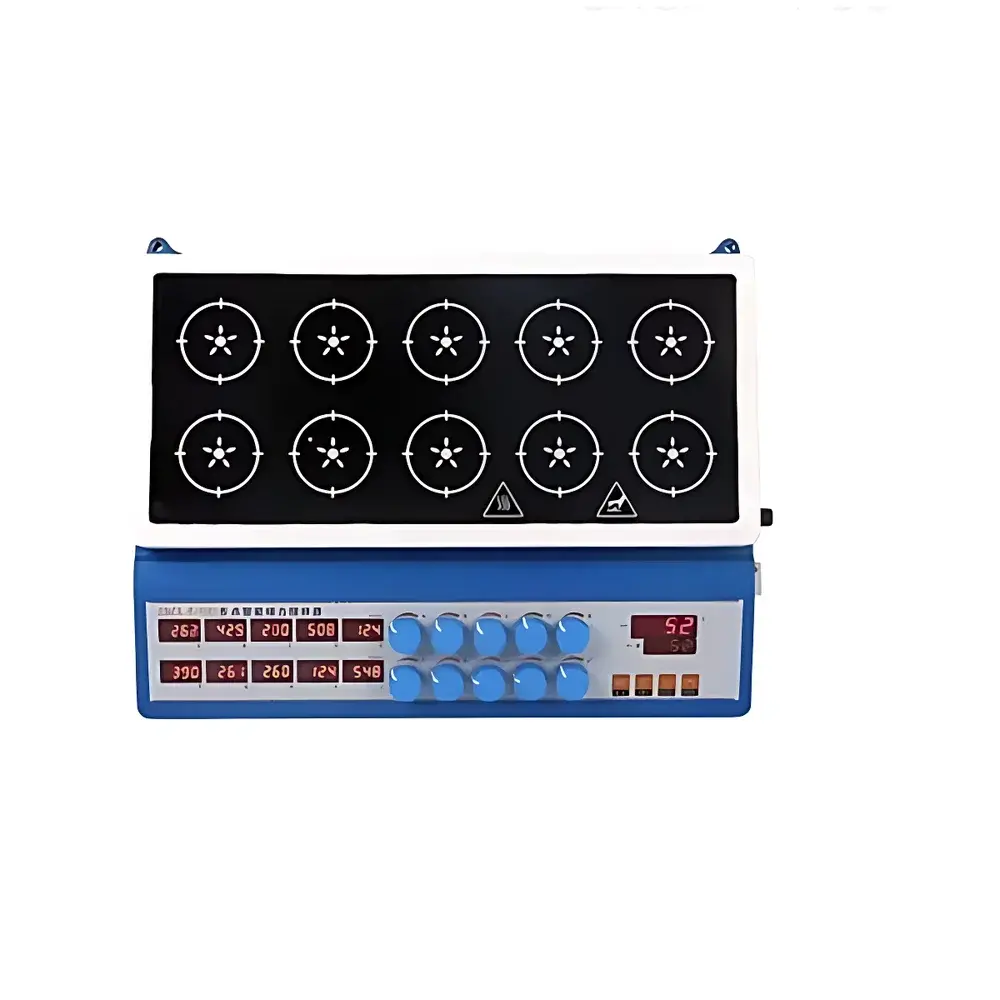
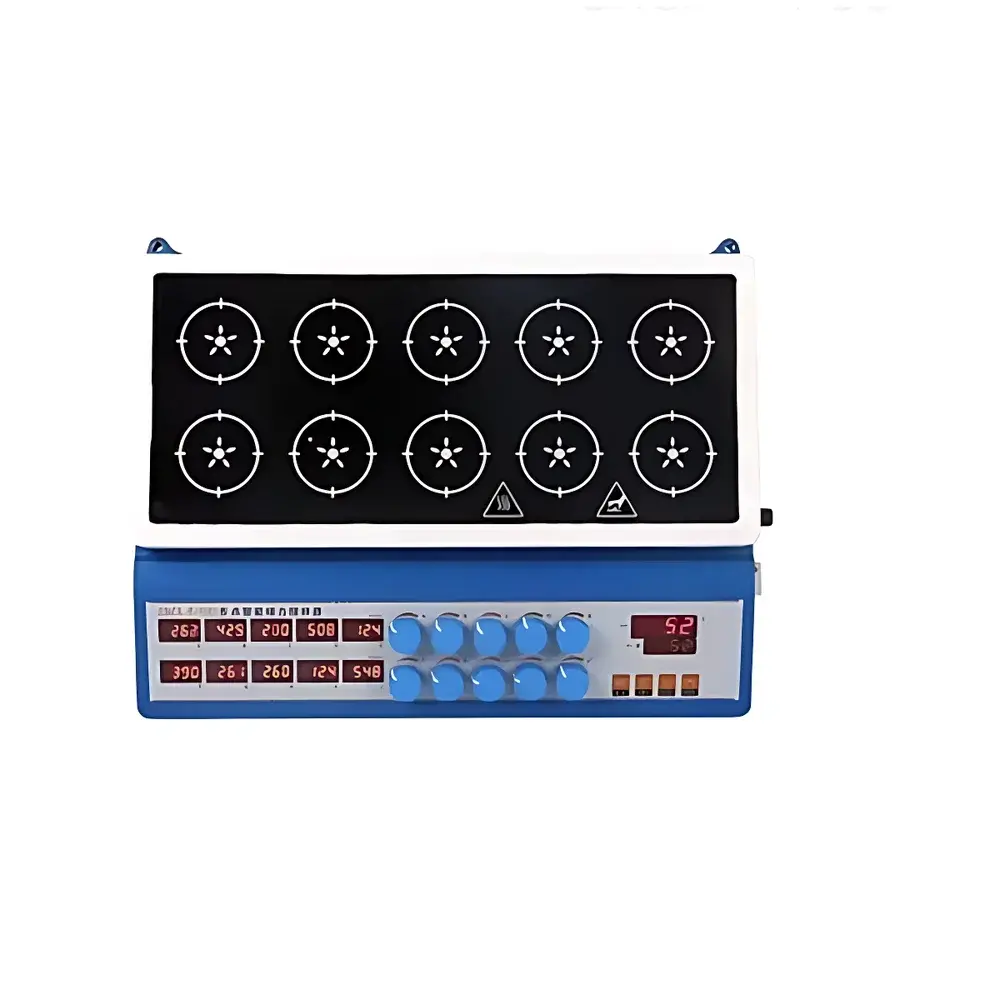
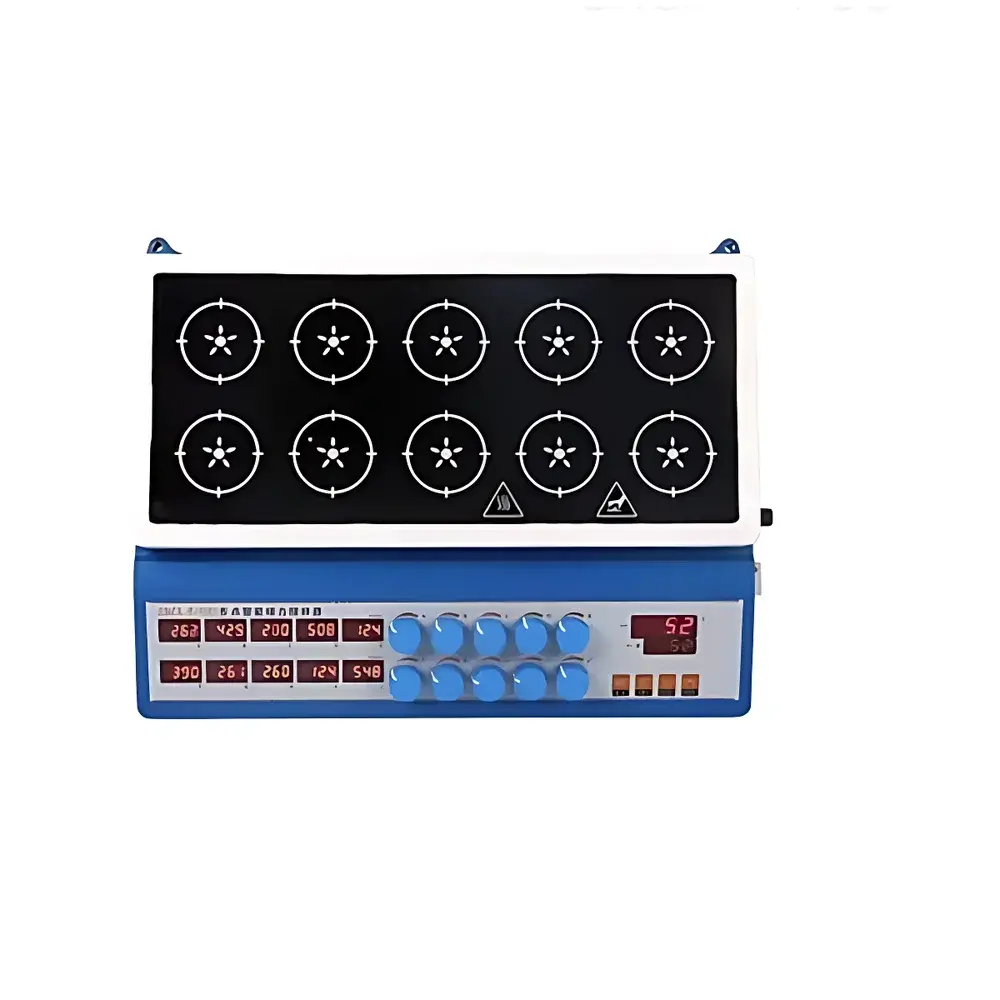
Gongyi Yuyi ZNCL-S-10D Digital Multi-Point Magnetic Hotplate Stirrer
| Brand | Gongyi Yuyi Instrument |
|---|---|
| Origin | Henan, China |
| Manufacturer Type | Authorized Distributor |
| Equipment Category | Domestic |
| Model | ZNCL-S-10D |
| Stirring Stations | 10 |
| Max. Stirring Volume per Station | 50–500 mL |
| Speed Range | 50–1800 rpm |
| Temperature Control Range | Ambient to 350 °C |
| Heating Plate Material | Ceramic |
| Control Method | Intelligent PID with Thyristor Output |
| Temperature Accuracy | ±1 °C |
| Stirring Power per Station | 8 W |
| Total Heating Power | 750 W |
| Dimensions (W×D×H) | 480 × 365 × 230 mm |
| Weight | 9.5 kg ± 0.2 kg |
| Voltage | 220 V AC, 50/60 Hz |
| Safety Features | Over-Temperature Protection, Thermocouple Break Protection, Insulated PBT Housing |
Overview
The Gongyi Yuyi ZNCL-S-10D Digital Multi-Point Magnetic Hotplate Stirrer is an engineered laboratory platform designed for parallel thermal and mechanical processing of up to ten independent samples under precisely controlled conditions. It operates on the principle of magnetic coupling—where rotating permanent magnets beneath a thermally stable ceramic surface induce motion in PTFE-coated stir bars placed inside reaction vessels—combined with resistive heating via embedded Cr20Ni80 alloy heating elements. Unlike single-station hotplate stirrers, the ZNCL-S-10D integrates spatially distributed stirring zones with unified thermal management, enabling consistent temperature uniformity across all stations while permitting individual speed adjustment. Its architecture supports continuous operation in ambient-to-350 °C regimes, making it suitable for solvent reflux, catalyst screening, polymerization kinetics, and multi-batch synthesis protocols where reproducibility, scalability, and operator ergonomics are critical.
Key Features
- 10 independently controllable magnetic stirring stations arranged across a single ceramic heating surface (450 × 190 mm), each supporting vessels from 50 mL to 500 mL capacity.
- DC brushless speed-controlled motors (8 W per station) deliver quiet, spark-free, maintenance-free operation with stable torque output across the full 50–1800 rpm range; low-speed precision (1500 rpm) are both preserved.
- Ceramic top plate resists chemical corrosion, thermal shock, and mechanical abrasion; maintains dimensional stability at sustained 350 °C surface temperatures without warping or discoloration.
- Intelligent dual-sensor PID temperature control system with auto-tuning capability—utilizes both internal and external thermocouples for real-time feedback, minimizing overshoot (<±1 °C deviation) and ensuring thermal repeatability across extended runs.
- Ergonomic 30° inclined control panel with dual digital displays (speed and temperature), tactile membrane switches, and one-touch parameter entry for rapid method setup.
- Integrated safety architecture includes over-temperature cutoff, thermocouple failure detection (open-circuit protection), and flame-retardant PBT polymer housing rated UL94 V-0 for electrical insulation and thermal resistance.
Sample Compatibility & Compliance
The ZNCL-S-10D accommodates standard and non-standard glassware—including round-bottom flasks, beakers, and crystallization dishes—as well as non-magnetic metallic or ceramic containers, provided they contain compatible magnetic stir bars. It complies with IEC 61010-1:2010 for laboratory electrical equipment safety and meets EMC requirements per EN 61326-1:2013. While not certified for use in classified hazardous locations (e.g., ATEX or IECEx), its spark-free motor design and insulated construction support safe operation in general-purpose chemistry labs handling flammable solvents under proper ventilation. The device supports GLP-aligned workflows through stable parameter logging (when paired with optional RS232/USB data export modules) and traceable thermal profiles.
Software & Data Management
The ZNCL-S-10D operates as a standalone instrument with no embedded operating system or cloud connectivity. All operational parameters—including setpoints, actual speed, real-time temperature, and elapsed time—are displayed locally on dual LED screens. Optional analog/digital interfaces (RS232 or USB-to-serial adapters) enable integration with third-party lab information management systems (LIMS) or custom Python/Matlab scripts for automated data capture. When used in regulated environments, users may implement manual audit trails per FDA 21 CFR Part 11 guidelines by recording instrument ID, batch number, operator initials, and start/end timestamps in bound logbooks.
Applications
- Parallel optimization of reaction conditions (temperature, mixing intensity) in organic synthesis and pharmaceutical process development.
- Multi-vessel dissolution testing in QC laboratories following USP and protocols (with appropriate vessel holders).
- Heating and homogenization of viscous emulsions, suspensions, and polymer melts in materials science research.
- Controlled evaporation and concentration of environmental water samples prior to ICP-MS or GC-MS analysis.
- Simultaneous digestion of food, soil, or biological matrices in accredited environmental testing labs adhering to ISO 17025 quality standards.
FAQ
Can the ZNCL-S-10D heat and stir ten vessels at different temperatures simultaneously?
No—the unit features a single-zone ceramic heating surface with uniform thermal distribution; all stations share the same set temperature.
Is it possible to operate individual stations without heating?
Yes—temperature control can be disabled while maintaining independent speed control for each station.
What type of stir bars are recommended for optimal performance at 350 °C?
High-temperature PTFE-encapsulated stir bars with Alnico or SmCo magnetic cores, rated for continuous use above 300 °C, are advised.
Does the unit support external temperature probes for vessel-specific monitoring?
Yes—it accepts optional external K-type thermocouples connected via the rear sensor port for direct solution-phase temperature feedback.
What maintenance is required for long-term reliability?
Routine cleaning of the ceramic surface with non-abrasive ethanol wipes; annual verification of PID calibration using a NIST-traceable reference thermometer is recommended.



