
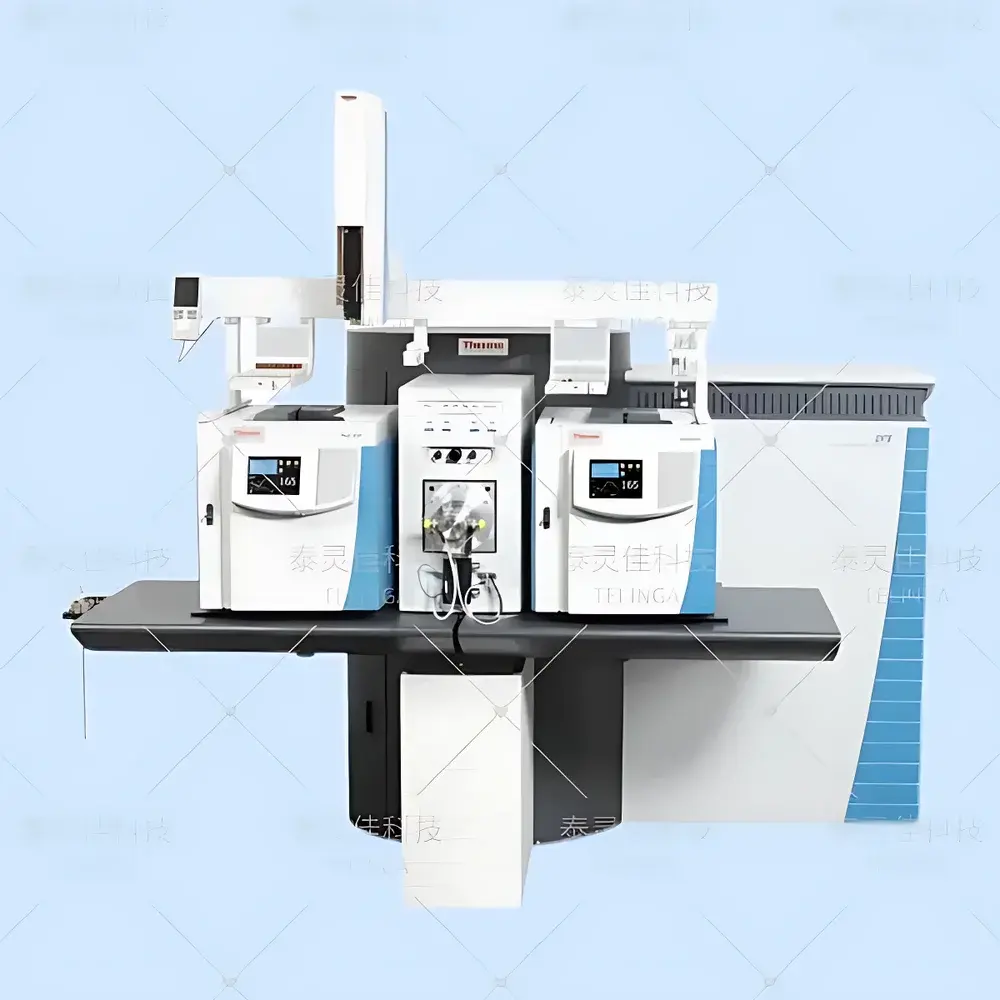
Thermo Fisher DFS High-Resolution Magnetic Sector Gas Chromatography Mass Spectrometer (Refurbished/Pre-Owned)
| Brand | Thermo Fisher |
|---|---|
| Model | DFS |
| Type | Double-Focusing Magnetic Sector GC-MS |
| Detector | Dual-Channel Electron Multiplier with Convertor Electrode |
| Resolution | Up to 100,000 (10% Valley) |
| Mass Range | 10–2000 m/z |
| Ion Source | Removable, Modular EI/CI Source |
| Vacuum System | Pneumatic Valve Lock for Ion Box Exchange Without Venting |
| GC Compatibility | Dual Trace 1310 GCs on Single Ion Source |
| Automation | TriPlus RSH Autosampler with Dual-Column Sequential Injection |
| Calibration | Field-Based, Mode-Independent Mass Calibration |
| Software | Thermo Xcalibur with DFS-Specific Acquisition & Quantitation Modules |
| Compliance | Designed for EPA Method 1613/8270, EU 2017/625, ISO 18073, and GLP/GMP environments requiring 21 CFR Part 11 audit trails |
Overview
The Thermo Fisher DFS is a high-resolution magnetic sector gas chromatography mass spectrometer engineered for definitive compound identification and ultra-trace quantification in regulated and research laboratories. Unlike quadrupole or time-of-flight instruments, the DFS employs double-focusing geometry—combining a high-precision toroidal electrostatic analyzer (ESA) and a radially segmented pole-piece magnet—to achieve mass resolution up to 100,000 (10% valley definition) with exceptional mass accuracy (< 0.2 ppm) and long-term stability. Its field-based calibration eliminates dependence on scan speed, ion polarity, or ionization mode (EI or CI), ensuring consistent mass assignment across analytical runs. The instrument’s architecture supports dual Trace 1310 gas chromatographs mounted on a single, shared electron ionization (EI)/chemical ionization (CI) source—enabling parallel chromatographic separation without cross-contamination or recalibration. This configuration is uniquely suited for method robustness validation, orthogonal column screening, and high-throughput dioxin/furan analysis where regulatory compliance demands unambiguous congener-specific detection.
Key Features
- Double-focusing magnetic sector design with toroidal ESA and precision radial magnet for distortion-free ion trajectories and superior peak shape fidelity
- Field-calibrated mass scale: independent of acquisition parameters, enabling reproducible mass assignment across EI, CI, and negative-ion modes
- Modular, removable ion source assembly with tool-free access—reducing maintenance downtime and supporting routine cleaning or replacement
- Pneumatic vacuum lock system allows rapid ion box exchange without breaking high-vacuum integrity, minimizing instrument idle time
- Dual-Trace 1310 GC integration with TriPlus RSH autosampler: sequential injection onto two independently temperature-programmed columns within one sequence
- Convertor electrode + extended-lifetime secondary electron multiplier detector for high gain stability and sub-femtogram (fg) sensitivity in selected ion monitoring (SIM) mode
- Embedded microcontroller network across all high-voltage plates and magnet power supply, enabling real-time parameter monitoring and adaptive tuning via Xcalibur
Sample Compatibility & Compliance
The DFS accommodates volatile and semi-volatile organic compounds ranging from C2 hydrocarbons to high-molecular-weight chlorinated dioxins (PCDD/Fs), brominated flame retardants (PBDEs, HBCDs), and polycyclic aromatic hydrocarbons (PAHs). Its validated workflows align with U.S. EPA Methods 1613 (dioxins), 8270 (semivolatiles), and 525.3 (pesticides), as well as EU Commission Regulation (EU) 2017/625 for food/feed contaminants. The system supports full 21 CFR Part 11 compliance when deployed with Xcalibur 4.3+ and appropriate IT infrastructure—including electronic signatures, audit trail logging, and role-based user permissions. All calibration, tuning, and data acquisition protocols are documented per GLP and ISO/IEC 17025 requirements.
Software & Data Management
Acquisition, processing, and reporting are managed through Thermo Xcalibur software with DFS-specific extensions. Key capabilities include automated resolution optimization, intelligent background subtraction for complex matrices, and congener-specific integration using retention time locking and isotope ratio confirmation. Raw data files (.RAW) retain full spectral fidelity and are compatible with third-party libraries (NIST, Wiley) and custom spectral matching algorithms. Batch processing supports multi-instrument comparison, internal standard normalization, and isotopic pattern verification. Audit trails record every parameter change, calibration event, and data export action—with timestamps, operator IDs, and reason codes—meeting FDA and EMA data integrity expectations.
Applications
The DFS serves as the reference platform for regulatory-grade dioxin analysis in environmental, food safety, and pharmaceutical impurity testing laboratories. Its demonstrated detection limits of 0.05 fg I-TEQ for 2,3,7,8-TCDD and linear dynamic range spanning six orders of magnitude enable confident quantification in soil, sediment, milk fat, and human serum. In pesticide residue analysis, it delivers unambiguous identification of co-eluting isomers (e.g., tolylfluanid vs. dichlofluanid) and accurate quantification down to low-fg levels in fruit/vegetable extracts. Additional applications include forensic toxicology (novel psychoactive substances), petrochemical fingerprinting (biomarker ratios), and polymer additive screening (phthalates, organotins).
FAQ
Is this DFS unit fully refurbished and performance-verified?
Yes—each unit undergoes Thermo-certified refurbishment including magnet reconditioning, ESA alignment verification, vacuum integrity testing, and full system qualification against ASTM D7595 and ISO 17025 criteria.
Does the dual-GC configuration require custom hardware integration?
No—the DFS ships with factory-installed dual-GC interface hardware, pre-aligned ion optics, and validated Xcalibur method templates for synchronized operation.
Can the system be upgraded to support GC×GC or LC interfaces?
The DFS platform is GC-optimized; while API sources are not supported, optional GC×GC modulators (e.g., LECO Modulator II) can be integrated with external timing control via TTL triggers.
What documentation accompanies the instrument?
Full refurbishment report, IQ/OQ protocols, original factory certificates of calibration, and digital copies of service manuals and safety documentation are provided.
Is remote diagnostics and support available post-installation?
Yes—Thermo Fisher offers optional CareTrack remote monitoring and priority technical support contracts for refurbished DFS systems under extended warranty coverage.




