
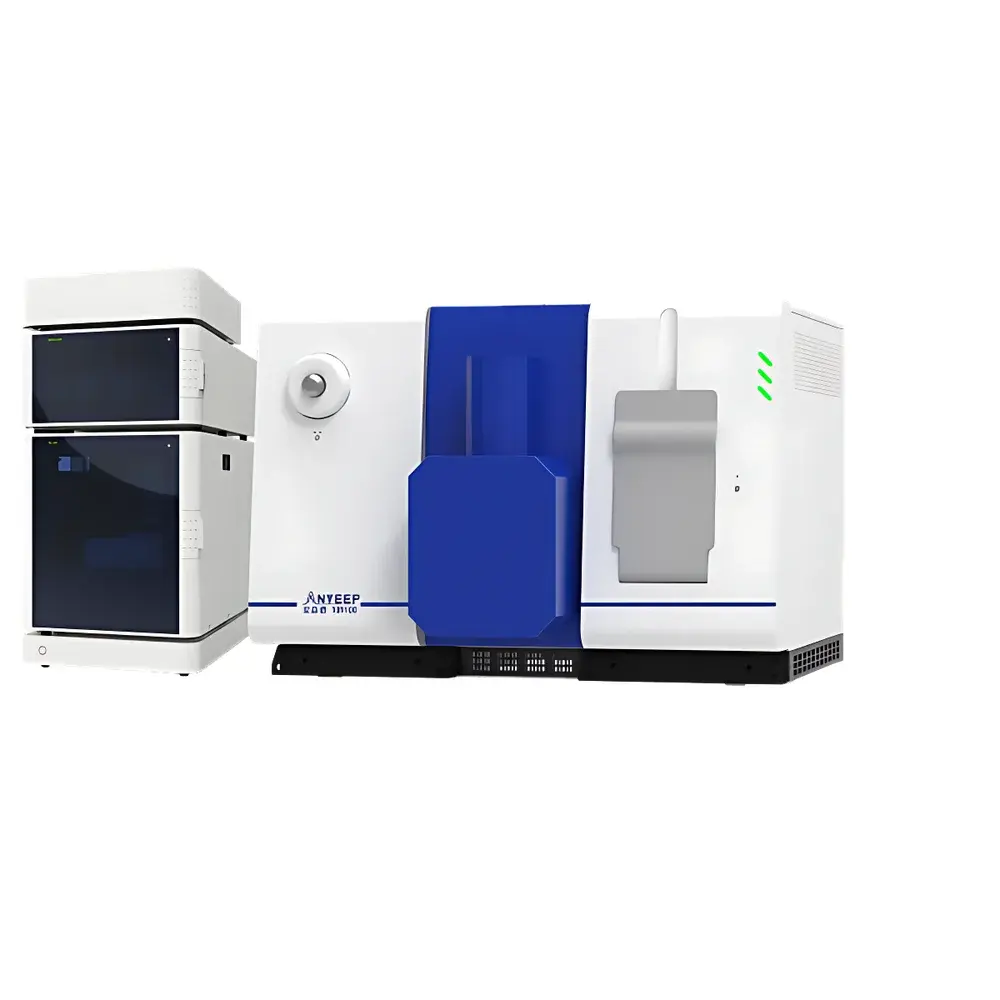
Anyeep TQ9100 Ultra-High Performance Liquid Chromatography–Tandem Quadrupole Mass Spectrometer
| Brand | Anyeep |
|---|---|
| Origin | Jiangsu, China |
| Manufacturer Type | Original Equipment Manufacturer (OEM) |
| Product Category | Domestic |
| Model | TQ9100 |
| Instrument Type | Triple Quadrupole Mass Spectrometer (QqQ) |
| Application Scope | General-Purpose LC-MS/MS |
| Resolution | Unit Resolution (m/Δm ≈ 1,000 FWHM at m/z 500) |
Overview
The Anyeep TQ9100 is an ultra-high performance liquid chromatography–tandem quadrupole mass spectrometry (UHPLC-QqQ MS/MS) system engineered for robust, quantitative bioanalysis and small-molecule characterization in regulated and research laboratory environments. Built upon a collision-cell-based triple quadrupole architecture, the TQ9100 operates under electrospray ionization (ESI) and atmospheric pressure chemical ionization (APCI) modes, delivering high specificity through selected reaction monitoring (SRM) and multiple reaction monitoring (MRM) acquisition. Its design emphasizes reproducible ion transmission, low chemical noise, and stable dwell-time allocation across >100 transitions per run—critical for high-throughput clinical toxicology, endogenous metabolite quantification (e.g., bile acids), and pharmaceutical impurity profiling. The system integrates seamlessly with industry-standard UHPLC modules operating up to 1300 bar, supporting sub-2 µm particle columns and gradient elution profiles with ≤5 µL system dispersion volume.
Key Features
- Triple quadrupole mass analyzer with RF-only Q1 and Q3 rods, enabling high transmission efficiency and optimized duty cycle for MRM
- Dual-mode ion source (ESI/APCI) with heated probe, adjustable gas flows, and polarity-switching capability within <100 ms
- Collision-induced dissociation (CID) cell with nitrogen or argon gas, programmable collision energy (CE) from 0–100 eV in 0.1 eV increments
- Unit-resolution mass filtering in Q1 and Q3 (FWHM ≤ 0.7 Da at m/z 500), compliant with ICH M7 and USP <1225> specificity requirements
- Dynamic range of ≥5 orders of magnitude (linear response, R² ≥ 0.999) for calibration curves using internal standard normalization
- Robust vacuum architecture: dual-stage turbomolecular pumping system achieving ≤5 × 10⁻⁷ Torr in the analyzer region
- Modular hardware design supporting future upgrades including differential mobility separation (DMS) interface compatibility
Sample Compatibility & Compliance
The TQ9100 accommodates biological matrices including plasma, serum, urine, tissue homogenates, and cell lysates following protein precipitation, solid-phase extraction (SPE), or liquid–liquid extraction (LLE). Method validation adheres to FDA Bioanalytical Method Validation Guidance (2018), EMA Guideline on Bioanalytical Method Validation (2022), and ISO/IEC 17025:2017 requirements for testing laboratories. System suitability testing includes retention time stability (RSD ≤ 1.0%), peak area precision (RSD ≤ 5.0% for LLOQ), and carryover ≤ 0.1%—verified per USP <1058>. Full audit trail, electronic signatures, and 21 CFR Part 11-compliant user access control are supported via optional secure software licensing.
Software & Data Management
Controlled by Anyeep MassAnalyzer™ v3.2, the platform provides intuitive method building, real-time spectral visualization, and automated peak integration using weighted (1/x²) linear regression. Raw data files conform to open mzML 1.1.0 format, ensuring interoperability with third-party tools (e.g., Skyline, Compound Discoverer, OpenMS). All processing parameters—including integration algorithms, baseline correction models, and calibration weighting—are version-controlled and embedded in metadata. Audit logs record operator actions, instrument state changes, and data modification events with timestamps and user IDs—fully traceable for GLP/GMP inspections.
Applications
- Quantitative analysis of 15 bile acid species in human plasma (e.g., cholic acid, deoxycholic acid, glycochenodeoxycholic acid) using stable isotope-labeled internal standards and MRM transitions
- Therapeutic drug monitoring (TDM) of immunosuppressants (tacrolimus, cyclosporine A) and antiepileptics (lamotrigine, levetiracetam)
- Residue screening in food safety: veterinary drugs (β-agonists, sulfonamides), mycotoxins (aflatoxin B1, ochratoxin A), and pesticide metabolites
- Endogenous metabolomics: acylcarnitines, amino acids, organic acids, and oxylipins in dried blood spots or CSF
- Impurity identification and quantification per ICH Q3B(R2), supporting regulatory submissions for generic and novel drug substances
FAQ
What ionization sources are supported on the TQ9100?
ESI and APCI sources are factory-installed and interchangeable without tooling; nano-ESI and MALDI interfaces are not supported.
Is the system compatible with third-party UHPLC systems?
Yes—the TQ9100 accepts analog voltage inputs (0–10 V) and digital trigger signals (TTL) for synchronization with Agilent 1290, Waters Acquity UPLC, and Shimadzu Nexera systems.
Does the TQ9100 meet 21 CFR Part 11 requirements out-of-the-box?
Hardware-level security features (e.g., password complexity, session timeout) are embedded; full Part 11 compliance requires installation of MassAnalyzer™ Secure Edition with PKI certificate management.
What maintenance intervals are recommended for routine operation?
Source cleaning every 72 hours of cumulative run time; quadrupole calibration quarterly; turbomolecular pump oil replacement annually or after 10,000 hours of operation.
Can the system perform qualitative analysis (e.g., full-scan or product ion scans)?
Yes—full-scan (Q1), product ion scan (Q3), and precursor ion scan modes are available, though sensitivity is optimized for MRM quantitation rather than discovery workflows.




