
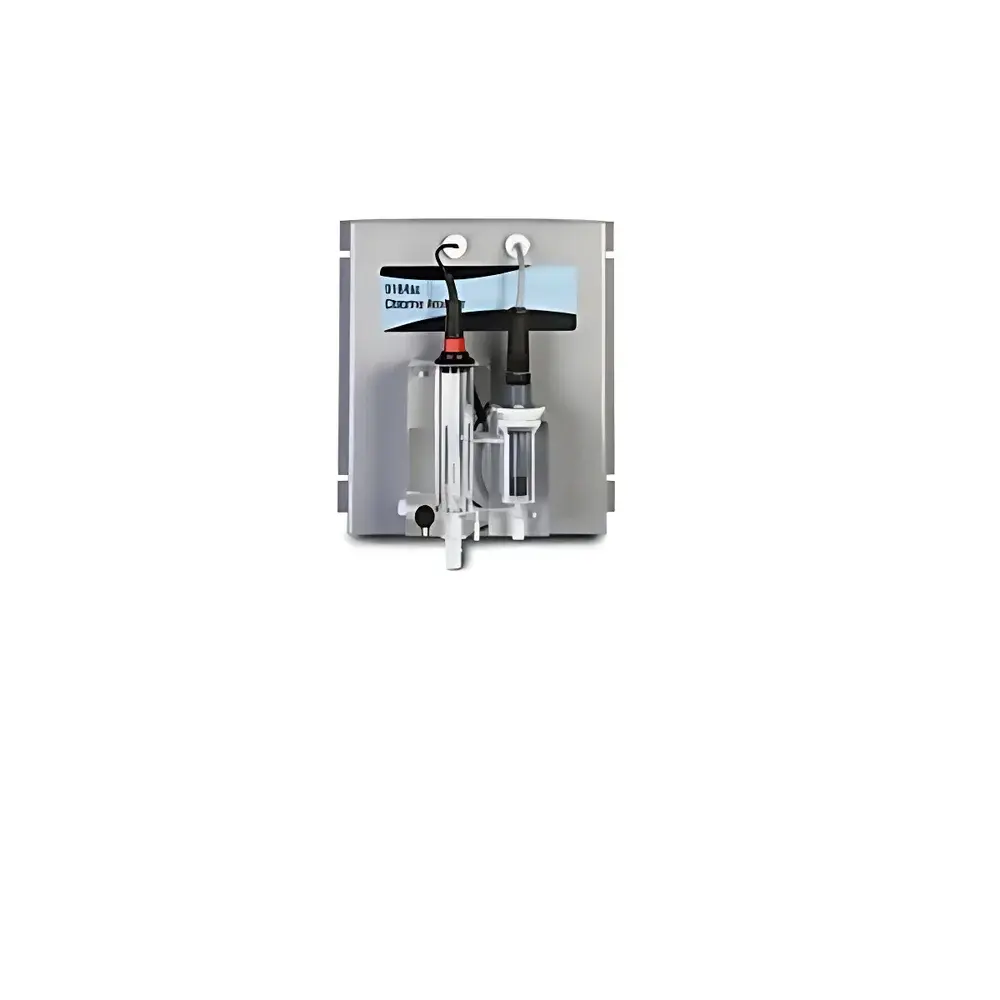
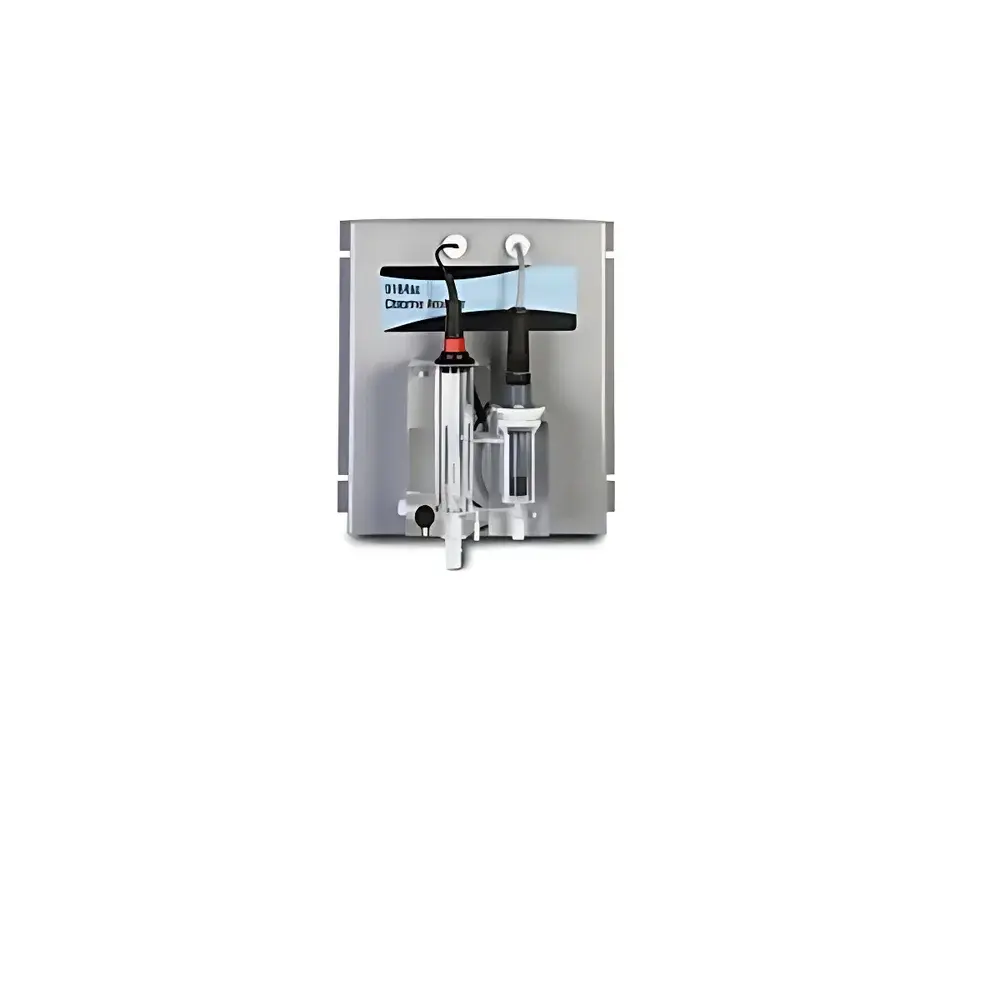
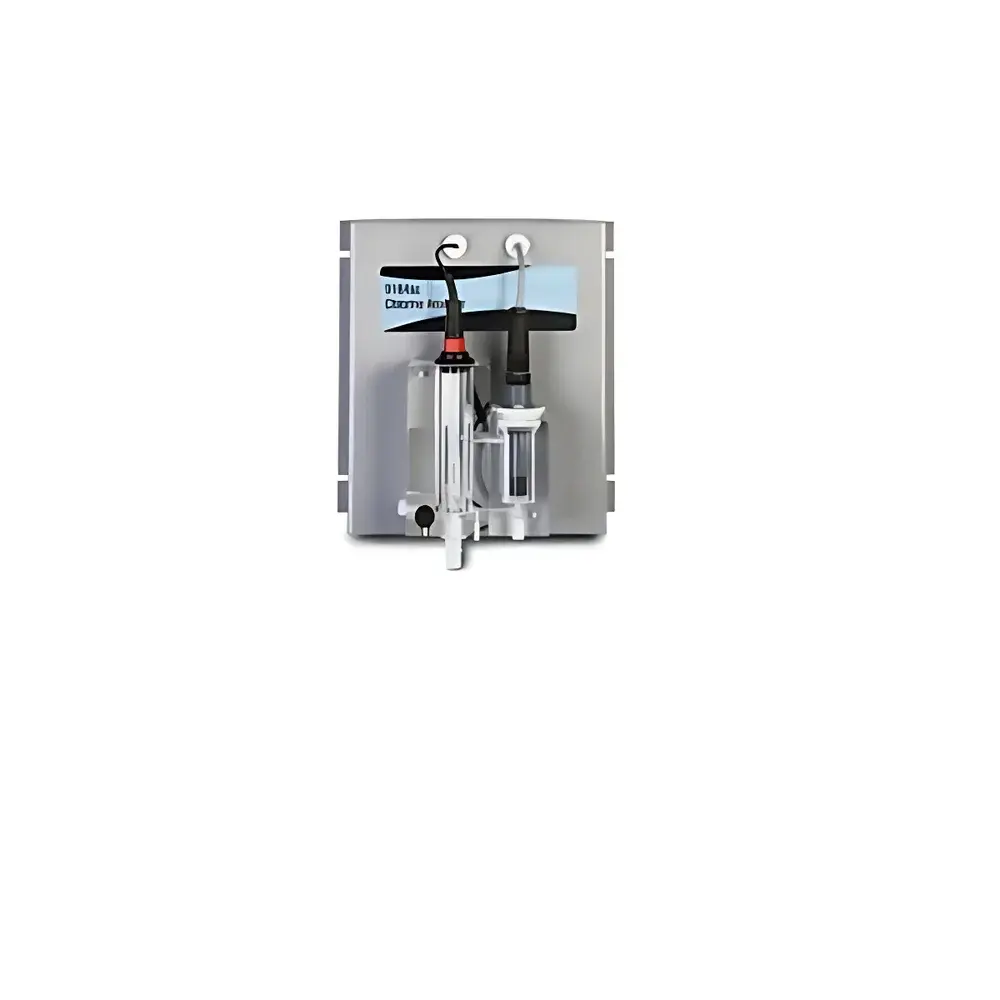
Hach 9184sc Online Residual Chlorine Analyzer
| Brand | Hach |
|---|---|
| Origin | USA |
| Model | 9184sc |
| Instrument Type | Online Analyzer |
| Measurement Principle | Amperometric Electrochemical Sensor (HOCl-selective Membrane) |
| Measurement Parameter | Free Chlorine (as HOCl) |
| Range | 0.005–20 ppm (mg/L) HOCl |
| Accuracy | ±2% of reading or ±10 ppb HOCl (whichever is greater) |
| Detection Limit | 5 ppb (0.005 mg/L) HOCl |
| Response Time (t₉₀) | <90 seconds |
| Sample Flow Rate | 200–250 mL/min (automatically regulated) |
| Operating Temperature | 0–45 °C |
| Sample Temperature Range | 2–45 °C |
| Sample pH Range | 4–8 |
| Calibration Interval | Every 2 months |
| Membrane & Electrolyte Replacement Interval | Every 6 months |
| Enclosure Rating | IP66 / NEMA 4X |
| Dimensions | 270 × 250 mm |
| Storage Temperature | −20–60 °C |
| Inlet/Outlet Fittings | 1/4″ O.D. inlet, 1/2″ I.D. outlet |
Overview
The Hach 9184sc Online Residual Chlorine Analyzer is a dedicated amperometric sensor system engineered for continuous, real-time measurement of free chlorine (hypochlorous acid, HOCl) in potable water, process water, and pre-membrane feed streams. It employs a selective gas-permeable membrane that allows only undissociated HOCl to diffuse into the electrochemical cell—ensuring high specificity in complex matrices where chloride, chloramine, or oxidant interferences may be present. Unlike colorimetric or DPD-based methods, the 9184sc operates without reagents, consumables, or optical components, delivering long-term stability and minimal drift. Its design follows fundamental electrochemical principles: HOCl diffuses across the membrane and undergoes reduction at the cathode (ClO⁻ + 2H⁺ + 2e⁻ → Cl⁻ + H₂O), while silver oxidation occurs at the anode (Ag + Cl⁻ → AgCl + e⁻). The resulting current is linearly proportional to HOCl concentration and is converted to a calibrated digital output. Built-in temperature and pH compensation algorithms correct for kinetic and speciation effects—critical because the HOCl/ClO⁻ equilibrium shifts significantly with pH and temperature, directly impacting measured free chlorine activity.
Key Features
- Amperometric HOCl-selective membrane sensor with no reagent consumption or optical path degradation
- Wide dynamic range: 0.005–20 mg/L HOCl, optimized for low-level monitoring in RO pretreatment and distribution systems
- Detection limit of 5 ppb (0.005 mg/L) HOCl—suitable for compliance with stringent regulatory thresholds (e.g., EPA 300.0, ISO 7393-2)
- Integrated temperature and pH compensation using embedded Pt1000 RTD and optional inline pH sensor input
- Automatically regulated sample flow (200–250 mL/min) via internal peristaltic pump or external flow controller interface
- IP66/NEMA 4X-rated enclosure for outdoor or wet industrial environments
- Low-maintenance architecture: calibration every 60 days; membrane and electrolyte replacement every 180 days
- Plug-and-play electrode module with standardized BNC analog output and Modbus RTU over RS-485
Sample Compatibility & Compliance
The 9184sc is validated for use in clarified, filtered, and low-turbidity water matrices typical of municipal drinking water treatment plants, pharmaceutical water systems (PW/WFI), food & beverage process lines, and semiconductor ultrapure water (UPW) pretreatment loops. It meets operational requirements under ASTM D1253 (Standard Test Method for Total Chlorine in Water) and ISO 7393-2 (Electrochemical determination of free chlorine). While not a primary reference method, its performance is traceable to NIST-traceable chlorine standards and supports GLP/GMP data integrity when integrated with Hach’s SC1000 platform or third-party SCADA systems. The instrument complies with electromagnetic compatibility (EMC) per IEC 61326-1 and safety standards IEC 61010-1. For FDA-regulated environments, audit trails and user access control are enabled when paired with Hach’s DataStream software compliant with 21 CFR Part 11.
Software & Data Management
The 9184sc outputs a 4–20 mA analog signal and Modbus RTU digital data stream compatible with PLCs, DCS, and HMI platforms. When connected to Hach’s SC1000 Universal Controller or DataStream cloud service, it enables remote configuration, automated calibration logging, trend visualization, alarm thresholding (high/low, rate-of-change), and exportable CSV reports. All calibration events—including date, operator ID, standard concentration, and deviation from reference—are time-stamped and stored locally for ≥12 months. Firmware updates preserve historical configuration and maintain data continuity during field upgrades. Optional integration with LIMS via OPC UA ensures seamless transfer of QC results into enterprise quality management systems.
Applications
- Real-time monitoring of free chlorine in reverse osmosis (RO) and nanofiltration (NF) feed water to prevent membrane oxidation damage
- Chlorine residual control in finished water storage tanks and distribution networks
- Process verification in pharmaceutical purified water (PW) and water-for-injection (WFI) systems per USP
- Disinfection validation in food processing rinse water and CIP return loops
- Regulatory compliance reporting for EPA Stage 2 Disinfectants and Disinfection Byproducts Rule (DBPR)
- Leak detection and breakpoint chlorination optimization in chloramination systems
FAQ
Does the 9184sc measure total chlorine or only free chlorine?
The 9184sc measures free chlorine exclusively as hypochlorous acid (HOCl) using a membrane that excludes ClO⁻ and chloramines—no cross-sensitivity to monochloramine or dichloramine is observed under normal operating conditions.
Can it operate without an external pH sensor?
Yes—the analyzer includes built-in pH compensation logic assuming a stable sample pH between 4 and 8; however, for highest accuracy in variable-pH applications (e.g., post-acidification), connection to an inline pH transmitter is recommended.
What maintenance is required beyond membrane replacement?
No routine cleaning or electrode polishing is needed; the sensor is self-cleaning via continuous flow. Only periodic verification against a certified DPD standard solution is required for calibration confirmation.
Is the 9184sc suitable for seawater or brackish water applications?
No—it is not designed for high-chloride matrices (>5,000 mg/L Cl⁻); elevated chloride concentrations accelerate silver anode passivation and reduce sensor lifetime.
How does temperature compensation work in practice?
An integrated Pt1000 RTD measures sample temperature in real time; the firmware applies Arrhenius-derived correction coefficients to normalize diffusion rate and reaction kinetics across the 2–45 °C operating range.
Related Products







