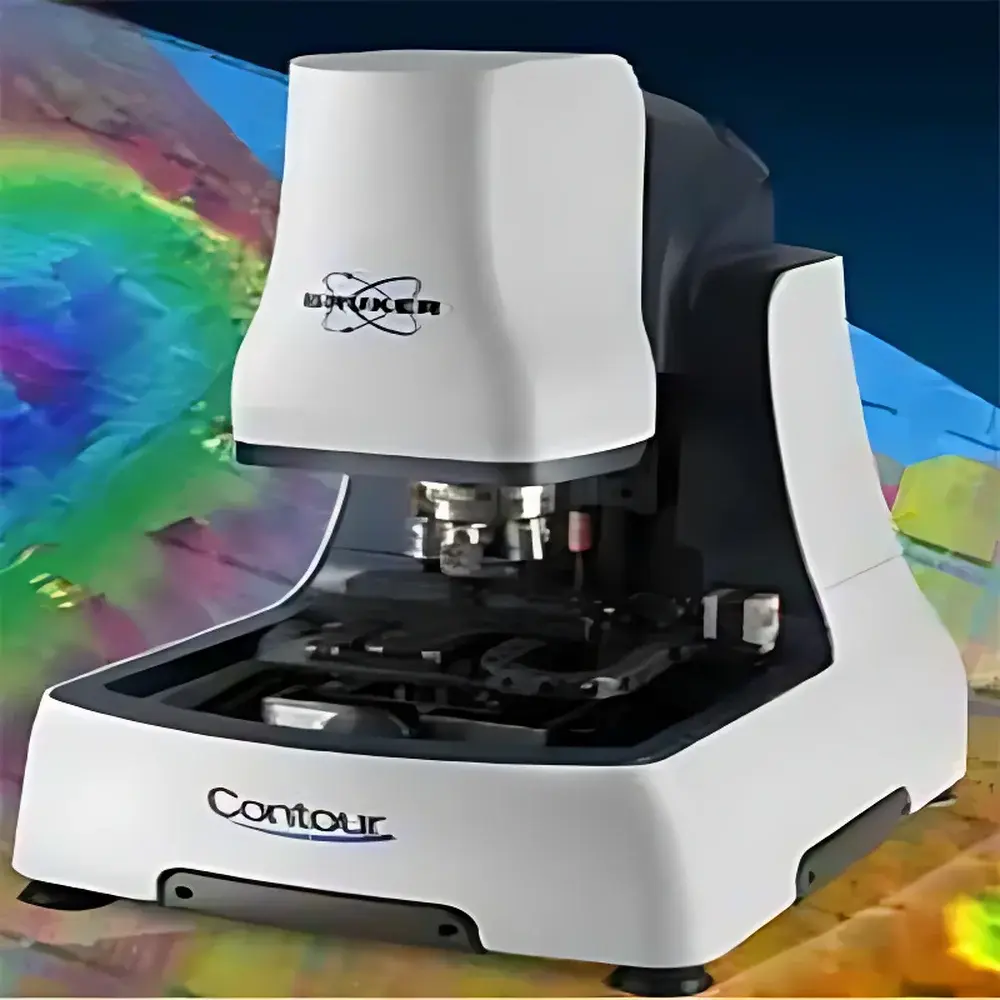
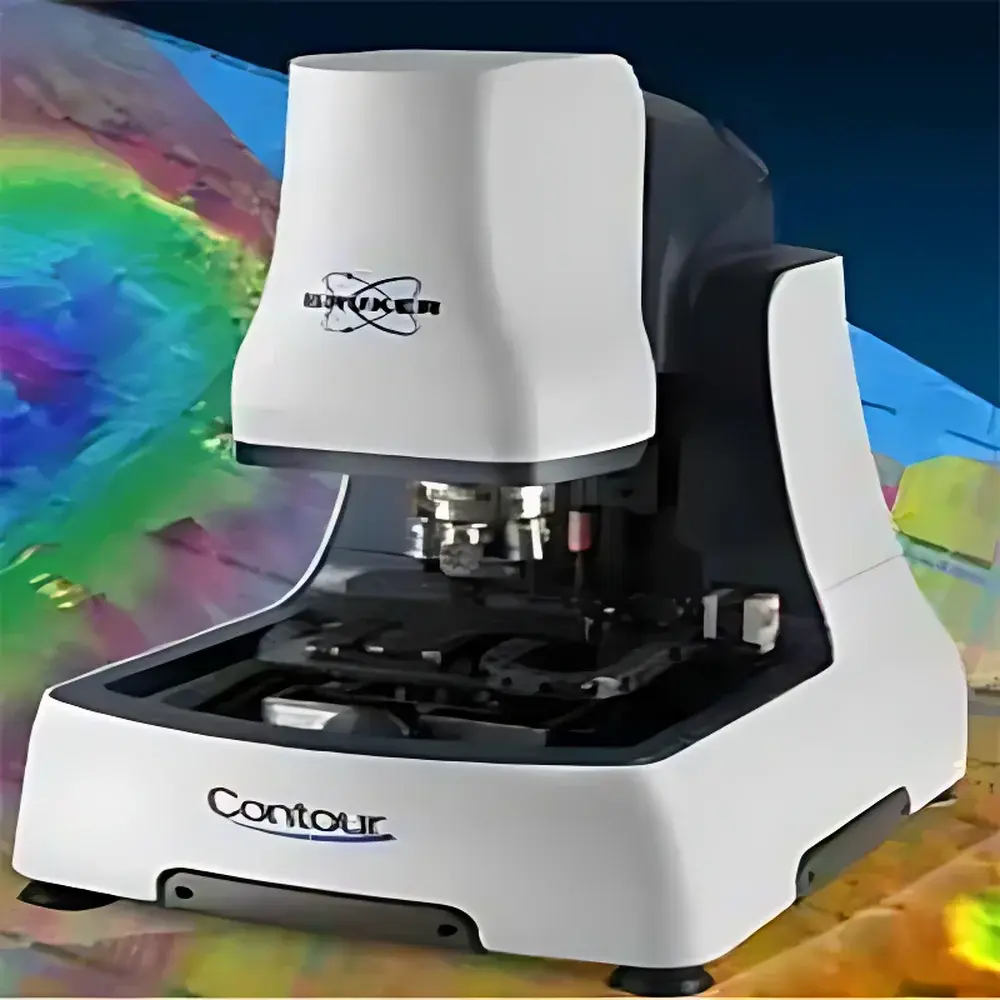
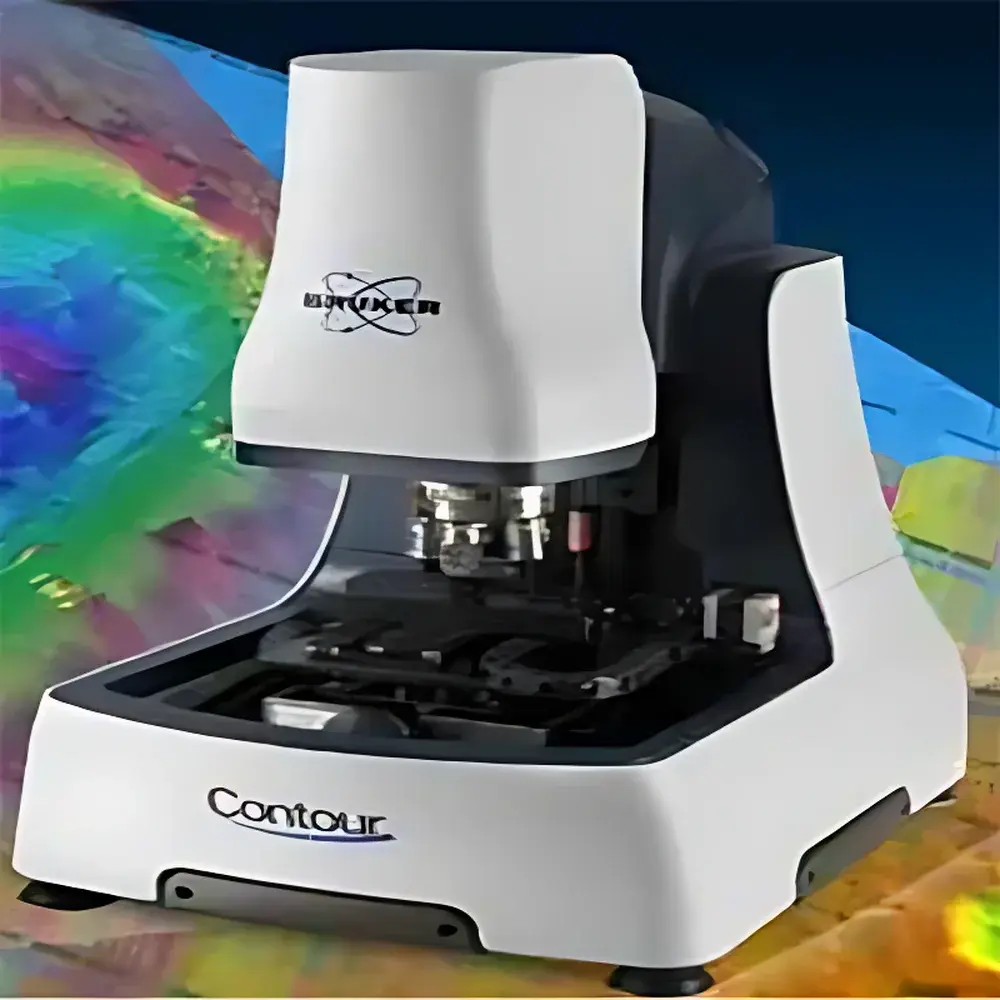
Bruker ContourX-200 White Light Interferometric Profilometer
| Brand | Bruker |
|---|---|
| Origin | Germany |
| Model | ContourX-200 |
| Product Type | Non-contact Optical Profilometer / Surface Roughness Analyzer |
| Measurement Principle | White Light Interferometry (WLI) |
| Vertical Resolution | Sub-nanometer (typical < 0.1 nm RMS noise) |
| Lateral Resolution | Diffraction-limited, dependent on objective magnification (e.g., 0.49 µm at 50×) |
| Camera | 5 MP high-speed CMOS sensor |
| Stage | Motorized XY stage with 100 mm × 100 mm travel |
| Field of View | Up to 4.8 mm × 3.6 mm (with 2.5× objective), scalable via 5×–100× objectives |
| Compliance | Fully supports ISO 25178-2, ISO 4287, ASME B46.1, and NIST-traceable calibration protocols |
Overview
The Bruker ContourX-200 is a benchtop white light interferometric (WLI) profilometer engineered for quantitative, non-contact 3D surface topography measurement across research laboratories and production environments. Unlike stylus-based or confocal systems, the ContourX-200 employs broadband interference fringes generated by a Michelson-type interferometric objective to resolve surface height variations with sub-nanometer vertical precision—without physical contact, wear, or sample damage. Its optical architecture delivers true Z-axis resolution independent of magnification, enabling consistent metrology from macro-scale form (e.g., lens curvature, wafer bow) to micro-scale texture (e.g., Ra, Rz, Sa, Sq) and critical dimension analysis (e.g., step heights, sidewall angles, film thickness uniformity). Designed as a compact yet metrologically robust system, it integrates a high-sensitivity 5-megapixel CMOS camera, motorized precision XY stage (100 mm × 100 mm range), and interchangeable long-working-distance objectives (2.5× to 100×), supporting both wide-field survey imaging and high-magnification defect localization.
Key Features
- Sub-nanometer vertical resolution (< 0.1 nm RMS noise floor) enabled by Bruker’s proprietary WLI engine and vibration-damped optical baseplate
- Magnification-independent Z accuracy—validated per ISO 25178-6 and NIST SP 250-95 guidelines
- Automated multi-objective turret with 12-position capability and integrated focus calibration
- Motorized XY stage with closed-loop encoders and programmable positioning repeatability of ±0.5 µm
- Dual software platform: Vision64® for advanced metrology scripting, statistical process control (SPC), and GLP/GMP-compliant audit trails; VisionXpress™ for rapid setup, one-click roughness analysis, and guided workflow templates
- Robust surface adaptability—measures surfaces with reflectivity ranging from 0.05% (black silicon, anodized aluminum) to 100% (polished metals, dielectric mirrors)
Sample Compatibility & Compliance
The ContourX-200 accommodates diverse sample geometries—from 2-inch wafers and MEMS dies to medical implants, ophthalmic lenses, and injection-molded polymer parts—without requiring conductive coating or vacuum. Its non-destructive nature ensures compatibility with soft materials (hydrogels, photoresists), delicate thin films (ALD oxides, sputtered metals), and optically complex surfaces (anti-reflective coatings, diffractive optics). All measurements adhere to international surface metrology standards, including ISO 25178-2 (areal surface texture parameters), ISO 4287 (profile-based roughness), ASME B46.1 (surface characterization definitions), and ASTM E2923 (nanoscale dimensional metrology). System validation includes factory-certified traceability to NIST reference artifacts, with optional IQ/OQ/PQ documentation packages available for regulated environments (FDA 21 CFR Part 11, ISO 13485, IATF 16949).
Software & Data Management
Vision64® provides full metrology-grade analysis: automated feature recognition, custom filter chains (Gaussian, Spline, Robust Gaussian), parameter mapping (Sa, Sz, Vmp, Vmc), and statistical reporting with Cp/Cpk calculation. It supports batch processing, database-driven report generation, and export to CSV, TIFF, STP, and Metrology Markup Language (MML). VisionXpress™ simplifies routine tasks via context-aware wizards—e.g., “Roughness QuickScan” applies ISO-compliant filters and generates PDF reports in under 90 seconds. Both interfaces enforce role-based user permissions, electronic signatures, and full audit trails compliant with FDA 21 CFR Part 11 and EU Annex 11 requirements. Raw interferograms and processed height maps are stored in Bruker’s proprietary .ZDF format, ensuring lossless data integrity and backward compatibility across software versions.
Applications
The ContourX-200 serves as a primary metrology tool in semiconductor packaging (bump height, underfill void analysis), MEMS fabrication (actuator displacement, comb drive geometry), biomedical device manufacturing (stent strut roughness, intraocular lens surface fidelity), precision optics (coating uniformity, scratch depth quantification), and additive manufacturing (powder bed fusion surface finish, support removal effects). It is routinely deployed for incoming material inspection, in-process verification, and final release testing—supporting zero-defect quality initiatives through repeatable, operator-independent measurement protocols.
FAQ
Does the ContourX-200 require environmental isolation (e.g., anti-vibration tables)?
No—its monolithic granite base and passive air-damping design meet ISO 10360-2 stability requirements without external isolation.
Can it measure transparent or semi-transparent thin films?
Yes—WLI enables simultaneous top-surface and film-substrate interface detection; thickness and refractive index can be derived via spectral analysis modules.
Is calibration traceable to national standards?
Yes—each system ships with NIST-traceable step-height and roughness calibration artifacts, and calibration certificates include uncertainty budgets per ISO/IEC 17025.
What level of training is required for routine operation?
VisionXpress™ enables full operational proficiency within one day; Vision64® advanced scripting requires ~3 days of application-specific training, optionally delivered onsite or remotely.
How does it handle highly sloped or discontinuous surfaces?
Adaptive fringe tracking algorithms and multi-acquisition stitching ensure reliable phase unwrapping on slopes up to 70° and step edges exceeding 100 µm in height.