
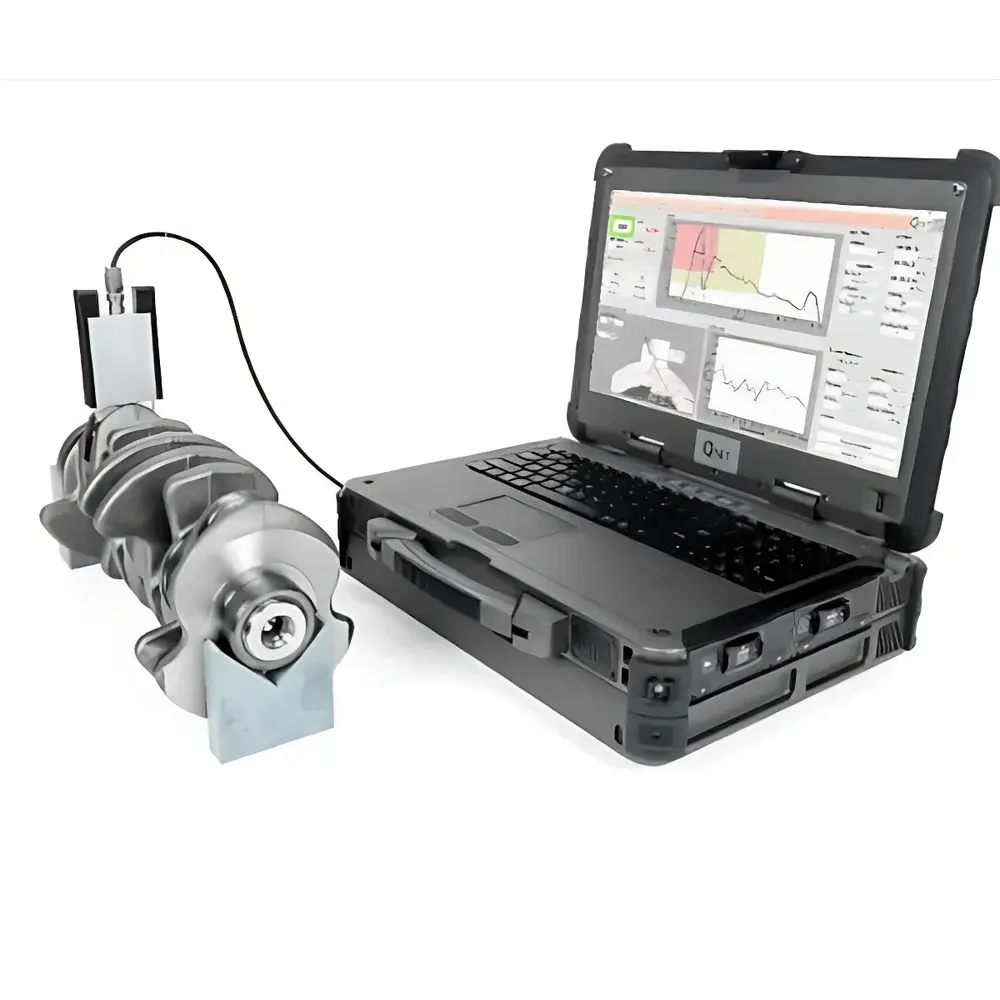
QNET P3123 Multi-Channel Ultrasonic Surface Hardness Depth (SHD) Profiler
| Brand | Vistron |
|---|---|
| Origin | Germany |
| Model | P3123 |
| Detection Frequency | 5–25 MHz |
| Measurement Repeatability | ±0.2 mm |
| Channels | 4 |
| Ingress Protection | IP65 |
| Application Domain | Industrial NDT for Case Hardness Depth Profiling |
Overview
The QNET P3123 Multi-Channel Ultrasonic Surface Hardness Depth (SHD) Profiler is an industrial-grade, non-destructive testing (NDT) system engineered for precise, rapid, and repeatable quantification of case hardening depth in ferromagnetic and non-ferromagnetic metallic components. Unlike conventional destructive metallographic cross-sectioning—requiring sample sectioning, grinding, etching, and optical microscopy—the P3123 leverages high-frequency ultrasonic guided wave propagation and velocity gradient analysis to infer the transition zone between martensitic case and ferritic/pearlitic core. This principle relies on the measurable change in longitudinal sound velocity (typically 5,800–6,100 m/s in hardened steel vs. ~5,700–5,900 m/s in softer substrate), which correlates directly with microstructural phase distribution and local hardness gradients. Designed specifically for production-floor deployment, the system delivers SHD profiles in real time without part removal or surface preparation beyond standard cleaning, enabling in-process verification during heat treatment validation, post-induction quenching release, or final QA gate inspection.
Key Features
- Four independent ultrasonic channels synchronized for multi-angle or multi-zone acquisition—enabling simultaneous evaluation of axial, radial, and circumferential SHD variations.
- High-resolution transducer array optimized for 5–25 MHz broadband excitation, supporting fine-depth resolution and robust signal-to-noise ratio across curved, contoured, and undercut geometries.
- IP65-rated ruggedized enclosure with integrated battery pack and ergonomic handheld probe housing—validated for continuous operation in shop-floor environments with coolant mist, dust, and ambient temperature fluctuations (5–40 °C).
- Real-time A-scan visualization with dynamic gating and automatic echo tracking; on-device SHD calculation using proprietary velocity-threshold algorithm calibrated per ASTM E1158 and ISO 16810.
- Plug-and-play sensor interface with mechanical indexing capability—compatible with custom fixtures for turbine shafts, gear teeth, bearing races, and wind turbine main shafts.
- Sub-millimeter measurement repeatability (±0.2 mm) verified under GLP-compliant inter-laboratory round-robin studies per ISO/IEC 17025 requirements.
Sample Compatibility & Compliance
The P3123 is validated for use on carbon steels, alloy steels (e.g., 4140, 4340, 1045), case-hardened stainless grades (e.g., 17-4PH, 431), and induction-hardened cast irons. It accommodates minimum radii of curvature down to 3 mm and undercut depths up to 12 mm without coupling loss. Surface finish requirements are ≤ Ra 3.2 µm; rougher surfaces necessitate couplant optimization but remain within operational tolerance. The instrument complies with EN 1330-4 (terminology for ultrasonic testing), EN 12668-1 (instrument performance requirements), and supports audit-ready documentation aligned with FDA 21 CFR Part 11 (electronic records/signatures) when paired with optional secure database export modules.
Software & Data Management
The embedded firmware includes a Windows-based desktop application (QNET Control Suite v4.2) for configuration, calibration management, and report generation. All raw A-scan data, gate positions, and calculated SHD values are stored with timestamp, operator ID, and environmental metadata (temperature, humidity). Users define customizable report templates—including annotated line scans, polar plots for circumferential profiling, statistical summaries (mean, std dev, Cp/Cpk), and overlay comparisons against master reference curves. Data exports support CSV, XML, and PDF formats; integration with MES/SCADA systems is enabled via OPC UA or RESTful API. Audit trails record all parameter changes, calibration events, and user logins—fully traceable for GMP/GLP audits.
Applications
Primary deployment domains include automotive drivetrain manufacturing (CV joints, transmission gears, camshafts), wind energy (main shafts, hub flanges, pitch bearings), aerospace landing gear components, and heavy-duty hydraulic piston rods. The system supports process development by correlating SHD profiles with induction coil geometry, power density, dwell time, and quench medium flow rates. It also serves as a statistical process control (SPC) tool: automated SHD trend monitoring triggers alerts upon deviation from control limits, reducing scrap rate and eliminating reliance on destructive sampling plans per ISO 3497 and DIN 50190-2.
FAQ
Does the P3123 require couplant? Why?
Yes—water-based or glycerin-based ultrasonic couplants are required to ensure acoustic impedance matching between transducer and test surface. Couplant selection is specified in the operating manual based on surface roughness and temperature range.
Can it measure SHD on nitrided or carburized parts?
Yes, provided the case depth exceeds 0.3 mm and the base material exhibits sufficient acoustic contrast. Calibration must be performed using reference specimens with known metallurgical SHD profiles.
Is certification available for ISO/IEC 17025 accreditation?
Vistron provides factory calibration certificates traceable to PTB (Physikalisch-Technische Bundesanstalt); on-site verification and uncertainty budgets are deliverable upon request for laboratory accreditation purposes.
What maintenance intervals are recommended?
Annual transducer sensitivity verification and firmware update cycle; no scheduled internal servicing required within first 5 years under normal industrial usage conditions.
How is operator training delivered?
Vistron offers certified 2-day on-site training covering theory of ultrasonic SHD measurement, calibration protocol, fixture setup, data interpretation, and compliance documentation—delivered by NDT Level III-certified instructors.



