
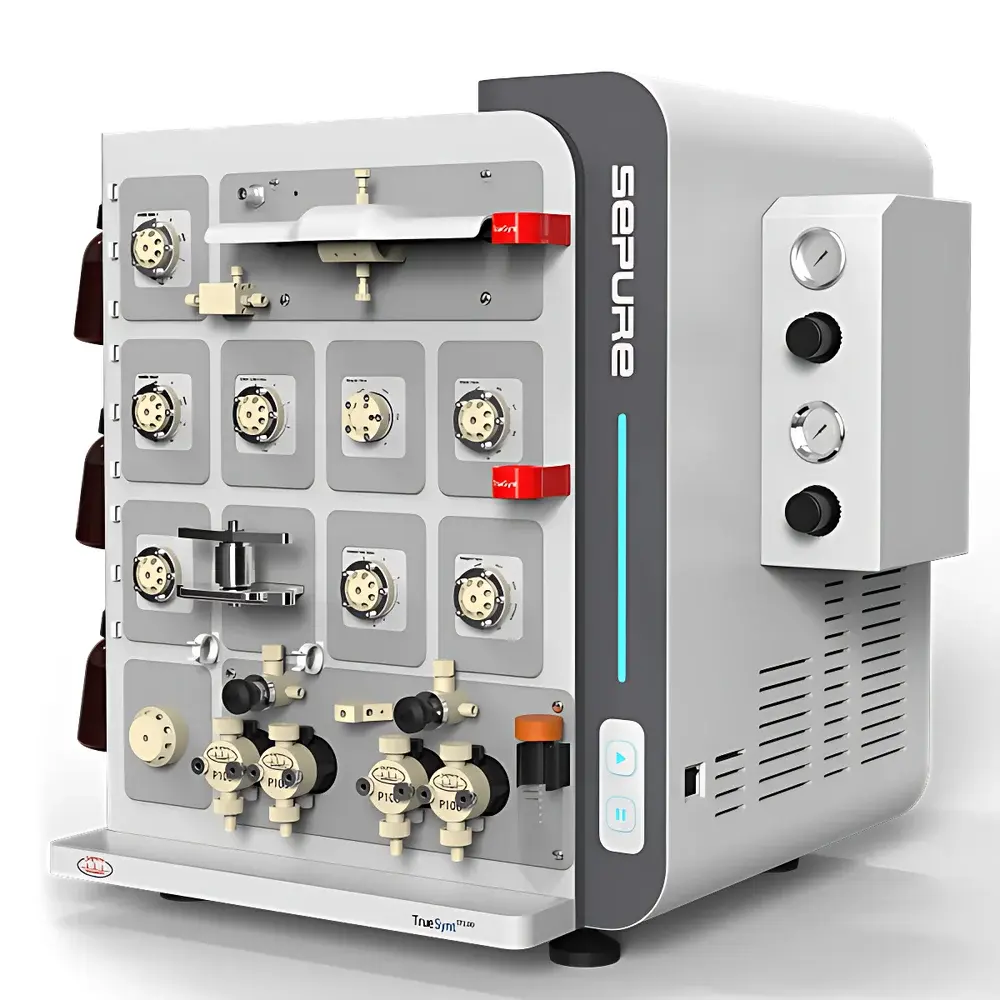
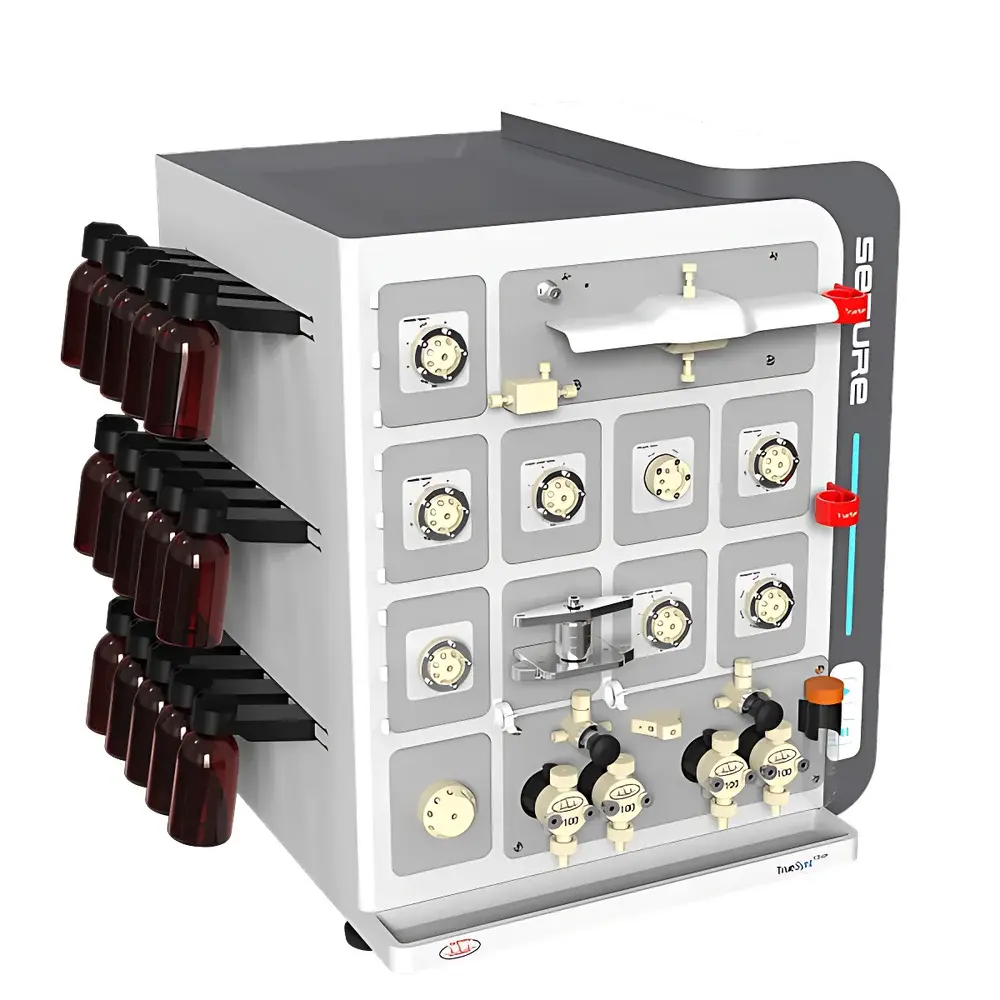
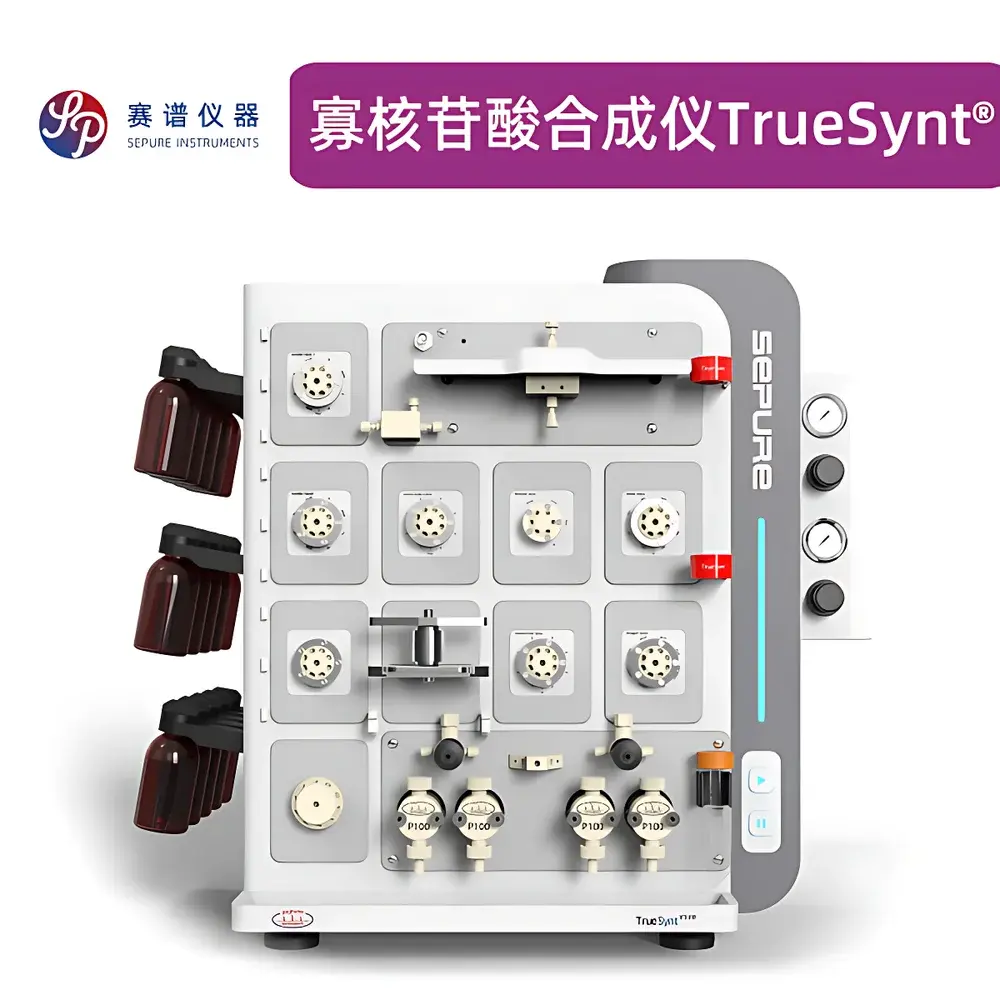
TrueSynt® STS 0100 Automated DNA/RNA Synthesizer
| Brand | Sepure Instruments |
|---|---|
| Origin | Jiangsu, China |
| Manufacturer Type | OEM Manufacturer |
| Instrument Type | Low-Throughput Synthesizer |
| Coupling Efficiency | DNA >99% |
| Oligonucleotide Length Range | 5–80 bases |
| Synthesis Scale | 50 µmol – 9 mmol |
| UV Detector Wavelength Range | 200–800 nm (4-channel simultaneous detection) |
| Max Operating Pressure | 2 MPa |
| Pump Type | High-Precision Dual Plunger Pumps |
| Flow Rate | ≤ 2 × 100 mL/min |
| Column Reactor Count | 7 |
| Standard Monomer Inlets | 12 |
| Waste Outlets | 8 |
| System Protection | Inert Gas (N₂/Ar) Purge |
| Power Supply | 220 VAC / 600 W |
| Dimensions (W×H×D) | 583 × 614 × 523 mm |
| Included Accessories | PEEK/PTFE Tubing Kit, Installation Manual, User Manual, Fittings, Basic Tool Set |
Overview
The TrueSynt® STS 0100 is a benchtop, fully automated oligonucleotide synthesizer engineered for precision and reproducibility in laboratory-scale solid-phase synthesis of DNA, RNA, and modified nucleic acids. It implements the standard phosphoramidite chemistry protocol under strictly controlled anhydrous and inert conditions—utilizing nitrogen or argon gas purging to maintain reagent integrity and suppress side reactions. Designed for low-throughput applications, the system supports synthesis scales ranging from 50 µmol (ideal for probe validation and small-batch functional screening) up to 9 mmol (suitable for preparative-scale production of antisense oligonucleotides or aptamer libraries). Its modular column reactor architecture—featuring seven independently addressable synthesis columns—enables parallel synthesis of multiple sequences with distinct coupling protocols, while minimizing cross-contamination risk through segregated fluidic pathways.
Key Features
- High-precision dual plunger pumps delivering stable, pulse-free reagent delivery with sub-microliter accuracy—critical for consistent coupling efficiency across extended synthesis cycles.
- Integrated 4-channel UV-Vis detector (200–800 nm) enabling real-time monitoring of detritylation yield and stepwise coupling completeness without requiring offline HPLC verification.
- Optimized fluidic design reducing phosphoramidite and activator consumption by up to 35% compared to legacy systems—validated against ASTM E2913-13 guidelines for reagent economy in nucleic acid synthesis.
- Seven-column reactor module with individually heated and temperature-stabilized reaction vessels (±0.5 °C), supporting both standard and thermally sensitive modifications (e.g., 2′-O-methyl, LNA, thiolated bases).
- Full inert gas management system—including pressure-regulated purge lines, sealed reagent reservoirs, and automatic valve sequencing—to ensure <10 ppm O₂ exposure during all synthesis steps.
- Compliant with GLP documentation requirements: audit-trail-enabled control software logs all parameter changes, sequence uploads, reagent lot tracking, and maintenance events in tamper-resistant binary format.
Sample Compatibility & Compliance
The STS 0100 accommodates standard CPG, polystyrene, and controlled-pore glass supports with pore sizes from 500 Å to 3000 Å. It supports synthesis of unmodified DNA/RNA as well as chemically modified oligos including siRNA duplexes (with 3′-overhang handling), miRNA mimics, antisense oligonucleotides (ASOs) with phosphorothioate backbones, and aptamers bearing biotin, fluorescein, or cholesterol conjugates. All operational parameters align with ISO 13485:2016 for medical device-related nucleic acid manufacturing environments and support FDA 21 CFR Part 11 compliance when paired with validated electronic signature modules. Reagent compatibility includes standard β-cyanoethyl phosphoramidites, oxazaphospholidine monomers, and non-nucleosidic spacers (e.g., C3, C6, Spacer 9, TEG).
Software & Data Management
The STS Nucleic Acid Synthesis Workstation software provides intuitive sequence import (FASTA, GenBank, plain text), automated coupling parameter generation based on length and modification profile, and customizable cycle templates for iterative optimization. All synthesis runs generate timestamped .csv and .xml metadata files containing real-time UV traces, pressure logs, pump actuation records, and error flags—structured for integration into LIMS platforms via RESTful API. Raw data retention meets ICH M10 requirements for analytical method traceability, and software version history is maintained per GAMP 5 Annex 11 guidance.
Applications
- Research-grade synthesis of custom primers, probes, and CRISPR guide RNAs for genotyping and gene editing validation.
- Preparative-scale production of therapeutic ASOs and splice-switching oligos under non-GMP pilot conditions.
- Rapid prototyping of diagnostic aptamers for biosensor development and lateral flow assay optimization.
- Synthesis of isotopically labeled oligonucleotides (¹⁵N/¹³C) for NMR structural studies.
- Teaching laboratories requiring robust, serviceable instrumentation with transparent fluidic architecture and full maintenance access.
FAQ
What synthesis scale ranges does the STS 0100 support, and how are they implemented physically?
The system achieves scalable synthesis—from 50 µmol to 9 mmol—by varying column diameter (0.2–12 mm ID), support loading density (10–200 µmol/g), and reagent volume per coupling step. All scales use identical chemistry protocols and hardware; no mechanical reconfiguration is required.
Is the UV detector calibrated traceably to NIST standards?
Yes—the photodiode array detector undergoes factory calibration using NIST-traceable tungsten-halogen and deuterium lamp references, with certificate of calibration provided per unit.
Can the instrument be integrated into a cleanroom environment with Class 7 (ISO 14644-1) specifications?
Yes—its sealed chassis, zero-oil vacuum system, and external exhaust interface meet ISO 14644-1 particle emission limits when connected to facility-grade ducting.
Does the system support synthesis of peptide nucleic acids (PNAs)?
No—STS 0100 is optimized exclusively for phosphoramidite-based nucleic acid synthesis. PNA synthesis requires orthogonal coupling chemistries and is outside its validated scope.
What level of user training is required for routine operation?
Operators require basic knowledge of solid-phase synthesis principles and safety handling of acetonitrile and dichloroacetic acid. Full operational competency is typically achieved within two days of hands-on training, supported by video-guided SOPs embedded in the workstation software.





