
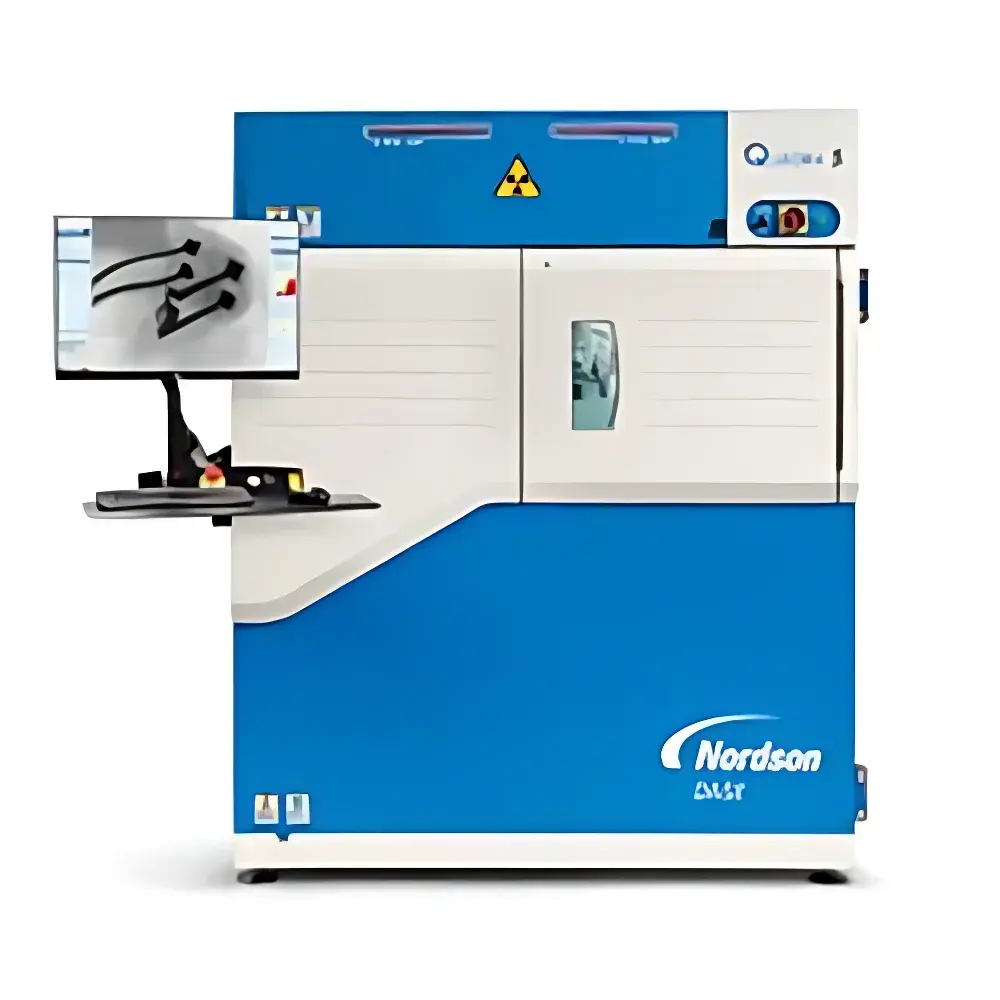
Nordson Dage Quadra™ 5 X-Ray Inspection System
| Origin | USA |
|---|---|
| Manufacturer Type | Authorized Distributor |
| Origin Category | Imported |
| Model | Nordson Dage Quadra™ 5 |
| Price Range | USD $130,000–$195,000 (est.) |
| Instrument Type | Scanning X-ray System |
| X-ray Tube Power | ≤10 W (0.35 µm spot size), ≤20 W (0.95 µm spot size) |
| X-ray Source | QuadraNT™ Sealed Transmission Tube |
| Detector | AspireFP™ Flat-Panel Detector |
| Integrated Micro-CT Stage | Yes |
| Thermal Stage for Reflow Simulation | Yes |
| Compliance Standards | IPC-A-610, IPC-7095, ISO/IEC 17025 (for lab accreditation), FDA 21 CFR Part 11 (software audit trail enabled) |
Overview
The Nordson Dage Quadra™ 5 X-Ray Inspection System is a high-resolution, benchtop microfocus X-ray inspection platform engineered for non-destructive evaluation of electronic assemblies at sub-micron resolution. Operating on the principle of transmission radiography, the system generates real-time 2D and computed tomography (µCT) 3D images by directing a finely focused electron beam onto a tungsten target within the proprietary QuadraNT™ sealed transmission X-ray tube. Unlike conventional open-tube systems, the QuadraNT™ source eliminates filament replacement, vacuum oil maintenance, and thermal drift—ensuring long-term geometric stability and measurement repeatability. With a minimum resolvable feature size of 0.35 µm at ≤10 W and 0.95 µm at ≤20 W, the Quadra™ 5 delivers exceptional contrast sensitivity for void detection in solder joints, wire bond integrity assessment, die attach analysis, and counterfeit component verification—critical for advanced packaging technologies including flip-chip, wafer-level CSP, and heterogeneous integration.
Key Features
- QuadraNT™ sealed transmission X-ray source: No filament replacement, no oil-based vacuum pumps, and <10⁻⁷ Torr base pressure maintained via ion pump technology—enabling >10,000 hours of uninterrupted operation.
- AspireFP™ flat-panel detector with 14-bit dynamic range and 50 µm pixel pitch, optimized for high signal-to-noise ratio imaging across varying material densities and thicknesses.
- Integrated µCT stage supporting full 360° rotation and precise Z-axis translation, enabling volumetric reconstruction with isotropic voxel resolution down to 0.5 µm.
- Thermal reflow stage capable of programmable ramp/soak profiles up to 300 °C, synchronized with real-time X-ray acquisition to monitor solder joint formation, intermetallic growth, and void evolution during thermal cycling.
- Over 30 embedded image enhancement filters—including anisotropic diffusion, multi-scale wavelet decomposition, and adaptive histogram equalization—designed to suppress noise while preserving edge fidelity for automated defect classification.
- X-Plane® multi-angle projection software for rapid identification of Head-in-Pillow (HiP) defects, tombstoning, and bridging without manual slice navigation.
Sample Compatibility & Compliance
The Quadra™ 5 accommodates samples up to 300 mm × 300 mm × 120 mm (W × D × H), with configurable sample holders for PCBs, QFNs, BGAs, SiP modules, and MEMS packages. Its metrology-grade mechanical stage provides ±0.1 µm repeatability in XY and ±0.5 µm in Z, traceable to NIST-certified artifacts. All automated measurement routines—including BGA void percentage calculation, solder bump diameter/circularity, wire sweep angle, and QFN cavity void mapping—are validated against IPC-A-610 Class 3 and IPC-7095 guidelines. The system supports GLP/GMP workflows through optional 21 CFR Part 11-compliant software modules, featuring electronic signatures, audit trails, and role-based access control for regulated environments.
Software & Data Management
Control and analysis are unified under the Aspire™ software suite—a Windows-based application built on Qt and leveraging CUDA-accelerated GPU processing for real-time rendering and batch µCT reconstruction. Measurement data is stored in vendor-agnostic HDF5 format, with metadata compliant with ASTM E2912-22 (Standard Guide for Digital Radiographic Data Exchange). Automated report generation exports PDF/CSV outputs with embedded annotated images, statistical summaries (Cp/Cpk), and pass/fail flags aligned with user-defined acceptance criteria. Integration with MES and SPC platforms is supported via OPC UA and RESTful API interfaces.
Applications
- Failure analysis of solder joint voiding, cracking, and insufficient wetting in automotive and aerospace electronics.
- Process validation of reflow profiles using in-situ thermal X-ray imaging.
- Counterfeit detection via internal structure comparison, lead-frame geometry verification, and die marking authenticity assessment.
- Qualification of advanced substrates—including glass interposers and fan-out wafer-level packages—where traditional AOI fails due to opacity or layer stacking.
- Research applications in materials science: pore network modeling in low-k dielectrics, Cu diffusion kinetics in TSVs, and interfacial delamination quantification under thermo-mechanical stress.
FAQ
What is the typical spatial resolution achievable with the Quadra™ 5 under standard operating conditions?
At 10 W tube power and optimal magnification, the system achieves a practical limiting resolution of 0.35 µm (FWHM), verified per ISO 10215:2018 Annex B using tungsten line-pair test patterns.
Does the QuadraNT™ X-ray tube require periodic recalibration?
No. The sealed transmission design ensures stable focal spot geometry and consistent kV/mA output over time; only annual performance verification per ASTM E2737-21 is recommended.
Can the system perform quantitative void analysis in lead-free SAC305 solder joints?
Yes—using calibrated grayscale thresholding and 3D volume segmentation in Aspire™, void fraction is reported with ±0.8% relative uncertainty (k=2) for volumes >100 µm³.
Is µCT reconstruction compatible with third-party visualization tools?
Yes. Raw sinogram and reconstructed volume datasets export in DICOM, TIFF stack, and VTK formats, fully interoperable with Avizo, VGStudio MAX, and Dragonfly.
How is radiation safety ensured during routine operation?
The system complies with IEC 62495:2010 and 21 CFR 1020.40, featuring dual-interlocked shielding, real-time dose monitoring, and automatic beam cutoff upon door opening. Annual radiation survey documentation is provided per facility requirements.





