
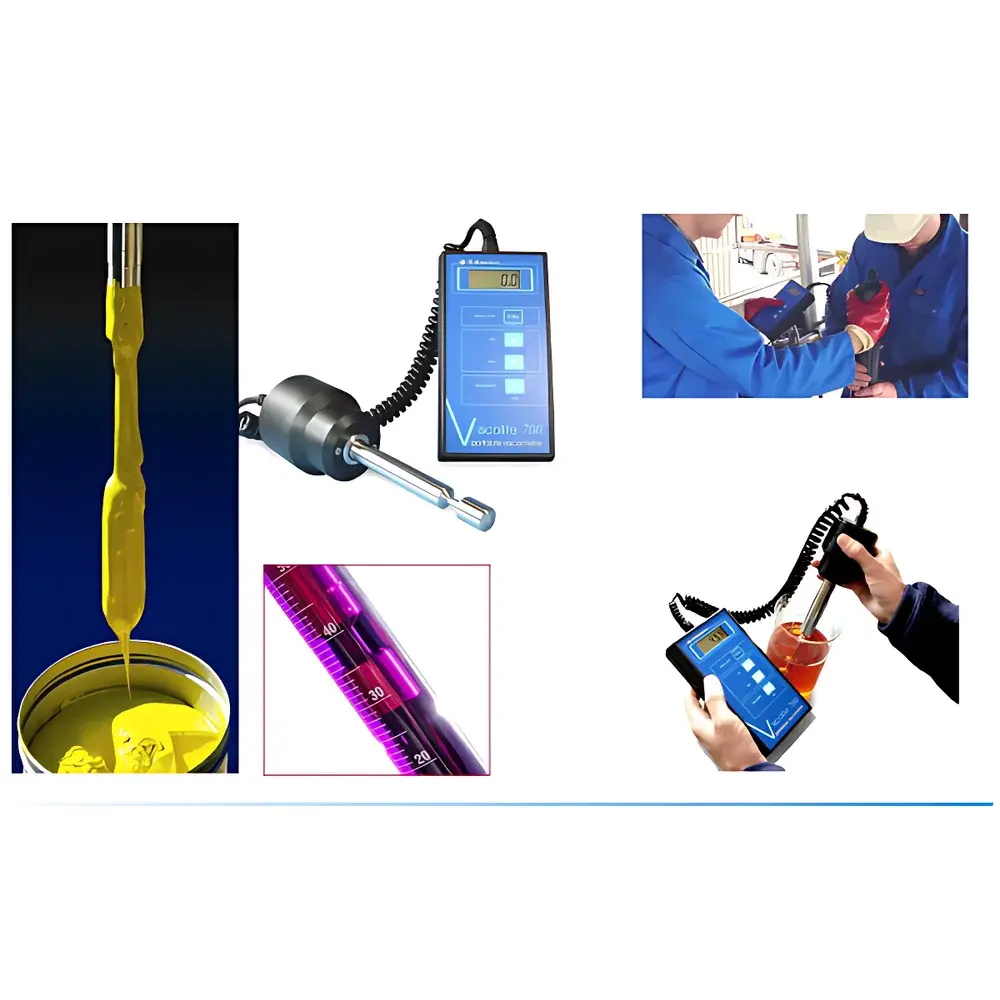
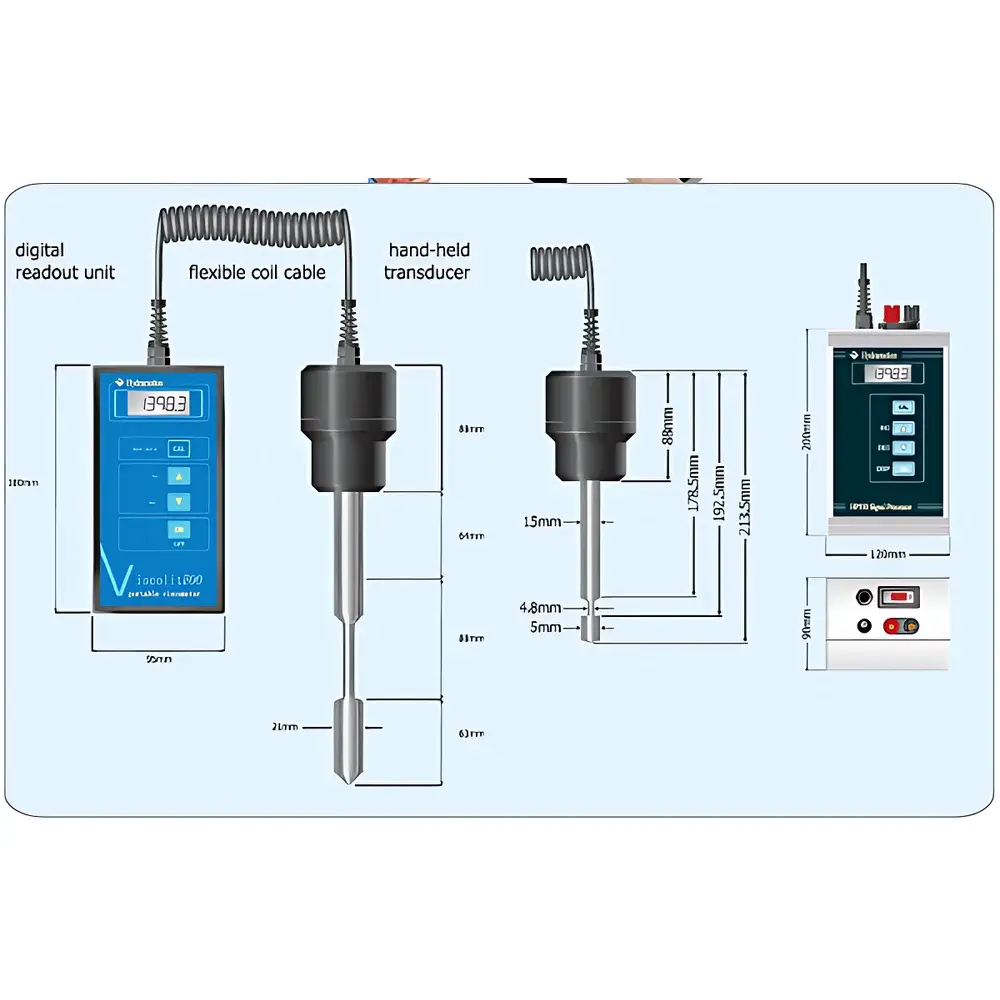
Hmsense VL7-100B Portable Oscillating Viscometer
| Brand | Hmsense |
|---|---|
| Origin | United Kingdom |
| Model | VL7-100B |
| Instrument Type | Oscillating Viscometer |
| Viscosity Range | 0–100,000 cP |
| Temperature Range | –20 to +120 °C |
| Sample Volume (Standard) | 100 mL |
| Sample Volume (Mini Probe Option) | 10 mL |
| Repeatability | <1% |
| Probe Weight | 700 g (Standard), 500 g (Mini) |
| Display Unit Weight | 500 g |
| Total Length | 305 mm (Standard), 215 mm (Mini) |
| Wetted Materials | ASTM A240 Grade 316 Stainless Steel |
| Housing Material | Delrin® (Polyoxymethylene, POM) |
| IP Rating | IP65 |
| Power Supply | 4 × AA Alkaline Batteries |
| Integrated Temperature Sensor | Yes |
| Calibration Correction | Real-time viscosity/temperature compensation |
| Sensing Surface Finish | Electro-polished Alloy C-22 (N06022) |
Overview
The Hmsense VL7-100B is a handheld, battery-powered oscillating viscometer engineered for field-deployable and at-line viscosity measurement of Newtonian and mildly non-Newtonian fluids. Unlike rotational or capillary instruments, the VL7-100B employs a resonant torsional oscillator principle: a precision-machined sensing element—fabricated from corrosion-resistant Hastelloy® C-22—is immersed in the sample and driven at its natural mechanical resonance frequency. Changes in fluid damping directly correlate to dynamic viscosity via calibrated frequency shift and decay time analysis. This method eliminates moving parts in contact with the fluid, delivering high reproducibility (<1% RSD) without mechanical wear, shear history effects, or pump-induced degradation. Designed for operation across extreme ambient conditions (–20 to +120 °C), the instrument maintains metrological integrity through integrated Pt1000 temperature sensing and real-time viscosity/temperature compensation algorithms compliant with ISO 2555 and ASTM D2196 methodologies.
Key Features
- True portable architecture: Fully self-contained unit with no external power supply, PC, or compressed air required—operational on four standard AA alkaline batteries (typical runtime >200 measurements per set)
- Dual-probe configuration: Standard probe (VL7-100B-d21) for routine QC sampling (100 mL minimum); optional mini-probe (VL7-100B-d15) optimized for R&D or high-value formulations (10 mL minimum)
- Corrosion-immune wetted path: ASTM A240 316 stainless steel sensor body combined with electro-polished N06022 (Hastelloy C-22) sensing surface ensures long-term stability in aggressive solvents, acids, caustics, and hydrocarbon media
- Ruggedized industrial enclosure: Delrin® (POM) housing rated IP65 for dust-tightness and low-pressure water jet resistance—suitable for refinery pits, offshore platforms, and pharmaceutical cleanroom anterooms
- Real-time thermal compensation: Onboard Pt1000 sensor (±0.1 °C accuracy) enables automatic correction to reference temperature (e.g., 25 °C or 40 °C) per ISO 3104 and ASTM D445 protocols
- Zero-drift calibration architecture: Factory-traceable calibration using NIST-traceable silicone oil standards; user-performed verification with single-point check fluid included
Sample Compatibility & Compliance
The VL7-100B accommodates a broad range of process and laboratory samples—including lubricants, resins, coatings, adhesives, polymer melts, crude oils, and aqueous suspensions—without requiring dilution or preheating. Its oscillatory measurement principle avoids structural breakdown of shear-thinning gels or fragile emulsions. The instrument meets IEC 61000-6-2 (immunity) and IEC 61000-6-3 (emissions) for industrial environments. For regulated industries, data output supports 21 CFR Part 11-compliant audit trails when paired with optional Hmsense DataLink software (requires USB-C connection). All firmware and calibration records are stored internally with timestamped version control, satisfying GLP and GMP documentation requirements for QC release testing.
Software & Data Management
The VL7-100B stores up to 500 measurement records onboard, each containing viscosity (cP), temperature (°C), timestamp, probe ID, and operator code. Data export is achieved via USB-C interface to Windows-based Hmsense DataLink v3.2 software, which provides batch reporting, statistical process control (SPC) charts, trend analysis, and PDF certificate generation. Raw .CSV files are compatible with LIMS integration (e.g., LabWare, Thermo Fisher SampleManager). Firmware updates are delivered via signed binary packages with SHA-256 hash verification to ensure integrity and traceability—critical for FDA-regulated manufacturing sites undergoing periodic validation requalification.
Applications
- Refinery & petrochemical: In-situ monitoring of fuel oil viscosity pre-injection, lube blending verification, and asphalt penetration grade estimation
- Pharmaceutical manufacturing: Final fill viscosity checks for ophthalmic solutions, topical gels, and suspension-based injectables per USP <911>
- Paint & coatings: Batch-to-batch consistency verification of acrylic emulsions, epoxy primers, and UV-curable resins prior to filtration
- Food & beverage: Quality gate screening of syrups, dressings, and dairy concentrates where shear-sensitive rheology must be preserved
- Academic research: Rapid screening of ionic liquid viscosity-temperature dependence and nanoparticle dispersion stability under variable thermal cycling
FAQ
Is the VL7-100B suitable for non-Newtonian fluids?
Yes—the oscillating principle measures apparent viscosity at a fixed oscillation amplitude and frequency (typically 10–50 Hz), making it appropriate for weakly time-dependent or shear-thickening systems where gross structural disruption must be avoided.
Can it be used in explosive atmospheres?
The unit is certified for safe-area use only (IECEx/ATEX Zone 2 / Class I Div 2). It is not intrinsically safe; hazardous area deployment requires an approved purge enclosure or remote probe installation.
What is the calibration interval recommendation?
Annual recalibration is advised per ISO/IEC 17025 guidelines; however, daily verification using the supplied 1,000 cP check fluid is required for GLP/GMP compliance.
Does it support viscosity units other than centipoise?
Yes—user-selectable units include mPa·s, cP, Pa·s, and mm²/s (kinematic, when density is manually entered).
How is temperature uniformity ensured in small-volume measurements?
The mini-probe’s reduced thermal mass and integrated Pt1000 sensor located <2 mm from the active surface enable rapid thermal equilibration (<30 s in stirred samples), minimizing gradient-related uncertainty.



