
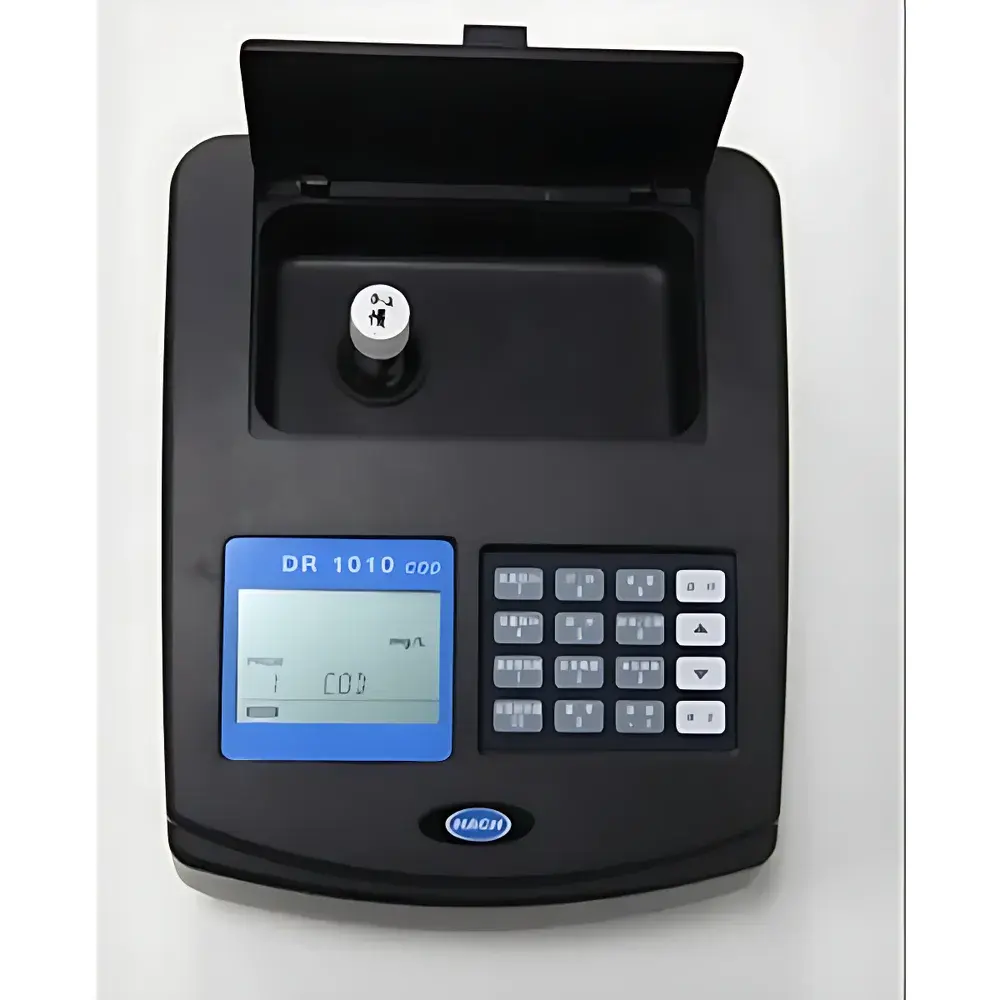
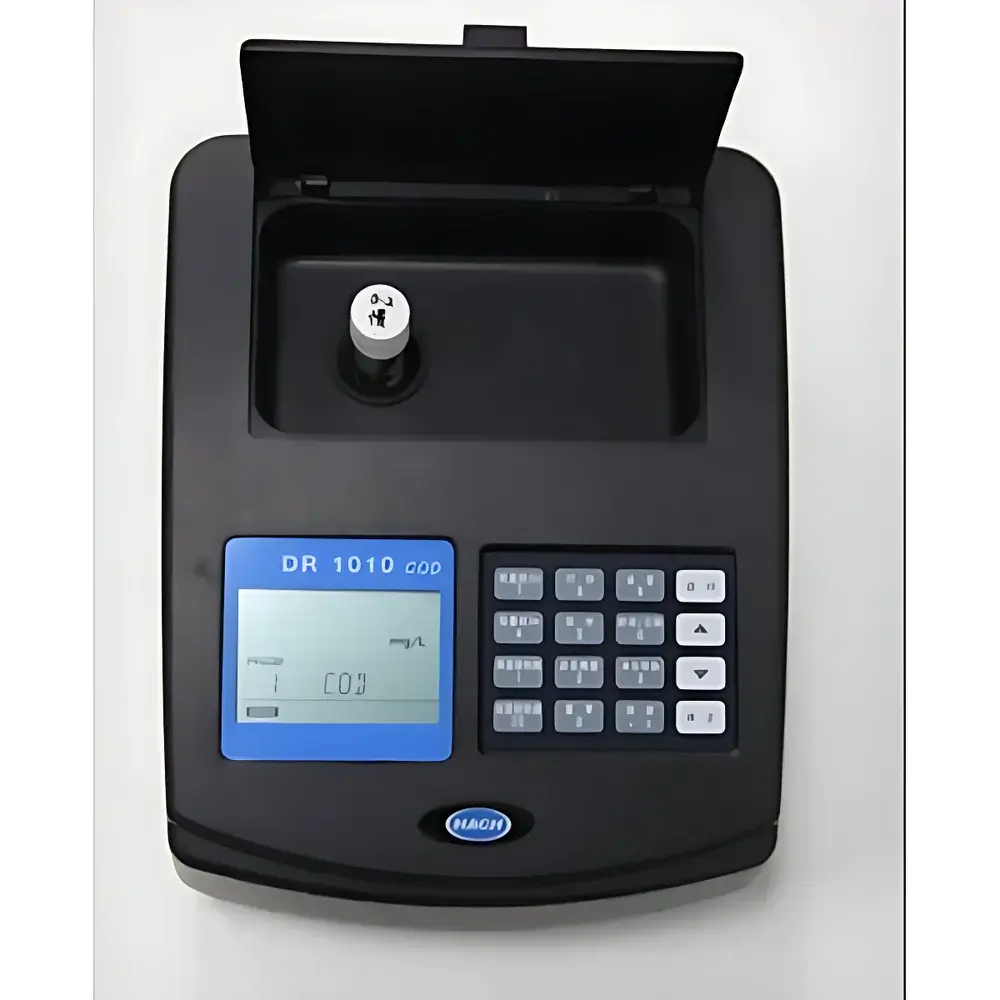
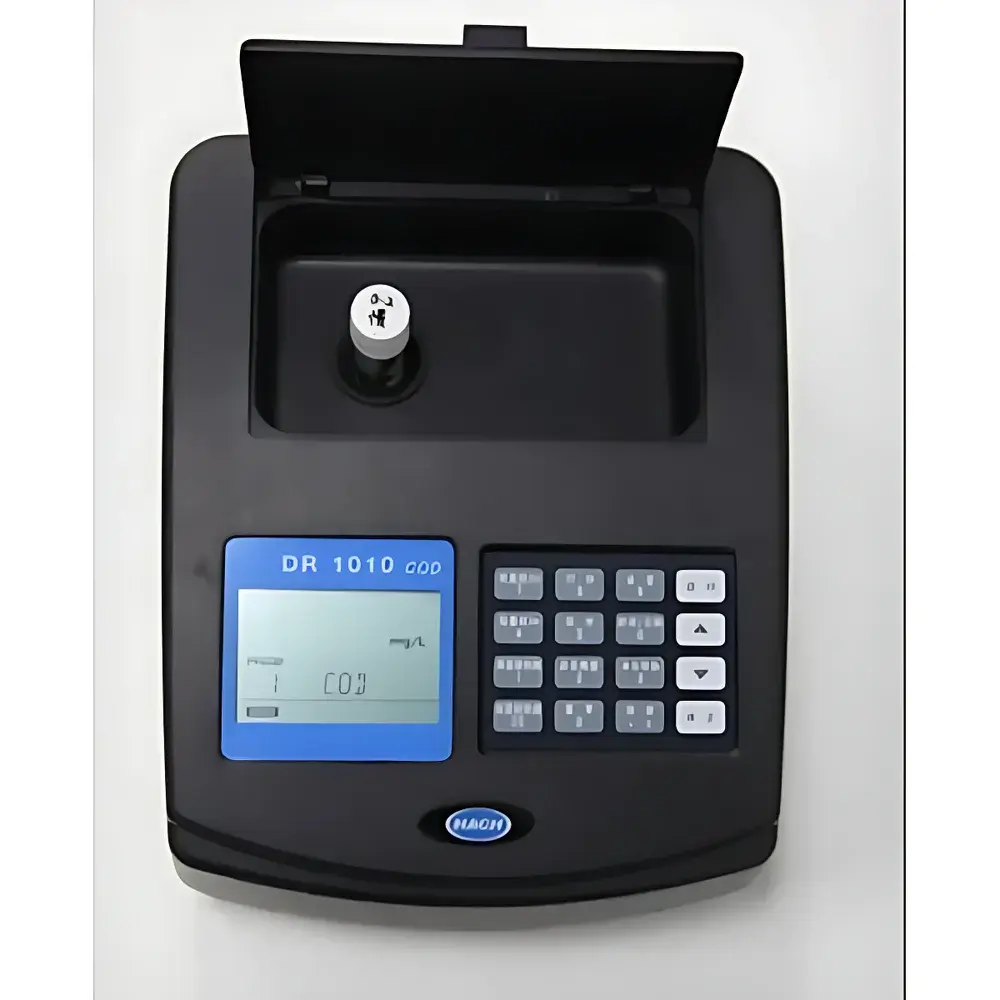
Hach DR1010 COD Portable Photometer
| Brand | Hach |
|---|---|
| Origin | USA |
| Model | DR1010 COD |
| Instrument Type | Portable |
| Measurement Principle | UV-Visible Absorption Spectrophotometry |
| Wavelengths | 420 nm and 610 nm |
| Photometric Accuracy | ±0.005 A at 1.0 ABS |
| Photometric Repeatability | ±0.005 A (0–1 A) |
| Wavelength Accuracy | ±1 nm |
| Photometric Linearity | ±0.002 A (0–1 A) |
| Detector | Silicon Photodiode |
| Power Supply | 190–240 V AC/50 Hz or 4×AA Alkaline Batteries |
| Environmental Rating | IP41 |
| Output Interface | RS232 Serial Port |
| Readout Modes | % Transmittance, Absorbance, Concentration |
Overview
The Hach DR1010 COD Portable Photometer is a compact, field-deployable spectrophotometric analyzer engineered for rapid, reliable determination of Chemical Oxygen Demand (COD) in water and wastewater samples. Operating on the principle of UV-Visible absorption photometry, the instrument quantifies COD concentration by measuring absorbance changes at two fixed wavelengths—420 nm and 610 nm—corresponding to the characteristic absorption peaks of dichromate reduction products following standardized acid digestion. Unlike benchtop spectrophotometers requiring full spectral scanning, the DR1010 employs fixed-wavelength optics optimized for Hach’s validated COD reagent chemistry, delivering high reproducibility without compromising portability. Its dual-power architecture—supporting both AC mains and four AA alkaline batteries—enables uninterrupted operation across laboratory, plant floor, and remote sampling sites. Designed in accordance with international methodological frameworks—including ISO 6060 and ASTM D1253—the DR1010 ensures traceable alignment with regulatory COD measurement protocols while maintaining compliance with GLP data integrity expectations.
Key Features
- Dual-wavelength photometric detection (420 nm and 610 nm) with ±1 nm wavelength accuracy and <±0.005 A photometric repeatability over 0–1 A range
- Integrated dual-power system: supports continuous operation via 190–240 V AC/50 Hz input or up to 2,000 measurements on four AA alkaline batteries
- Pre-programmed Hach COD calibration curves compliant with standard 2-hour reflux digestion (e.g., Standard Method 5220 B), plus user-definable curve storage for method customization
- IP41-rated enclosure providing protection against solid objects >1 mm and vertically falling water droplets—suitable for controlled field environments
- RS232 serial interface enabling direct data transfer to external printers or laboratory information management systems (LIMS) without proprietary software dependencies
- Three readout modes: absorbance (A), percent transmittance (%T), and concentration (mg/L COD), with automatic unit scaling based on selected method
Sample Compatibility & Compliance
The DR1010 is validated for use with Hach’s certified COD vials (e.g., LCK series) and compatible with standard open-reflux digestion procedures per EPA Method 410.4 and ISO 6060. It accommodates sample volumes of 2.5 mL within standard 16-mm round glass vials, supporting both low-range (0–150 mg/L) and high-range (0–1500 mg/L) COD assays when paired with appropriate reagent kits. All internal calibration routines adhere to NIST-traceable photometric standards. The instrument’s firmware and data handling architecture support audit-ready operation under GLP and GMP environments; raw absorbance values, timestamps, operator IDs (via optional keypad entry), and method identifiers are retained in non-volatile memory with write-protection capability. While not inherently 21 CFR Part 11 compliant out-of-the-box, its RS232 output enables integration into validated electronic lab notebooks (ELNs) with appropriate system-level controls.
Software & Data Management
The DR1010 operates independently of host software—measurements are executed and displayed directly on its monochrome LCD screen. No embedded operating system or firmware updates are required during routine use. All calibration data, user-defined curves, and up to 500 measurement records—including date/time stamps, wavelength selection, and absorbance readings—are stored internally with timestamped retention. Data export occurs exclusively via ASCII-formatted RS232 transmission at 9600 baud, compatible with generic terminal emulators, Excel-compatible CSV parsers, and most LIMS middleware. No drivers or cloud connectivity are implemented, minimizing cybersecurity exposure and ensuring long-term operational stability in regulated settings where software validation cycles constrain instrument lifecycle management.
Applications
This photometer serves as a primary or secondary COD verification tool across municipal wastewater treatment plants (WWTPs), industrial effluent monitoring stations, environmental consulting laboratories, academic teaching labs, and public health departments conducting routine water quality surveillance. Its portability and battery operation make it especially suited for grab-sample analysis at influent/effluent points, combined sewer overflow (CSO) monitoring nodes, and decentralized treatment facilities lacking dedicated lab infrastructure. In research contexts, the DR1010 supports method development studies requiring rapid screening of COD trends across batch reactors or pilot-scale bioreactors—particularly where real-time feedback informs process control decisions. Its robustness and method transparency also facilitate training programs aligned with APHA Standard Methods instruction modules.
FAQ
Does the DR1010 require annual factory calibration?
No—its optical path is factory-aligned using NIST-traceable reference filters; users perform daily zero and span verification using supplied blank and standard vials.
Can the DR1010 be used with non-Hach COD reagents?
It is validated only for Hach-certified LCK or TNT vials; alternative chemistries may yield non-linear responses due to spectral mismatch and invalid calibration assumptions.
Is the RS232 interface compatible with modern Windows/macOS systems?
Yes—when paired with a USB-to-serial adapter and configured with standard terminal settings (9600 baud, no parity, 1 stop bit), data streams directly into spreadsheet or database applications.
What is the expected battery life under typical field use?
Approximately 2,000 measurements per set of alkaline AA cells when operating at ambient temperatures between 10–30°C and with backlight disabled.
Does the DR1010 support multi-point calibration curves beyond the built-in ones?
Yes—up to five user-defined curves can be stored and recalled, each comprising up to ten concentration-absorbance pairs entered manually or imported via RS232.







