
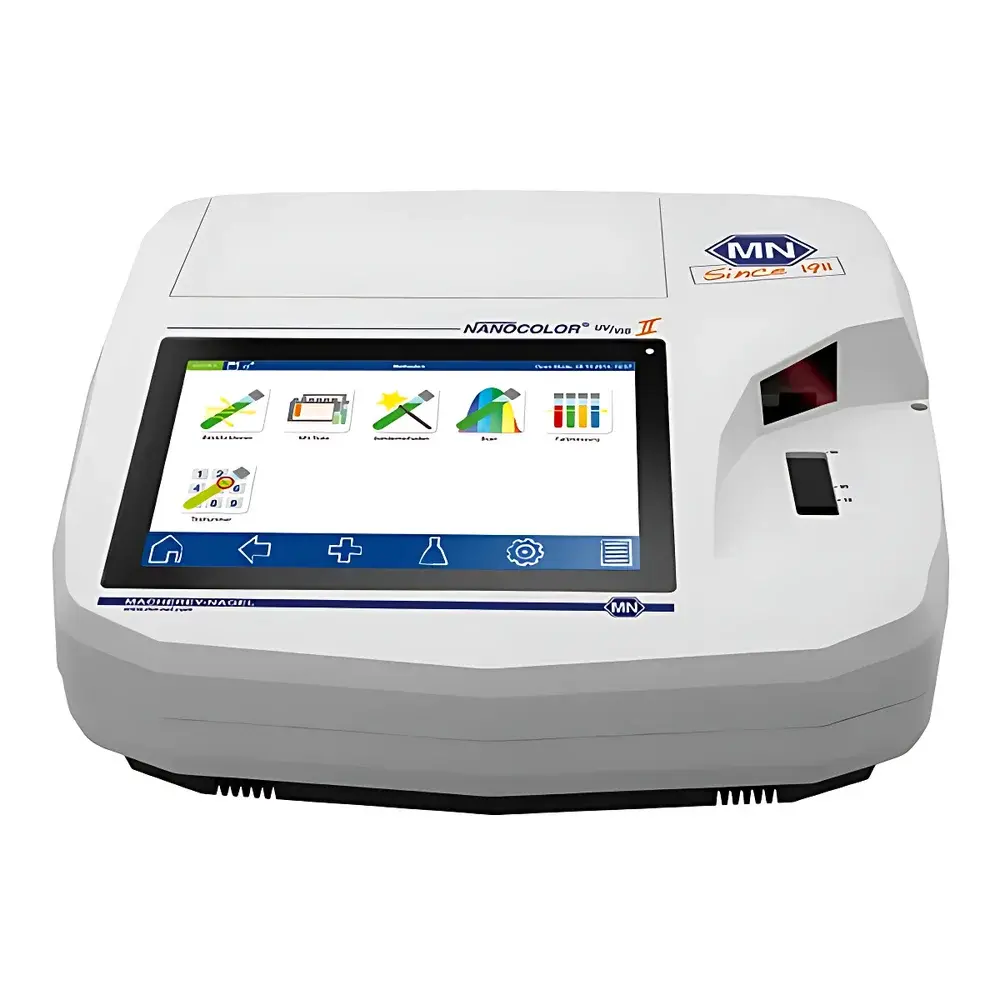
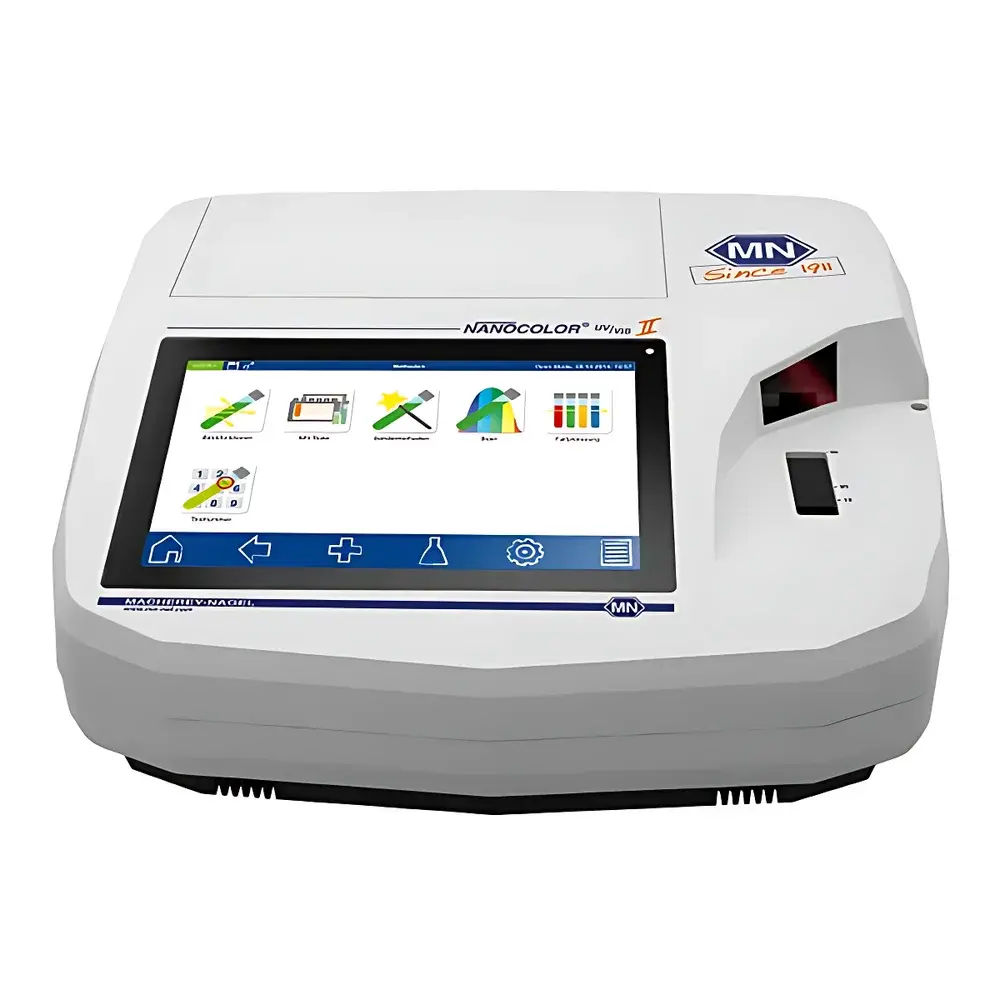
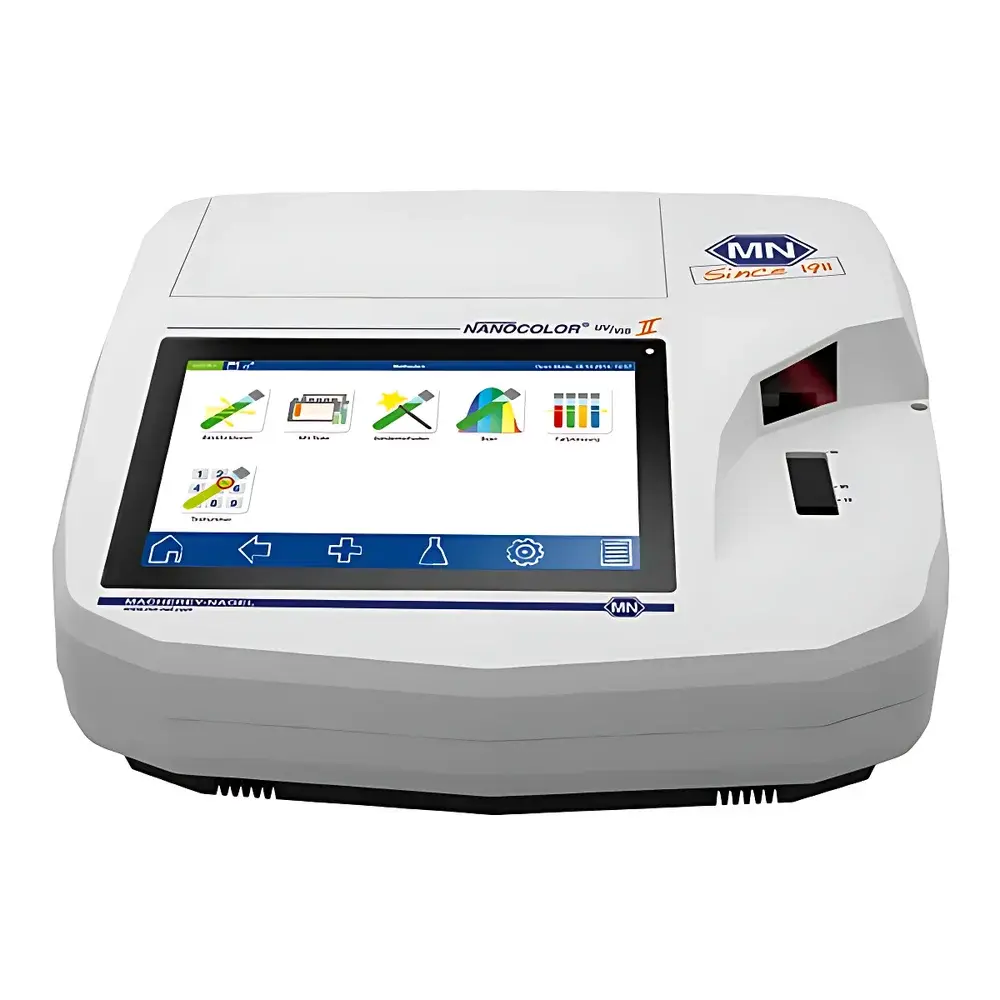
Macherey-Nagel NANOCOLOR UV-Vis Spectrophotometer II Model 919650.1
| Brand | Macherey-Nagel |
|---|---|
| Origin | Germany |
| Model | 919650.1 |
| Optical Design | Single-beam |
| Detector | Photodiode Array |
| Wavelength Range | 340–960 nm |
| Wavelength Accuracy | ±2 nm |
| Wavelength Repeatability | ±1 nm |
| Spectral Bandwidth | 5 nm |
| Stray Light | ≤0.5% |
| Automation | Automatic wavelength selection |
| Compliance | EN ISO 7027 for turbidity measurement |
Overview
The Macherey-Nagel NANOCOLOR UV-Vis Spectrophotometer II (Model 919650.1) is a precision single-beam spectrophotometer engineered for routine and regulatory-compliant analysis in environmental, industrial, and quality control laboratories. It operates on the principle of absorbance spectroscopy—measuring the attenuation of monochromatic light as it passes through a sample solution—to quantify analyte concentration via the Beer-Lambert law. Optimized for the visible and near-UV range (340–960 nm), this instrument integrates robust optical architecture with Reference Detection Technology (RDT), which continuously monitors source intensity and detector response to compensate for lamp drift and ambient light interference—enabling stable photometric performance without requiring a reference cuvette during measurement cycles. Its open-sample compartment design eliminates the need for lids or adapters, supporting direct insertion of pre-filled NANOCOLOR test tubes and standard square cuvettes. The system is purpose-built for water and wastewater analysis, meeting EN ISO 7027 for turbidity quantification across 0.1–1000 NTU, and is routinely deployed in compliance-driven environments including drinking water testing, effluent monitoring, and raw material QC.
Key Features
- 10.1-inch high-resolution PCAP capacitive touchscreen with anti-reflective glass—fully operable with gloves and intuitive graphical menu navigation
- Integrated barcode scanning engine enabling one-touch method selection and automatic parameter loading from NANOCOLOR pre-programmed reagent tubes
- Reference Detection Technology (RDT) for real-time compensation of light source fluctuations and ambient illumination, ensuring photometric stability in non-shielded lab environments
- Automated wavelength calibration and positioning—no manual alignment or external calibration standards required
- Full spectral scanning capability (<1 minute per scan) with 0.1 nm wavelength resolution and <4 nm effective spectral bandwidth
- Comprehensive photometric range: ±3.0 A (340–900 nm); accuracy of ±0.005 A (0–0.5 A) and ±1% (0.5–2.0 A); linearity deviation <0.5% up to 2.0 A
- Open-cuvette compartment accommodating 16 mm round tubes and square cells (2, 10, 20, 40, 50 mm pathlengths) without mechanical adaptation
Sample Compatibility & Compliance
The NANOCOLOR II supports both standardized reagent-based assays and custom analytical protocols. Its compatibility extends to all NANOCOLOR® pre-filled test tubes—including those certified under DIN EN ISO 7027 for turbidity—and conventional quartz, glass, or plastic cuvettes. Method validation aligns with international water quality standards (e.g., ISO 8466-1 for calibration curve linearity, ISO 7027 for turbidimetric measurement). Data integrity meets GLP requirements: each stored result includes timestamp, operator ID (if configured), method name, wavelength, pathlength, and measured absorbance/transmittance values. While not intended for clinical diagnostics (lacking FDA 510(k) or CE IVD classification), the instrument complies with general-purpose CE marking (2014/30/EU EMC Directive and 2014/35/EU LVD Directive) and supports audit-ready data export compliant with ISO/IEC 17025 documentation practices.
Software & Data Management
Equipped with embedded firmware supporting over 200 pre-installed analytical methods—including heavy metals, nutrients, oxidants, and organic pollutants—and 100 user-definable methods, the instrument stores up to 5,000 measurement records on its internal 16 GB Micro SDHC card. All entries are GLP-compliant: automatically tagged with date/time, method ID, calibration status, and operator metadata. Data export is supported via USB 2.0 (host and function ports), RS-232 serial interface, and 10/100 Mbps Ethernet (LAN)—enabling seamless integration into LIMS or centralized QA/QC databases. Firmware and method updates can be performed remotely over LAN or locally via USB drive. The system does not require proprietary PC software for basic operation but supports optional PC-based configuration tools compatible with Windows 10/11 and macOS 12+.
Applications
- Drinking water and wastewater analysis per EPA, APHA, and ISO standard methods (e.g., nitrate, phosphate, ammonia, chlorine, iron, manganese)
- Turbidity monitoring in filtration plants and distribution networks (EN ISO 7027 traceable)
- Raw material verification and in-process control in food, beverage, and pharmaceutical manufacturing
- Environmental field labs performing rapid screening of surface and groundwater contaminants
- Educational laboratories requiring robust, low-maintenance instrumentation for teaching quantitative spectroscopic principles
- Calibration verification and performance qualification of other photometric systems
FAQ
Does this spectrophotometer support GLP-compliant data storage?
Yes. Each measurement record includes immutable metadata (timestamp, method ID, wavelength, pathlength, operator ID if enabled), and all data is stored with write-protected integrity on the internal Micro SDHC card.
Can I use non-NANOCOLOR cuvettes or reagents?
Yes. The instrument accepts standard 16 mm round tubes and square cuvettes (2–50 mm pathlength). Absorbance, transmittance, kinetics, and full-scan modes operate independently of barcode recognition.
Is external calibration required for wavelength accuracy?
No. The system performs automatic wavelength calibration using an internal holmium oxide reference filter; no user intervention or external standards are needed.
What is the maximum allowable ambient light level during operation?
The RDT optical architecture enables reliable operation under typical laboratory lighting (up to 1000 lux), eliminating the need for darkroom conditions or sample compartment covers.
How is firmware updated?
Updates are delivered via secure HTTPS download through the built-in LAN interface or loaded from a FAT32-formatted USB drive—no third-party software required.







