
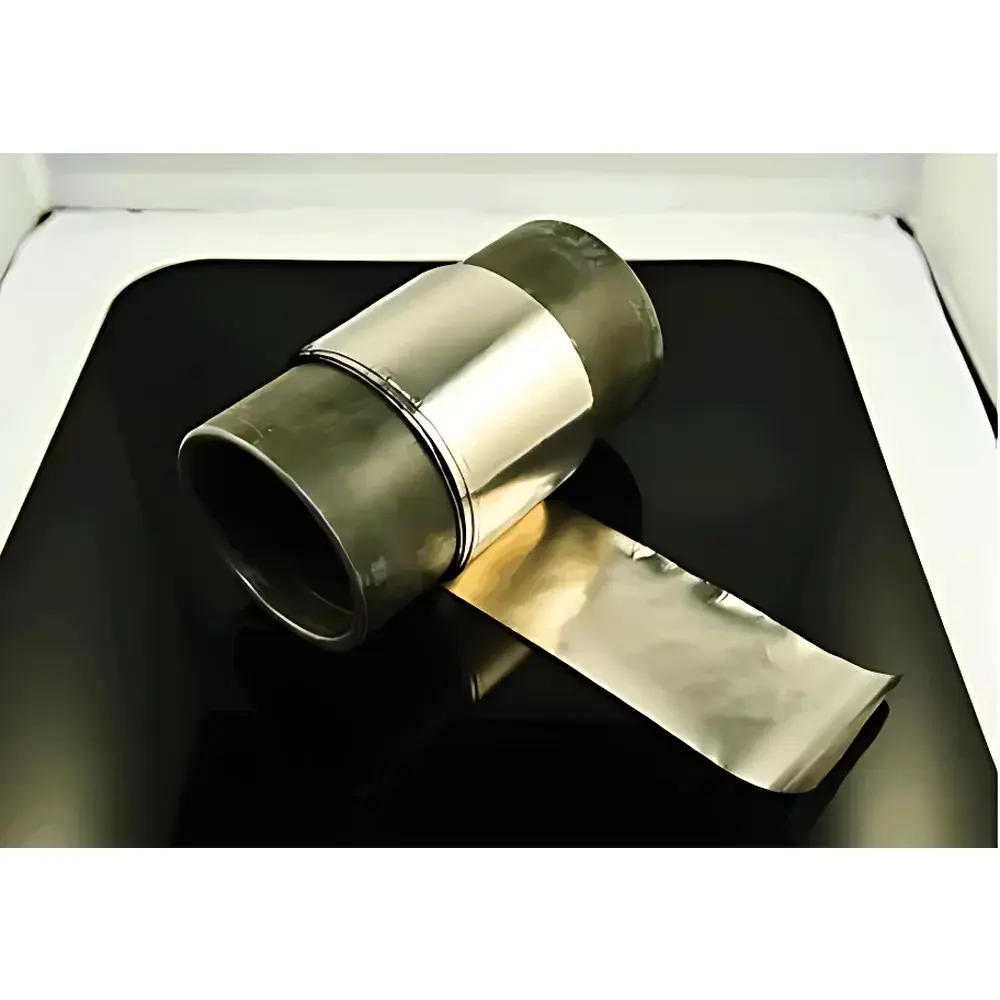
Cu Foil for Quartz Crystal Microbalance (QCM) Electrodes – Hefei Kejing Brand
| Brand | Hefei Kejing |
|---|---|
| Origin | Anhui, China |
| Manufacturer Type | Authorized Distributor |
| Origin Category | Domestic (China) |
| Model | Cu Foil |
| Price Range | USD 0.15–1,500 (based on size, thickness, and packaging grade) |
| Diameter Options | 25.4 mm (1"), 50.8 mm (2"), 76.2 mm (3") |
| Thickness Range | 50 µm (minimum) to 1 mm (standard) |
| Purity | 99.99% (4N) |
| Packaging | Vacuum-sealed in Class 100 cleanroom bags, stored and shipped under inert atmosphere (N₂ or Ar) |
| Compliance | ASTM F2627-22 (Standard Specification for High-Purity Metals for Semiconductor Applications), ISO 14644-1 Class 5 (equivalent to ISO Class 5 / Fed Std 209E Class 100) |
Overview
Cu Foil for Quartz Crystal Microbalance (QCM) Electrodes is a high-purity, ultra-thin metallic substrate engineered specifically for electrochemical QCM applications requiring precise mass-sensitivity, stable interfacial electron transfer, and minimal background interference. Unlike generic copper foils used in battery or PCB manufacturing, this variant is fabricated via vacuum melting and cold-rolling under controlled inert atmosphere, followed by electropolishing and ultrasonic cleaning in high-purity solvents (e.g., acetone, isopropanol, and deionized water). Its 99.99% (4N) purity ensures negligible trace-metal contamination—critical when measuring sub-nanogram mass changes during redox-driven adsorption, polymer film growth, or biomolecular binding events on QCM-D (QCM with Dissipation monitoring) platforms. The foil serves as both working electrode and mass-sensitive transducer interface when sputter-deposited or thermally bonded onto AT-cut quartz crystals (typically 5–10 MHz fundamental frequency), enabling real-time, label-free quantification of interfacial processes with picogram-level resolution.
Key Features
- High-purity copper (99.99% minimum, certified per ASTM E1019 and ICP-MS trace analysis)
- Controlled thickness tolerance: ±2.5 µm for foils ≤100 µm; ±5 µm for foils >100 µm
- Surface roughness (Ra) < 0.05 µm after electropolishing—optimized for uniform electrodeposition and low-noise QCM signal stability
- Vacuum-sealed packaging in ISO Class 5 (100-class) cleanroom environments prevents oxidation and particulate contamination
- Customizable geometry: circular discs (25.4 mm, 50.8 mm, 76.2 mm diameter), square sheets, or irregular shapes via laser cutting (kerf width < 30 µm)
- Available with optional pre-patterned electrode architectures (e.g., dual-electrode arrays or micro-ring configurations) for multi-channel QCM experiments
Sample Compatibility & Compliance
This Cu foil is compatible with standard QCM resonators operating at 5 MHz, 10 MHz, and 25 MHz fundamental frequencies, and supports both liquid-phase (aqueous/organic electrolytes) and gas-phase (controlled humidity or reactive atmospheres) measurement modes. It meets material requirements specified in ASTM D7213 (Standard Practice for QCM-Based Mass Sensing in Corrosion Studies) and ISO/IEC 17025-accredited laboratories for reference electrode fabrication. All batches are accompanied by Certificate of Analysis (CoA) including residual impurity profiles (Fe, Ni, Pb, Sb, As < 1 ppm each), oxygen content (< 50 ppm), and hydrogen content (< 2 ppm). The foil conforms to GLP-compliant handling protocols and is suitable for use in FDA-regulated electrochemical biosensor development where material traceability and batch consistency are mandatory.
Software & Data Management
While the Cu foil itself is a passive consumable, its integration into QCM systems (e.g., Q-Sense E4, MaxiQ, or Stanford Research Systems QCM200) enables full compatibility with vendor-specific data acquisition software supporting time-resolved frequency (Δf) and dissipation (ΔD) tracking. When used in conjunction with electrochemical workstations (e.g., BioLogic SP-300 or Gamry Interface 5000E), the foil supports synchronized potentiostatic control and QCM response logging—enabling Sauerbrey-based mass calculations (Δm = −Cf·Δf / f02) and Voigt-model viscoelastic parameter extraction. Raw data exports comply with ASTM E2500-22 (Standard Guide for Specification, Design, and Verification of Pharmaceutical and Biopharmaceutical Manufacturing Systems) for audit-ready CSV, HDF5, or MATLAB-compatible formats. All CoAs and lot-specific test reports are digitally archived and retrievable via secure customer portal with 21 CFR Part 11–compliant electronic signatures.
Applications
- In situ monitoring of copper electrodeposition/dissolution kinetics in acid sulfate and cyanide-based electrolytes
- Real-time characterization of self-assembled monolayers (SAMs) on Cu surfaces for corrosion inhibition studies
- Electrochemical QCM detection of heavy metal ions (e.g., Pb²⁺, Hg²⁺) via selective chelation or amalgam formation
- Development of Cu-based enzymatic biosensors (e.g., glucose oxidase immobilization on functionalized Cu oxide layers)
- Fundamental investigation of solid-electrolyte interphase (SEI) evolution in Li-ion and Na-ion battery anode models
- Gas-phase sensing of NH₃, NO₂, or H₂S using Cu-oxide-modified QCM transducers
FAQ
Is this Cu foil suitable for use as a working electrode in three-electrode electrochemical cells?
Yes—its high conductivity, low contact resistance, and electrochemical stability in pH 1–12 aqueous media make it ideal for potentiodynamic and chronoamperometric measurements.
Can I request surface passivation or native oxide removal prior to delivery?
Yes—Hefei Kejing offers optional argon sputter-cleaning (5 min, 50 W) or dilute HNO₃ etching (10 s, 0.1 M) with post-rinse verification via XPS; specify at order entry.
What is the shelf life under recommended storage conditions?
24 months when stored unopened at 20–25°C in original vacuum packaging; avoid exposure to ambient humidity >30% RH.
Do you provide dimensional metrology reports for custom-cut foils?
Yes—laser interferometry-based thickness mapping and optical profilometry (±0.1 µm accuracy) are available upon request with NIST-traceable calibration.
Is this material compliant with RoHS and REACH directives?
Yes—certified per EU Directive 2011/65/EU (RoHS2) and Regulation (EC) No 1907/2006 (REACH), with full SVHC screening documentation provided.





