
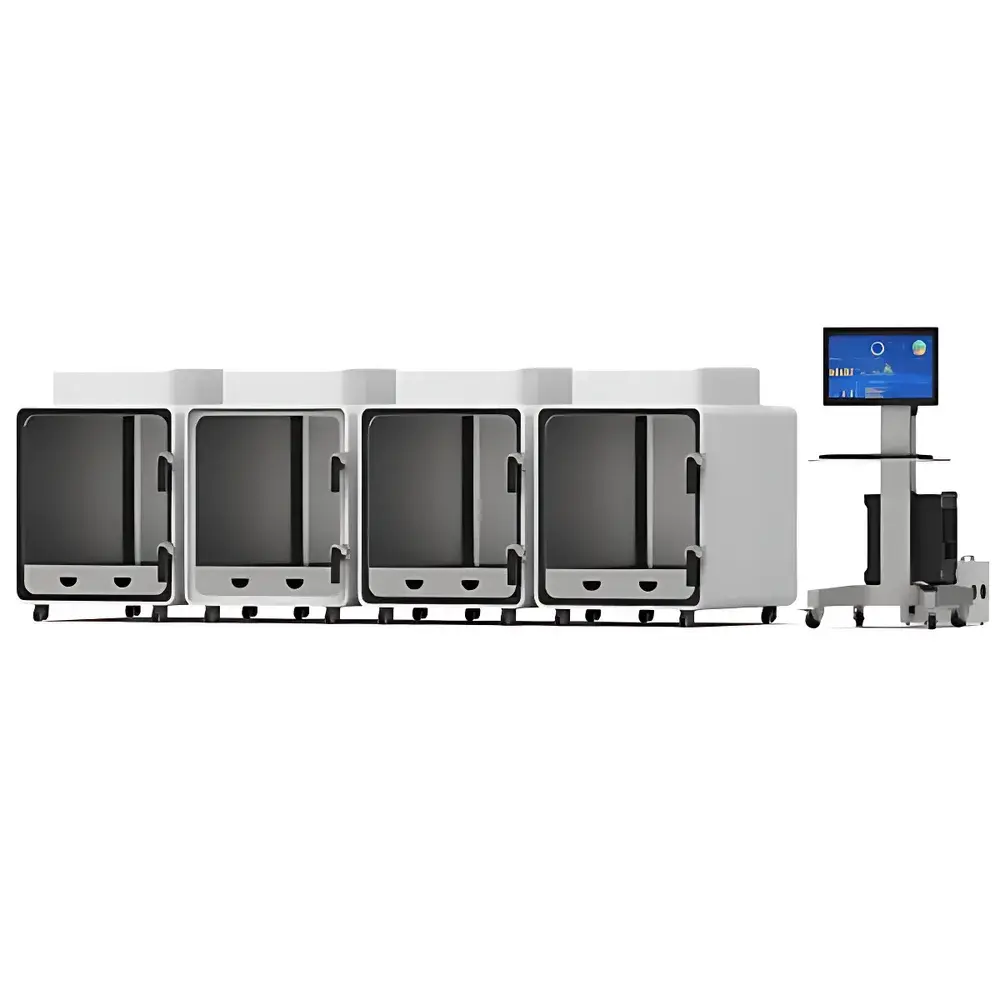
TOW-INT WBP-P Whole Body Plethysmography System for Non-Human Primates
| Brand | TOW-INT |
|---|---|
| Model | WBP-P |
| Animal Application | Cynomolgus and Rhesus Macaques |
| Measurement Principle | Unrestrained Whole-Body Plethysmography (WBP) |
| Aerosol Delivery | Integrated Nebulization Module |
| Calibration | Automated In-Situ Pressure & Flow Calibration |
| Data Output | Exportable to .csv and .txt |
| Optional Integrations | ECG, Blood Pressure, Core Temperature, Heart Rate, Telemetry Compatibility |
| Compliance | Designed for GLP-compliant respiratory pharmacology and toxicology studies |
Overview
The TOW-INT WBP-P Whole Body Plethysmography System is a purpose-engineered, non-invasive platform for longitudinal, conscious respiratory assessment in non-human primates—specifically cynomolgus (Macaca fascicularis) and rhesus macaques (Macaca mulatta). Unlike invasive methods requiring tracheostomy, intubation, or general anesthesia, the WBP-P operates on the principle of unrestrained whole-body plethysmography: minute pressure fluctuations within a sealed, temperature- and humidity-controlled chamber are transduced into high-fidelity respiratory waveforms using ultra-low-noise differential pressure sensors. These signals are mathematically resolved via real-time integration and differentiation algorithms to derive standard pulmonary parameters—including tidal volume, peak inspiratory/expiratory flow, and enhanced pause (PenH)—without physical restraint or surgical intervention. This design enables physiologically relevant data acquisition under baseline, challenge (e.g., methacholine, histamine), or therapeutic conditions, supporting translational respiratory research where species-specific airway mechanics, neural control, and drug metabolism closely mirror human pathophysiology.
Key Features
- Primate-Optimized Chamber Design: Ergonomically contoured acrylic chamber with integrated primate restraint chair (WBP-P configuration), ensuring stable positioning while preserving natural posture and spontaneous locomotion.
- Integrated Aerosol Challenge Capability: Onboard ultrasonic nebulizer module delivers precise, particle-size-controlled (MMAD 1–3 µm) aerosols directly into the plethysmograph chamber, enabling standardized bronchoprovocation protocols aligned with ISO 17025 traceable calibration standards.
- Automated Sensor Calibration: Self-verifying pressure and flow transducers perform routine zero-point and span calibration before each session, eliminating manual drift correction and ensuring inter-session reproducibility per ASTM E2913-22 guidelines.
- Multi-Parameter Synchronization: TTL-triggered I/O ports enable hardware-level synchronization with external telemetry systems (e.g., DSI TA-F10, Data Sciences International), allowing concurrent acquisition of ECG, arterial blood pressure, core temperature, and heart rate alongside respiratory metrics.
- Regulatory-Ready Software Architecture: Data acquisition and analysis software supports 21 CFR Part 11-compliant user authentication, electronic signatures, and full audit trail logging—including operator actions, parameter modifications, and raw file export events.
Sample Compatibility & Compliance
The WBP-P system is validated for use with adult cynomolgus and rhesus macaques (body weight range: 2.5–8.0 kg). Chamber volume (22 L), internal airflow dynamics, and sensor sensitivity thresholds are optimized to resolve respiratory cycles at frequencies between 20–60 breaths/min with signal-to-noise ratios >60 dB across the 0.1–100 Hz bandwidth. All materials contacting the animal or chamber atmosphere comply with USP Class VI biocompatibility standards. The system architecture adheres to ISO/IEC 17025 requirements for measurement uncertainty estimation, and its validation documentation package includes IQ/OQ/PQ protocols suitable for GLP audits and regulatory submissions (e.g., FDA IND, EMA CTIS). It is routinely deployed in safety pharmacology core laboratories conducting ICH S7A-compliant respiratory assessments.
Software & Data Management
Acquisition and analysis are performed using TOW-INT Respiratory Analytics Suite v4.2—a Windows-based application built on .NET Framework with deterministic real-time sampling (≤1 ms jitter). The software provides live waveform visualization (pressure, flow, volume), automated breath-by-breath detection with adjustable artifact rejection thresholds, and batch processing of multi-day datasets. Calculated parameters include Ti, Te, PIF, PEF, Volbal, F, Vt, MV, AV, EF50, PenH, and Rpef—all traceable to NIST-calibrated reference standards. Raw data files (.wbp) retain full 1 kHz resolution and metadata (animal ID, protocol timestamp, environmental conditions). Export modules generate ANSI-compliant .csv and tab-delimited .txt files compatible with SAS, R, Python (pandas), and GraphPad Prism. Audit trails are stored in encrypted SQLite databases with SHA-256 hashing and immutable timestamps.
Applications
This system serves as a primary endpoint tool in preclinical respiratory research domains including: (1) Asthma & Airway Hyperresponsiveness: Quantification of PenH and PEF suppression following anti-inflammatory biologics or bronchodilators; (2) Pulmonary Fibrosis Models: Longitudinal tracking of tidal volume decline and breathing frequency elevation in bleomycin- or TGF-β-induced fibrosis; (3) Inhalation Toxicology: Dose-response characterization of PM2.5, ozone, or engineered nanomaterials per OECD TG 412; (4) High-Altitude & Hypoxia Physiology: Assessment of ventilatory acclimatization kinetics during simulated hypobaric exposure; (5) Sleep-Disordered Breathing: Detection of apneic events and hypoventilation indices during undisturbed nocturnal monitoring; and (6) Respiratory Safety Pharmacology: ICH S7B/S7A-compliant evaluation of CNS-active compounds, opioids, and neuromuscular blockers.
FAQ
What primate species and weight ranges are supported?
The WBP-P configuration is validated for cynomolgus and rhesus macaques weighing 2.5–8.0 kg. Custom chamber adaptations are available for juvenile or larger cohorts upon request.
Does the system support GLP-compliant study execution?
Yes—full validation documentation (IQ/OQ/PQ), 21 CFR Part 11-enabled software, and audit-trail functionality meet OECD GLP Principles and FDA expectations for nonclinical laboratory studies.
Can aerosol delivery be precisely controlled for dose consistency?
The integrated nebulizer supports programmable duty cycle, solution volume delivery, and particle size verification via cascade impactor testing per USP & Ph. Eur. inhalation device standards.
Is remote monitoring or multi-site data aggregation possible?
The system supports secure HTTPS-based data upload to centralized repositories and integrates with LIMS via RESTful API endpoints for automated metadata ingestion and cross-study analytics.
How is thermal and humidity stability maintained during extended recordings?
Chamber environmental control maintains ±0.3°C temperature uniformity and 40–60% RH via PID-regulated Peltier modules and saturated salt buffer systems, minimizing evaporative artifact in long-duration (>24 h) protocols.



