
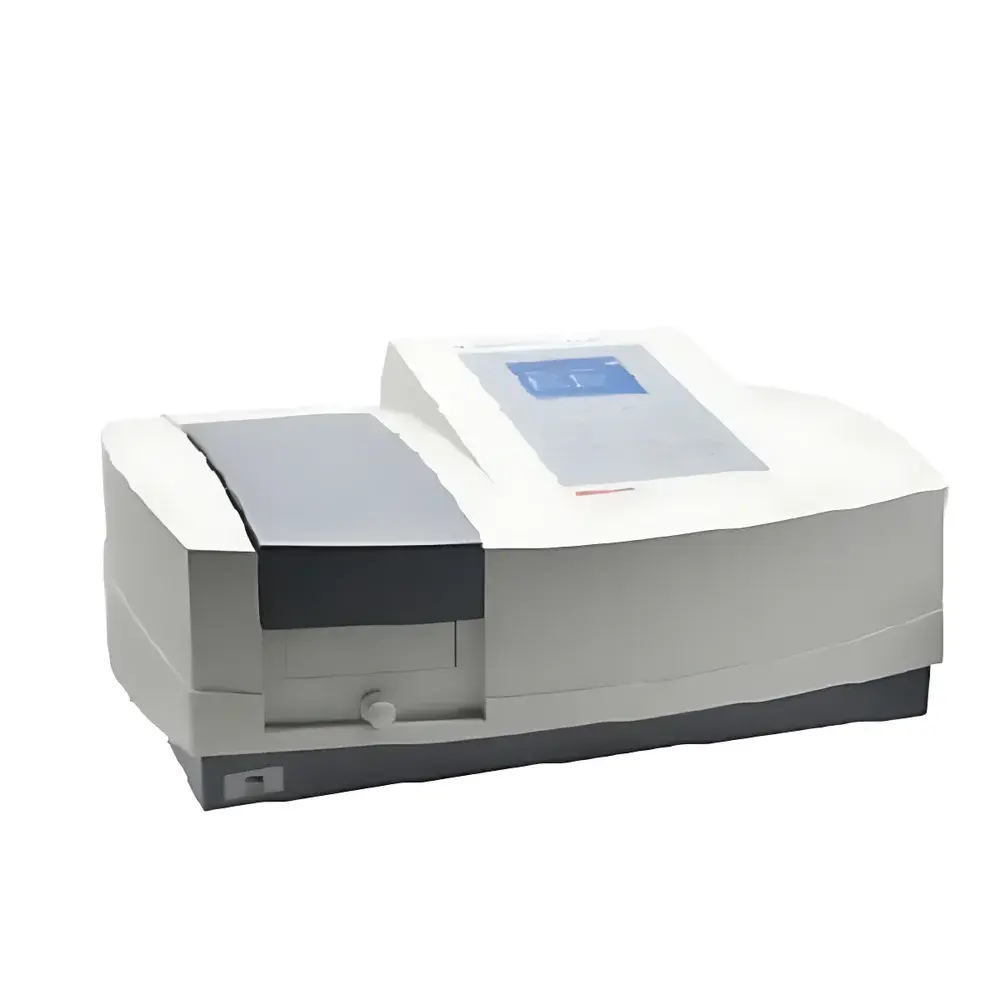
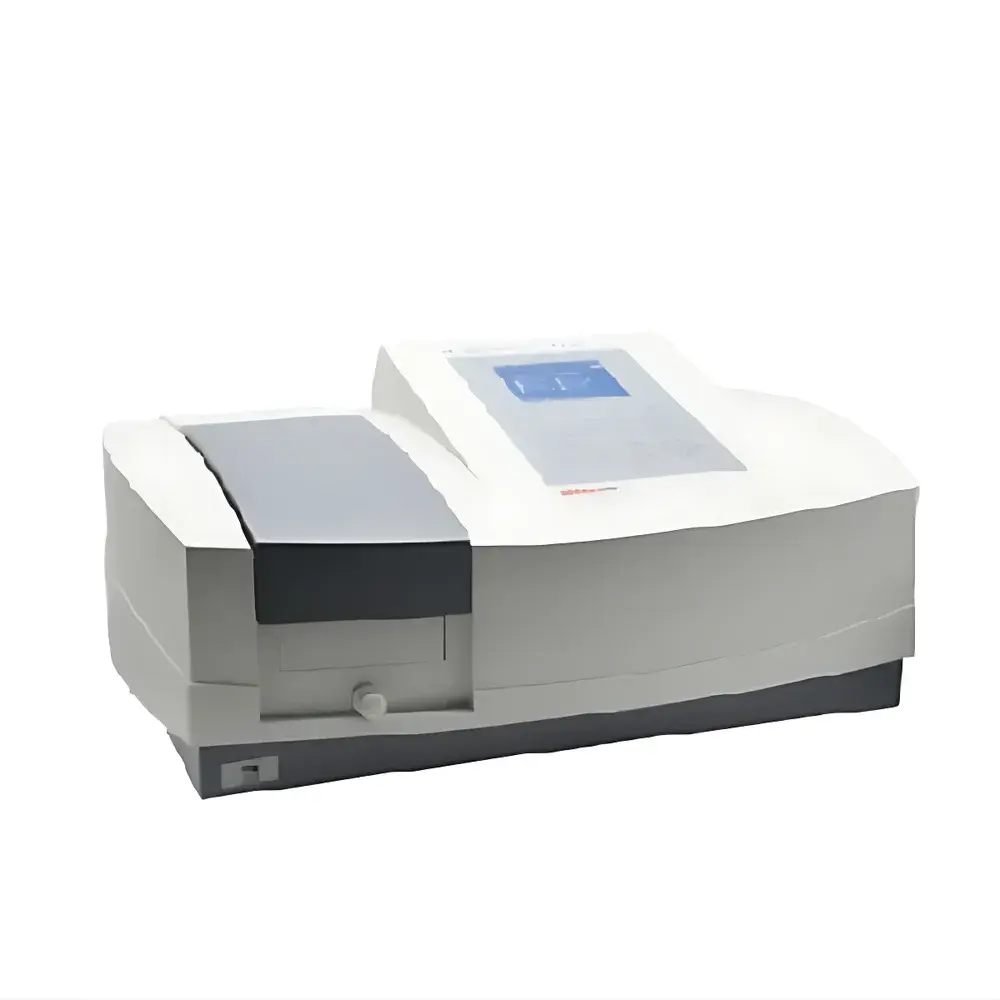
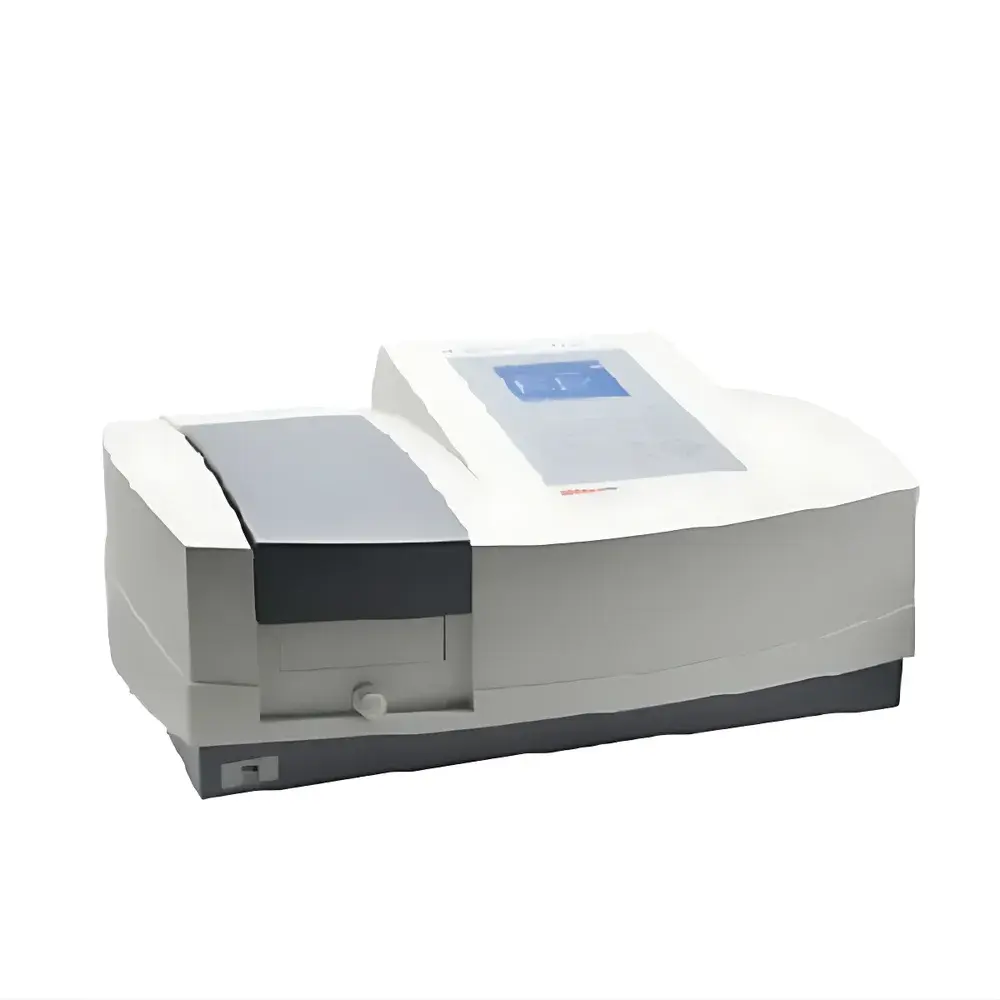
UniCo UV-2802S Single-Beam Ultraviolet-Visible Spectrophotometer
| Brand | UniCo |
|---|---|
| Origin | Shanghai, China |
| Model | UV-2802S |
| Optical System | Single-beam with 1200 lines/mm holographic grating |
| Detector | Photomultiplier Tube (PMT) |
| Wavelength Range | 190–1100 nm |
| Wavelength Accuracy | ±0.3 nm |
| Wavelength Repeatability | ≤0.2 nm |
| Spectral Bandwidth | 0.5 / 1 / 2 / 4 nm (selectable) |
| Stray Light | ≤0.05% T |
| Photometric Accuracy | ±0.004 Abs (0–0.5 Abs), ±0.004 Abs (0.5–1.0 Abs), ±0.5% T |
| Photometric Repeatability | ±0.001 Abs (0–0.5 Abs), ±0.002 Abs (0.5–1.0 Abs), ±0.2% T |
| Baseline Linearity | ±0.002 A |
| Stability | ±0.002 A/h (at 500 nm, after warm-up) |
| Display | 320 × 240 graphical LCD |
| Data Interface | USB port |
| Dimensions (W×D×H) | 625 × 405 × 280 mm |
| Weight | 20 kg |
Overview
The UniCo UV-2802S is a precision-engineered single-beam ultraviolet-visible (UV-Vis) spectrophotometer designed for routine and research-grade quantitative absorption spectroscopy across academic, pharmaceutical, environmental, and quality control laboratories. It operates on the fundamental principle of Beer–Lambert law-based absorbance measurement, utilizing a high-efficiency 1200 lines/mm holographic grating and a low-noise photomultiplier tube (PMT) detector to deliver high signal-to-noise ratio performance over a broad spectral range of 190–1100 nm. Its single-beam architecture—optimized for stability and cost-effective operation—incorporates rigorous thermal and mechanical design to minimize drift during extended measurements. The instrument supports direct wavelength scanning, kinetic time-course analysis, multi-wavelength quantitation, and dedicated nucleic acid/protein assays (A260/A280), making it suitable for both method development and standardized testing workflows.
Key Features
- Four-step adjustable spectral bandwidth (0.5, 1, 2, and 4 nm) enables optimization between resolution and throughput depending on sample complexity and regulatory requirements.
- High-precision wavelength drive system ensures accuracy of ±0.3 nm and repeatability better than 0.2 nm—critical for method transfer and inter-laboratory comparability.
- Low stray light performance (≤0.05% T at 220 nm and 340 nm) enhances linearity and dynamic range, particularly for high-absorbance samples such as concentrated protein solutions or colored dyes.
- Integrated 320 × 240 graphical LCD display with intuitive touch-sensitive keypad allows full standalone operation—no PC required for basic measurements, calibration, or data review.
- USB interface supports direct data export to USB flash drives and seamless connectivity to Windows-based systems via UniCo’s proprietary application software, including encrypted license management via hardware dongle.
- Robust optical bench design, thermally stabilized PMT housing, and pre-aligned grating mount ensure long-term photometric stability (±0.002 A/h at 500 nm post warm-up).
Sample Compatibility & Compliance
The UV-2802S accommodates standard 10-mm pathlength cuvettes—including supplied quartz (for UV region < 350 nm) and optical glass cells—and is compatible with optional accessories such as microvolume adapters, temperature-controlled holders, and automated eight-cell changers. Its optical specifications meet or exceed key international performance benchmarks referenced in ISO 8579, ASTM E275, and USP for UV-Vis spectrophotometers. While not inherently 21 CFR Part 11 compliant in standalone mode, the instrument’s software package supports audit-trail-enabled data acquisition, electronic signatures, and user-access-level configuration—facilitating alignment with GLP and GMP documentation standards when deployed in regulated environments.
Software & Data Management
UniCo’s advanced PC application provides comprehensive instrument control, spectral processing, and report generation. Functions include baseline correction, peak identification, derivative spectroscopy, kinetic curve fitting, and customizable calibration curve construction (linear, quadratic, cubic, or non-linear regression). All raw spectra and processed results are saved in vendor-neutral CSV and XML formats. The software implements role-based user accounts, password-protected method storage, and timestamped data logs—enabling traceability required for internal QA audits and external inspections. Data integrity is further reinforced through checksum validation and automatic backup to designated network locations.
Applications
- Quantitative analysis of pharmaceutical actives and excipients per USP/EP monographs.
- DNA/RNA concentration and purity assessment (A260/A280 and A260/A230 ratios).
- Enzyme kinetics monitoring via time-scan mode (e.g., NADH oxidation at 340 nm).
- Water quality testing (nitrate, phosphate, COD estimation) following APHA/EPA protocols.
- Colorimetric assay validation in food safety and clinical diagnostics labs.
- Educational use in undergraduate chemistry and biochemistry laboratories for spectral interpretation and calibration practice.
FAQ
Is the UV-2802S compliant with FDA 21 CFR Part 11?
The hardware itself does not enforce Part 11 requirements; however, the optional UniCo software package includes configurable audit trails, electronic signatures, and secure user authentication—providing a foundation for Part 11 readiness when implemented with appropriate IT governance and SOPs.
What cuvette materials are supported?
Standard 1-cm quartz cuvettes (for 190–350 nm), optical glass (350–1100 nm), and polystyrene (visible-only applications) are fully compatible. Custom pathlength or flow-cell configurations require third-party adapters.
Can the instrument perform spectral deconvolution or multicomponent analysis?
Yes—the software supports multivariate calibration using classical least-squares (CLS) and offers built-in templates for common two- or three-component mixtures, provided reference spectra are supplied.
Does the UV-2802S support external printers or network printing?
Direct printer output is not native; however, reports generated in PDF or Excel format via the PC software can be routed through standard Windows print queues or enterprise document management systems.
What maintenance is recommended for long-term reliability?
Annual verification of wavelength accuracy and photometric linearity using NIST-traceable holmium oxide and neutral density filters is advised. Routine cleaning of the sample compartment and optical window with lint-free, solvent-moistened swabs is sufficient for daily upkeep.




