
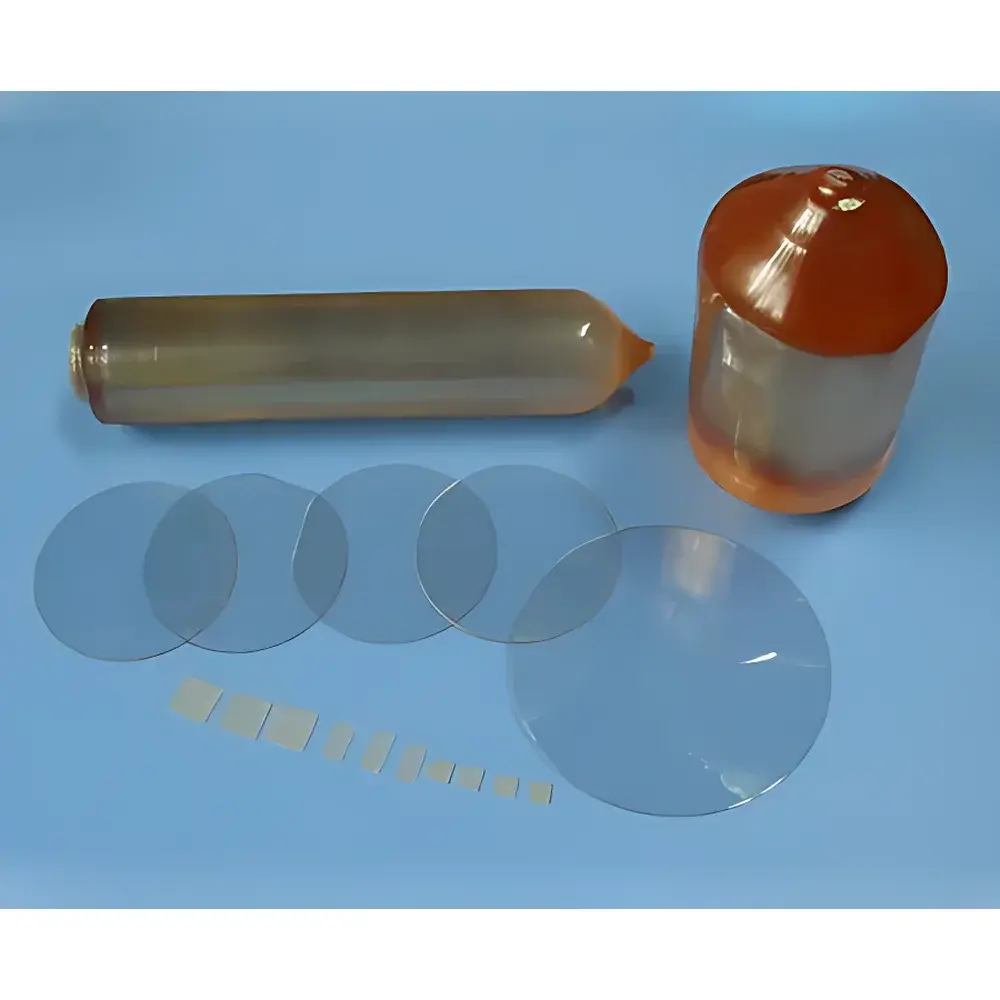
LaAlO₃ (Lanthanum Aluminate) Single-Crystal Substrates –合肥科晶 | Model LaAlO3
| Brand | MTI Corporation (formerly Hefei Kejing Materials Technology Co., Ltd.) |
|---|---|
| Crystal Orientation | <100>, <110>, <111> |
| Lattice Parameter | a = 3.792 Å |
| Crystal Structure | Pseudocubic Perovskite |
| Growth Method | Czochralski (CZ) |
| Melting Point | 2080 °C |
| Density | 6.52 g/cm³ |
| Mohs Hardness | 6.5 |
| Thermal Expansion Coefficient | 10 × 10⁻⁶ /°C |
| Dielectric Constant (εᵣ) | 25 |
| Loss Tangent (tan δ) | ~3 × 10⁻⁴ @ 10 GHz, 300 K |
| Surface Roughness | Ra < 5 Å (<100>, <111>) |
| Chemical Stability | Insoluble in mineral acids at room temperature |
| Standard Dimensions | 5 × 5 × 0.5 mm, 10 × 10 × 0.5 mm, Ø25.4 × 0.5 mm, Ø50.8 × 0.5 mm |
| Orientation Tolerance | ±0.5° |
| Polishing | Single- or double-side polished |
| Packaging | Class 1000 cleanroom, Class 100 clean bags or individual substrate cassettes |
Overview
MTI Corporation’s LaAlO₃ (lanthanum aluminate) single-crystal substrates are high-purity, orientation-controlled perovskite wafers engineered for epitaxial thin-film deposition in advanced materials research and device fabrication. As a pseudocubic oxide with lattice parameter a = 3.792 Å, LaAlO₃ exhibits exceptional lattice matching with numerous functional oxides—including YBCO (YBa₂Cu₃O₇), LCMO (La₀.₇Ca₀.₃MnO₃), and STO (SrTiO₃)—making it a preferred substrate for high-temperature superconducting and colossal magnetoresistive heterostructures. Its low dielectric loss (tan δ ≈ 3 × 10⁻⁴ at 10 GHz and 300 K) and high relative permittivity (εᵣ = 25) further support applications in microwave resonators, tunable dielectrics, and integrated ferroelectric devices. Grown via the Czochralski method under controlled oxygen partial pressure, each substrate undergoes rigorous crystallographic verification (XRD rocking curve FWHM < 0.1°), surface metrology (AFM-measured Ra < 5 Å for and orientations), and optical inspection to ensure absence of slip lines, twins, or polishing defects.
Key Features
- High structural fidelity: Pseudocubic perovskite lattice with minimal octahedral tilting; verified by high-resolution X-ray diffraction and Raman spectroscopy
- Precision orientation control: Available in , , and orientations with angular tolerance ≤ ±0.5°, certified via Laue back-reflection and pole-figure mapping
- Ultra-smooth surfaces: Double-side polished variants achieve root-mean-square roughness < 5 Å (, ) and < 15 Å (), meeting stringent requirements for molecular beam epitaxy (MBE) and pulsed laser deposition (PLD)
- Thermal and chemical robustness: Stable up to 2080 °C melting point; inert toward HCl, HNO₃, and H₂SO₄ at ambient conditions; compatible with standard oxide thin-film processing chemistries
- Scalable manufacturing: Produced in MTI’s ISO 9001-certified crystal growth facility—capable of >15 kg/month LaAlO₃ ingot production with full traceability from boule to wafer
- Custom configurability: Standard sizes include 5 × 5 × 0.5 mm, 10 × 10 × 0.5 mm, Ø25.4 × 0.5 mm, and Ø50.8 × 0.5 mm; custom dimensions, thicknesses, and edge profiles available upon request
Sample Compatibility & Compliance
LaAlO₃ substrates are routinely employed in UHV-compatible deposition systems (MBE, PLD, sputtering) and high-temperature annealing environments (up to 900 °C in O₂). Their thermal expansion coefficient (10 × 10⁻⁶ /°C) ensures mechanical compatibility with common perovskite films during thermal cycling. All substrates are processed in ISO Class 1000 cleanrooms and packaged in Class 100 clean bags or individually sealed cassettes to prevent particulate contamination. Material safety data sheets (MSDS) and RoHS-compliance documentation are provided with every shipment. While not classified as medical or IVD devices, LaAlO₃ substrates conform to ASTM F273–22 (Standard Specification for Single-Crystal Oxide Substrates for Epitaxial Thin Films) and support GLP-aligned lab records when used in regulated R&D workflows involving USP analytical instrument qualification.
Software & Data Management
As a passive crystalline substrate—not an active instrumentation platform—LaAlO₃ does not incorporate embedded firmware, software interfaces, or digital data output. However, its metrological specifications are fully integrated into MTI’s substrate tracking database, enabling batch-level traceability (boule ID, growth date, orientation verification report, surface roughness AFM scan metadata). Customers receive a Certificate of Conformance (CoC) with each order, including XRD θ–2θ scans, rocking curve data, and optical micrographs. For integration into automated thin-film platforms, substrate dimensions and orientation vectors may be imported into lithography alignment software (e.g., EVG® SmartView, SUSS MicroTec LithoScan) via standardized .csv or .txt coordinate files.
Applications
- Epitaxial growth of high-Tc superconductors (e.g., YBCO, BSCCO) and complex oxide heterostructures
- Fabrication of spintronic devices leveraging interfacial symmetry breaking at LaAlO₃/SrTiO₃ interfaces
- Dielectric resonator design for 5G/mmWave filter modules requiring low-loss, high-εr ceramics
- Substrate for resistive switching memristors and ferroelectric tunnel junctions
- Reference material in X-ray reflectivity (XRR) and grazing-incidence small-angle scattering (GISAXS) calibration protocols
- Platform for in situ synchrotron studies of oxide interface reconstruction and charge transfer dynamics
FAQ
What is the typical twin domain density observed on polished LaAlO₃ substrates?
Natural twin domains are inherent to the pseudocubic structure and commonly visible under cross-polarized optical microscopy; their periodicity ranges from 1–10 µm depending on thermal history. Twin boundaries do not impair epitaxial quality and are routinely accommodated during film nucleation.
Can LaAlO₃ substrates withstand rapid thermal processing (RTP) cycles above 800 °C?
Yes—LaAlO₃ exhibits excellent thermal shock resistance due to its moderate thermal expansion coefficient and high thermal conductivity (~10 W/m·K at 300 K). RTP cycles up to 900 °C in O₂ or N₂ ambients are routinely performed without cracking or surface decomposition.
Is hydrofluoric acid (HF) etching recommended prior to film deposition?
No—HF attacks LaAlO₃ surfaces aggressively. Recommended pre-deposition cleaning consists of sequential ultrasonic baths in acetone, isopropanol, and deionized water, followed by in-situ O₂ plasma treatment (100 W, 5 min) or UV-ozone exposure.
Do you provide substrates with pre-patterned alignment markers or fiducials?
Yes—custom photolithographic patterning (e.g., Cr/Au alignment crosses, SiO₂ etch-stop markers) is available upon request; minimum feature size 2 µm, alignment accuracy ±0.5 µm relative to crystallographic axes.
How is orientation accuracy verified for -cut substrates?
Orientation is confirmed using both Laue diffraction (±0.1° precision) and high-resolution XRD ω-scan rocking curves; final certification includes a full pole-figure map documenting azimuthal symmetry and mosaic spread.





